
A Children’s Column by Lauren Duncan, PhD.
Cochise found Mardi in the yard the next morning, already sitting, already waiting.
“You are eager,” he said.
“You said there was more,” Mardi said. “I want to know all of it.”
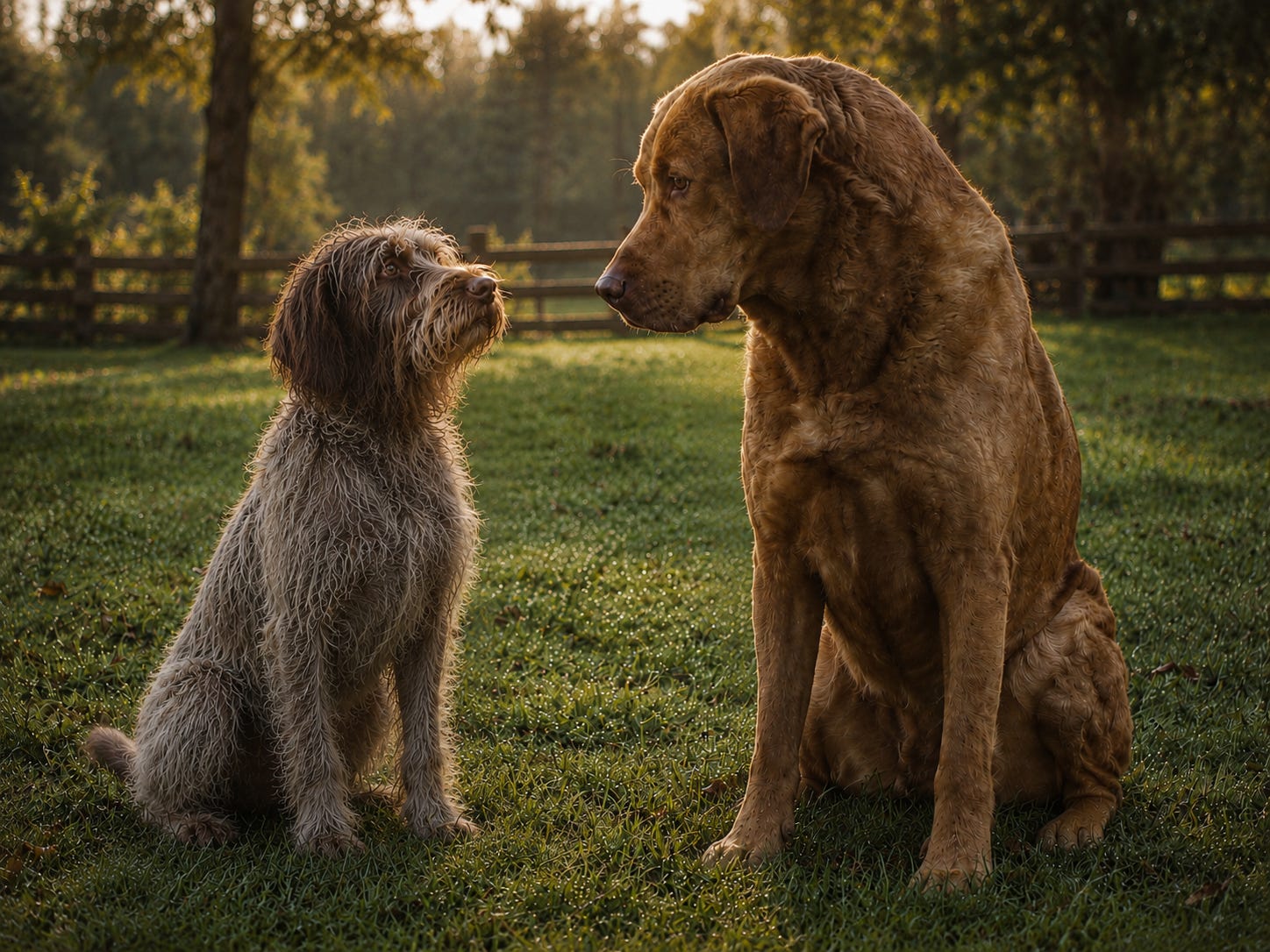
“Two more pieces,” Cochise said. “The alert, and the stay. Once you have both, you will understand why everything else mattered.”
“What is the alert?”
“It is how you tell your handler you found someone,” Cochise said. “Finding is only half the job. If no one knows you found them, it does not count yet.”
“How do I tell them?”
“Some dogs bark,” Cochise said. “Some dogs go still, a sit, or a point, quiet as a held breath. That one is called a passive alert. Barking is called an active alert. Neither one is better. It depends on the dog, and it depends on the job.”
“Which one am I?”
“Active,” Cochise said. “So let me tell you what that can look like before you try it. Some dogs bark and stay right there, barking until their handler arrives. Some dogs paw or jump at the spot where they found the scent. And some dogs do something called a refind. They find the person, run all the way back to their handler, jump or spin or bounce on their front feet to say I found someone, and then lead the handler back to the spot.”
Mardi’s ears perked at each one. “Which one do I get to learn?”
“Today, the bark,” Cochise said. “Show me.”
Mardi opened her mouth and let out a bark. It came out sounding more like a squeak.
Cochise did not laugh, though his eyes crinkled like he wanted to. “Again.”
She tried again. It cracked in the middle.
“Again.”
By the fifth try, it still was not much of a bark, but it was hers, and it was getting louder.
“That is enough for today,” Cochise said. “Yours is active, little one. Loud, and getting louder. It will not sound like that forever. Right now, it only has to sound like it means something. The rest comes with time.”
Mardi flopped down, a little tired, a little proud. “That was harder than the runaway game.”
“It usually is,” Cochise said. “The runaway game feels like play. The alert feels like work, because you are learning to use your voice on purpose instead of just because you feel like it.”
“What is the stay, then?”
“The most important piece of all,” Cochise said. “A dog who can search but cannot stay is not ready. Not for a staging area. Not for the edge of dangerous water. Not for a handler who needs to trust that you will be exactly where they left you, no matter how long it takes.”
“That sounds boring.”
“It is,” Cochise said, “and it is also the piece that makes people trust you with their lives. Boring keeps you safe. Boring keeps everyone around you safe too.”
Mardi thought about that for a moment.
“Mardi, you would have to learn three tests before you could move on. Here is how the first one goes.
“A stranger walks up and pretends to shake your handler’s hand, careful not to touch you at all. That is to prove you can stay calm while people greet your person. Then that same stranger pets you, on your head and your back, and you do not flinch or pull away. After that, they check you over, like a vet would, brushing you and looking at your ears and paws.
“Then comes the walk. You walk on a leash beside your handler through a right turn, a left turn, a turn all the way around, and a stop, without dragging them around. After that, you walk close by a small crowd of people. You are allowed to notice them. You are just not allowed to jump on them.
“Then your handler asks you to sit, and to lie down, and picks whichever one you should hold. They walk all the way to the end of a long line and come right back. You do not move until they return.
“After that, with you still on that same long line, your handler walks ten steps away and calls your name. When they call, you go straight to them.
“Then comes another dog. Another handler and their dog walk up close to you and your handler. The two handlers pretend to shake hands, right in front of both of you, and chat for a moment like old friends. You are allowed to notice the other dog. You are just not allowed to make a fuss about it.
“Then come the distractions. Something surprising happens nearby, maybe a loud noise, maybe someone hurrying past. You are allowed to notice. You are just not allowed to panic, and you are not allowed to act tough about it either.
“Last, a stranger holds your leash, and your handler walks out of sight for three whole minutes. You are allowed to notice they are gone. You are just not allowed to panic.
“That one is the Canine Good Citizen test. Then comes Community Canine. This one is not tested in a quiet ring. It happens out in the real world, at a store, a park, a show.
“You have to settle down and wait calmly while your handler is busy nearby, filling out paperwork, or having a snack, or talking to someone. Then you walk on a loose leash through turns, stops, and changes of pace, in a real place, not a ring. After that, you walk on a loose leash straight through an actual crowd of people, and past other dogs too, without pulling toward any of them.
“Then you have to sit and stay in a small group, with two other handlers and their dogs nearby. A stranger carrying something- a backpack, a bag- walks up and asks to pet you, and you allow it calmly. Food gets set right on the ground in front of you, and when your handler says leave it, you leave it alone.
“Then your handler walks all the way across a distance, picks something up, and comes back, while you hold a stay the whole time. After that, they walk even farther away and call you, with all of that same excitement still happening around you. And last, you hold a stay while your handler walks through a doorway or a narrow passage alone.
“Last is Urban Canine Good Citizen. That one only happens in a real city. You walk in and out of doorways without pulling. You walk a busy sidewalk, close enough that strangers pass within a foot of you. You hear sirens, and horns, and skateboards rattling by, and feel different ground under your paws: concrete, grates, wet sidewalk, and none of it rattles you. You wait at a corner and cross a street under control. You walk right past food dropped on the sidewalk and leave it alone. A stranger carrying a bag walks up and pets you. You go into a real building, walk calmly across whatever floor is inside, and hold a down stay for three whole minutes. You handle stairs, and you ride in an elevator, calm the entire way up and the entire way down. And you behave yourself riding in a car, or a train, or however you need to travel that day.”
Mardi’s eyes had gone wide. “That is three whole tests.”
“It is,” Cochise said. “And you need to learn and pass all of them. They are not something extra. They are what you must earn before you move on to more advanced training. Passing one proves you are ready for the next. And when people see you have earned all three, they know something important about you. They know you take your training seriously.
“Training is a lot like math,” Cochise added. “If you miss a piece, you will have trouble with everything that comes after it. You cannot skip ahead and hope it works out.”
Mardi was quiet for a moment. Then she stood up, the same way she had sat down before, without being told to.
“I can work hard,” she said. “I can do this. I want to do this.”
Cochise’s eyes crinkled again, the way they did when he almost laughed. “I know you can. That is exactly why I am here.”
Try This With Your Own Puppy: The Long Sit and Long Down
Mardi here.
Cochise told me the stay is one of the most important pieces of all. But here is something worth knowing first. Not every trainer even uses the word “stay.” A lot of trainers teach it so that “sit” already means sit and hold, no extra word needed. If you do want to add the word “stay,” you can, but only after your dog already knows sit and down. Just say it right after: “sit... stay, stay.”
Now let me teach you how to build a real Long Sit and Long Down, the same way real trainers do it.
Getting a good sit. Start somewhere quiet and easy, inside your house, in the garage, or in a fenced yard. Save the places with distractions for later. Your dog should be wearing a regular flat collar. Hold a treat right at the level of your dog’s nose. As your dog’s nose follows the treat up, slowly move your hand back toward his tail. This should make his bottom drop straight to the floor. The second his rump touches the floor, give the treat and say “good sit.” Do this ten times. If your dog scoots backward instead of sitting, try it with your dog sitting in front of a wall. That gives him nowhere to back into.
Remember this order every single time: say the word, your dog does the action, then the reward comes. Word. Action. Reward.
Proving the sit. Once your dog knows a good sit, it is time to prove he can hold it. Clip on your five-foot leash. Ask for a sit, then take one single step forward. If your dog gets up, do not give a treat. Just step back to his side and try again until he holds still. Once that is easy, take a full step, then walk the whole length of the leash out in front of your dog. After that, try walking all the way around your dog in a circle. If he holds the whole time, that is a real win.
Once your dog can do that, let the leash lightly brush against his back or his head while he holds the sit. If he gets up, that is all right. Just go back to the last easy step and build up again from there.
When all of that feels solid, wrap your twenty-to thirty-foot-long leash around a tree or a post, thread the toggle through the hand loop, and pull it snug. Clip your dog onto the toggle. Ask for a sit, then walk all the way out to the end of the leash. Turn around and face your dog from a few feet away. If he is still sitting, say “good sit,” walk back, and give the treat. Slowly build up how long you wait and how far you walk each time.
Do this ten times, then give your pup a rest and go play. Then do it again in a different spot, maybe the front yard instead of the back, or the garage, or even different rooms in the house. Try it at different times of day too, in the bright afternoon, in the evening, and early in the morning before the world wakes up. Every new place and every new time teaches your dog the same thing: a sit means sit, no matter what.
Teaching the down. Once your dog knows a good sit, it is time to teach him to down. Start with your dog sitting. Hold a treat right to his nose, say “down,” and slowly move the treat toward the floor, sliding it toward his chest and between his legs to get him to down. Some dogs will do a play bow instead of going all the way into a down. If that happens, hold the treat still and wait. He will get tired of holding the bow and drop his rear on his own. A tiny nudge of the treat back toward his nose or chest can help too. The second he is all the way down, release the treat and say “good down.”
Proofing the down. The down is proved the same way the sit is. One step forward on the five-foot leash. Then the full leash length out in front. Then a full circle around your dog. Then the leash brushing his back or head. Then the twenty to thirty foot lead tied off to a tree or post, walking all the way out, turning to face him, and building up the time and the distance. Ten reps, a rest and some play, then a new location, then new times of day.
It seems simple, but it is not.
Holding still is hard work for a puppy, maybe even harder than running and finding someone. Only practice a few rounds, and always stop while your dog is winning. Make sure your dog always has plenty of water nearby too.
You do not have to be training for search and rescue to teach this. This training is the basis of all kinds of fun training, like trick dog training and even therapy dog training. You can do anything when your dog learns the basics.
© 2026 Lauren Duncan, PhD, and Inside the Canine Mind, LLC. All rights reserved.
Comments
Nothing yet. Say the first thing.
Sign in to join the conversation.