
Kent Jones has long been one of cinema’s greatest thinkers, so to simply refer to him as a director seems a gross oversimplification for what has been a lifetime spent serving cinema. Jones’ contributions are innumerable — his given titles at varying points in his career have been: film critic, editor-at-large for Film Comment, video archivist and co-director for Martin Scorsese, programmer at Film Forum, Associate Director of Programming at Film Society of Lincoln Center, director of the New York Film Festival, and Guggenheim Fellowship recipient, to name only a few.
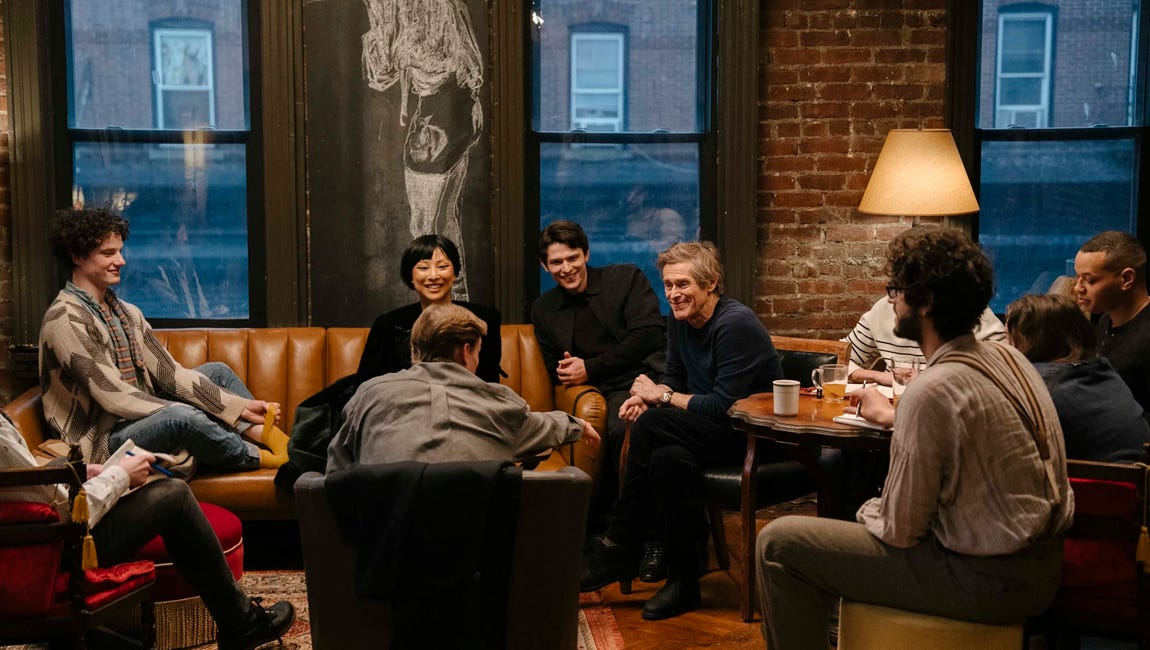
His newest venture, Late Fame, starring Willem Dafoe, Greta Lee, and Edmund Donovan, is a dazzling meditation on aging, lost time, and critical rediscovery — an apt premise for a critic long-known for his reappraisals of underappreciated work.
Ahead of Late Fame’s theatrical release, I sat down with Jones to discuss his illustrious career, criticism, and New York.
Joseph Dimacchia: I wanted to start with your career as a critic, because you come from a long line of critics turned filmmakers, which I think is really interesting. Obviously, the Cahiers [du Cinéma] members, Bogdanovich, and others come to mind. I don’t want to speak for you, but it seems that criticism, in many regards, can cause the first impression of a film to kind of mutate and evolve as you parse your thoughts and write about it. Do you notice something similar happening with your own films? When you’re doing interviews and press junkets, are your thoughts regarding your work changing?
Kent Jones: Well, first of all, yeah. But let me start by saying that like, yeah, there’s a long tradition, but it’s not American. [laughs] I mean, yeah, there’s Paul Schrader. People have brought up Bogdanovich. I don’t think Bogdanovich qualifies for the simple reason that he wasn’t really a critic, per se. He was a journalist, for sure, and a very specialized one. And he was also a programmer at the New Yorker Theater. But the whole time he was already like, you know — he was already part of Roger Corman’s stable. And his writing on movies seems to me to be kind of like... it’s not on current movies. It’s usually looking back at older films. But by the time he wrote about The Long Goodbye [Altman, 1973] or something like that, he was already an established director. So there’s Schrader. Yeah. I mean, I suppose that there are some other people too that I’m missing, but Schrader’s the most obvious example, and he happened to be a good friend.
I guess that your question though is really interesting because it’s just sort of like, yeah, the more that you’re talking about a movie — I mean, when I made Diane (2018), the way that I structured it with the car, the repeated image behind the car moving forward, I was thinking to myself: I had a flash of inspiration from another movie and I can’t think of what is was. It was really interesting. I was like, was it Kiarostami? Was it Taste of Cherry or The Wind Will Carry Us? I don’t think so. And it occurred to me, possibly in the middle of talking about it, that it was this: I think it was Alain Resnais’ last movie, Life of Riley (2019), which I liked. It’s just something that lingered in my mind.
And I guess that as I’ve been talking about this movie, it’s like yeah, talking about something is a way of thinking about it and responding to it in the present, or else you’re just repeating the same answers over and over again, which is not interesting for anybody.
JD: Yeah, I was going to bring up Mekas in that conversation as well but — it’s a great point — he was also already making films, too. But I do think it’s really interesting; critics turned filmmakers bring a very unique sensibility in that career change. I know you had made Hitchcock/Truffaut (2015) and then your first narrative in Diane. When you first made Diane, was it difficult to separate those critical sensibilities with your artistic ones, or did you find them working in tandem?
KJ: Yeah, if I started making fiction films younger, that would have been a real problem, there’s no doubt about it. But because I started later in my life — there were a lot of reasons for that — in a weird way, I think that one of the reasons — and I’ve said this to other people — is that I wanted to get past the moment where I would have made the films that I would have made when I was in my twenties and thirties. On the other hand, I would have been at it more, but it’s like Truffaut said, “there are different ways of learning how to make films.” One of them is to work your way up and unions, you know, the way that they did it in France before the New Wave. But another way was to watch films and study them, but you have to look at them in a particular way, and by the time I made Diane, no, I did not have anything haunting me.
JD: That’s another reason why I’m so intrigued by it, because you’ve had a pretty interesting career trajectory in terms of doing narrative features a little later. I read that you had this — you called it romantic — idea of studying under Nick Ray at NYU, and he passed before you got there.
KJ: [chuckles] Yeah, that’s right.
JD: I’m curious, to kind of put yourself back in your own shoes around that time before you began making films, did you ever think in terms of regret? Like wishing an opportunity like studying under Nick Ray hadn’t passed by. Or did you always have that kind of Godardian bravado of, “I know I’m going to make films. I need to get my film out into the world.”?
KJ: [laughs] “Godardian bravado.” That’s funny. There are scripts that I wrote that I got close to making and didn’t, for different reasons. And then of course I worked on documentaries with Marty [Scorsese]. I helped with the script of Jimmy P (Desplechin, 2013). It was a script that existed but Arno [Desplechin] is a really close friend and he asked me. I’m really proud of it. I’m very fond of that film. And you know, Marty and I have written a couple scripts together that maybe will be made… I don’t know, we’ll see. I think I never doubted that I would make a film. I mean, the circumstances were such that I started at that point in my life. Maurice Pailat started when he was, what, 51 I think? Yeah, which is interesting. It’s interesting that you bring up Godard because one of the things that I got into as a critic was really like... I wanted to get closer and closer. I was really never that interested in like, this is good, this isn’t. Maybe when I was younger. And I was very, very close to Manny Farber and that was a thing that he professed to be against. However, he was pretty judgemental, but nonetheless, he was a different kind of critic. He wanted to get under the hood and see how the machinery worked, and so did I, but for different reasons. Manny was just fascinated by it. For me, I was fascinated by it as well because I was ultimately pointed in that direction [filmmaking].
And Godard was someone who always loomed very large for me, so large that I reached a point where I wanted to argue with him and against his films. And so I wrote stuff that was meaningless. It doesn’t mean anything to me now because I just wanted to. I was so engaged with his work. I didn’t have any desire to duplicate it, you know; he’s just, he’s an inspirational figure in a lot of ways, and that’s another reason that it’s good to wait, because when there are inspirational figures, you have to get past a certain moment in your life.
JD: I think bringing up Godard is very interesting because he kind of — I don’t want to misquote — but he seemed to look at film criticism as a way of filmmaking. It gets to your point about understanding film, having to study films to make them.
KJ: Yeah, I suppose that he’s right, but only to the extent that it’s a kind of filmmaking by those who later became filmmakers. When you’re reading his criticism, it’s very present. If you’re reading him writing about Bitter Victory [Ray, 1957], it’s better than the movie, ultimately. I think that it’s a little bit less true of Truffaut, but still present. A little bit less true of Éric Rohmer and Jacques Rivette, but you can still feel it. It’s not the same thing when you’re reading Pauline Kael, that’s a different kind of engagement with movies, you know? Nonetheless, she’s someone who went out and worked in the film industry for her two years, and with good reason.
Comments
Nothing yet. Say the first thing.
Sign in to join the conversation.