
Today, the Clean Economy Project published the first report in their Innovation Initiative Blueprint Series, a proposed redesign of how the Department of Energy runs its Small Business Innovation Research (SBIR) program. We partnered with Clean Economy to write it, drawing on our collective experience building and running commercialization programs inside DOE.
We wanted to use this post to explain how the paper came together, why we focused on SBIR, what readers will find in it, and why we think the timing matters. For those who want to jump straight to the report, you can find it here.
The four of us at Waypoint Strategy Group spent a combined 50+ years inside DOE. We led or helped build programs across the department’s innovation portfolio, from early-stage R&D and SBIR execution to prize competitions, the Technology Commercialization Fund, technical assistance programs, the Powering the Blue Economy initiative, Office of Clean Energy Demonstration program design, partnership intermediary agreements and the Foundation for Energy Security and Innovation. SBIR was one of many diverse efforts allowing us to see the myriad of ways impactful programming can work in DOE within the same set of authorities, processes, and institutional constraints. We know what the system can do when it works well because we have seen it, and we know where friction can impede well intentioned programs because we have felt it.
We were all involved in SBIR through the technology offices we led and worked in, but we were not in a position to fundamentally impact how SBIR was run. The program sat in the Office of Science (SC), which managed it under a set of norms and processes that reflected its own research-first mission. The technology offices (the offices within what was formerly EERE, Nuclear Energy, Fossil Energy, and others) participated in SBIR by writing topics and reviewing applications, but the fundamental program architecture was set by SC. Over the years, each of us bumped into the consequences of how SC ran the program from different angles: founders who were confused by the process, program managers who wanted to do things differently but couldn’t, technologies that graduated from Phase II with no clear place to go inside DOE. In this construct, SBIR was underperforming its potential. We talked about how SBIR could be improved among ourselves but never had the time or the platform to write it all down in a way that could actually be useful to someone trying to fix it.
Clean Economy’s Innovation Initiative gave us a platform to share the SBIR program design we had imagined. The Innovation Initiative is building what they call the Blueprint Series, a library of implementable policy designs developed in partnership with former federal leadership, practitioners, founders, investors, and stakeholders who understand how the system operates in practice. Each blueprint targets a specific structural failure in the federal energy innovation system and is designed to be actionable enough that agencies and policymakers could begin implementing it immediately. They asked us to take on SBIR as the first blueprint, and that partnership gave us the space to do something we think has been missing from the SBIR conversation: not just a diagnosis of what is wrong, but a detailed operating design for how the program could actually work. We are grateful to Adria Wilson, Farah Benahmed, and the broader Clean Economy team for backing this effort and for the editorial rigor they brought to it.
Several current and former federal officials reviewed drafts along the way. We will not list them all here, but their willingness to engage with the details and push back where we were wrong or imprecise made this a considerably better product.
We want to be clear about what this paper is and what it is not. It is an attempt to start a conversation about how SBIR could work at DOE, not to deliver a final answer. The program has a lot of people who care about it, inside and outside the department, and have worked for years to improve it. The goal is to give them something real to react to, build on, and improve.
Of all the programs in DOE’s portfolio, SBIR occupies a unique position for early-stage energy companies. It is often the first non-dilutive federal funding a small company can access. There is no equity stake, no cost share requirement, and no need for a prior federal relationship. A Phase I award is only $200,000, but when the program works well, it carries a validation signal worth more than the dollars: DOE looked at your technology and found it worth funding. That signal can open doors with investors, prospective customers, strategic partners like offtakers, and other parts of the federal system.
Because of this, SBIR functions as DOE’s de facto front door for startups. How a company enters through that door shapes how they are perceived and the network they have access to going forward. The front door shapes almost everything that follows, which is why getting SBIR right has outsized consequences for DOE’s ability to meet the program’s dual mandate of supporting scientific excellence and driving commercialization outcomes.
The paper documents what we believe are the core structural reasons the program underperforms its statutory commercialization mandate. A few of them are worth summarizing here because they illustrate why incremental fixes have not worked and why a redesign is warranted.
The first has to do with where the program sits inside DOE. SBIR has been managed by the Office of Science since 1982, when Secretary Edwards assigned it there because SC had the competitive grant-making infrastructure. That made sense at the time, but SC is fundamentally a basic research organization whose culture, review norms, definition of success, and hiring priorities all reflect that orientation. Running a commercialization-focused program out of a research-focused office produces exactly the kind of misalignment you would expect. That is not a criticism of SC staff, who are doing good work within the system they have. It means the program is being asked to produce commercialization outcomes inside an office that was built to produce research outcomes.
The second is the degree of fragmentation inside the program. What looks from the outside like one program is actually thirteen micro-programs, one under each technology office, operating under a shared submission portal but with different topic priorities, different review cultures, and different levels of engagement with applicants. A startup applying to “DOE SBIR” is really applying to whichever technology office wrote the topic that most closely matches their work, and if no topic matches, there is usually no way in. Open topics, which would allow companies to propose solutions within broad technology areas, have been rare because technology office staff, who carry SBIR as one of many duties, cannot handle the application volume that open topics would generate under the current staffing model.
The third is the weight of the application process relative to the size of the award. Phase I is a $200,000 feasibility study, but the application includes approximately 14 components: a mandatory letter of intent, active registrations in both SAM.gov and Grants.gov, a technical narrative, a commercialization plan, a detailed budget, key personnel qualifications, and compliance documentation. For a company that has never navigated federal grants, this process can take 150 hours or more, and some of them look at it and decide a chance at $200,000 is not worth the effort. DOE never has a chance to support those companies, who may have breakthrough solutions to further DOE’s mission, because they never enter the pipeline.
The fourth is what happens (or more accurately, what does not happen) after a company finishes Phase II. A company can complete SBIR Phase II with a validated prototype and still have no defined pathway into DOE’s broader demonstration, deployment, or procurement programs, because no office inside the department owns that handoff. When transitions do happen, it’s because an individual technology office program manager went out of their way to make a connection, not because the system was designed to produce that outcome. The paper also discusses SBIR Phase III, a statutory authority that allows agencies to award follow-on contracts to SBIR companies without running a new competition. DOE has almost never used it, but other agencies have. The Department of Defense reported $1.44 billion in Phase III contract transitions through AFWERX in FY2024 alone, which gives some sense of the scale of what DOE is leaving on the table.
The report lays out ten interconnected reforms organized across four areas: (1) how the program is designed and managed, (2) how applications are formatted and reviewed, (3) what award mechanisms are used and how to manage the awards, and (4) how awardees are connected to markets and measured after the funding ends.
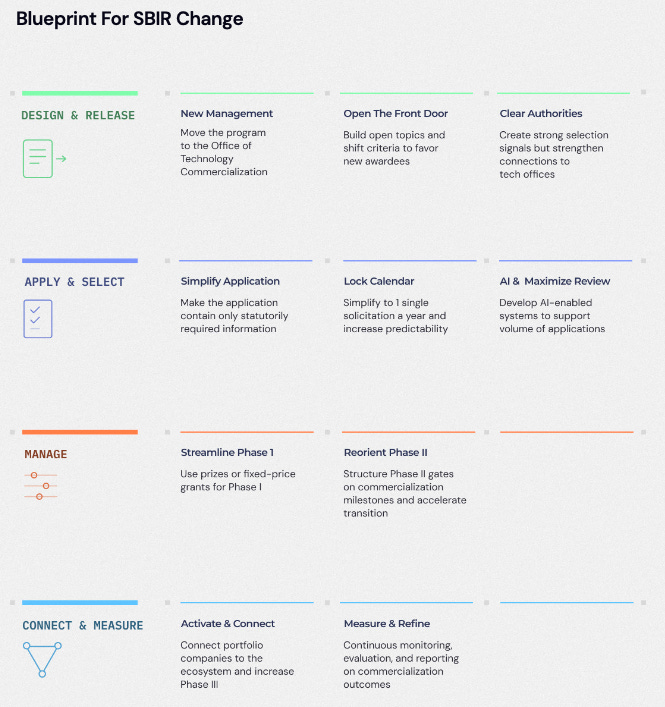
While wholesale adoption is ambitious, it is achievable. But even if DOE elects to not implement the entire reform, these concepts can fundamentally transform the SBIR program, even if adopted incrementally or in part. And this is a critical starting point to work from for all stakeholders thinking about SBIR reform, whether inside the department, on the Hill, or in the broader ecosystem. But we also recognize that this is a detailed starting point; we have offered it as a hypothesis to be refined, and we genuinely welcome the conversation that hopefully follows.
SBIR’s authorization lapsed last October for the first time in the program’s 43-year history, and for roughly six months eleven federal agencies were unable to issue new SBIR solicitations or make new awards. Congress has since passed a five-and-a-half-year reauthorization (S. 3971, the Small Business Innovation and Economic Security Act) with broad bipartisan support. The reauthorization includes some structural changes, including new proposal limits, enhanced foreign risk due diligence, and a new Strategic Breakthrough Award mechanism, but it does not address the deeper program design issues at DOE which this paper focuses on. The legislative debate over the past year opened a window for this kind of conversation, and we hope that window is still open even as the program restarts.
The tools that would make reform possible also exist now in ways they did not during previous conversations about SBIR modernization. General purpose AI tools are reaching a level of practical capability where they could support the development of trusted screening and compliance processes, which would be necessary to manage the application volumes that open topics would generate. The partnership intermediary infrastructure has been established and is in active use across DOE for other programs. The new DOE foundation, which has an explicit mission to support commercialization - the Foundation for Energy Security and Innovation - has launched and is staffing up. Technical and Business Assistance vouchers are an available but chronically underutilized authority. Recent Section 309 appropriations language enables fund flexibility for open topics. None of these existed in their current form the last time DOE had a serious conversation about SBIR reform.
And the proof points exist: AFWERX, ARPA-E, NASA, NSF, and DOE’s own (former) Solar Energy Technologies Office and (former) Water Power Technologies Office have all demonstrated, under the same legal framework that governs DOE SBIR, that federal innovation programs can move faster, reach more companies, and produce better commercial outcomes than what DOE’s SBIR program currently delivers. The reforms we are proposing have already been tested in other federal contexts, and the question at this point is less about whether they work and more about whether DOE will apply them to a $300 million program that has been running on essentially the same design for over four decades.
We have written before on Innovation Waypoints about the process of designing federal programs from scratch, the sequence of decisions that determines whether a well-intentioned program actually produces the outcomes Congress intended. (Our Common Language post walked through those steps in detail.) This paper is that thinking applied to a specific program with real consequences for the companies and technologies DOE is supposed to be supporting.
If you have been through the SBIR system, whether as a founder, a program officer, a reviewer, or an investor who watches federal funding signals, you have a perspective that matters here. We hope you will read the report and tell us where we got it right and what we missed. We want this to be the beginning of a longer conversation about how DOE supports the next generation of energy companies, not the last word on it.
The full report is available here.
Clean Economy’s introduction to the Blueprint Series.
Innovation Waypoints is brought to you by Waypoint Strategy Group.
Comments
Nothing yet. Say the first thing.
Sign in to join the conversation.