
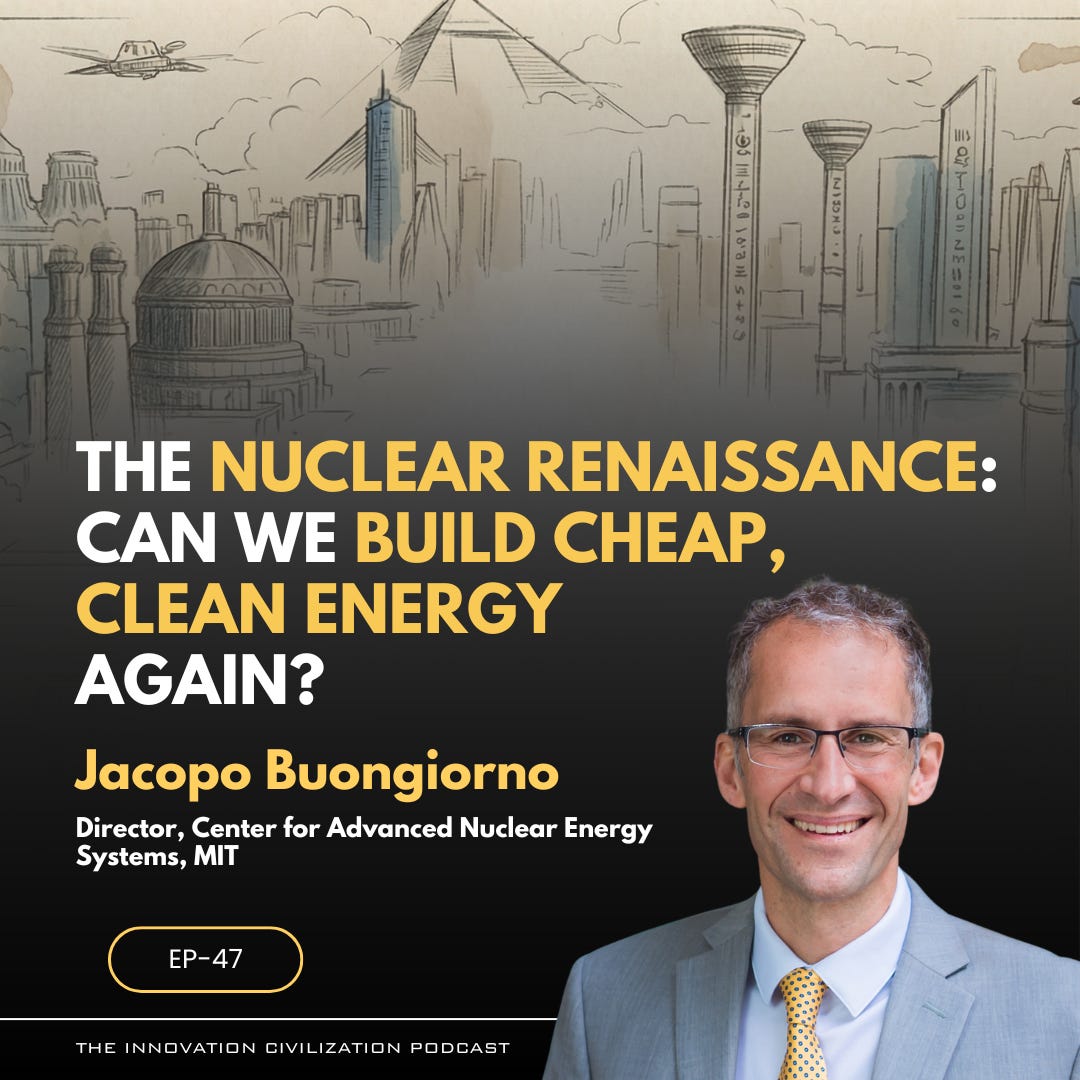
Listen on Apple Pod, Spotify, & Youtube. “Energy is the real bottleneck—not compute.”
You hear this everywhere now. Admittedly, many of the people saying it own energy stocks. Analysts have a remarkable ability to discover that the future belongs to whatever is already in their portfolios.
But that does not make them wrong.
The AI industry is rediscovering something the software era allowed us to forget: the digital world sits on top of a physical one. Models need chips. Chips need data centres. Data centres need grids, transformers, cooling systems—and electricity every second of the day.
Our World in Data’s long-run estimates suggest global primary-energy use per person has risen roughly fourfold since 1800. Nearly every increase in human capability has involved commanding more energy, then converting it more intelligently.
That brings us to nuclear.
It supplies around 9% of global electricity; France received 67.3% of its electricity from nuclear in 2024. It offers almost exactly what AI infrastructure wants: clean, compact, round-the-clock power.
So why is the match still so difficult?
I asked Professor Jacopo Buongiorno, Professor of Nuclear Science and Engineering at MIT and a leading authority on advanced reactors. I was joined by friend of the podcast Wojciech Kulikowski, founder and early-stage investor.
Thirteen ideas from the conversation:
1. Nuclear sells a bundle, not a single feature
No energy source is truly zero-carbon once mining, manufacturing and construction are counted. Nuclear’s advantage is a rare bundle: low life-cycle emissions, high availability and extreme energy density.
That matters because electricity is not a commodity with one attribute. A megawatt available on demand is more useful than one available only when weather permits. Nuclear’s product is not merely energy. It is firm, low-carbon power with a small physical footprint.
The correct comparison is not cost per panel, turbine or reactor. It is the cost of delivering the power profile the customer actually needs.
2. Nuclear’s first boom was a demand-regime shift
The 1970s build-out followed oil shocks and fears about energy security. When those fears receded—and cheap natural gas arrived—Western nuclear lost its economic urgency.
Three Mile Island worsened public distrust despite causing no deaths or injuries. But the deeper lesson is that nuclear booms when societies pay a premium for security, predictability or decarbonisation, not simply cheap electricity.
AI may be creating another such regime shift.
3. State capacity compounds like technical debt
Countries that kept building accumulated suppliers, routines and experienced leaders. Countries that stopped did not remain stationary; their capability decayed.
Jacopo estimates welders, electricians and pipefitters can be trained in roughly two to three years. The harder bottleneck is the construction manager who has already delivered several megaprojects. China’s advantage is not mysterious reactor physics. It is teams moving from project one to project two to project three.
Nuclear has a learning curve—but only if you keep building. Stop, and the curve runs backwards.
4. SMRs trade economies of scale for economies of repetition
The “Gen I–IV” language can distract from the real innovation. Most operating reactors are water-cooled; what SMRs principally change is the deployment model.
A large reactor tries to make each unit cheaper through size. An SMR accepts a smaller unit in exchange for factory production, repeatable modules and shorter projects. It is a bet that learning-by-doing can outweigh lost scale economies.
That requires an orderbook, not a prototype. Kairos has begun nuclear construction; TerraPower began Natrium construction in April 2026. The decisive evidence will be units five through ten—not unit one.
5. Nuclear has a brutally simple cost stack
Jacopo’s rule of thumb is 70% construction, 20% operations and maintenance, 10% fuel. This changes where innovation matters.
The highest-value levers are faster concrete and steel installation, more standardisation, automated operations using machine learning and digital twins—and cheaper capital. A ten-year project accumulates financing costs while producing nothing.
For investors, the implication is sharp: follow schedules, repeat orders, contractor quality and financing terms before following the uranium price.
6. AI solves the offtake problem—not the construction problem
The IEA expects data-centre electricity use to rise from 485 TWh in 2025 to 950 TWh in 2030, with AI-focused use tripling (2026 projection). By 2027, one advanced server rack could draw as much peak power as 65 households.
Hyperscalers can sign long-term power-purchase agreements, converting uncertain merchant revenue into contracted infrastructure income. Google’s Kairos agreement is designed around multiple reactors precisely to create an orderbook.
But demand certainty does not pour concrete. AI can underwrite a plant; it cannot make one arrive on time. And data centres need power sooner than most new reactors can provide it.
7. Good industrial policy buys a learning curve
One reactor is a project. Ten similar reactors are an industry.
A credible programme lets suppliers invest in factories, workers build experience and lenders lower their risk premium. That is the logic behind America’s goal of ten large reactors under construction by 2030 and $17.5 billion in conditional supply-chain loans tied to bulk orders for long-lead components.
The test is whether public capital purchases standardisation and repetition—or merely absorbs another first-of-a-kind overrun.
8. A reactor export is an operating system
China now has 37 reactors under construction. Russia is already supplying projects in countries including Bangladesh, Egypt, Belarus and Türkiye.
The strategic product is not the reactor alone. It is a decades-long stack of finance, fuel, training, standards, maintenance and waste management. The vendor becomes embedded in the customer’s critical infrastructure.
Think of it less like exporting a power station and more like installing a national energy operating system—with switching costs measured in decades.
9. Proliferation risk lives in the architecture
A civilian reactor does not automatically produce a weapons programme. The larger risks sit around enrichment, reprocessing and diversion of material—hence the Non-Proliferation Treaty, IAEA inspections and material accounting.
Supplier take-back of spent fuel can reduce the risk further. An IAEA study finds the idea technically possible but legally and politically difficult.
This reveals a trade-off: the arrangements that reduce proliferation and waste burdens can also deepen dependence on the supplier state.
10. Nuclear suffers from an availability bias problem
Three Mile Island, Fukushima and Chernobyl occupy the same mental category but produced radically different outcomes. Fukushima caused no acute radiation injuries or deaths, though evacuation caused serious harm. Chernobyl was far more severe.
Nuclear accidents are rare, vivid and concentrated. Air pollution and fuel extraction kill through dispersed, ordinary processes. Humans overweight the visible catastrophe and underweight the chronic baseline.
Good policy must price both tail risk and everyday harm.
11. Floating nuclear changes the asset boundary
A conventional plant is fused to its site. A floating plant can be built repeatedly in a shipyard, moved to the customer and returned for decommissioning.
That changes nuclear from a bespoke local construction project into something closer to a manufactured, serviceable asset. It may also enable supplier-controlled fuel and waste handling.
Russia’s Akademik Lomonosov remains the only operating floating nuclear plant. The harder problems may be maritime security, liability and cross-border regulation—not the reactor.
12. Fusion headlines confuse discovery with deployment
A scientific breakthrough proves that a process can work. A power plant must also survive heat and radiation, convert energy, operate reliably, be maintained and compete on cost.
Jacopo is sceptical of commercial fusion in the early 2030s. The wider lesson applies across deep tech: technology readiness is a stack, and progress at one layer does not collapse the others.
13. Watch execution signals, not renaissance headlines
Jacopo expects stronger growth in East Asia, the Middle East and parts of Eastern Europe than in the West. The useful question is not whether a country “supports nuclear”.
Watch five things: a standard design, a multi-unit orderbook, committed financing, an experienced delivery team and improving build times. If one is missing, you probably have an announcement. If all five are present, you may have an industry.
The difference will not be enthusiasm. It will be execution.
Nuclear is not a silver bullet. It does not need to be.
Its future will be decided where software optimism collides with industrial reality: procurement, concrete, capital, regulation and repetition.
The physics works. The scarce technology is the ability to build.
Comments
Nothing yet. Say the first thing.
Sign in to join the conversation.