
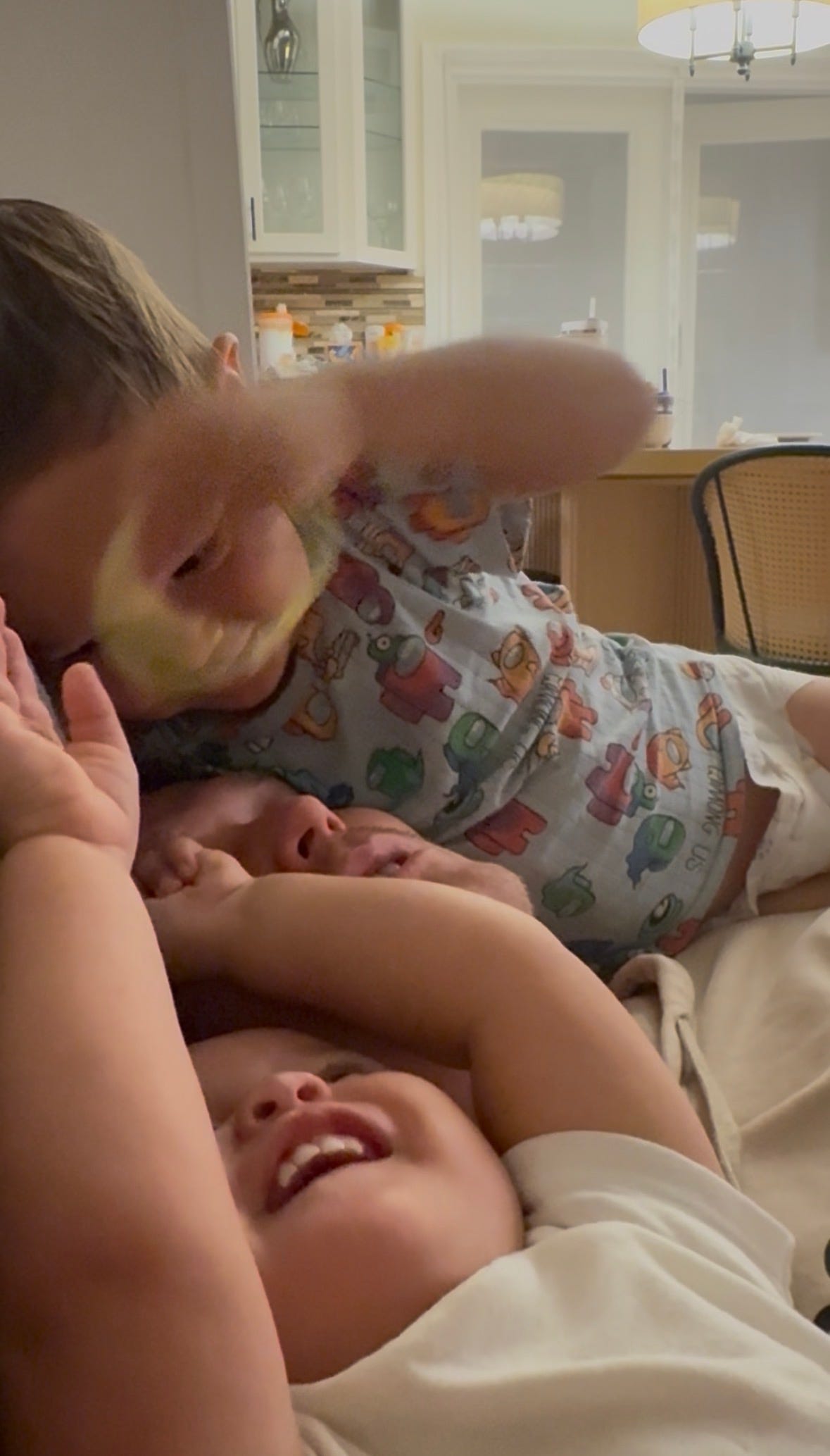
Someone asked me recently how I’m preparing my kids for the future —
a future of AI, acceleration, and constant change.
Here’s how I see it: AI isn’t good or bad. It just is.
It’s not something I believe we should fear, friends. It’s here — and among many other things it’s revealing to us about the world, it is serving as an inevitable mirror of our collective consciousness. It reflects both our brilliance and our blind spots, our innovation and yes, our disconnection.
And that mirror is revealing something many of us have a hard time seeing clearly — that our collective nervous system is severely dysregulated.
You can see it everywhere — in politics, in social media threads, in the undertone of daily conversations. People are arguing to be right, grasping for control, or checking out entirely.
And there’s also this quiet despair that many people are experiencing.
I’ve been struck lately by how many people say they no longer want to have children —
not because they don’t love life, but because they don’t want to bring children into this world.
That saddens me because becoming a parent thus far, has been the most fulfilling role I’ve ever had. And yet, I also understand it. When everything feels uncertain, the nervous system does what it’s wired to do: fight, flee, or shut down.
It doesn’t distinguish between good and bad change — only between predictable and unpredictable.
Which means even progress can register as danger.
So for me, preparing my children for the future isn’t about protecting them from change.
It’s about expanding their capacity to meet it — from safety, adaptability, and curiosity.
Here’s what that looks like in our home.
Before about age 3½ to 4, children don’t yet have the brain wiring to self-regulate. Their prefrontal cortex — the part responsible for impulse control and emotional balance — is still developing. As a matter of fact, the nervous system itself doesn’t fully mature until around 25 years old.
So their sense of safety comes directly from ours. They learn regulation not through words, but through modeling…through our presence.
My husband and I are often told how calm or “easy” our kids seem. The truth is: I really believe it’s because nervous system health is a daily priority in our home. Of course nature plays a role — every child has their own temperament — but nurture sets the baseline. I’ve helped many clients transform their entire households as they learned to regulate first. Unbeknownst to many parents, children actually mirror their nervous systems.
In our home, curiosity isn’t just encouraged — it’s the air we breathe.
We invite our kids to ask a lot of questions. Nothing is too small or too strange.
When Matteo says something, we don’t rush to correct him or give the “right” answer. We ask him to tell us more. We explore why he thinks that way. It’s not about being right; it’s about learning how to think.
Nothing in our household is concrete. Everything can be explored.
Curiosity is how we help sharpen discernment — it helps them recognize that truth is often layered, that perspective matters, and that they have permission to keep asking.
This practice trains their nervous systems to stay open in uncertainty instead of shutting down in the face of the unknown.
One thing my husband and I are both intentional about — and something Christian does especially well — is letting our kids make their own calls, even when we’d prefer a different outcome.
Admittedly, I’m still sharpening this skill for myself but we genuinely try not to over-correct. When we can, we step back and let them experiment, fail, or figure things out on their own.
That space to choose helps wire self-trust. Over time, it becomes the foundation for intuition — the inner knowing that tells them, “I can listen to myself and it’s safe to do so.”
This is a big one. We don’t rush to stop tears or correct feelings. When my son cries, I’ll often ask, “What’s happening inside your body right now?”
It helps him understand that emotions are experiences moving through him, not who he is.
Over time, his nervous system learns that emotions are safe — that anger, sadness, and joy can all exist without threat. This prevents the unhealthy coping strategies so many of us developed to avoid feeling: numbing, fawning, overachieving, shutting down.
We keep routines — but we also welcome novelty.
We travel, rearrange, and talk about change as a natural part of life. We show them that stability isn’t about everything staying the same; it’s about knowing how to find center even when the world shifts.
Adaptability is a nervous system skill, too. And it’s one we’re all having to strengthen — not just our children.
This is the stuff that I help my clients figure out for their own households inside of Inner Mastery Code, which is getting a massive upgrade right now. The world we’re moving into requires more than mindset work; it asks for nervous system resilience, emotional capacity, and the ability to stay coherent in motion.
The new evolution of the Inner Mastery Code is about helping people do just that — rewire their systems for safety in the midst of change, so they can expand their capacity to create, lead, and love from regulation, not reactivity.
It’s the same foundation I’m teaching my children — only translated for the adult nervous system that’s been taught to survive instead of trust.
Preparing our children for the future isn’t about teaching them to outsmart technology. It’s about helping them stay human in a world that’s moving fast.
And maybe, as we remember how to regulate, discern, trust, and adapt — we start creating that same future for ourselves.
No posts
Comments
Nothing yet. Say the first thing.
Sign in to join the conversation.