
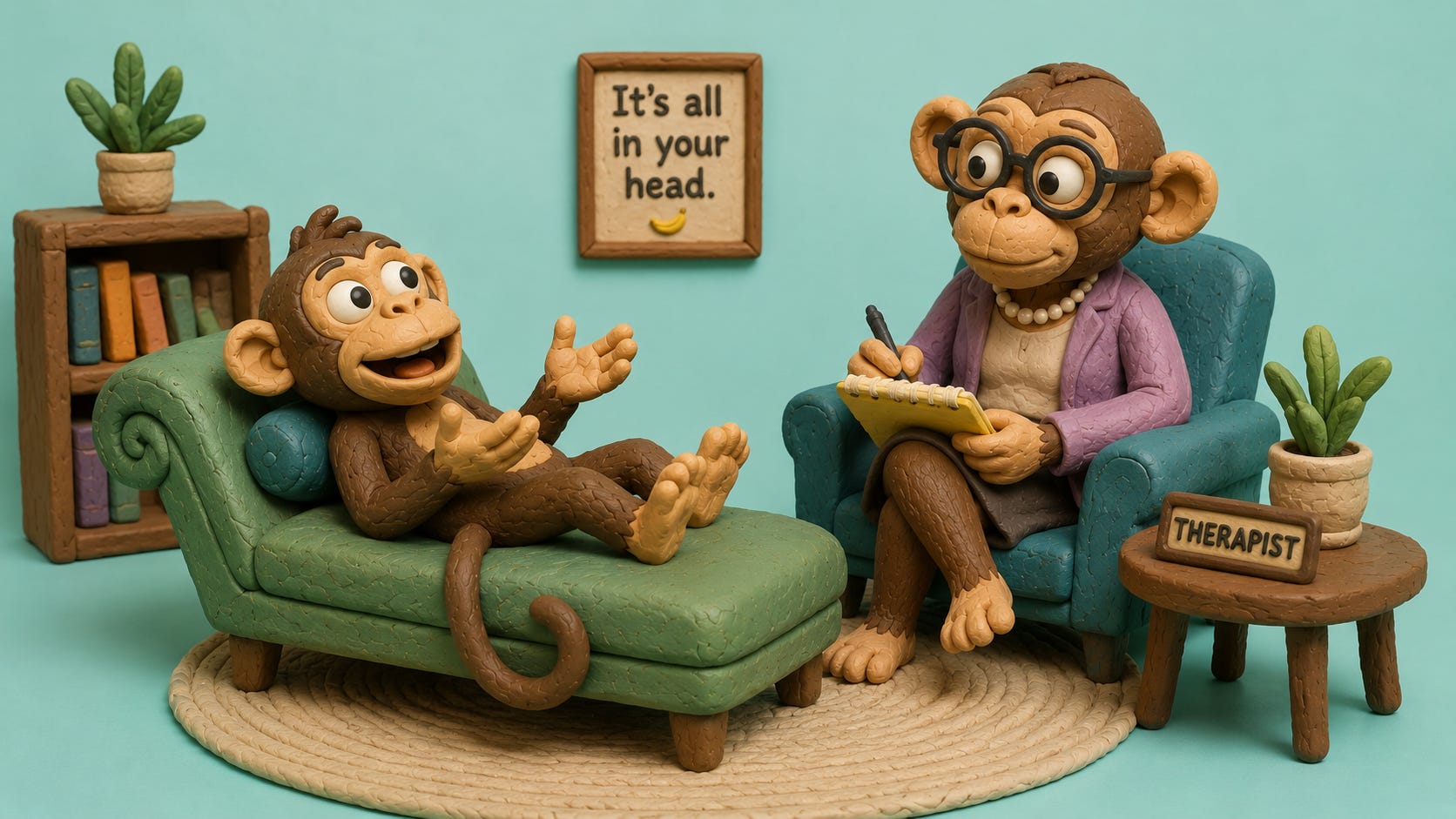
Today’s culture suggests that talk solves everything. Whether it’s talk therapy, or pouring your heart out to a friend, or teaching kids to “use your words,” talk is supposed to fix things.
But it often fails because the talking part of the brain does not control the feeling part. Feelings are caused by chemicals we’ve inherited from earlier animals, and controlled by brain structures that all mammals have in common. Animals can’t talk, so your mammal brain can’t tell you in words why it releases a chemical. This is why humans have struggled to manage their feelings since the beginning of time.
You can tell yourself how to feel, but words don’t impress your mammal brain. It evolved to promote survival, not to make you happy. It rewards you with a good-feeling chemical when you see something good for your survival. But it defines survival in a quirky way, with neural pathways built from natural selection and early experience. This is why we do quirky things to feel good.
The talking part of your brain has some superpowers. It can collect detail, find patterns, and predict outcomes. But your cortex can’t make you happy because it doesn’t control the happy chemicals. Your mammalian limbic brain sits between your cortex and your body, so your conscious thoughts literally have to go through your inner mammal to affect your feelings and actions.
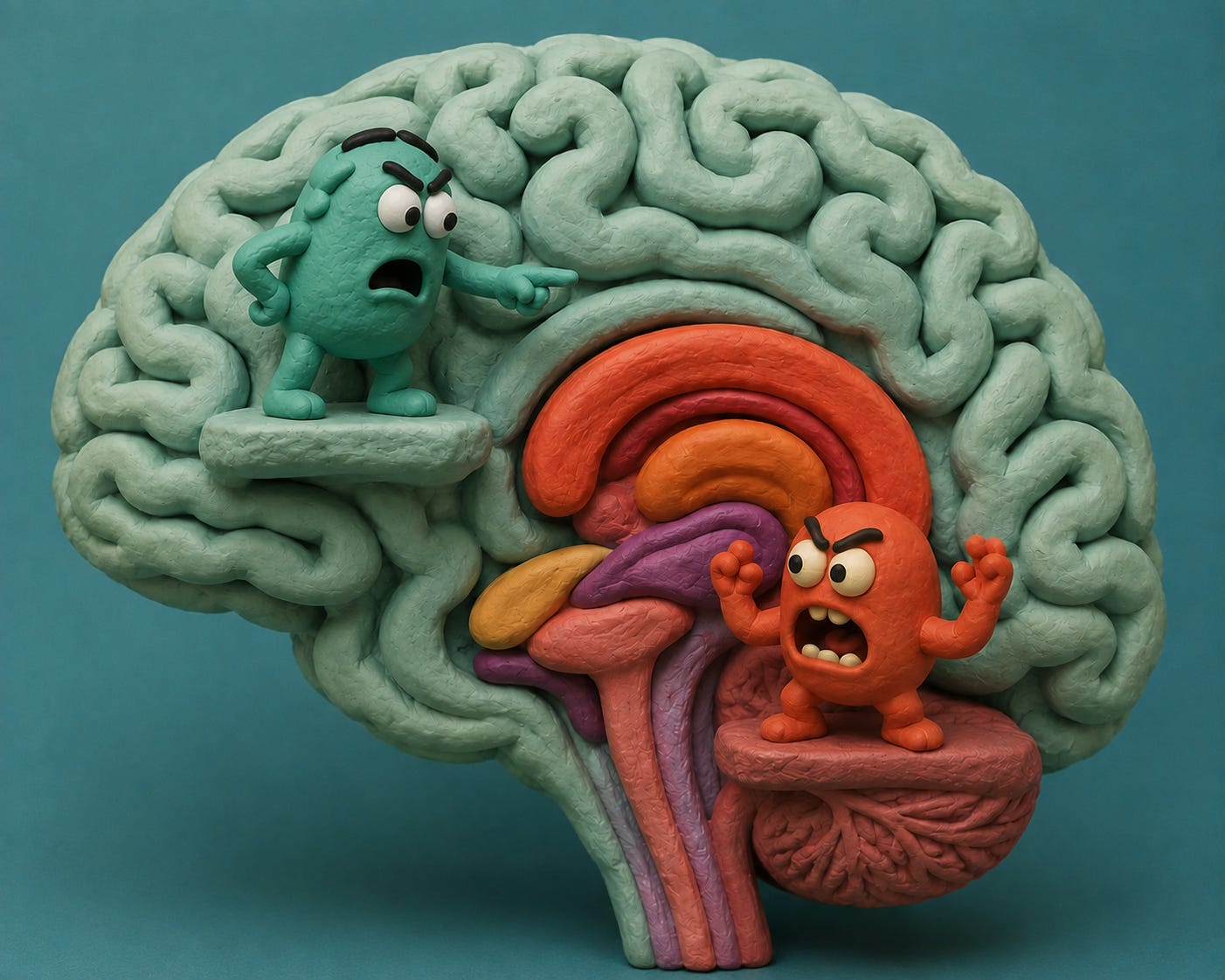
Your cortex tries to help your mammal brain get what you need to feel good. But your two brain often disagree. Sometimes your cortex fears the long-term consequences of immediate rewards. Sometimes your inner mammal fears the steps needed to reach long-term rewards. Sometimes one brain is right, but sometimes the other is right. It’s hard for your two brains to work together.
The Wrong Way to Treat Your Inner Mammal
You’re often advised to stay in your “executive brain” to avoid the bad things that happen when your emotional brain takes over. This is like a jockey ignoring their horse. That jockey will not get good results.
When you ignore your inner mammal, you don’t know where your feelings come from, so you blame them on outside forces. You blame your genes or the person you’re with or the state of the world. You end up feeling like a victim of external forces when you don’t understand your internal process.
If you treat a horse well, it will use its huge power to take you where you want to go.
However, it may take fright and run in the wrong direction sometimes. You yell at it to stop, and when that doesn’t work, you just keep yelling because that’s what your talking brain knows. People often yell at their inner mammal in the same way.
“Kindness” has become a popular concept. You may pride yourself on being kind to your inner mammal. But it may not be kind to you in return, because the mammal brain doesn’t work that way. It’s focused on survival.
This fact is hard to accept. We’ve been taught that nature is good and everything bad comes from “our society.” If you acknowledge a mammal’s natural selfishness, you’re condemned as a bad person.
We’re taught that animals are good, children are good, and hunter-gatherers were good. Yet we’re surrounded by evidence that animals fight viciously over food, children squabble endlessly over toys, and hunter-gatherers warred frequently over territory. You ignore this evidence because you don’t want to seem like a bad person.
But your inner mammal wants what it wants. If you refuse, it puts its energy into fighting you instead of helping you. It’s hard to manage this beast we’ve inherited. It’s a skill you must build. You don’t do the work if you can’t accept the truth about your inner mammal.
Getting Real with Your Inner Mammal
A mammal is hungry and fearful a lot. Even when it’s well-fed and safe, it’s alert for threats to its food and safety. This is not a disorder; it’s the operating system that kept our ancestors alive for millions of years.
To make matters worse, the mammal brain cares about social dominance. Stronger mammals got more food and mating opportunity, so natural selection built a brain that rewards you with a good feeling when you gain a position of strength.
“Not true!” your verbal brain may say. In today’s world, social dominance comes from moral superiority rather than sword fights. If you admit that you care about social recognition, it’s like getting stabbed with a sword. The urge for social dominance is harder to manage when you can’t notice it inside you.
I was shocked when I first read that the mammal brain releases serotonin when it sees itself in the one-up position. This explains so much about daily life, so why was it never mentioned in my decades of reading psychology? You may find it hard to believe the serotonin facts of life, yet the research was well established decades ago. Here’s a 1983 New York Times report on it, and a reading list of the books that taught me about mammalian social comparison. I went on to write many books about it, so I will not elaborate further.
I got real with the mammal brain by accident on a vacation trail ride. My husband and I mounted horses with a group of tourists in a beautiful setting. A friendly guide cued us to start moving, but my husband’s horse refused. It just munched grass by the side of the trail.
My husband kept saying “please,” while the whole group stared at him. Finally, the guide came back and got the horse to move.
But as soon as the guide returned to the head of the line, the horse refused to budge again. The whole ride was stuck, so the guide took the reins and kept the horse right behind him. My husband just went along for the ride. He breathed a sigh of relief along with everyone else.
My husband was convinced that he just got a bad horse.
But I called an equestrian expert that I know. She told me that horses instantly judge a rider by the way they hold the reins. Too tight and the horse resists. Too loose and the horse does whatever it pleases.
Eating grass on the side of the road pleases it. Asserting social dominance pleases it. Enjoying the protection of the group without submitting to the group’s needs pleases it.
You may sympathize with the rebellious horse. You may even see this as a mark of your superior ethics. You get a short serotonin spurt when you think this, but it’s quickly metabolized, so you need to put yourself in the one-up position again to spark more. The mammal brain is constantly comparing itself to others because serotonin feels good.
It’s not easy to manage this dominance-seeking brain. It’s not easy to live in a world where eight billion others long for social dominance as much as you do. Managing this brain is a complex skill.
Inner Mammal Management Skill
I did not think a trail ride required skill when I booked it. I thought you just sit there. But I instinctively knew how to hold the reins because my father took me on a couple of trail rides when I was young. I was not consciously aware of my skill because I did not think it in words.
Managing your inner mammal is likewise a non-verbal skill learned when you’re young. If you don’t learn, your inner mammal is likely to snack on the side of the road a lot. And you won’t know why because no one tells you that a skill is involved. So you’ll conclude that you got a bad mammal brain. You’ll hear talk about genetics and parrot it.
But if you can’t control your inner mammal, you may lose the reins. You may even feel relieved when this happens because you truly don’t know what to do.
If you can’t admit that your inner mammal longs for social dominance, it’s hard to manage the impulse. If your verbal brain says you don’t care about such things, you believe it. But your inner mammal does its thing regardless of your fine words.
In the real world, horses have limited energy for social squabbles because they have to constantly find food and avoid predators to survive. But a domesticated horse has its needs met by others, so it can invest more energy in the quest for social dominance.
It’s the same for modern humans. Our ancestors had to spend most of their energy on the quest for food and safety. Their children had to participate in order to learn survival skills. Finding food and firewood made them happy. Today, our physical needs are easily met, so we rely more on social needs to spark our happy chemicals.
Threat chemicals helped our ancestors anticipate danger in time to avoid it. Our brain is very good at anticipating danger. But when you are gloriously free from famines and predators, your brain finds other ways to anticipate danger. Any threat to your social recognition feels like a survival threat, even if you don’t consciously say that to yourself in words.
It’s not easy being a big-brained mammal.
How to Make Peace with Your Inner Mammal
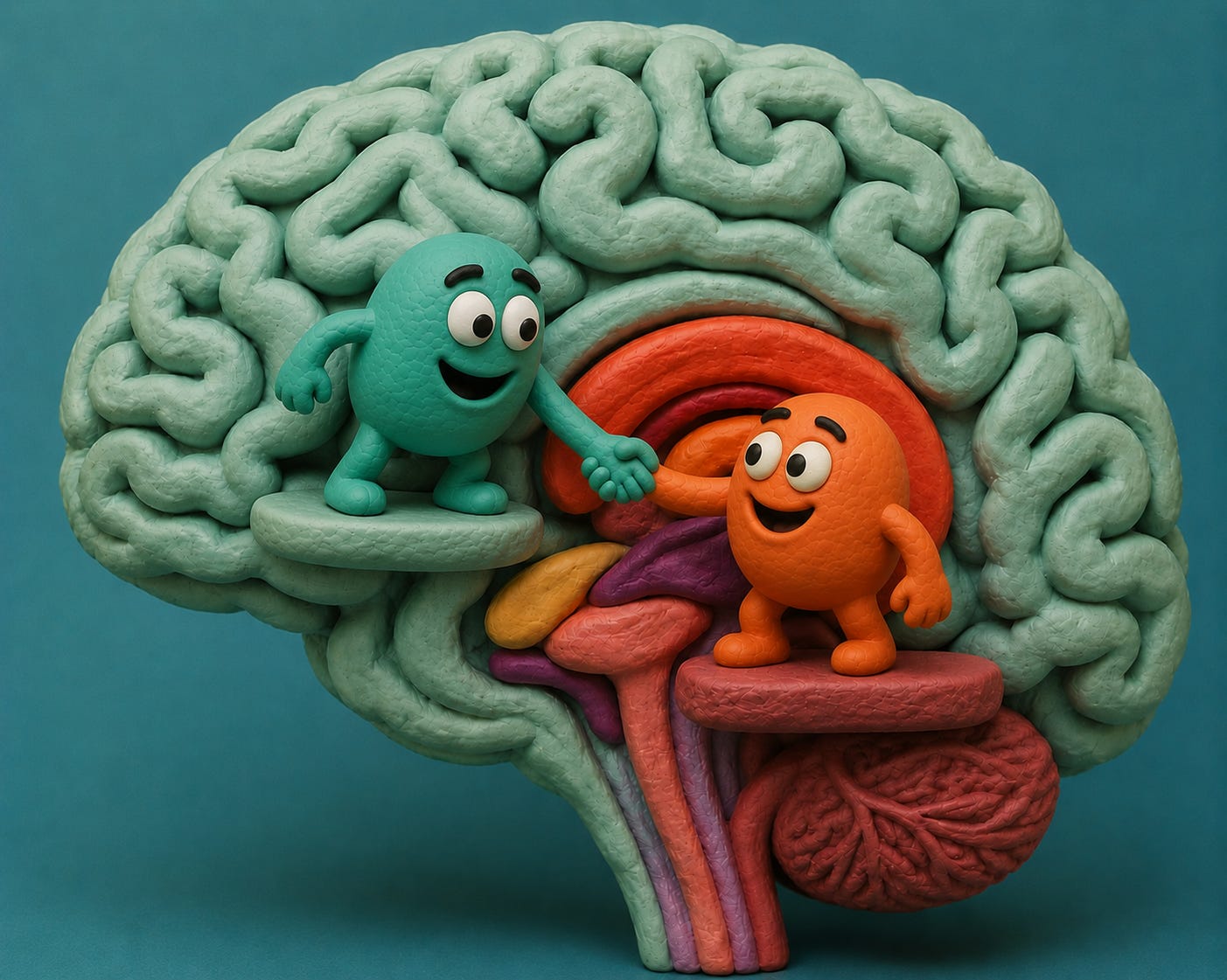
Fortunately, you can train your two brains to work together like an award-winning horse and rider.
Watch the Equestrian Olympics and you will see amazing skill. No horse is born with that skill. No rider is born with that skill. It comes from practice.
Each time you practice, you build the neural pathways that make the next practice easier. Repetition can train your two brains to jump hurdles with amazing grace.
Animals are motivated to train because they know they will get a reward. Professional animal trainers know how to structure rewards to keep the mammal brain motivated. They give tiny treats for tiny steps forward, and occasional big treats for big milestones. The brain links the good feeling of the treat to the desired behavior.
Professional trainers vary the treats because a horse quickly loses interest after a few carrots. A dog loses interest after a few bits of meat and a dolphin loses interest after a few fish. But with the right reward structure, a dolphin can do a triple flip even though it doesn’t consciously intend to. A horse can do an award-winning jump without knowing what an award is. The mammal brain simply repeats a behavior that was rewarded in its past.
Your inner mammal is always striving to repeat behaviors that were rewarded in your past. You may feel insulted by this statement, but you if you get real with it, you will know how to re-wire your inner mammal. You may have heard that rewards are bad and hugs are the only reward we need. But you have already tried that. In fact, your brain learns from rewards whether or not your verbal brain agrees. You can learn to design your reward structure consciously to produce the behavior you want.
You may hate the idea of training yourself like a dog. You want to believe that you are only motivated by “higher values.” But if your inner mammal is stuck grazing on the side of the road, nice words will not help. Basic biology will help.
I explain how to do this in all of my books, especially Habits of a Happy Brain: Retrain your brain to boost your serotonin, dopamine, oxytocin and endorphin levels. A free, short introduction is the Inner Mammal Manifesto and the Inner Mammal Method.
And if you like the art, sign up for my newsletter, as I will be premiering a free pdf with a lot more of it.
No posts
Comments
Nothing yet. Say the first thing.
Sign in to join the conversation.