
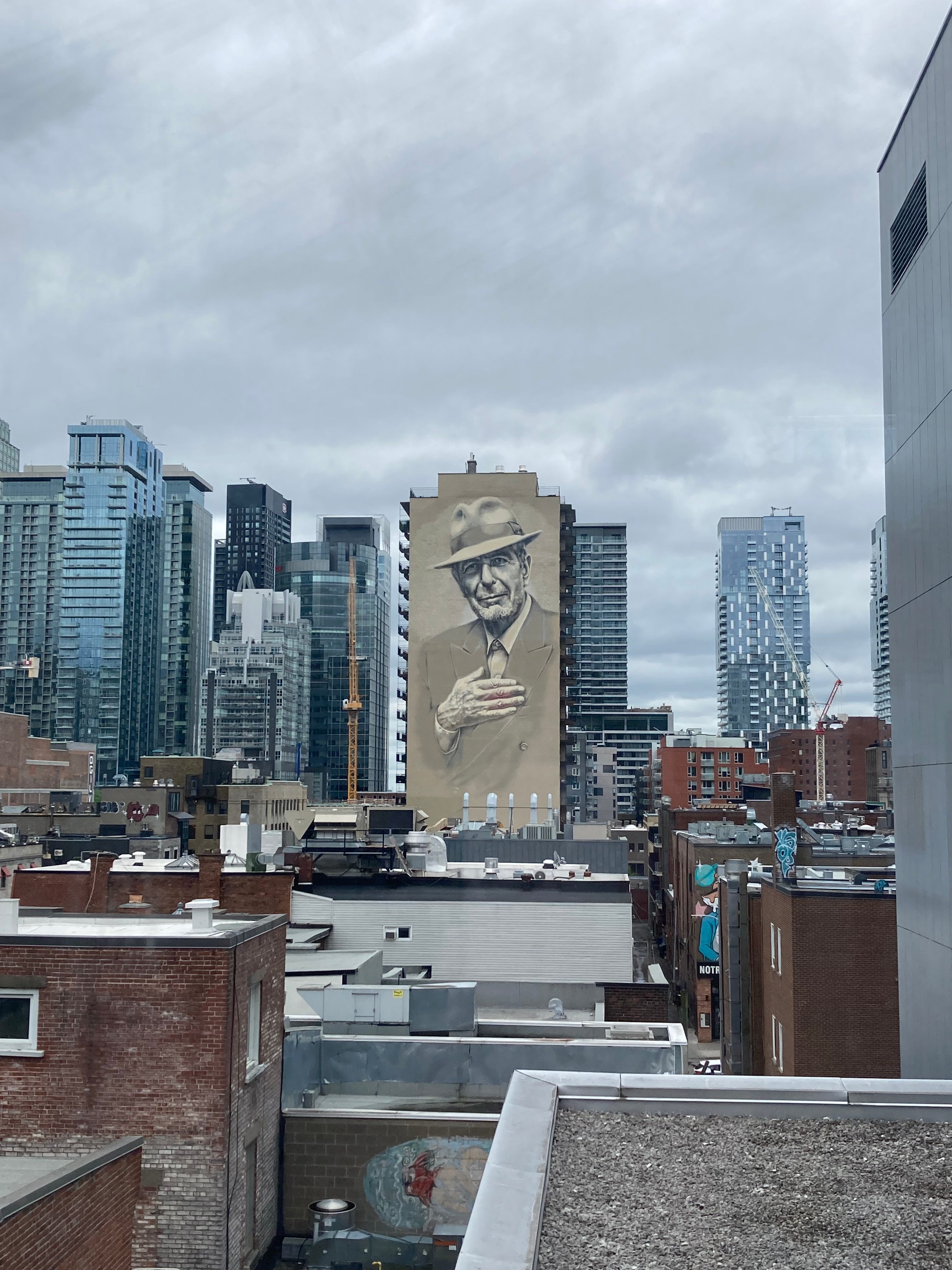
Last week a friend surprised me with a ticket to a concert in our local Mile End neighbourhood. The acclaimed Israeli folk-rock singer David Broza came into town. Broza, who blends pop, rock, folk, and Spanish flamenco is a household name in Israel. Although I grew up with more Rita than Broza, I recognized most of Broza’s songs that took me back to my (not always so happy) childhood in Israel. Memories were gushing in, tears forming at the corner of my eyes.
Broza is seventy years old, but you quickly forgot this fact as soon as he began playing his guitar. He had a full command of the stage that was completely bare except the simple stool that he was sitting on. He was an embodiment of his music; passion and aliveness oozing from his every pore. I watched him mesmerized. So, this is what a man who follows his passion and creativity looks like at an older age, I thought.
Like Broza’s music, my writing is heavily influenced by the cultures and languages I grew up in (Hungarian, Hebrew and English) and the cultures and languages I have acquired in my adult life (French, Spanish and Italian). But unlike Broza, I didn’t become a national phenomenon in my early twenties and sometimes feel that I might be too late to the party. What can I say that hasn’t been said? What can I write about that hasn’t been written about? What can I add to the impressive literary canon, written by people much younger, and more talented than me? What is the point of even trying?
I am pretty certain that I am not alone in feeling this way; I am pretty certain that the greatest writers and artists I see as demigods have at least on occasion struggled with the same ‘imposter syndrome.’
Whenever I feel this pressure to produce a flawless work of art—and then, the inevitable disappointment with myself for failing to produce this flawless work of art —I remind myself that beside this constant striving, producing and achieving as an artist, I have a life to live, and this (ordinary) life, and how I choose to live it, is art in itself.
But how to live a life that is in line with your soul’s purpose (dharma) when practically every message that you receive from the world is undermining this instinct? Markers of success are the visibles like a big house, pool, car, kids in private schools etc. not the invisibles like the joy you radiate when you do what you love. There are no visible markers for meaningful connections, nor prestigious diplomas and PHDs to earn for establishing a good friendship. And yet, as Esther Perel tells us, the quality of your life is determined by the quality of your relationships.
I was recently inspired by Thomas Moore’s Care of the Soul that I admit I had resisted reading, mistaking it for another popular self-help book that was trying to sell me cheap tricks as a way to fix myself. I couldn’t have been more wrong. Moore who is a psychotherapist and university professor brings inspirations from his own practice, his background in religious studies, but also from his keen interest in Greek mythology and literature. Reading him felt as if I had stumbled upon a wise elder, an old friend, who was gently tapping me on my shoulder, inviting me to follow my instincts.
In the last chapter of the book, The Sacred Arts of Life, Moore argues that we have banished art to the museum and fail to give it place in ordinary life. But care of the soul requires craft (techne) or techne tou biou, the craft of life (Plato)—
skill, attention, and art. To live with a high degree of artfulness means to attend to the small things that keep the soul engaged in whatever we are doing, and it’s the very heart of soul-making.
In other words, art is not separate from our lives, and is not outside of our it, but is inside of it: an expression of this very life.
So, what is artful living?
According to Moore, “art is that which invites us into contemplation and intensifies the presence of the world.” When we allow the world in through careful attention, we see, and feel it more vividly and deeply. Trouble is, our fast-paced world is keen to distract us from this kind of attention, and therefore “living artfully might require something as simple as pausing.” When we allow ourselves the luxury of non-doing, non-striving, non-achieving through meditation, daydreaming, or simply walking down the street without our headphones on, we can allow the impressions of the day to sink in.
For a while I used to get my best writing inspirations shortly after I had crawled into bed and had spent a few minutes in silence, preparing to fall asleep. But instead of falling asleep, a poem began to compose itself in my mind and I had to scramble in the dark to find my phone in order to capture it in my notes. Really? A poem, right now? I’d sometimes complain to the Gods of creation, until I realized that those were the only ‘empty’ moments a poem could reach me, because I had been so busy filling myself with inspirations from books, podcast and art. As soon as I began to spend more time in silence, without inspirations and wisdom from the best podcasts to flood my brain, my poems didn’t need to keep me awake at night.
According to Moore,
art is not about the expression of talent or the making of pretty things. Art is about the preservation and containment of soul. It is about arresting life and making it available for contemplation. Art captures the eternal in the everyday, and it is the eternal that feeds soul—the whole world in a grain of sand.
When I read this passage, I suddenly thought that what I call ‘The Art of Lite Living’ can be summarized more simply, borrowing from Moore, as living artfully by discovering the sacredness (or, “natural religion”) in all things.
This is why Moore’s book has been such a comfort to me. Unlike so many of the self-help books that propose a road map to a better version of yourself and a (fast) release from the troubles and pains of human existence, care of the soul is “in no way separate from life.” In Moore’s beautiful words:
We care for the soul solely by honouring its expressions, by giving it time and opportunity to reveal itself, and by living life in a way that fosters the depth, inferiority, and quality in which it flourishes.
This is of course a much deeper work that requires commitment and not a small amount of discomfort. And in this path of caring for the soul there are no quick fixes, nor guarantees. This is the path of the unknown.
But the reward?
If we learn to pause and pay attention—not only to the outside world, but to the mysterious world within—with reverence, curiosity and compassion, as a dedicated daily practice, “we step out of the way and let our full genius emerge.”
And in my book, this is the only worthwhile way to be in this world.
This post was inspired by the wonderful <Mary L. Tabor> who writes Only Connect, and is also the author of the memoir (Re)making Love that will prompt anyone to live—and love!— artfully, and fully!
Imola Zsitva writes The Art of Lite Living
No posts
Comments
Nothing yet. Say the first thing.
Sign in to join the conversation.