
0:00
-5:01
An email landed in my inbox announcing what “two Stanford graduates” were building.
I never found out what they had built. They had already lost me.
The credential was meant to create interest. Instead, it felt like a barrier, something separating me from them, an instruction to pay attention simply because these people went to Stanford.
The email hadn’t been the only thing to irritate me. I had also encountered someone using expertise and ego to create division, placing themselves above the conversation rather than participating in it. By coincidence, my friend Jen Benford messaged me, and by now I needed a cheeky rant…
We started laughing about the credential parade we had both noticed, and then found ourselves asking more serious questions.
When do credentials create trust?
When do they create distance?
How does ego get wrapped around expertise?
The conversation was juicy enough that we decided to continue it live on Substack.
Jen is the founder of Benford Talent Alchemy, a brand strategist, coach, and writer of The Divergent Talent Alchemist. She helps creators, divergent thinkers, and aspiring entrepreneurs build brands and businesses that fit who they are. Her work spans identity-led brand strategy, sustainable entrepreneurship, thoughtful AI, and neurodiversity—which made her exactly the person to explore this conversation with.
Now to be clear, neither of us is anti-credential. “We both have some letters”. And credentials matter, particularly in medicine, law, and therapy. If someone is going to perform surgery, represent me in court, or provide clinical care, I want evidence that they have completed the necessary training.
A credential gives us a place to start. It tells us that someone met a particular standard, in a particular place, at a particular time.
But we often allow it to imply much more.
We assume expertise. Intelligence. Current knowledge. Good judgment. Practical ability. Sometimes, even superiority.
My MBA tells you that I completed an MBA. It tells you I invested in my education and had an interest in business. It doesn’t mean I win every conversation about business. It doesn’t tell you what I remember, how well I apply it, or whether the education I received twenty years ago is even relevant in today’s business environment.
A credential is a snapshot. We often treat it like a permanent verdict.

Credentials become problematic when they stop adding context and start carrying the argument.
“This training informs my perspective” opens a conversation.
“I have this training, so my perspective outweighs yours” closes it.
You can often see the difference when someone is challenged. Do they engage with the question? Can they acknowledge the limits of their knowledge? Or do they retreat behind their title?
This matters in medicine, where a doctor’s technical knowledge is essential, though so is the patient’s knowledge of their own body. It matters in coaching, where training helps, but the client still understands their life better than anyone else. It matters in leadership, where authority doesn’t grant access to every useful perspective in the room.
The credential can get someone into the room. It cannot tell us how they will behave once they’re there.
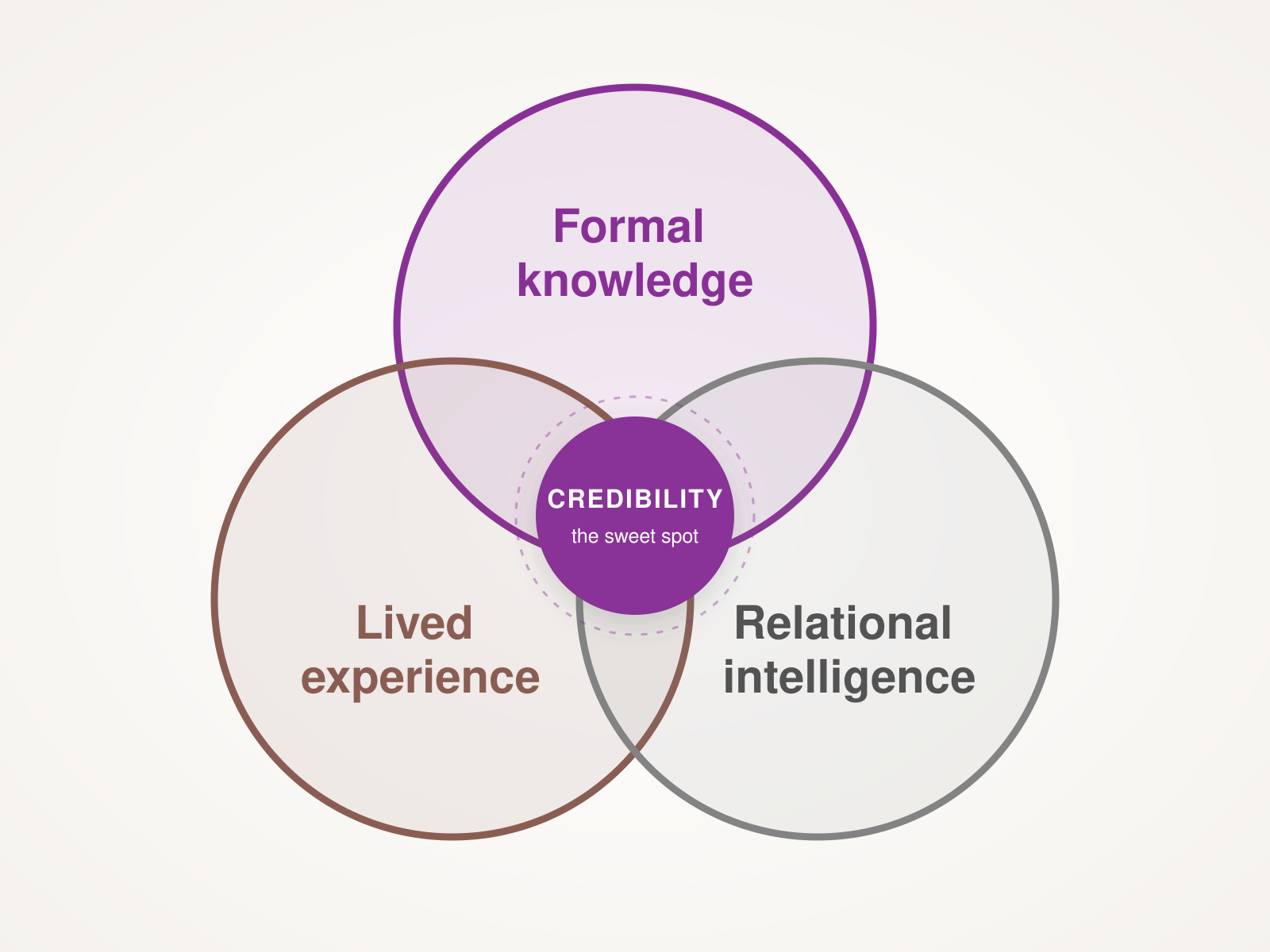
As Jen and I talked, a fuller picture emerged:
Formal knowledge: What have you studied, and what standards have you met?
Lived experience: What have you encountered, practiced, and learned?
Relational intelligence: Can you listen, remain curious, and integrate what another person knows?
The strongest practitioners bring all three together. They have knowledge without needing to perform certainty. They have experience without assuming they have seen everything. They understand that every person they meet knows something they do not.
Experience can sharpen judgment, but it can also harden our assumptions. Expertise stays useful when curiosity stays alive.
Social media rewards shorthand. Titles, institutions, follower counts, and years of experience help us make quick decisions in a noisy world.
Credentials should help people understand the lane we operate in. They shouldn’t determine where other people belong in relation to us.
This conversation has also turned the lens back on me. I’m paying closer attention to the context and intention behind how I use my own credentials. Am I mentioning my MBA because I’m speaking with business leaders and it helps establish that I understand their world? Or am I expecting the letters to carry weight that my ideas haven’t earned?
Jen and I only scratched the surface here. We’ll pick the conversation back up in Part Two on September 9.
A huge thank-you to Jen for hosting me. If you’re interested in identity, creative range, brand strategy, and building a business that fits your wiring, I highly recommend following her work at The Divergent Talent Alchemist.
Thank you KarenC-Book Collector📚⚖️🗽🗳️🧿♒️, Syd Malaxos, Teron Wolf, Marielle, Rituparna Ghosh, and many others for tuning into our live video.

Available for iOS and Android
Comments
Nothing yet. Say the first thing.
Sign in to join the conversation.