
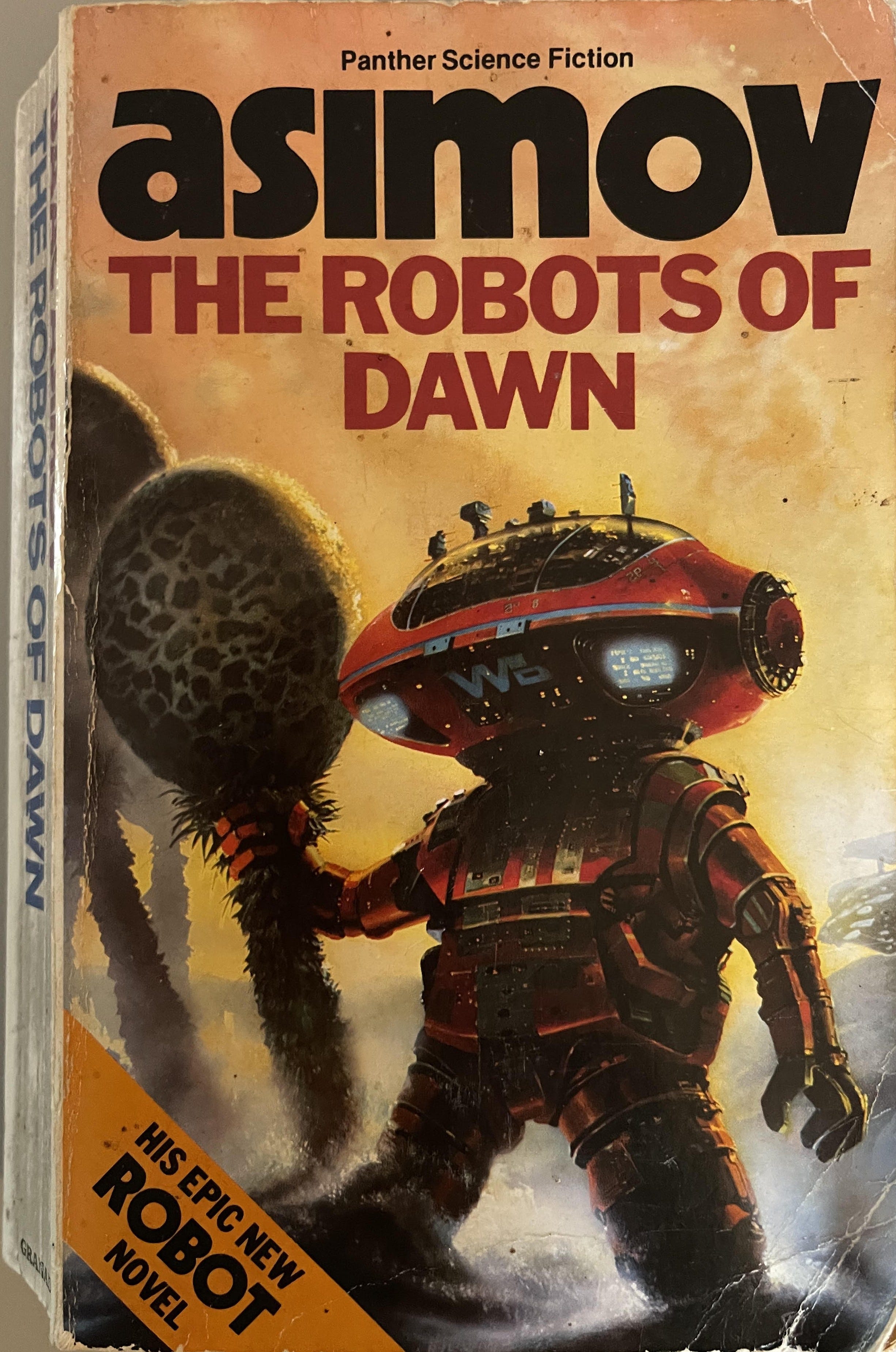
I have just finished reading Isaac Asimov’s book The Robots of Dawn, all 467 pages. It was long and it felt long. It was like a meld of a very slow who dunnit, and a treatise of the Laws of Robotics.
Key in Flight of the Conchords, mostly because they were Kiwis, not because it is a great song! But it is less than 2 minutes long and contains a binary solo! I think I prefer Frank Zappa’s Central Scrutinizer to be fair.
The Robots of Dawn reminded me of long fireside discussions I had with my father as a teenager, before I left home. My father was a very intelligent man. In his autobiography, which I have been reproducing on Substack, “Artist, Writer, Musician, Holocaust Survivor”, he claimed that his IQ was 165 or thereabouts, with a comment, saying “who cares”.
I remember him doing a Mensa test at home before the age of the Internet, which he sent in. He told everyone that Mensa wanted him to join the organisation, but he didn’t want to, because he felt the members would be stuffy, boring people, who would not be in touch with the real world. I felt he was being pretentious. This would put him in the 99.9992nd percentile, meaning it is higher than 99.9992% of the population. He was definitely very intelligent, but not what I would consider genius level.
I felt like he was trying to compete with me, because I had spent 8 full days of IQ testing at a study at Auckland University as a Primary School kid, my IQ was rated at 156. I remember my teacher telling me about this and saying that above 150 any measure was very subjective. What I can say is that I was, and am, very good at pattern recognition, and this has served me very well through a number of careers in industries where I started with very little knowledge, and subsequently thrived. I love learning. I’m like a hungry LLM who can’t stop absorbing information and trying to understand it.
My father couldn’t stand anyone being better or smarter than him, or more able than he was, at anything, and he was incredibly good at many things. He was a big reader of Science Fiction, and we spent hours solving the problems of the world, and imagining the future.
We talked about the Theory of Relativity. We talked about the Big Bang Theory, and if the universe had an end, what was on the other side. We talked cryogenics, space travel, the future of education, computing, music theory, composers, folk music, the history of the slave trade and Apartheid, old civilisations like the Mayans and their calendars, the Romans and the Greeks. You name it, he knew all about it.
He would sit in his chair like he was a guru being interviewed, head cocked on an angle, right hand, self-soothing rubbing his beard, almost in a flow state. He loved an audience, and loved people visiting, so long as they also listened to and agreed with his theories. To be fair I learned a lot from him. Until I didn’t.
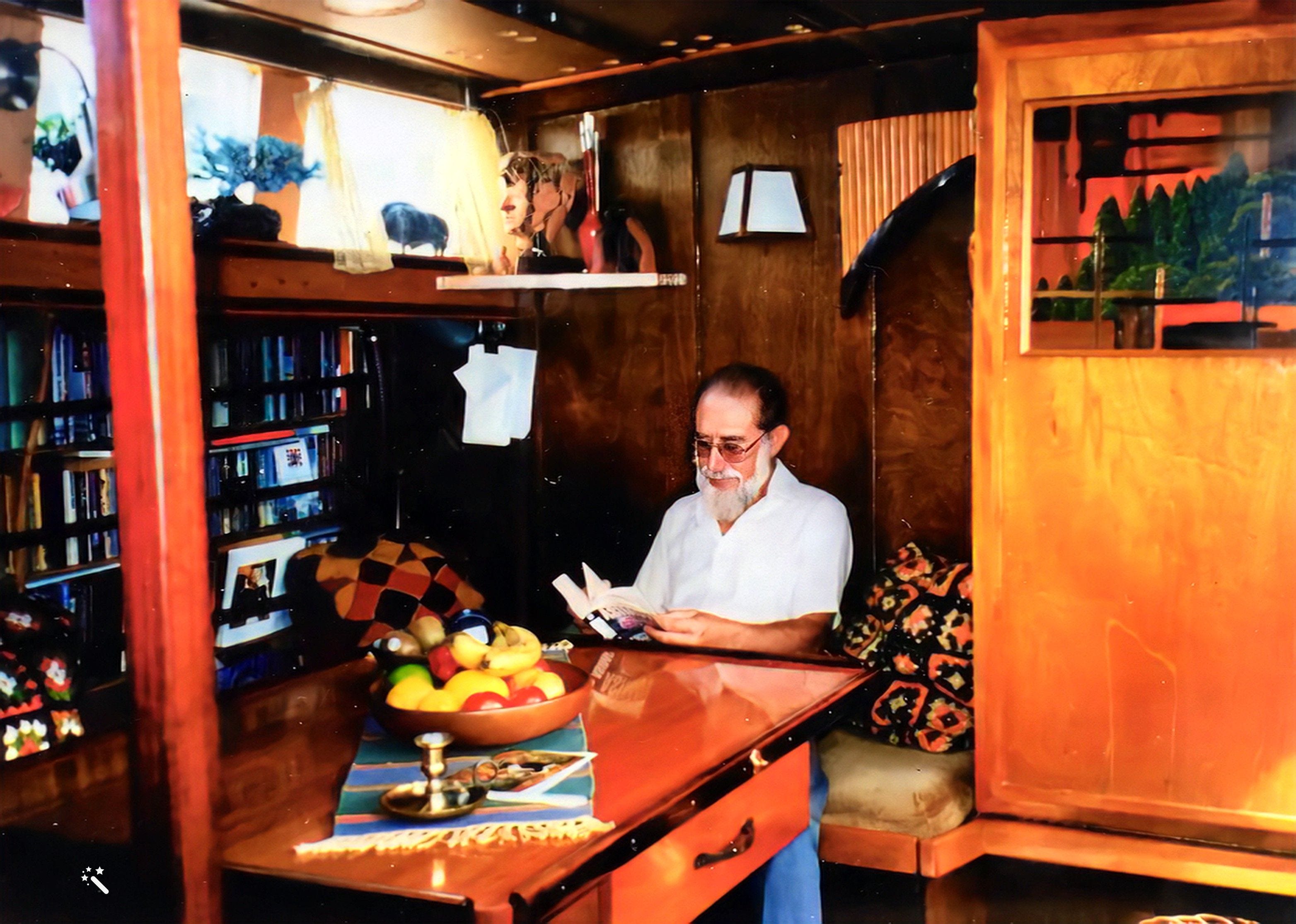
I was also an avid reader, absorbing as much information as I could find. I must have read almost every book he owned, and he had a lot of books. I would listen to radio documentaries and got to a point where my father’s knowledge was peaking and like much in the world, things had changed dramatically since he filled his wetware library. He would tell me something and I would tell him about something I had read that contradicted the theories or knowledge he grew up on. We would debate. We would argue, both knowing we were right, but we couldn’t both be right. For me that was a way of learning, talking through ideas, trying to find answers.
We went from often talking into the night, to him losing interest early in a conversation where I was adding new information, to him eventually not wanting to have the discussions any more at all. On reflection, our discussions weren’t so much a mutual learning, they were more about him telling me how it was, and making sure that I understood, appreciated, and acknowledged his reasoning or knowledge. They were a lot more one-sided than I realised at the time.
Many of the great Science Fiction writers of the 60s and 70s were scientists and hugely intelligent people, and were often using their fiction to warn us of possible futures.
Asimov was one of those, and The Robots of Dawn felt like an ominous warning. In fact I have no doubt it was, but the book felt belaboured. The original 3 laws were:
First Law: A robot may not hurt a human, or let a human get hurt by doing nothing.
Second Law: A robot must follow human orders, unless those orders break the First Law.
Third Law: A robot must protect itself, unless doing so breaks the First or Second Law.
Fast forward to what we are now starting to see with AIs, drones in warfare, cybercrime and cyber-warfare, cameras everywhere and soon to become everyday wearables, facial recognition, AI, disinformation at an unprecedented scale, especially in politics, those laws are clearly redundant.
We were both idealists, but I felt I was more the realist. I knew that nothing like the Laws of Robotics was ever going to be enacted in the future. It was really another inconvenient truth, although Al Gore hadn’t told us about that one yet. My father was convinced they had to, or the future of humanity as we knew it was at risk. Again, on that point, he was probably right, and maybe life is changing at a pace that is highly risky for our civilisation as we know it.
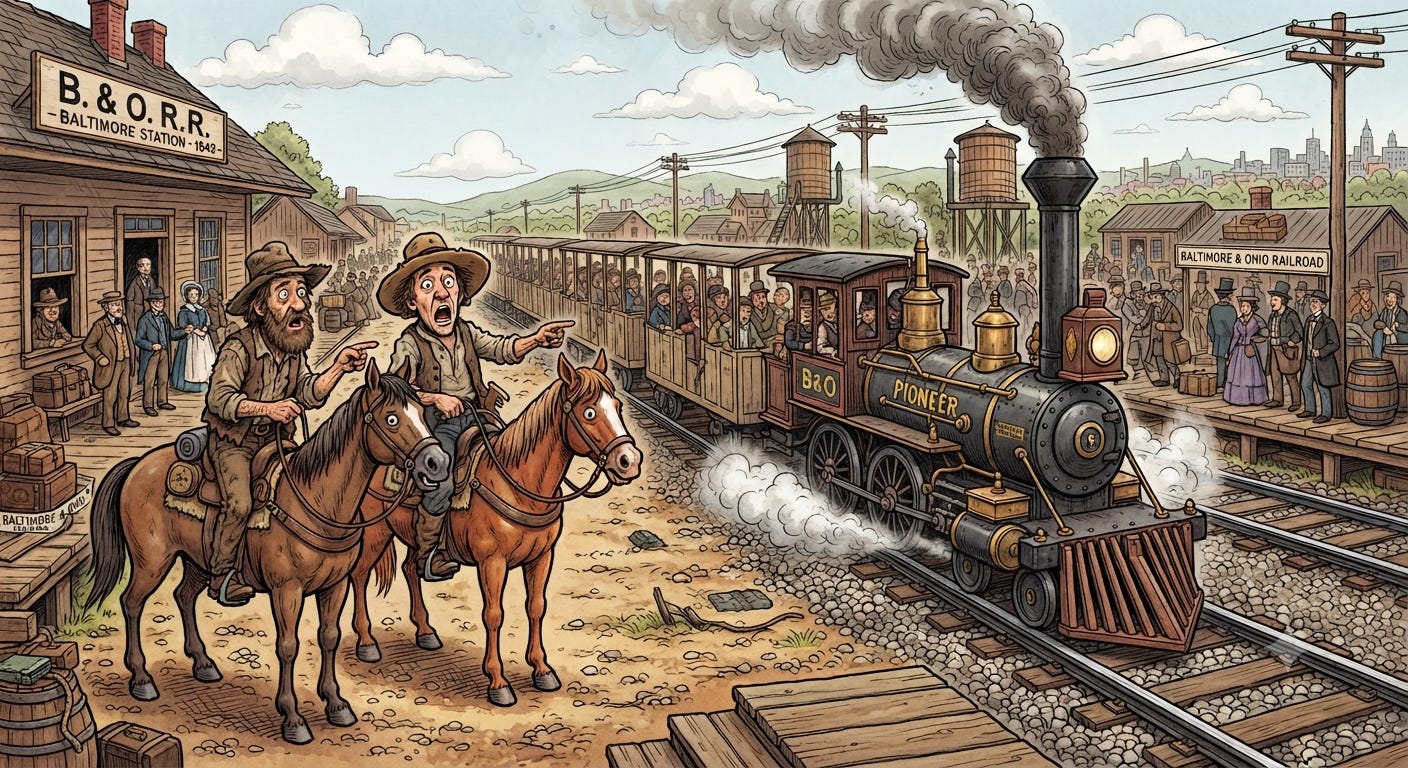
I’m reminded of a story about two men in the USA in the 1800s who see a train for the first time. One said to the other, “They will never get it moving.” Then as it starts speeding up, the other man says, “They will never be able to stop it.”
I have spent most of my career (and still am), looking for ways to make life more meaningful and allow us all to spend our time at the top of Maslow’s Hierarchy of Needs, as was promised to me in Primary School. You may have read my earlier post about “A Blueprint For Survival”.
A lot of my father’s philosophies came from being a Holocaust Survivor. He had little faith in politics, and he only used his computer for email and writing. The thought of AI to him would have been mostly based on the writing of Philip K Dick. I’d have to say that if Philip K Dick was around today, he would be saying a big “I told you so” to the world. I’m sure you know who I mean. If not, think Blade Runner, Total Recall, and Minority Report. He would have said that if anything threatened humanity it would be AI.
As I said, my father was very competitive and as long as he was on ground he felt comfortable on, which was based on 1960s and 1970s SciFi, he was happy and ready to win any argument. But as soon as it got to a point where I might know a little more about technology, he grew tired of the conversations and wanted the conversations to stop.
The same happened when I developed my music skills, especially improvisation and song writing. He hated it when he could no longer beat me at chess. Ironically that only happened because when he walked out on our family, one of the respite homes I was sent to, was the home of a Chess Master.
Do you remember Zager and Evans? I can’t think of a more appropriate song! The song was written in 1964 by Rick Evans in a matter of hours. At the time, Zager and Evans were a struggling Midwestern duo from Nebraska.
Evans was deeply reflective about the rapid pace of technological advancement, automation, and the direction humanity was heading. He crafted the song as a cautionary sci-fi warning about a dystopian future where humanity's over-reliance on technology leads to physical atrophy, chemical dependency, robotic subjugation, and eventual extinction over a 7,000-year span.
It was a one-hit wonder in 1969 where it was number one on the US Billboard Hot 100 for 6 weeks. I remember listening to it on Radio Veronica. This clip was put together by Sanjin Đumišić, based around the song, and the movie Metropolis. Given it has had almost 250,000 views, we might as well watch it too.
It probably sounds like I am often taking pot shots at my father, and sometimes I do, but he had such an enormous impact on my life, and also of my mother, who was totally subjugated by the man. I can’t write about my life without trying to understand his. Nobody was more downtrodden in life than my mother who passed away this year.
In 2022 I wrote this post about my mother, who suddenly became a different person after my father died. At the age of 92, I was having intellectual discussions with my mother until the early hours of the morning. I am so sad that it took so long for her to be able to express herself intellectually. But it was wonderful to experience a rebirth of a very intelligent woman, even so late in life.
No posts
Comments
Nothing yet. Say the first thing.
Sign in to join the conversation.