
At Politico, Megan Messerly and Myah Ward report that Israeli Prime Minister Netanyahu’s Tuesday meeting with US President Donald Trump, their first since the two countries struck Iran together in February, arrived at a fragile moment. Strikes between the US and Iran paused over the weekend amid hopes for a new ceasefire, but Trump kept threatening “massive attacks” if the latest diplomatic push collapsed. Messerly and Ward write that many in Trump’s anti-interventionist base worry Netanyahu could use the visit to push the president toward a more durable phase of war rather than toward peace.
Former White House strategist Steve Bannon told the reporters that Trump’s “most ardent” supporters outside the pro-Israel camp are furious, framing every Netanyahu visit as damaging to “America First” priorities.
The meeting also unfolded amid growing friction between the two leaders. Trump has criticized Netanyahu’s continued campaign against Hezbollah in Lebanon, and Vice President JD Vance has accused Netanyahu’s government of prolonging negotiations with Iran. Curt Mills of the American Conservative magazine called the meeting “DEFCON 1,” arguing that anything short of Trump committing to the pending memorandum of understanding risks further escalation.
A former official told the reporters that Trump increasingly associates Netanyahu with a war that has dragged on for five and a half months without resolution, adding that the president is “pissed off” about being tied to a conflict without a clear end in sight.
Netanyahu, who faces reelection in October and has built his political identity around confronting Iran, entered the meeting carrying more political risk than Trump, according to Elliott Abrams, who served as the US special representative for Iran during Trump’s first term.
Abrams told Messerly and Ward that the stakes are higher for the Israeli leader both because Trump remains the ultimate decision maker and because Netanyahu’s own job, not Trump’s, is on the ballot. Still, some Republicans have expressed hope the sit down could repair strains between the allies.
Republican Jewish Coalition CEO Matt Brooks said Trump has remained resolute that Iran must never obtain a nuclear weapon, even as domestic political costs mount ahead of November’s midterms.
At St. Louis Public Radio, Brian Munoz covers the killings of an Overland, Missouri, couple weeks after immigration enforcement split their family apart and pushed them back toward the poverty and violence they had originally fled. Nixon Giovanni Pérez Paz and Glendy Marisol González de la Cruz were found bound, gagged, and shot in a Guatemalan sugarcane field, their 14-month-old daughter discovered dehydrated and crying beside her mother’s body.
ICE detained Pérez Paz in 2025 while heading to a roofing job with his brother and deported them without a warrant, his brother Rolando said.
Rolando, who is now raising the couple’s three daughters, told the outlet, “I felt that they took the thing I wanted most.”
González de la Cruz self deported to Guatemala with her daughters after financial strain and fear of separation during an active asylum case.
Zachary Mueller, a strategist with States at the Core called the deaths evidence that deportation policy undercuts its own public safety rationale.
Marina Dunbar reports at The Guardian that the Pentagon quietly updated its official Iran war casualty database over the weekend, adding more than 140 wounded troops and creating a new “Overseas Operations” category for casualties starting July 7.
Combined totals now show 18 US troops killed and 624 wounded since the war began in February.
Representative Thomas Massie called the Pentagon’s approach “an absurd ruse” and accused Defense Secretary Pete Hegseth of breaking the law by exceeding the War Powers Act’s 90-day window without congressional authorization.
The Pentagon split the conflict into two phases, arguing an April ceasefire paused the War Powers Act clock before fighting resumed on July 7.
The department’s earlier casualty list omitted four soldiers who died in recent fighting, even though it named them in a separate release announcing their remains.
Lawmakers from both parties have challenged the administration’s timeline interpretation.
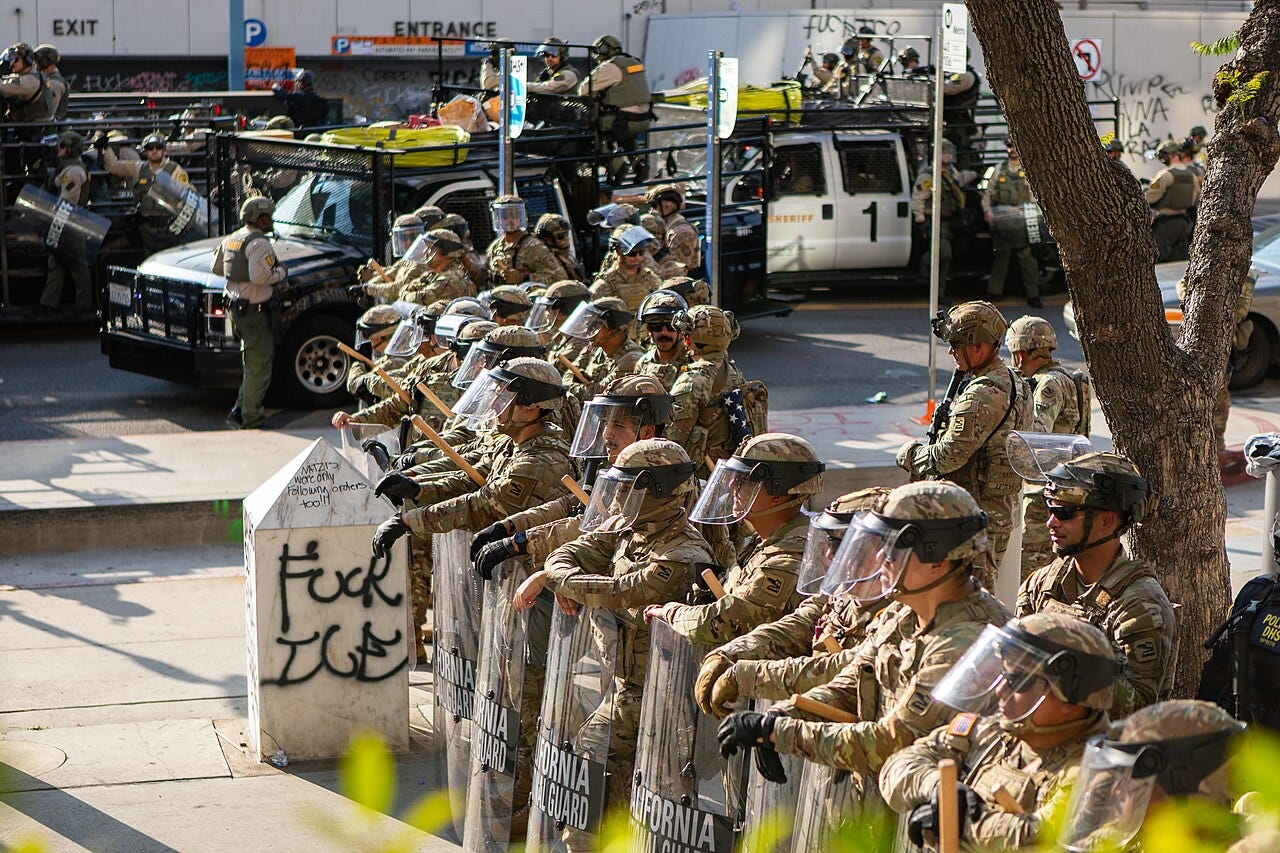
Attorneys for plaintiffs in Vasquez Perdomo v. Mullin have asked a federal court to block the Trump administration from continuing unjustified, racially discriminatory immigration stops across the Central District of California, pointing to a vastly expanded evidentiary record built from months of expedited discovery.
At ACLU of Southern California, Mayra Joachin, deputy director of the group’s immigrants’ rights project, said the filing should “shock the conscience,” arguing that internal government records confirm what affected communities have said all along.
The 40-page motion, filed July 27 in the US District Court for the Central District of California, draws on internal directives, sworn depositions, body worn camera footage, and text messages exchanged among agents. According to the filing, an ICE headquarters email sent in late May 2025 instructed field offices to begin arresting so-called “collaterals,” meaning people who were not the actual targets of investigations, en masse.
Trump reinforced that shift days later, directing federal law enforcement to “take all such action necessary to liberate Los Angeles from the Migrant Invasion.” What followed, the motion argues, was a sustained campaign of stops built not on individualized suspicion but on a demographic profile: people who appeared Latino and low income or working class.
The record describes three overlapping tactics. Under “roving patrols,” agents swept through neighborhoods hunting for “possibles” based on appearance alone, with no claimed enforcement target at all.
Under so-called “targeted area” operations, teams scouted locations like Home Depots and car washes, ran identity checks until they found a handful of possibly undocumented people, then raided the location on a chosen day regardless of whether the people they had identified were even present.
And in operations where defendants were simply labeled “targeted,” officers used a supposed target as pretext to question and detain other Latino bystanders nearby, including at a Pasadena bus stop where agents ambushed named plaintiffs who had no connection to any investigation.
Sworn testimony captured how central race was to these decisions. One Border Patrol supervisor, asked whether apparent Hispanic ethnicity factored into which stops officers made, said he would still consider it “one articulable fact,” even after acknowledging that most Hispanic people in the district were lawfully present.
Body camera footage and recovered text messages showed agents referring to people they targeted using slurs, including one instance in which an agent told a colleague to “plug us in wherever you see some tonks,” a term tied to the sound of a flashlight striking someone’s head. Other messages used a derogatory term for undocumented immigrants to describe people based solely on how they looked.
Officers repeatedly described their targets as “day laborers,” and referred to them as “wet” in bodycam footage, but the filing argues that term functions as shorthand for low-income Latino workers rather than any coherent occupational category. One lead officer, asked to describe the appearance he looked for, answered simply, “Older Hispanic males.”
The same officer testified he did not call people “day laborers” at all, saying instead: “I call them illegal aliens.” The record also documents a pattern in which agents stopped Latino customers or workers at a location while leaving light-skinned coworkers untouched nearby, evidence plaintiffs say undercuts any claim that officers were relying on neutral, work-related cues rather than race itself.
The filing details the toll these stops have taken on individuals who have been swept up despite lawful status, including several US citizens. One plaintiff, a Latino US citizen named Angel Santiago Tafolla, was stopped at gunpoint and later said the experience left him unable to sleep for a week. Another described losing confidence that citizenship offered any protection at all.
Attorneys argue that defendants’ stops violated both the Fourth Amendment’s protection against unreasonable seizures and the Fifth Amendment’s equal protection guarantee, noting that courts have long held that broad demographic characteristics cannot substitute for individualized suspicion.
Plaintiffs have asked the court to bar agents from stopping or detaining people based on apparent low-income Latino status without a prior, individualized basis to suspect unlawful presence, and to impose documentation requirements to enforce compliance.
A hearing on the motion is scheduled for Sept. 24 before US District Judge Maame Ewusi-Mensah Frimpong. The case follows a 2025 lawsuit brought by individual Latino workers alongside CHIRLA, the Los Angeles Worker Center Network, and the United Farm Workers, after a federal judge’s initial restraining order was stayed by the Supreme Court without explanation last August, allowing the challenged practices to continue while litigation proceeded.
At Inkstick, Tyler Hicks reports that white nationalist ideology has moved from the fringe into the center of the Trump administration’s policy. Hicks documents how figures like Border Patrol commander Greg Bovino attended a “remigration” summit in Portugal, while Stephen Miller pushed the Great Replacement theory to justify ending birthright citizenship. Extremism researcher Kris Goldsmith told Hicks that “there is no daylight between how the extreme far right and the Trump administration talk about immigration.” Journalist Christopher Mathias traced the mainstreaming of “remigration” from neo-Nazi chats to an official State Department office, calling it “an obvious euphemism for ethnic cleansing.”
Also at Inkstick, five foreign policy scholars examine whether US security assistance actually buys influence abroad. Georgetown’s Renanah Joyce warns that policymakers fall into a “substitution trap,” mistaking relationships with partner militaries for real policy leverage. Stimson Center fellow Elias Yousif argues that Trump’s counterterror strategy in Latin America has revived the failures of the Global War on Terror. Rachel Stohl challenges the claim that Russia or China could easily replace US arms suppliers, while Gil Barndollar notes training missions still offer valuable intelligence on partner forces even when they fail to build capacity.
At The World, Joshua Coe documents Latvia’s mandatory national defense training, where teenagers spend summer weeks learning combat tactics, first aid, and weapons handling at military bases outside Riga. Some 18-year-olds fire live rounds from Heckler and Koch G36 rifles, while younger trainees practiced with airsoft replicas during patrol base exercises in the forest. The program built on lessons already required during the school year and comes as Latvia has restored conscription and raised defense spending toward 5% of GDP. Foreign Minister Baiba Braže told Coe that Russia was “testing various means in various countries” across the Baltics.
If you want to support our nonprofit journalism, there are several ways, but one we suggest today is snagging yourself some of the snazzy Inkstick swag available for purchase at our merch store. If that’s not your style, don’t worry: We accept one-time donations and recurring monthly support year-round.
Critical State is written by Inkstick Media in collaboration with The World.
The World is a weekday public radio show and podcast on global issues, news, and insights from PRX and GBH.
Inkstick Media reports on how security decisions shape everyday life, following the money, power, and consequences of war.
Critical State is made possible in part by the Carnegie Corporation of New York.
Comments
Nothing yet. Say the first thing.
Sign in to join the conversation.