
At Mother Jones, Dan Friedman, Will Sytsma, and Nick Schwellenbach have co-authored an investigation into William Walters, whose firm Salus Worldwide Solutions holds the Trump administration’s exclusive contract to run its “self-deportation” program. The contract, worth up to $915 million, pays Salus to sign up detained immigrants for voluntary departure, buy them plane tickets, and process exit payments as part of the White House’s Project Homecoming initiative.
Walters has accused rival contractors of trying to destroy his business for profit.
Walters argues that private prison giant GEO Group and deportation flight contractor CSI Aviation stood to lose money if migrants left voluntarily rather than sitting in detention awaiting forced removal, writing that the companies “stand to profit the most from longer detention and custodial deportation.”
Walters has also claimed these companies “‘engineered’ congressional or media scrutiny of Salus,” though he has not provided proof.
The reporters detail how Salus won its contract through a process a DHS official had internally described as creating an appearance of favoritism toward the company, which prompted a lawsuit from CSI Aviation that a judge rejected in May.
DHS nonetheless announced a new competition for the work in July. Attorneys for detainees said Salus representatives have approached migrants inside ICE facilities with self-deportation paperwork, sometimes only in English, and argued the choice amounts to coercion in such detention conditions.
GEO and CSI maintain close ties to the administration, including a former GEO executive now leading ICE and a former GEO consultant serving as White House border czar.
The Mother Jones reporters also link CSI to a pending class action brought by Venezuelans deported to El Salvador’s CECOT prison, which alleges a no-bid contract modification was timed to enable those removals. DHS continued pressuring migrants regardless, warning in a July release that those who failed to leave voluntarily would face fines, arrest, and deportation.
Reuters reports on a State Department presentation at the AIDS 2026 conference in Rio de Janeiro that displayed a map of Africa in which every labeled country appeared in the wrong place.
The map reportedly showed coastal Nigeria as landlocked in the Sahara, relocated Mozambique from the southeast to the Horn of Africa, and set Ivory Coast on the opposite side of the continent.
Reuters found that the image carried a watermark indicating it had been generated with OpenAI tools, and officials from several of the mislabeled countries were present when the slide was shown.
Atlantic Council analyst Matt Petit wrote that whoever approved the slide “did not care to check their work.”
The State Department said a staffer hastily altered the slide deck just before the presentation and that it took “full responsibility” for the confusion caused.
At The Atlantic, Phillips Payson O’Brien argues that the US war with Iran has exposed a dangerous armaments shortfall that threatens Washington’s credibility with allies who depend on US weapons.
O’Brien reports that the US has used up two thirds of its Patriot missile interceptors, more than a third of its THAAD interceptors, and a third or more of its prewar Tomahawk cruise missile stock since fighting began in late February.
He writes that expensive systems like Patriot PAC-3 missiles, which cost millions of dollars apiece, have been used to shoot down Iranian drones that could be built for about $30,000.
O’Brien attributes the shortfall to three decades of bipartisan neglect of the US military-industrial base, warning that for Gulf partners and other allies dependent on US weapons, “the perils of such assumptions are becoming apparent.”
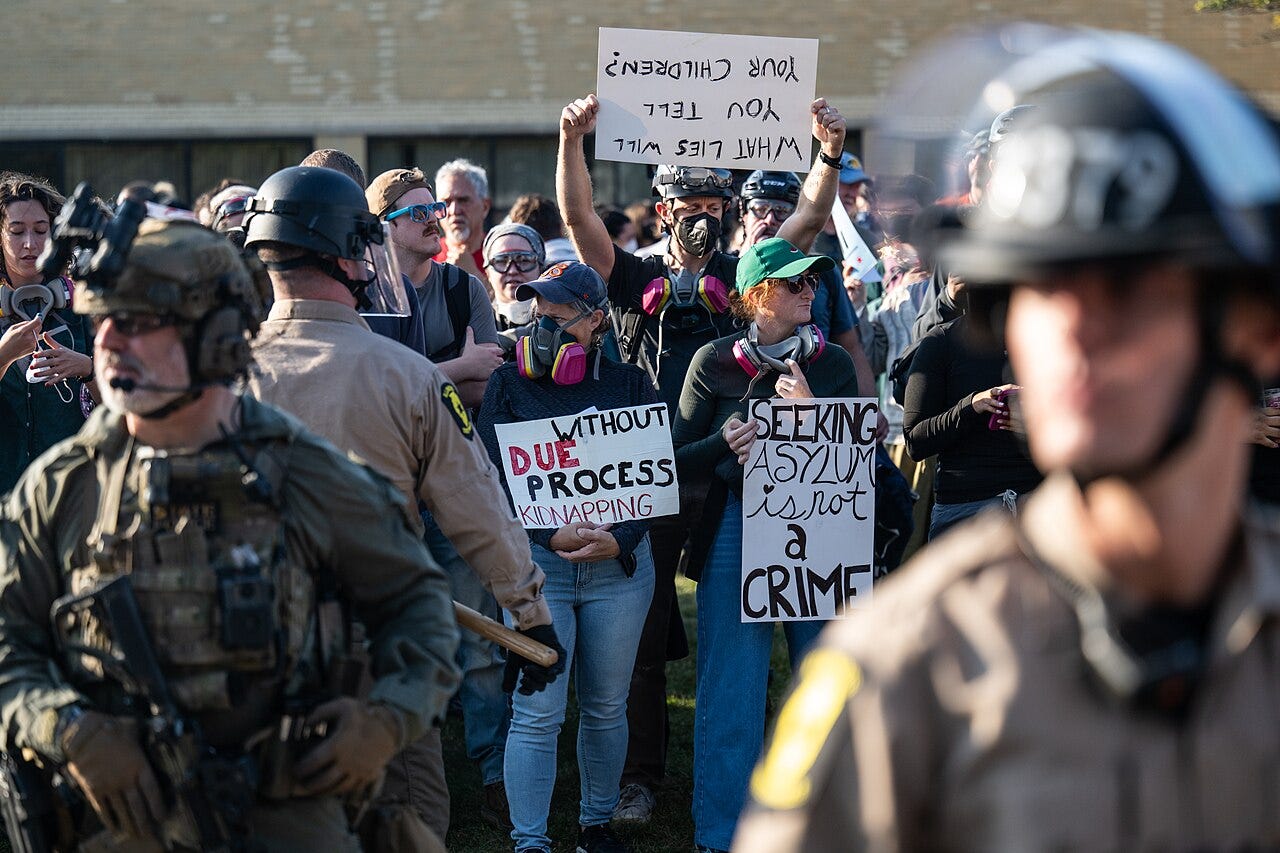
At least 52 people died in ICE custody in the 500 days between President Donald Trump’s second inauguration and June 4, 2026, according to a new report from Human Rights Watch and Physicians for Human Rights. The mortality rate over that period had more than doubled since Trump’s second term began, reaching nearly four times the rate under the Biden administration and more than two and a half times the rate during Trump’s first term, a period that includes the deadliest months of the Covid-19 pandemic.
The report has found that the surge in deaths outpaced the growth of the detained population itself. Between January 2025 and January 2026, the number of people in ICE custody rose by 77%, while annual deaths more than tripled, producing a 138% jump in the mortality rate. Researchers used a statistical smoothing method to filter out month-to-month noise and found that the underlying death rate had climbed to 8.4 per 10,000 detainees by June 2026, nearly double the peak trend level recorded during the first year of the pandemic. The gap was large enough to be statistically significant on its own terms, meaning the current sustained rate exceeded even the worst confirmed period of the Covid-19 era.
Physicians for Human Rights has reviewed the medical documentation ICE made public for the 39 deaths recorded during the administration’s first year and has concluded the records themselves to be part of the problem. Detainee Death Reports frequently omitted exact vital sign measurements, left unclear whether requested medical visits ever occurred, and failed to specify what treatment, if any, had been given before someone died. ICE’s own policy requires initial death notices within 48 hours and fuller reports within 30 days, but researchers found 64% of notices were posted late, and one report did not appear until a full year after the death it described.
Four case studies illustrate what the sparse records obscure. Maksym Chernyak, a 44-year-old Ukrainian man, suffered what doctors later diagnosed as a hemorrhagic stroke at the Krome North Service Processing Center in Florida. More than four and a half hours passed between an initial emergency call and his arrival at a hospital emergency room, and staff documented his pupils as nonreactive, a classic warning sign of brain herniation, without escalating his care. His medical records revealed elevated blood pressure at earlier clinic visits that had gone untreated. Reviewers say that the delay in calling 911 “almost certainly” contributed to his death.
Santos Banegas Reyes, a 42-year-old Honduran man, died 17 hours after arriving at the Nassau County Correctional Center in New York, where he had been flagged during intake for symptoms of alcohol withdrawal and prescribed medication but was not checked on again until he was found unresponsive the next morning. His attorney said the nearly 17-hour gap in monitoring was “inexcusable” given the severity of his condition.
Ismael Ayala-Uribe, a 39-year-old Mexican man held at the Adelanto ICE Processing Center in California, made repeated complaints about a growing abscess that staff treated with pain medication and ointment rather than a physical exam, and died of septic shock before reaching surgery.
Serawit Gezahegn Dejene, a 45-year-old Ethiopian man, sought care four times for back pain before an emergency room scan revealed what intake screening had missed entirely, a cluster of untreated infections including HIV that had progressed to AIDS.
The report ties the rise in deaths to both longstanding problems and changes specific to the current administration. Chronic understaffing, overcrowding, and weak reporting requirements predate Trump’s return to office, but researchers say that most of the 39 deaths occurred in facilities where the population in the two weeks beforehand had been far above historical norms, and that the administration had also dismantled oversight offices within the Department of Homeland Security that previously investigated in custody deaths. Seven of the 39 people died by apparent suicide, compared with one reported suicide in all of 2024, a shift researchers link to inadequate mental health screening and follow-up care.
Human Rights Watch and Physicians for Human Rights sent their findings to DHS Secretary Kristi Noem in January and to her successor, Markwayne Mullin, in May, along with questions for GEO Group, CoreCivic, Acentra Health, and Akima Global Services, the contractors that operate many of the facilities where deaths occurred. Only Acentra Health responded.
Acentra Health said that “we have not assessed whether delays or gaps in claims processing may affect the quality or continuity of health care provided to individuals in ICE custody. We are not contracted to assess quality or continuity of care, nor have we received any detainee data that might be used for such an assessment.”
The report calls on Congress to withhold funding for further detention expansion and to create an independent medical oversight body with authority to investigate deaths, inspect facilities, and enforce compliance. Without such changes, it warns, the current death rate is likely to continue.
At Inkstick, Mat Nashed reports from Tyre and Nabatieh on residents of south Lebanon living under the threat of renewed Israeli occupation. Nashed follows sisters Nadia and Marvet Arnaout, who have returned to their bombed apartment despite the danger, and Taleen Yassine, whose family has fled three times in two years. Nadia told Nashed, “Tyre will always be my home and my city.” The piece details how Israel’s campaign, launched in March alongside the wider war on Iran, displaced roughly 1.2 million people and killed medics and civilians even after two ceasefires, leaving many convinced that the current relative calm will not hold.
Joseph Stabile reviews Augusta Dell’Omo’s new book Saving Apartheid, which traces a decades-long transatlantic movement of activists, lawmakers, and everyday Americans who defended white minority rule in South Africa. Stabile connects that history directly to Trump’s own conspiratorial fixation on the country, noting that officials in his orbit had long promoted “white genocide” myths. He writes that Dell’Omo situates figures like Pat Buchanan and Peter Brimelow within a broader far right network that outlasted apartheid itself, one where movements alternate between mobilizing supporters and working to demobilize their opponents through borrowed human rights language.
At The World, Kori Suzuki traces how a century of US immigration law has shaped San Diego’s Filipino community, now the largest Asian American population in the country. Suzuki reports that Congress denied Filipinos citizenship after annexing the Philippines in 1898, later using the promise of independence in the 1934 Tydings-McDuffie Act to cut off immigration entirely. Historian Rick Baldoz told Suzuki that nativist lawmakers pursued Philippine independence as “really the only way” to stop Filipino migration. Suzuki finds a throughline from that history to current rhetoric from the Trump administration, which Baldoz said echoes the racist framing used against Filipinos a century ago.
If you want to support our nonprofit journalism, there are several ways, but one we suggest today is snagging yourself some of the snazzy Inkstick swag available for purchase at our merch store. If that’s not your style, don’t worry: We accept one-time donations and recurring monthly support year-round.
Critical State is written by Inkstick Media in collaboration with The World.
The World is a weekday public radio show and podcast on global issues, news, and insights from PRX and GBH.
Inkstick Media reports on how security decisions shape everyday life, following the money, power, and consequences of war.
Critical State is made possible in part by the Carnegie Corporation of New York.
Comments
Nothing yet. Say the first thing.
Sign in to join the conversation.