
A calm index with a live options market
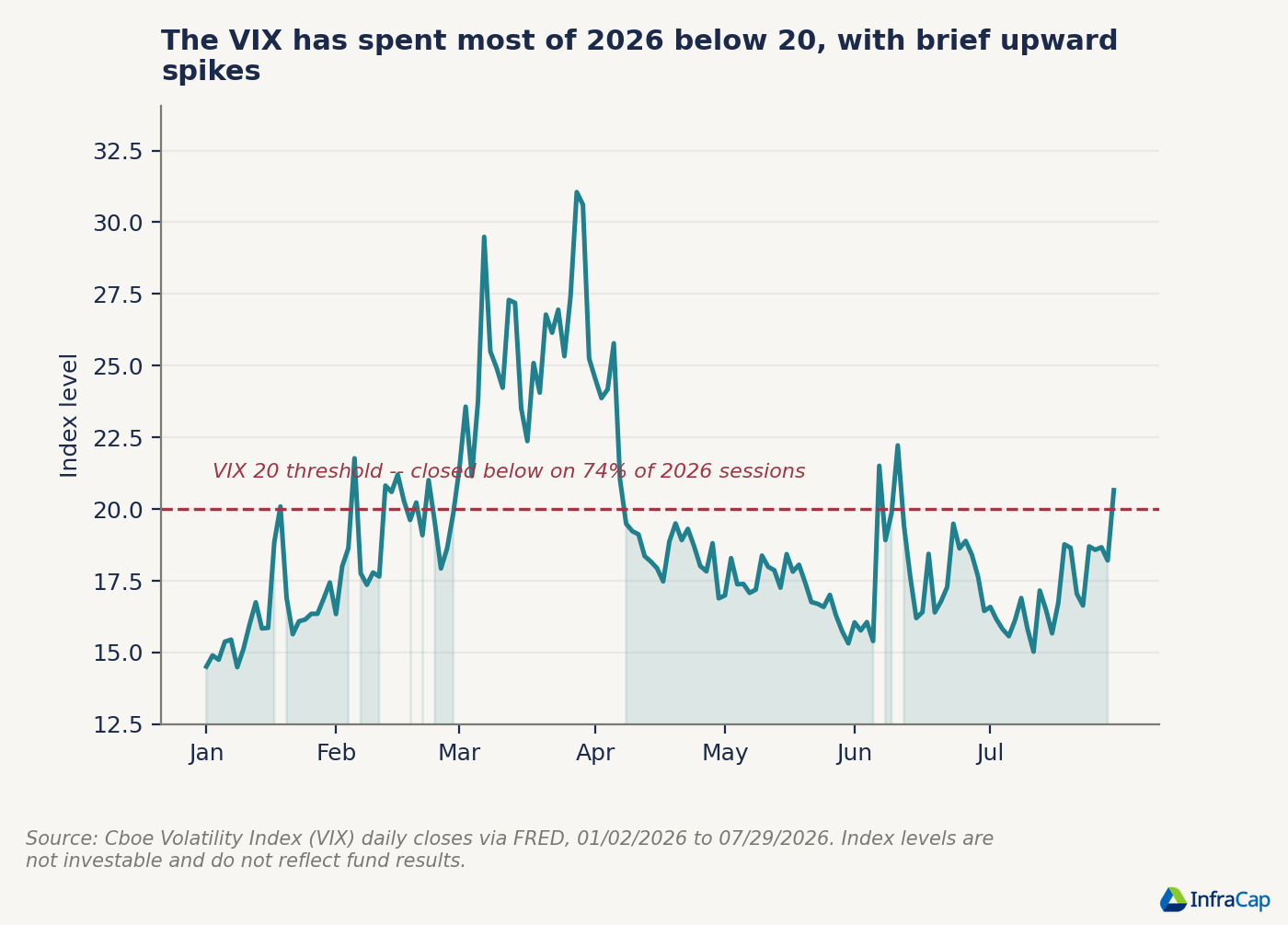
The Cboe Volatility Index (VIX) averaged 19.0 across the first seven months of 2026 and closed below 20 on 110 of 148 sessions.[1] The headline level suggests a quiet tape.
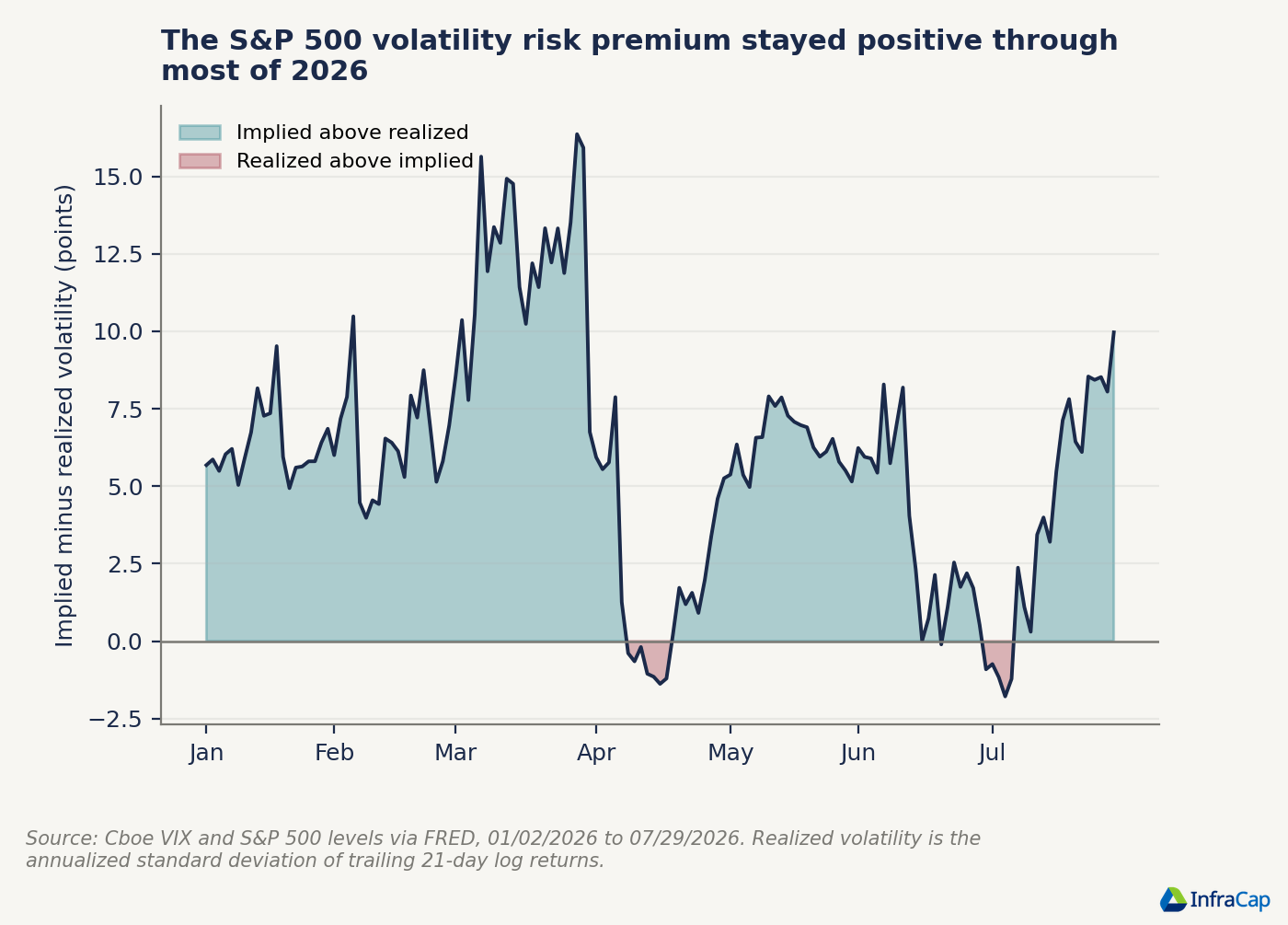
The volatility risk premium describes a different condition. Implied volatility on the S&P 500 exceeded trailing 21-day realized volatility by an average of 5.9 points during 2026, and the spread remained positive on 130 of 143 sessions.[1][2] Premium stayed available even while the headline measure of expected volatility sat below its long-run norm.
Both conditions hold at once because an index-level volatility measure captures the aggregate rather than the components. Offsetting moves among constituents suppress index volatility while individual positions still travel far enough to make single-name call writing worthwhile.
When the writer collects and when the writer pays
A covered-call position converts uncertain future upside into cash received today. The exchange favors the seller when realized volatility lands below the implied volatility embedded in the option premium, which described most of 2026.[1][2]
The exchange turns against the seller during fast rallies from oversold levels. April 2026 illustrates the case. The average implied-minus-realized spread on the S&P 500 narrowed to roughly 2.0 points for that month and turned negative on seven consecutive sessions in mid-April.[1][2] A writer holding short calls through that move surrenders the recovery on the written portion of the book.
Timing and sizing therefore matter more than the average spread. A mandate that writes on a fixed calendar at a fixed strike distance accepts whatever the market offers on the scheduled date. A mandate that varies coverage ratio, strike distance and expiry by position retains the ability to write less when premium is thin and to leave upside uncapped after a drawdown.
What discretion looks like in the portfolio
ICAP writes options selectively against individual holdings rather than systematically against the entire portfolio, and the fund employs modest leverage typically in a 15 percent to 30 percent range.[3] ICAP held roughly $115 million in net assets at a $28.14 net asset value in mid-July 2026, and distributed $0.250 per share for the most recent monthly declaration.[3][4]
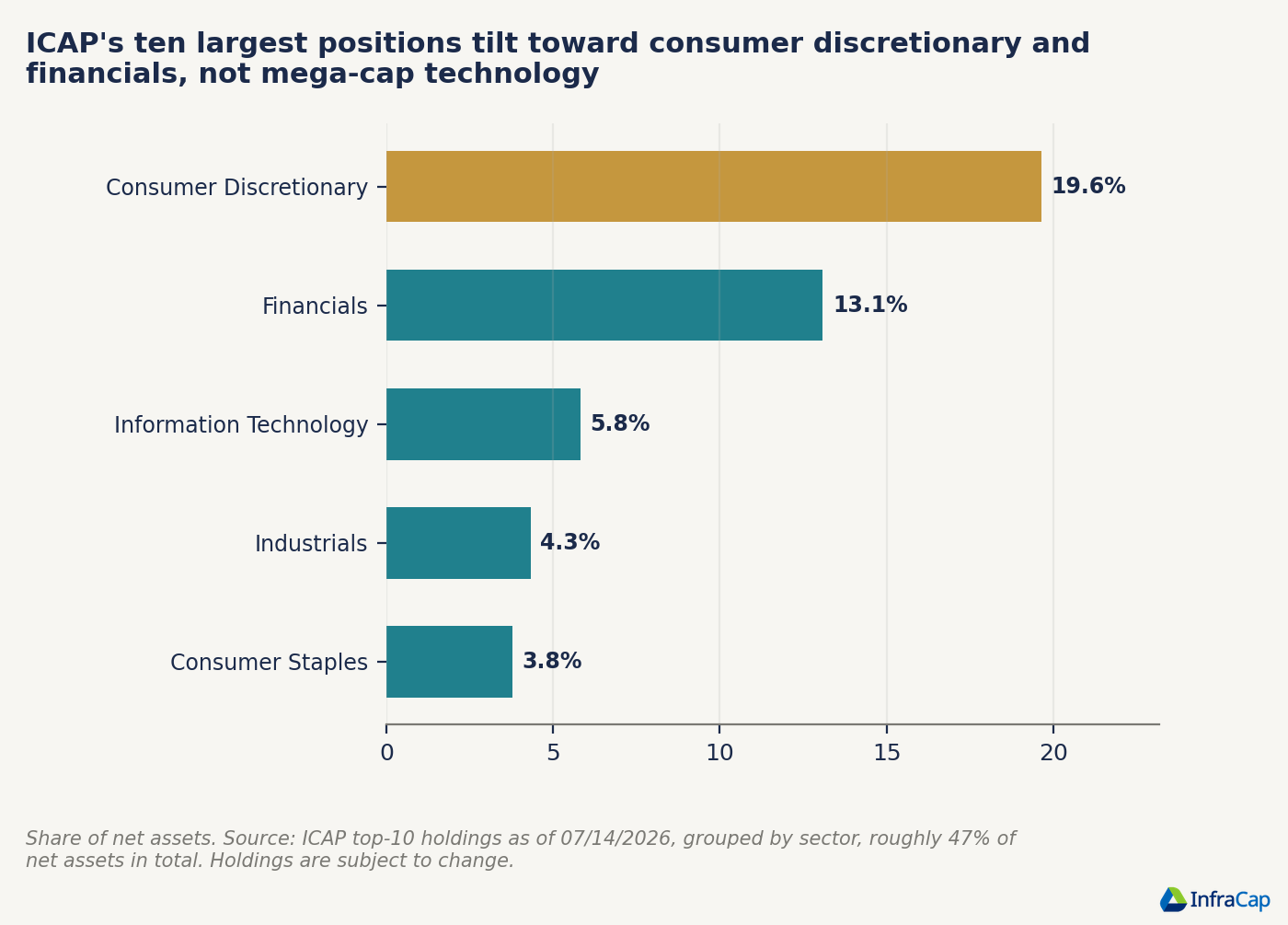
Holdings depart from a market-capitalization replica. Consumer discretionary positions accounted for close to 19.6 percent of net assets across the ten largest holdings, financials for roughly 13.1 percent, and a single information-technology position for roughly 5.8 percent.[3] Homebuilders and banks occupy the space that a passive large-cap buy-write index fills with the largest technology constituents.
That tilt carries its own risk. Concentration in housing and financials links the sleeve to the rate cycle more tightly than the broad index does, and leverage magnifies the outcome in both directions.
Two questions follow for anyone sizing a covered-call allocation. The first asks whether the current premium adequately compensates for the upside surrendered. The second asks who decides when the answer is no.
Past performance is not indicative of future results. Fund holdings are subject to change at any time and should not be considered a recommendation to buy or sell any security. Click here for the fund’s Top Ten Holdings https://www.infracapfund.com/ICAP.
Notes
1. Cboe Global Markets, Volatility Index (VIX) daily closes, retrieved via Federal Reserve Bank of St. Louis, FRED, July 29, 2026.
2. S&P 500 index daily closes, retrieved via Federal Reserve Bank of St. Louis, FRED, July 29, 2026.
3. ICAP fund fact sheet, fund data as of June 30, 2026, and holdings as of July 14, 2026.
4. Fund adviser, monthly distribution announcement, Substack, July 30, 2026.
Please see the “Indices / Performance Terminology Used” below for additional information regarding indices. *The Cboe Volatility Index (VIX) is a real-time market index that measures the expected 30-day volatility of the S&P 500 index. Created by Cboe (the Chicago Board Options Exchange), it is widely known as the market’s “fear gauge” or “fear index” because it reflects investor anxiety, stress, and uncertainty. A coverage ratio is a financial metric used in fund management and credit analysis to measure a portfolio company’s ability to service its debt and pay fixed obligations. Portfolio managers use it to evaluate credit risk, assess solvency, and decide if a business generates enough cash flow to support its financial commitments. Option Strike Distance: Option strike distance refers to either the strike width (the fixed dollar interval between sequential strike prices on an option chain) or the moneyness distance (how far a specific strike price is from the underlying asset’s current market price).
About Us
Infrastructure Capital Advisors LLC is a SEC-registered investment adviser based in New York. The firm offers an ETF suite covering bond income, small-cap income, equity income, MLPs, preferred stock, and REIT preferreds. Funds: BNDS (Infrastructure Capital Bond Income ETF); SCAP (InfraCap Small Cap Income ETF); ICAP (InfraCap Equity Income Fund ETF); AMZA (InfraCap MLP ETF); PFFA (Virtus InfraCap U.S. Preferred Stock ETF); PFFR (InfraCap REIT Preferred ETF). For more information visit www.infracapfunds.com.
DISCLOSURE
This information is not an offer to sell, or solicitation of an offer to buy any investment product, security, or services offered by Jay Hatfield, or Infrastructure Capital Advisors, LLC, (”ICA”) or its affiliates. ICA, will only conduct such solicitation of an offer to buy any investment product or service offered by ICA, if at all, by (1) purported definitive documentation (which will include disclosures relating to investment objective, policies, risk factors, fees, tax implications and relevant qualifications), (2) to qualified participants, if applicable, and (3) only in those jurisdictions where permitted by law. Jay Hatfield or ICA may have a beneficial long or short position in securities discussed either through stock ownership, options, or other derivatives; nonetheless, under no circumstances does any article or interview represent a recommendation to buy or sell these securities. This discussion is intended to provide insight into stocks and the market for entertainment and information purposes only and is not a solicitation of any kind. ICA buys and sells securities on behalf of its fund investors and may do so, before and after any particular article herein is published, with respect to the securities discussed in any article posted. ICA’s appraisal of a company (price target) is only one factor that affects its decision whether to buy or sell shares in that company. Other factors might include, but are not limited to, the presence of mandatory limits on individual positions, decisions regarding portfolio exposures, and general market conditions and liquidity needs. As such, there may not always be consistency between the views expressed here and ICA’s trading or holdings on behalf of its fund investors. There may be conflicts between the content posted or discussed and the interests of ICA. Please reach out to the ICA for more information. Investors should make their own decisions regarding any investments mentioned, and their prospects based on such investors’ own review of publicly available information and should not rely on the information contained herein. ICA nor any of its affiliates accepts any liability whatsoever for any direct or consequential loss howsoever arising, directly or indirectly, from any use of the information contained herein. We have not sought, nor have we received, permission from any third-party to include their information in this article. Certain information contained in this document constitutes “forward-looking statements,” which can be identified by the use of forward-looking terminology such as “may,” “will,” “should,” “expect,” “anticipate,” “project,” “estimate,” “intend,” “continue” or “believe” or the negatives thereof or other variations thereon or other comparable terminology. Due to various risks and uncertainties, actual events or results may differ materially from those reflected or contemplated in such forward-looking statements.
This material must be preceded or accompanied by a prospectus. The information contained herein represents our subjective belief and opinions and should not be construed as investment, tax, legal, or financial advice. For a prospectus with this and other information about the Funds, please visit www.infracapfunds.com. Investors should consider the investment objectives, risks, charges, and expenses carefully before investing. Please read the prospectus carefully before investing. For more information about the Funds, Fund strategies or Infrastructure Capital, please reach out to Craig Starr at 212-763-8336 (Craig.Starr@icmllc.com). The Funds are distributed either by Quasar Distributors, LLC or by VP Distributors, LLC, an affiliate of Virtus ETF Advisers, LLC. ICAP, SCAP, and BNDS ETFs are distributed by Quasar Distributors LLC. PFFA, PFFR, and AMZA ETFs are distributed by VP Distributors, LLC an affiliated of Virtus ETF Advisers, LLC.
Investors should consider the investment objectives, risks, charges, and expenses carefully before investing. For a prospectus with this and other information about the Fund, please click here. Please read the prospectus carefully before investing. For more information about the Fund, Fund strategies or Infrastructure Capital, please reach out to Craig Starr at 212-763-8336 (Craig.Starr@icmllc.com).
A word about ICAP Risk: Investing involves risk, including possible loss of principal. An investment in the Fund may be subject to risks which include, among others, investing in equities securities, dividend paying securities, utilities, preferred stocks, leverage, short sales, small-, mid- and large- capitalization companies, real estate investment trusts, master limited partnerships, foreign investments and emerging, debt securities, depositary receipts, market events, operational, high portfolio turnover, trading issues, options, active management, fund shares trading, premium/discount risk and liquidity of fund shares, which may make these investments volatile in price. Foreign investments are subject to risks, which include changes in economic and political conditions, foreign currency fluctuations, changes in foreign regulations, and changes in currency exchange rates which may negatively impact the Fund’s returns. Small and Medium-capitalization companies, foreign investments, options, leverage, short sales, and high yielding equity and debt securities may be subject to elevated risks. The Fund is a recently organized investment company with no operating history. Please see prospectus for discussion of risks. Derivatives Risk: Derivatives are investments whose value depends on (or is derived from) the value of an underlying instrument, such as a security, asset, reference rate, or index. Derivatives may be riskier than other types of investments because they may be more sensitive to changes in economic or market conditions than other types of investments and could result in losses that significantly exceed the Fund’s original investment. Options Risk: Options transactions involve special risks that may make it difficult or impossible to close a position when the Fund desires. The Fund may sell call options on securities it holds (covered calls) or on securities it does not hold (uncovered or naked calls). The use of options may subject the Fund’s investment performance to the lower of the call price or market price of the security, the requirement that the Fund continue to hold the underlying security during periods that may be disadvantageous, or to deliver the underlying security or its equivalent in cash at a price that is disadvantageous to the Fund.
ICAP fund distributor, Quasar Distributors, LLC.
Comments
Nothing yet. Say the first thing.
Sign in to join the conversation.