
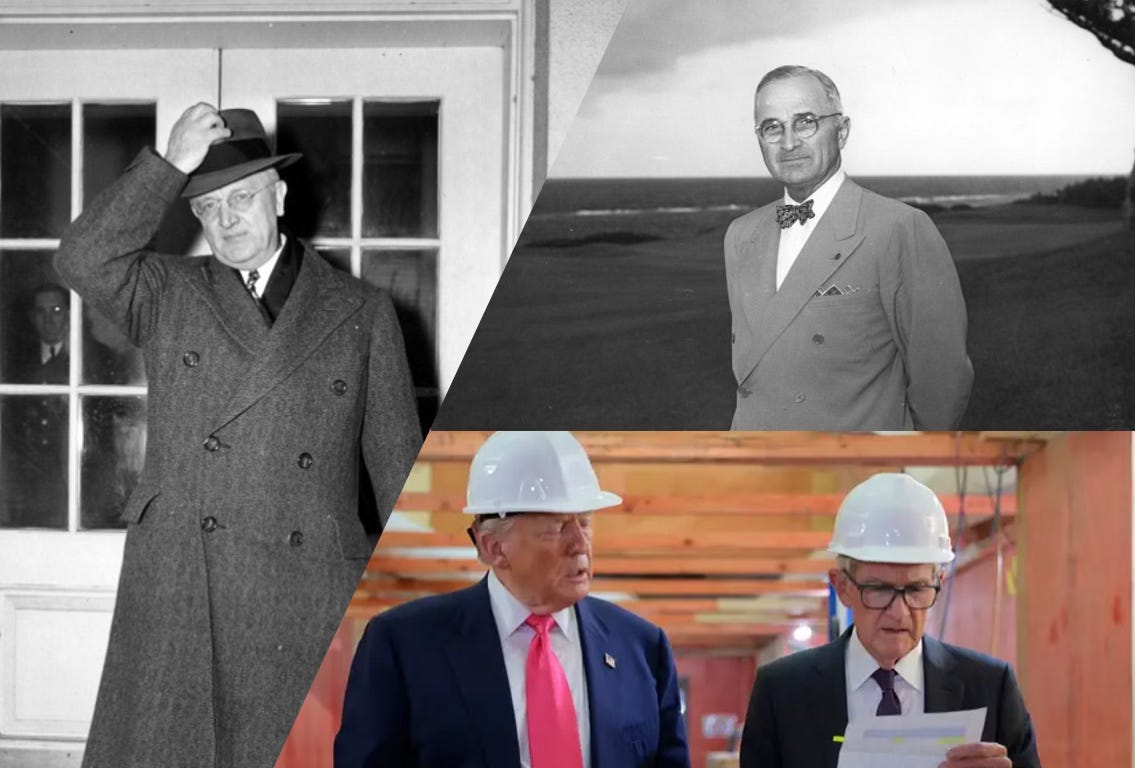
From the Shores of Lake NATO, 13 December 2025
By Axel L. Jacob
‘Trump said he thought the next Fed chair should consult with him on where to set interest rates. “Typically, that’s not done anymore. It used to be done routinely. It should be done,” Trump said. “It doesn’t mean—I don’t think he should do exactly what we say. But certainly we’re—I’m a smart voice and should be listened to.”’
‘Asked where he wants interest rates to be a year from now, Trump said, “1% and maybe lower than that.” He said rate cuts would help the U.S. Treasury reduce the costs of financing $30 trillion in government debt.’
‘During a 45-minute meeting with Warsh on Wednesday at the White House, the president pressed Warsh on whether he could trust him to support interest-rate cuts... Trump, in the Journal interview, confirmed that reporting.’
— The Wall Street Journal, 12 December 2025
The statements reproduced above are not the private grumblings of a frustrated executive. They are the publicly declared intentions of a sitting President, delivered to The Wall Street Journal in a formal interview, concerning his criteria for selecting the next Chairman of the Federal Reserve.[1] Jerome Powell’s term expires in May 2026. The selection process is underway. The candidates—Kevin Warsh, Kevin Hassett, and others—are being vetted. And the President has now made explicit the basis upon which that vetting is occurring: willingness to subordinate monetary policy to presidential preference and Treasury financing requirements.[2]
This is not ‘jawboning’—the traditional, if regrettable, practice of presidents publicly urging the Fed toward their preferred policy. Jawboning is rhetorical pressure applied to an independent institution. What the President describes is structural subordination: a chairman selected for his commitment to ‘consult’ with the White House on rates, vetted on whether he can be ‘trusted’ to cut, and justified explicitly by the need to reduce government debt service costs. The distinction is fundamental. One leaves independence intact whilst testing its resilience; the other abolishes independence as a condition of appointment.
The timing compounds the gravity. The Federal Reserve cut rates this week to 3.5–3.75%, yet the President demands 1% ‘and maybe lower.’ Three governors dissented from even this modest cut—the most since 2019—reflecting genuine disagreement about whether current conditions warrant continued easing.[3] However, two of them wanted no rate cut, whilst the irascible, economically ignominious, and intellectually incoherent Trump designee Stephen Miran once more demanded a much more significant cut to please his liege. Into this already contested environment, the President introduces a new criterion: not economic conditions, not inflationary pressures, not employment dynamics, but the Treasury’s financing costs on $30 trillion of accumulated debt—the complex refinancing agenda of which he almost certainly has little comprehension, and his Treasury Secretary, whilst technically competent, remains strategically far below par compared to Baker, Regan, or Paulson.
Moreover, this demand for radically lower rates arrives alongside trade policies—tariffs of 25% on major trading partners—that economists across the political spectrum recognise as inflationary. The President is simultaneously advocating policies that will elevate prices and demanding monetary accommodation that would amplify that elevation. The combination is not merely inconsistent; it is the precise formula for the stagflation that devastated the American economy in the 1970s.
What makes this moment historically distinctive is not the desire for lower rates—every president since the Accord has wished for cheaper money—but the explicit, public, and unapologetic character of the demand. Previous presidents pressured Fed chairmen in private, maintained at least the pretence of respecting institutional boundaries, and accepted (however grudgingly) that monetary policy was not their prerogative. This President dispenses with such formalities. He states openly that consultation ‘should be done,’ that he is a ‘smart voice’ entitled to be ‘listened to,’ and that candidates will be evaluated on their reliability in supporting his rate preferences.
The question before Congress, the financial markets, and the American public is therefore not whether a president may wish for lower rates—of course he may—but whether the institutional architecture that has insulated monetary policy from such wishes since 1951 will survive the appointment of a chairman selected to circumvent it. The answer to that question will shape American monetary stability for a generation. The following is the case for why the answer must be no:
Comments
Nothing yet. Say the first thing.
Sign in to join the conversation.