
From the Shores of Lake NATO, August 20, 2026
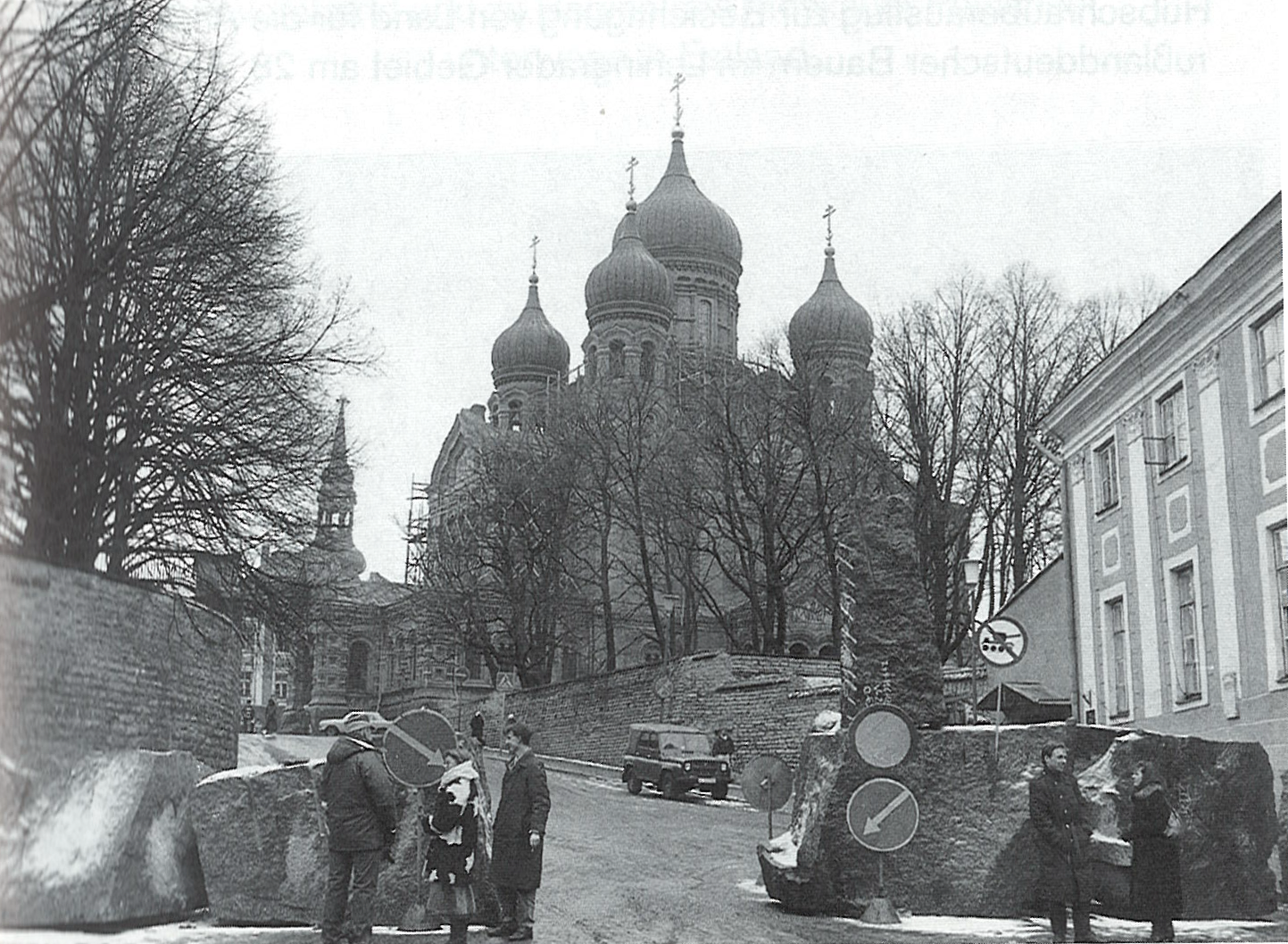
January 1991: granite erratics — laid down on Estonian soil by the last ice age — bar the approaches to Toompea, beside a road sign forbidding passage to tanks. Estonian hearts and granite saved the date. (From Henning von Wistinghausen, Im freien Estland, Böhlau 2004.)
Despite the thunderclap and rain today, Taasiseseisvumispäev is one of the most beautiful days in the Estonian calendar, because it celebrates something greater than the acquisition of independence: the survival of a nation and the restoration of a Republic which had never, in law or in memory, ceased to exist. On 20 August 1991 Estonia did not found a new state. It stood up again. And behind that restoration lies a much longer story — of language and culture, of courage and political judgement, and of people of different backgrounds who chose the idea of a Republic of Estonia over empire.
Today, 20 August, Estonia celebrates the 35th anniversary of the restoration of independence. The distinction contained in the Estonian word Taasiseseisvumine matters. On the night of 20 August 1991, at 23.03, sixty-nine of the Supreme Council’s 105 members voted for the resolution on Estonia’s national independence — or was it at 23.04, as the Foreign Ministry’s chief of protocol, Kalle Ott, reported it by telephone to the German Consulate-General in Leningrad the following morning (Wistinghausen, p. 112)? The Moscow-loyal deputies who had hitherto rejected independence outright did not vote against it, but abstained (Wistinghausen, p. 114). What they restored was explicitly the Republic proclaimed on 24 February 1918. The resolution’s own opening words proceed ‘from the continuity of the Republic of Estonia as a subject of international law’: legal continuity was affirmed, rather than a successor state being created from the ruins of the Soviet Union (Riigikogu; the English text transmitted that night is reproduced in Wistinghausen, pp. 113–14). That distinction gives the day its particular dignity, and it instructs the generations that follow.
The Soviet occupation had lasted more than half a century. Governments, borders, institutions and generations had changed. Tens of thousands of Estonians had been killed, deported or driven into exile; the demographic, cultural and economic fabric of the country had been deliberately altered. Yet the proposition that the Estonian Republic itself had disappeared was never accepted. Its diplomatic representatives continued abroad; its citizens and their descendants preserved its legal identity; Estonian language, music, literature and historical memory maintained something which no occupying administration could manufacture or abolish.
When the opportunity finally arrived in August 1991, therefore, Estonia did not have to invent an identity. It had one. It invoked the illegality of the occupation and of forced Sovietisation, and the unbroken legal existence of the Estonian Republic, to generate registers of citizens and to let the people — and then their representatives — vote, the occupation notwithstanding. The Estonian SSR did not merely secede from the Soviet Union; Estonia reasserted itself.
That is part of the extraordinary cultural beauty of Taasiseseisvumispäev. The blue, black and white above Pikk Hermann is not simply the flag of the political arrangement which happens to govern this territory today. It represents a state stretching backwards through 1991 to 1918, through occupation and exile, and still further into the cultural awakening from which political Estonia emerged. The singing, the language, the universities and schools, the churches, farmsteads, towns and islands, the accumulated memory of families — all became repositories of a country while that country’s normal institutions had been taken from it.
The story is therefore not only one of resistance. It is one of continuity.
And that continuity takes us back naturally to the first struggle for Estonian independence, after the collapse of the Russian and German empires in 1918.
There is a particularly interesting German dimension to that history, because it resists the comfortable simplification of dividing people according to ethnicity. The Baltic in 1918–20 was full of the remnants of imperial armies. When I refer to the Tsar’s Army in this context, I mean precisely that military inheritance: enormous numbers of the officers and experienced soldiers fighting on both the White and the Red sides had been trained in, conscripted into or commissioned by the former Imperial Russian Army. The Tsar was gone, but his army had shattered into successor formations, just as the Kaiser’s army produced German volunteer formations and Freikorps after November 1918 — particularly in deeply suffering East Prussia and in the Baltic lands to its north-east.
The question confronting men in the Baltic was therefore no longer simply which army did you once serve in? It was: what political order do you now choose to serve? What future shall be yours to fight for?
Comments
Nothing yet. Say the first thing.
Sign in to join the conversation.