
Infophilia: A Positive Psychology of Information | June 27, 2026 | Vol. 4, Issue 34
Biophilia | Civic Infophilia | Economics of Information | Technophilia
✨ Welcome to Infophilia, a weekly serial and a living lab exploring how our love of information and connection can help us thrive, individually and collectively. This is avant-garde research in how we engage with knowledge, meaning, and each other. If this is your first time here, I’m glad to have you. To learn more, browse the links above, the Archive or About. Or simply discover your infostyle by taking an anonymous, private, 10 question assessment.
Yesterday, I received a notice from the Caxton Club announcing the passing of Donald Krummel on June 25, 2026, at the age of 97. Professor Emeritus Krummel had a long and distinguished career at the University of Illinois, which is where I first met him in the 1990s. I am deeply grateful to him for nurturing my love of bibliography and library history. I was fortunate to be in touch with him as recently as this month, and his inimitable humor was still fully intact. I will write more in a future issue, but I wanted to note his passing here. Rest in peace, Professor Krummel.
📌 Access & Attribution: This serial offers free previews always and occasional open access essays to keep scholarship accessible. Students and those facing financial barriers can request complimentary access. If you find value here, please cite the original work and consider supporting the public scholarship through subscription. Proper attribution sustains this work and models healthy information engagement.
Cite as: Coleman, A. S. (2026, June 27). Digital literacy in public libraries: Review essay on digital resilience, access, and practice. Infophilia, A Positive Psychology of Information, 4(34).
This is public scholarship so feel free to share it.
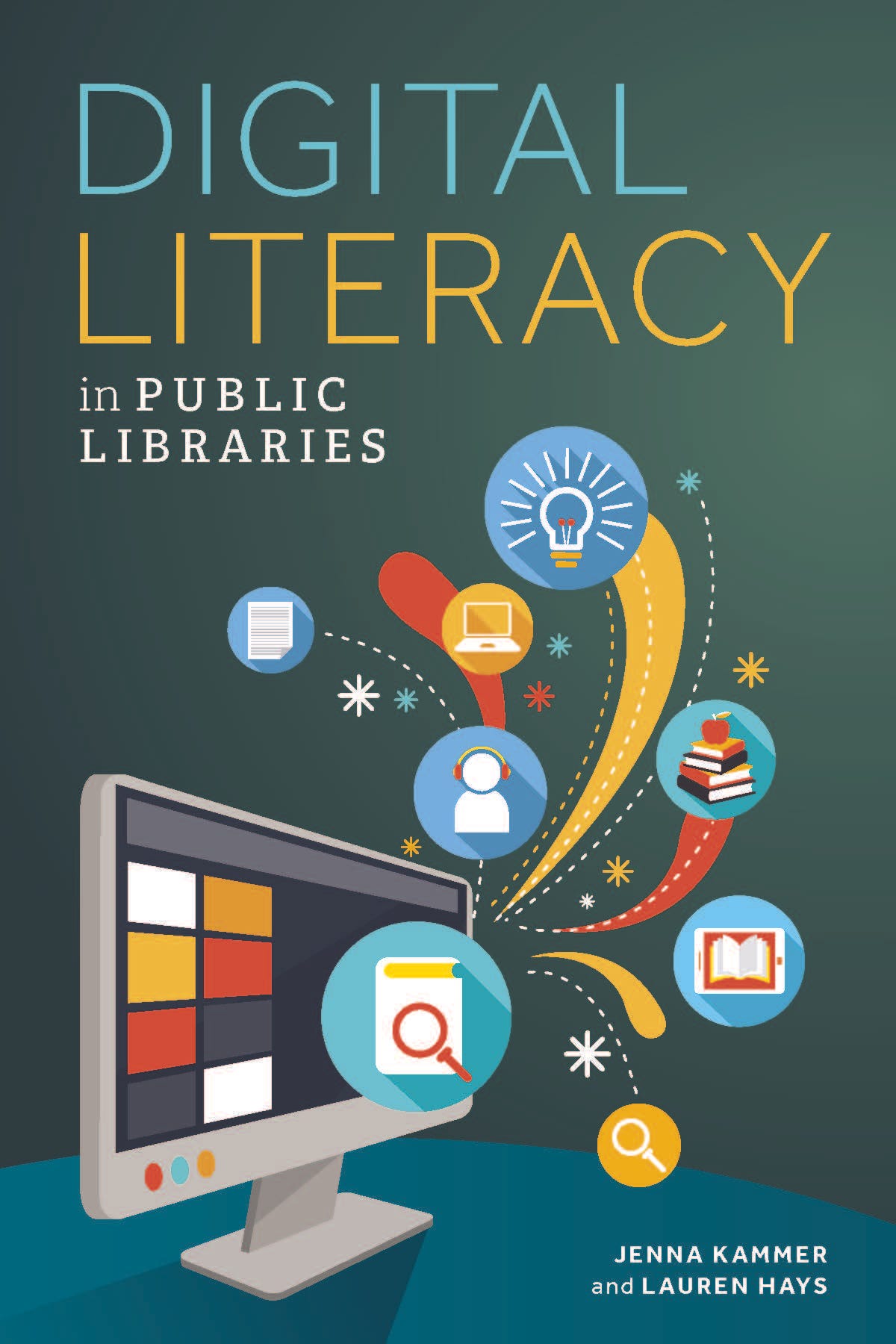
Kammer, J., & Hays, L. (2026). Digital literacy in public libraries. ALA Editions. 140 p. Includes bibliographical notes and index.
This review draws on a conversation with both authors about the book’s origins and reception. Disclosure: my concept of infophilia is cited in Chapter 2 to introduce their approach to digital literacy skills.
It’s an open secret that some people thrive with technology while others feel perpetually behind. Some people open a new app, hit a dead end, and feel a small thrill at the puzzle. Others hit that same dead end and feel shame, frustration, or simply give up. The difference isn’t intelligence. It’s a set of habits — habits of mind — that can be taught, modeled, and supported.
That’s exactly the territory Jenna Kammer and Lauren Hays map out in their new book, Digital Literacy in Public Libraries (published earlier this year by ALA Editions). And while the title might suggest this is a niche professional manual for catalogers and reference desks, I want to make the case — as someone who reads broadly across information science, psychology, humanities, and technology — that this book belongs on the shelf of anyone who loves information, works with the public, or simply wants to understand why “just Google it” stopped being good enough advice a long time ago.
Kammer and Hays aren’t new to this conversation. This is their third collaboration on digital literacy — following one book aimed at higher education and another built for K-12 schools. Digital Literacy in Public Libraries completes what is, in effect, a trilogy spanning the entire arc of a person’s life: the classroom, the campus, and finally, the place that holds all of us together once school is over and the workplace doesn’t cover the gap — the public library.
What’s striking is the origin story behind this particular book. Kammer recalls a conversation with public librarians who were struggling to run adult literacy programming because of gaps in basic digital skills. She wanted to hand them the K-12 book she and Hays had already written — a book built around the idea of weaving digital literacy into everyday teaching moments rather than treating it as a separate subject — but it simply wasn’t built for that audience. That gap became the reason this book exists.
It’s a small story, but it says something important: this book wasn’t written from a theory downward. It was written from a need upward.
If you’ve ever felt confused about why there are so many overlapping flavors of “literacy” — digital, information, media — you’re not alone. The authors address this head-on rather than dodging it.
Their framing, distilled, is this: information literacy traditionally lives in the world of doing well in school — it’s about succeeding within academic systems. Digital literacy, as Kammer and Hays define it, pulls that skill set into the real world: the way we seek out information on our phones, the way we navigate systems that have nothing to do with grades or research papers, and — critically — what happens when the technology in front of us breaks.
That last point is where the book becomes interesting. Hays describes digital literacy as encompassing not just can you use the technology, but do you have the habits of mind — particularly the capacity to persist and troubleshoot when something inevitably goes wrong. That’s not a technical skill. That’s an emotional and cognitive one and the author lay this out very clearly in the first two chapters, including digital resilience and the Universal Declaration of Human Rights.
Where this book really shines — and where I’d encourage even non-librarian readers to spend their time — is in its collection of field stories, gathered the old-fashioned way: through conversations at library conferences, supplemented by an open call for contributions. Every chapter has an Ask the Expert section (one or more). For example, the Ask the Expert section in chapter 1, Supporting Digital Resilience in Library Computer Classes features Stephanie Singleton, PhD, Oakland Public Library.
Some other examples worth knowing about before you even open the book:
Digital navigators. Many of the stories come from “digital navigators” — often young people in outreach roles, sometimes funded through AmeriCorps or modeled on frameworks from the National Digital Inclusion Alliance — whose entire job is connecting the public with library and community resources. One contributor, a navigator working with the North Star Digital Literacy assessment program out of Minnesota, describes training other librarians on how to bring those resources into daily practice. These stories capture something that’s easy to lose in policy discussions: actual humans, often early in their careers, watching in real time as someone gains a skill that changes what they can do in the world.
The QR-code-in-the-hospital story. One of the most quietly brilliant examples in the book comes from a Kansas librarian who noticed that traditional library websites — the carefully built resource guides many of us grew up relying on — simply aren’t where people look for help anymore. Her solution wasn’t to build a better website. It was to create six topic-specific handouts and place them physically in hospitals, where people could scan a code and get directly to the digital health resources they needed, exactly when and where they needed them. It’s a small, elegant example of “just-in-time” information design — and a reminder that sometimes the fix for a digital problem is a very analog one.
The funding chapter that had to be rewritten — twice. In a detail that says a lot about how fast this landscape moves, the authors note that their funding-resources section had to be substantially revised after a change in federal funding priorities shifted what was available to libraries almost overnight. It’s a small but telling reminder that digital literacy work doesn’t happen in a stable policy environment — it happens in a moving one, and the people doing it have to be as adaptable as the technology itself.
The authors are candid about AI: they didn’t design this book around AI. Their book was already well underway when generative AI tools began reshaping how people search, learn, and avoid learning. And yet the book reads as remarkably timely, because it isn’t really about any one technology. It’s about the underlying capacity to engage with whatever technology shows up next.
That distinction matters more than ever. As both authors note, websites — the long-standing backbone of public information sharing — aren’t used the way they used to be. People increasingly go straight to an AI assistant and get an answer, rather than navigating a page themselves. That is shifting what “digital literacy” needs to mean. It’s less about can you find the page and more about can you evaluate what you’re being told, and do you know where to go when the answer isn’t enough.
And there’s a wonderfully human postscript to this discussion: even as AI accelerates the search for answers, the authors observe a counter trend toward wanting a human in the loop — picking up the phone, walking into a library, asking a real person.
If I had to compress Digital Literacy in Public Libraries into one idea for readers who’ll never crack the spine, it’s this:
The public library may be the only place left where a person — outside of work, outside of school — can go to develop digital literacy skills, for free, with a human guiding them.
Workplaces train their employees. Schools train their students. But for everyone else — the parent juggling ten different login portals for their kid’s school, the retiree trying to access a telehealth portal, the job seeker filling out an online application for the first time — there is often exactly one place left that combines free access, real technology, and a human willing to sit down and help. That place is the public library.
This is where the book moves from “useful professional resource” to something closer to a quiet manifesto. It’s not arguing that libraries should add a digital literacy program. It’s arguing that digital literacy — woven through collections, programming, open hours, and the everyday conversations librarians have with patrons — is what the modern public library is for.
Despite being published with librarians as the primary audience, the conversation around this book reveals a far wider readership already finding it — information enthusiasts, military analysts, nurses, physicians, library science students, and plain old “library lovers” who want to understand the intellectual core of the profession a little better.
If any of the following describes you, this book has something for you:
Librarians of every type — public, school, academic — looking for a practical, story-driven framework rather than another abstract theory text.
Parents navigating the bewildering sprawl of school technology systems, who will recognize themselves immediately in the authors’ own experiences.
Healthcare workers, social workers, and community organizers who regularly watch people get stuck not because they lack intelligence, but because no one ever modeled the habit of troubleshooting calmly.
Information enthusiasts of any stripe — anyone curious about the psychology of how people relate to information, technology, attention, and flow — looking for a grounded, real-world set of stories to sit alongside the more theoretical conversations.
Policy-minded readers curious about how funding shifts at the federal level ripple down into something as concrete as whether your local library can run a tech-help session this year.
What I appreciated most is that the authors refuse easy binaries. They are not techno-utopians insisting AI and digital tools will fix everything. They are not nostalgic alarmists pining for a pre-screen world. They are, in the best sense, techno-realists — people who believe we live in a technology-rich world, that not all of it is good, that some of it is genuinely addictive by design, and that the answer isn’t retreat but informed, supported engagement. It is built through habits of mind, supported by real human connection, and made possible, again and again, by the quiet infrastructure of the public library.
Digital Literacy in Public Libraries by Jenna Kammer and Lauren Hays is available now.
Jenna Kammer and Lauren Hays are professors at the University of Central Missouri and are also parents, with children ranging in age from toddlers to college students.
A small postscript: this is the first time I’ve seen my own work cited in someone else’s book, and that’s been a quietly delightful thing to reflect on while writing this review.
Comments
Nothing yet. Say the first thing.
Sign in to join the conversation.