
In a new survey from the Civic Information Needs Census (CINC), Arkansas residents reported the lowest levels of satisfaction with their news and information options on key local topics recorded by CINC this year.
Only information options about local weather were satisfying to significantly more than half Arkansans (71%). On 12 other local topics surveyed, satisfaction levels ranged from 32 to 54% and mostly fell well below the percent who felt information on those topics was important to their everyday lives. The 26% average gap between views of importance and levels of satisfaction across all 13 topics was larger than the average gaps identified in Chicago (22% average gap), Marin County, California (20%), and Tampa Bay, Florida (14%).
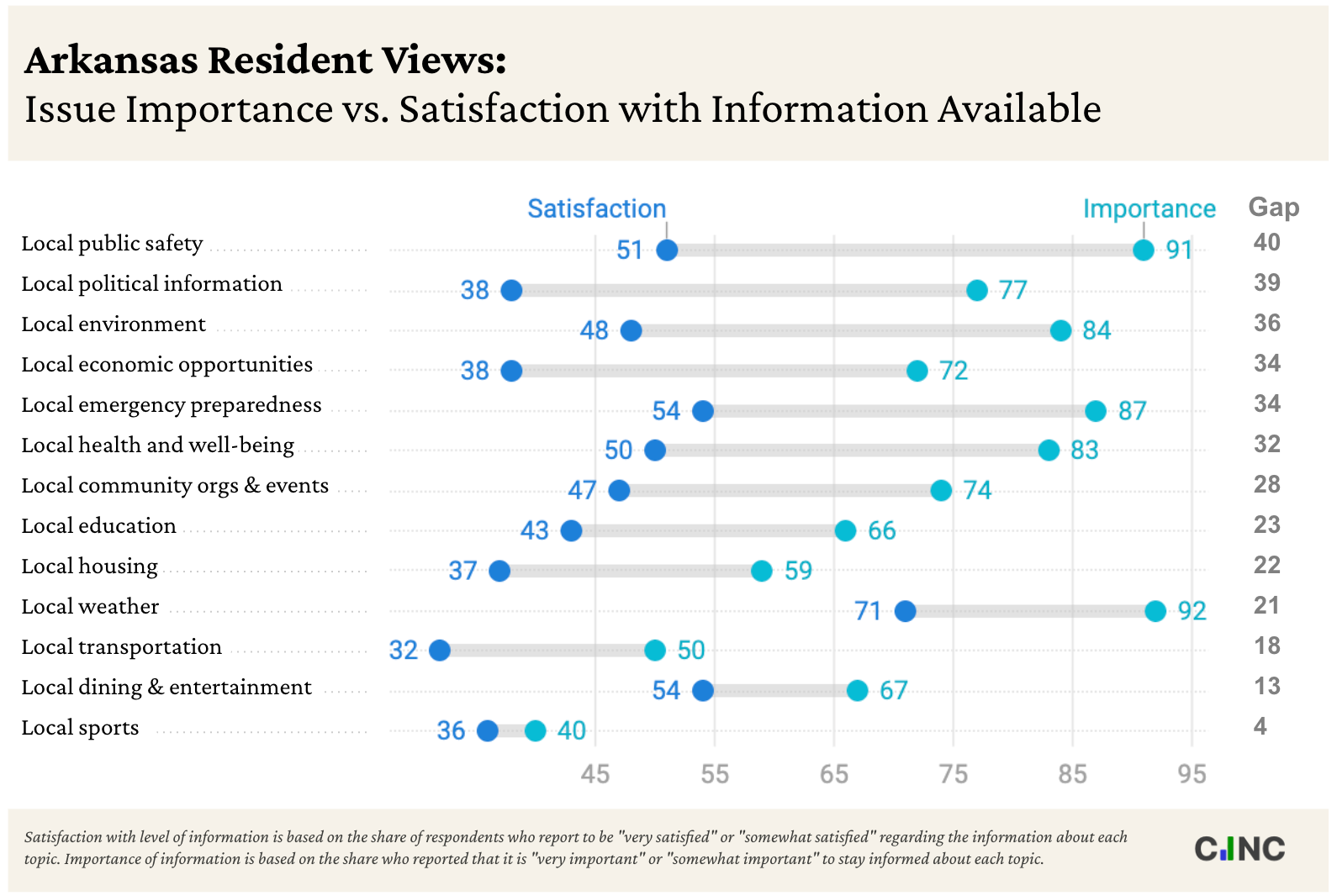
Those findings are from a new study of Arkansas conducted by the Civic Information Needs Census (CINC) in partnership with Deep South Today. Embold Research surveyed 1,011 adults (weighted) statewide between June 9 and June 18, 2026.
The full report and crosstabs for the 2026 Arkansas CINC can be found here, along with past CINC studies.
The Civic Information Needs Census (CINC) is a research tool and initiative housed at Civic News Company and done in partnership with Embold Research.
It is designed to equip the civic information field — newsrooms, funders, libraries, government, and community organizations — with essential shared data on local information needs, media habits, and civic engagement. It is both a community survey and a coalition-building practice, designed to bring practitioners and funders together around a common set of facts so they can prioritize their work and track their impact over time.
CINC started in 2024 with a national baseline survey followed by pilots in Chicago and New York City. This year, we’re releasing results from four new studies done with local partners in each community: Chicago, Marin County, California, Tampa Bay, Florida, and this study of Arkansas.
You can find the full reports and crosstabs for all CINC studies at infocensus.org.
As we have found in every other CINC study where we’ve asked the question, Arkansans report that they have a more difficult time getting news about their neighborhood, city or town, county, and state than the country or the world.
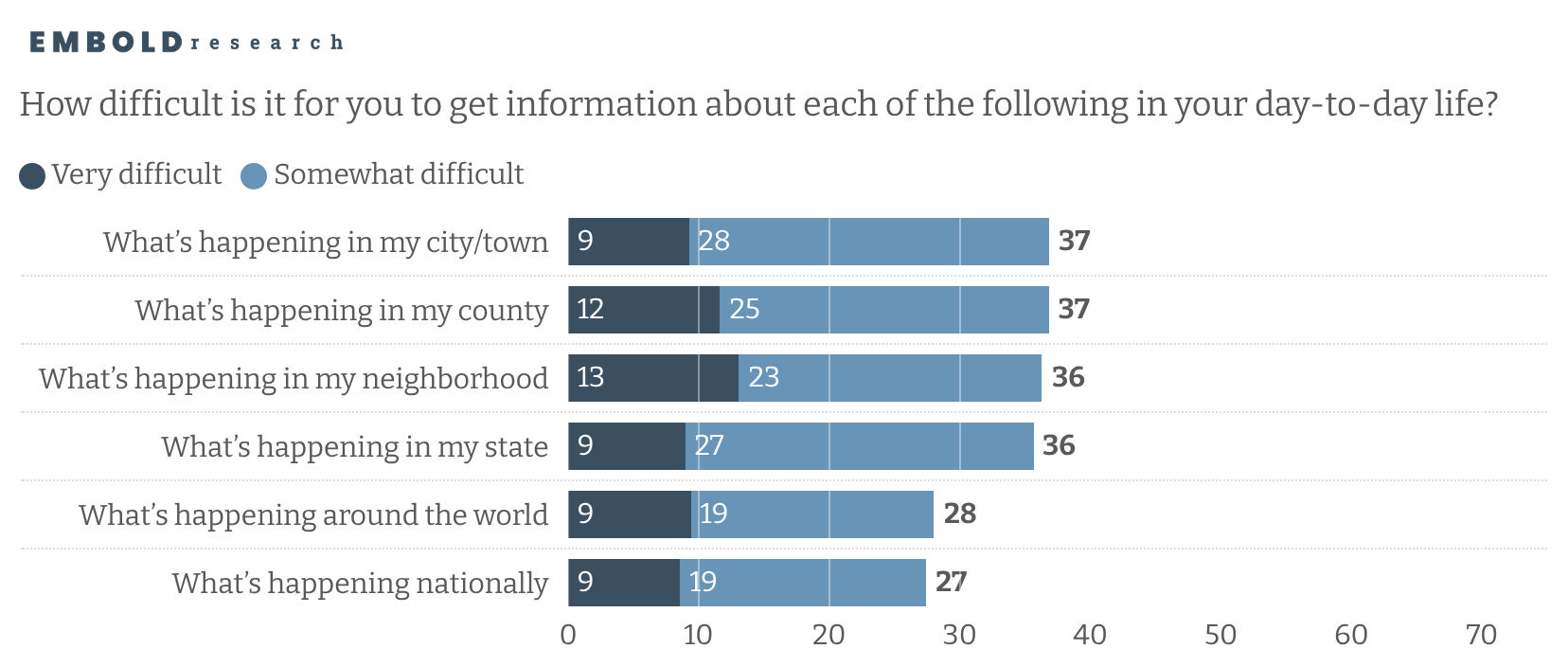
We call this historic reversal in which the news closest to us is the hardest to get, the Proximity Paradox.
In Arkansas the gap was smaller than we’ve often seen, however, and wasn’t universal across demographics in the state. For younger and non-white Arkansans, national and international news was about as difficult to get as forms of local news, closing the gap.
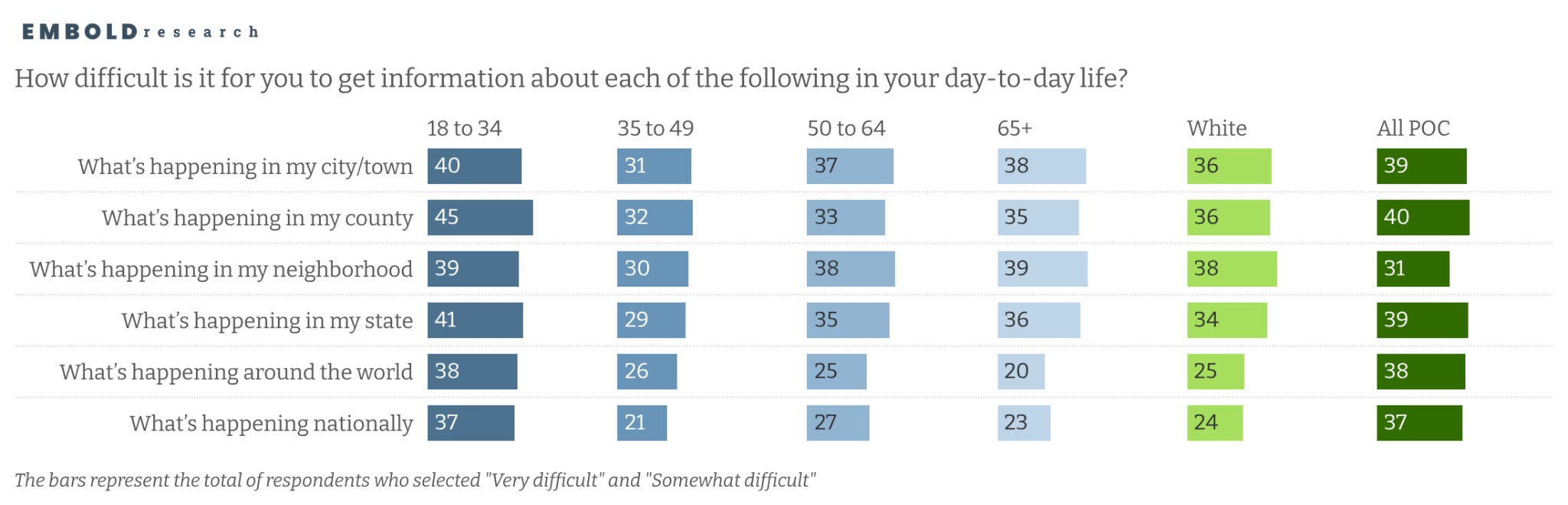
That difference in experience for different members of the Arkansas population was mirrored in other findings in the survey.
Asked which sources are most useful for high-quality local information, Arkansans didn’t point to any news organization first. They pointed to each other, and to their own initiative.
Friends, family, colleagues, and neighbors (40%), local online groups and communities like Facebook Groups, Reddit, and Nextdoor (38%), and plain online search (38%) all outrank local TV (27%), local digital news (22%), local radio (18%), and print newspapers (10%). Government agencies (17%) and social media content creators (15%) fall in between.
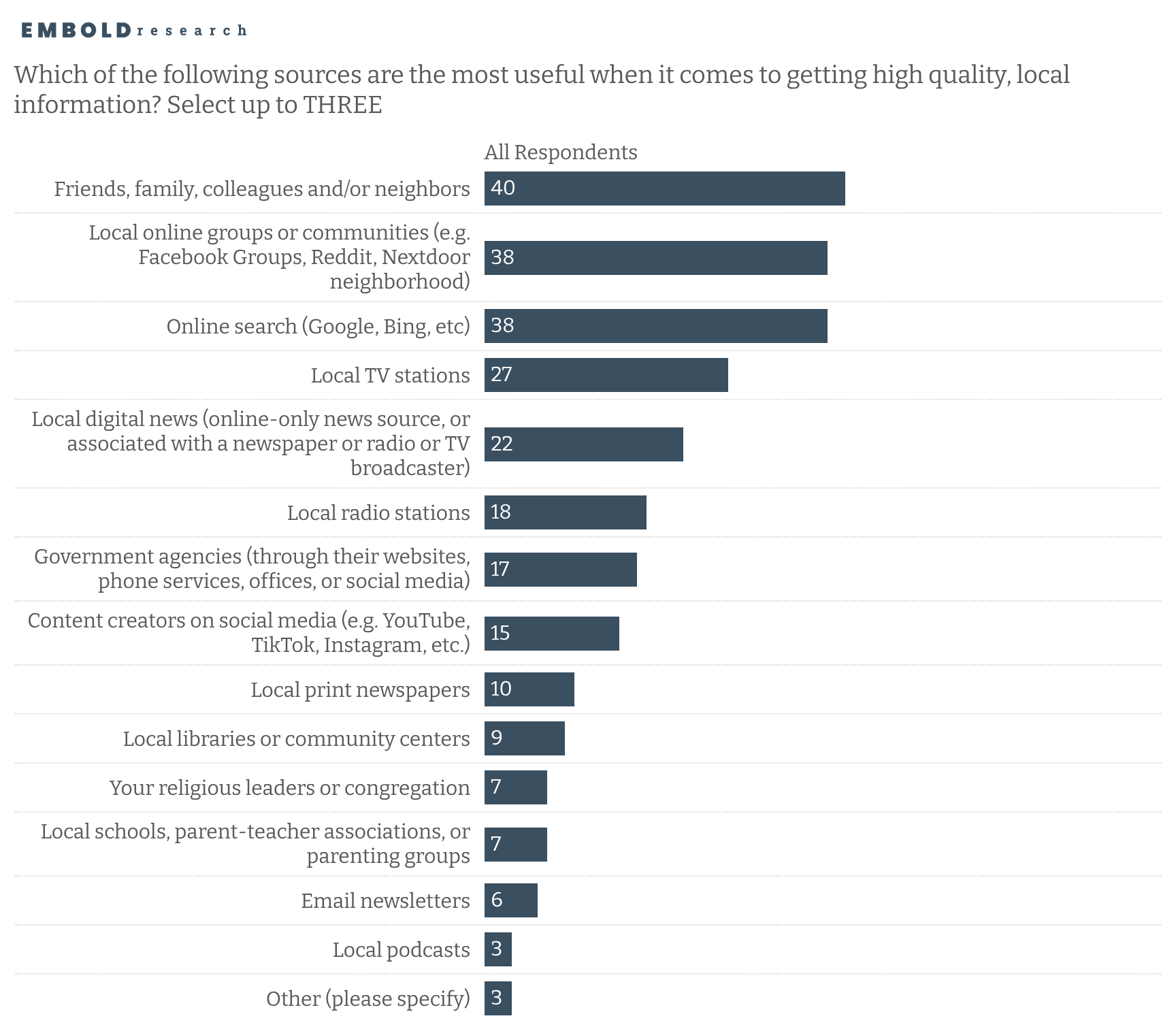
The throughline across the top three is informal and self-directed: Arkansans are relying on the people around them and on their own searching more than on any single outlet built to deliver local news to them.
As it has in past CINC studies, local sources were different for Arkansans of different ages. Younger residents were more likely to cite content creators on social media, for example, while older residents were more likely to cite local TV.
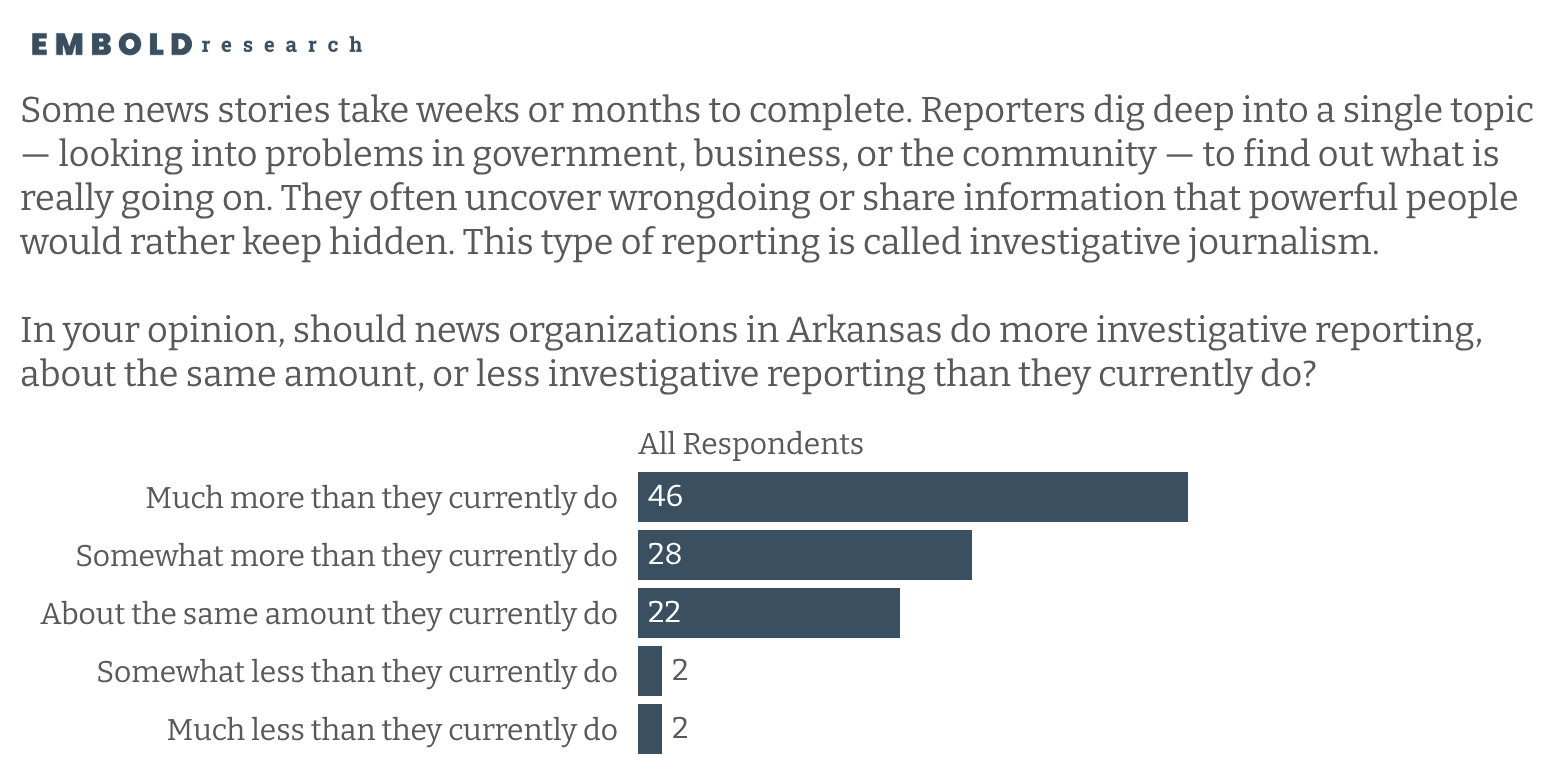
Despite, or maybe because of, the satisfaction gaps above, Arkansans want more investigative journalism. Nearly three-quarters (74%) said news organizations in the state should do “much more” or “somewhat more” investigative reporting than they currently do; just 4% said less. That appetite crosses party lines: 80% of Arkansas Democrats and 75% of Republicans want more investigative reporting, with fewer than 3% of either group wanting less. The pattern holds by 2024 vote choice too — 83% of Harris voters and 75% of Trump voters said the same.
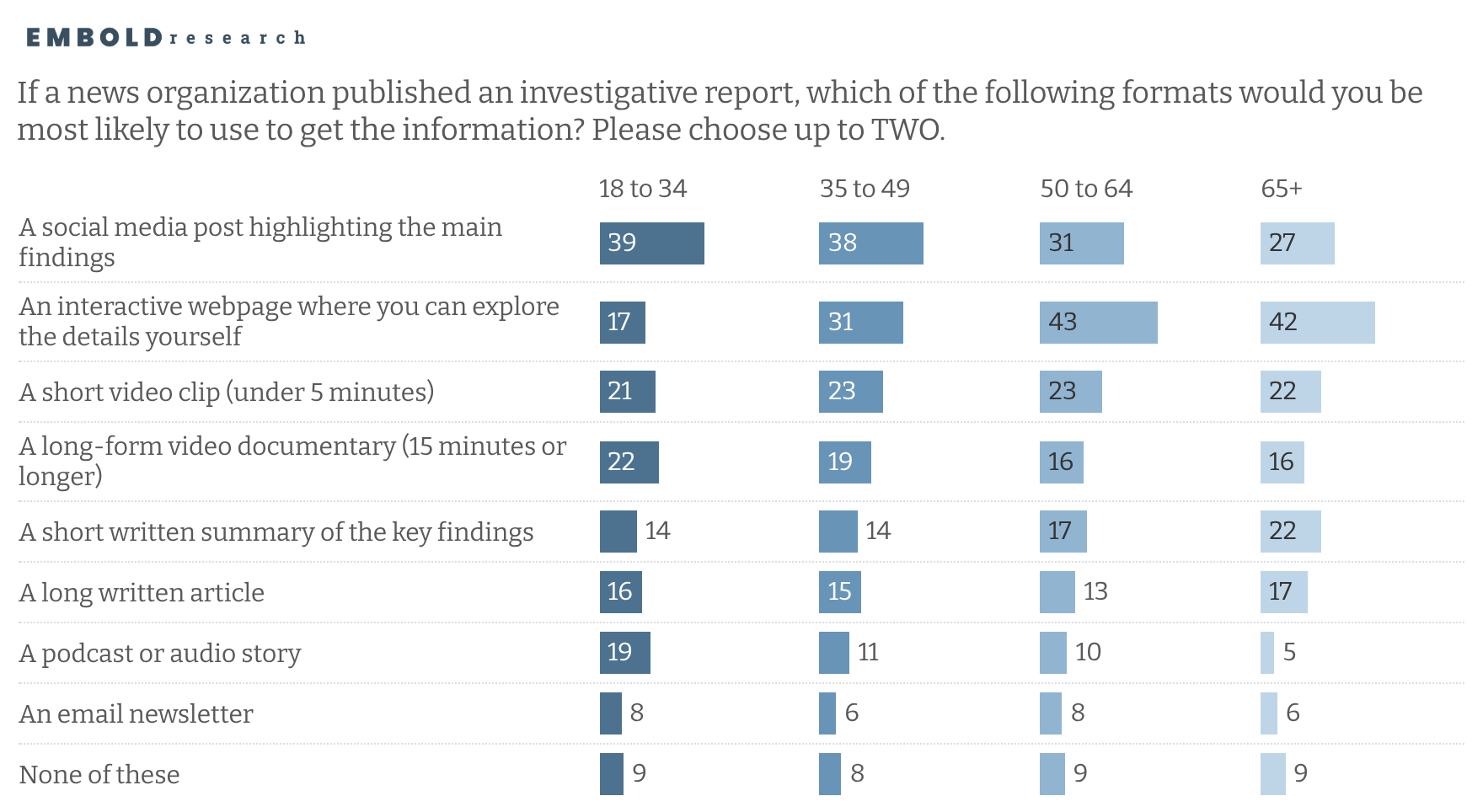
Notably, the forms Arkansans hoped that work would take were diverse and varied by age. Residents said they prefer social media posts highlighting key findings, interactive webpages, and short videos more than other formats, but 7 of the 8 options were selected by at least 10% of respondents:
Arkansas is the fourth and final of the 2026 CINC studies we set out to publish this summer, following Chicago, Tampa Bay, and Marin County. Coming later this summer: some cross-market analysis exploring topics covered in all four local studies. And maybe some new CINC results from new, TBA communities!
Subscribe to get all that and more.
—
Figures in the first graphic show the share of respondents who said it is “very” or “somewhat” difficult to get information, in response to the question: “How difficult is it for you to get information about each of the following in your day-to-day life?”
Surveys were conducted by the Civic Information Needs Census with Embold Research. The Arkansas survey was fielded June 9–18, 2026, with a sample size of 1,011 (weighted) and a modeled margin of error of 3.3%.
No posts
Comments
Nothing yet. Say the first thing.
Sign in to join the conversation.