
What exactly is an agent? The term has become a buzzword across AI circles, yet its meaning shifts depending on who you ask.
In classical AI, agents perceive and act within an environment. In the current LLM era, the concept has evolved to describe systems that reason, plan, and interact autonomously within structured runtimes.
This post explores how research labs, and crowd sourced practitioners define “agent” and distills it all into a concise, working definition.
Russell & Norvig: Anything that perceives its environment and acts upon it [1]
OpenAI: An AI application consisting of a model equipped with instructions that guide its behaviour, access to tools that extend its capabilities, encapsulated in a runtime with a dynamic lifecycle [2]
Anthropic: Systems where LLMs dynamically direct their own processes and tool usage, maintaining control over how they accomplish tasks [3]
Weaviate: systems that combine LLMs for reasoning and decision-making with tools for real-world interaction, enabling them to complete complex tasks with limited human involvement [4]
Simon Willison crowd sourced 260 agent definitions and had an LLM group the tweets into a set of definitions. His results are available in a GitHub Gist and are worth checking out.
Naturally, the next step was to to further summarise Simon’s grouped results and turn them into an infographic using ChatGPT:
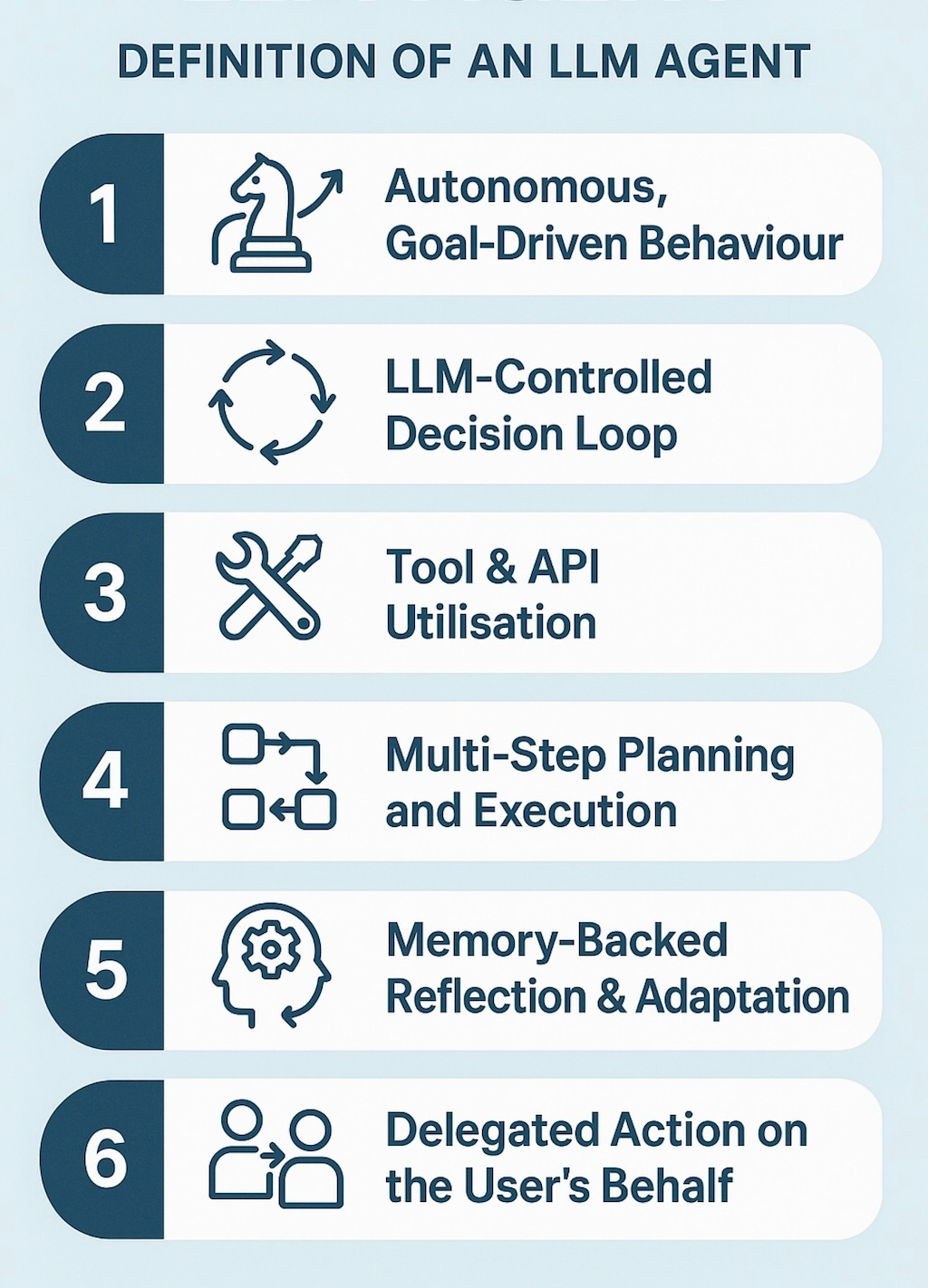
While not bad, it’s still overly complicated for a working definition and can be distilled further…
Given the expert definitions, and the crowd sourced input, we land on a concise working definition of an LLM agent:
Agents are models using tools
with memory in a loop
The four core components of an agent:
🧠 Models: a large language model providing core reasoning for planning, decision making, recovering from errors, and reflection
🛠️ Tools: external APIs, databases, or functions that the model can call to retrieve data or act on the world
🗂️ Memory: store context history and tool results to avoid repetition and reason over time
🔁 Loop: provided orchestration, iteratively take actions, observe results, track goals, and decide next steps
Thanks for reading, feel free to share: Agents are models using tools in a loop.
Whether framed as OpenAI’s model-plus-tools runtime, Anthropic’s self-directed systems, or Weaviate’s tool-augmented LLMs, the essence is the same: models using tools with memory in a loop. Together, these elements define the minimal, functional blueprint of AI agents.
While the definition captures the essential simplicity of agents and provides a blueprint, beyond this core lies a fun and rich frontier: context management, RAG integration, multi-agent coordination, tool protocols, conversation trajectories, evaluation and observability that make agents robust in the real world. A future post will explore the practical systems and design patterns that turn this agentic definition into scalable, trustworthy AI.
No posts
Comments
Nothing yet. Say the first thing.
Sign in to join the conversation.