The place for technical guides, customer observability & IoT use cases, product info, and news on leading time series platform InfluxDB, Telegraf, SQL, & more.
This tutorial demonstrates both approaches using the InfluxDB 3 Processing Engine’s built-in bird tracking simulator plugin. You will generate telemetry, aggregate it into 10-second windows, and validate the result with SQL. The same pattern works for infrastructure metrics, industrial sensors, application telemetry, and other time series workloads. Why downsample time series data? High-resolution…
Time series data shows up wherever the physical world meets software. A satellite constellation streams altitude, power, and thermal telemetry from every spacecraft on every pass. A factory floor running on Industry 4.0 principles instruments every line, every motor, every batch. And underneath all of it sits a humbler problem that anyone who has worked in operational technology knows well:…
Veteran infrastructure executive to lead product and engineering as InfluxData expands adoption of InfluxDB 3 SAN FRANCISCO, August 11, 2026 – InfluxData , creator of the leading time series database InfluxDB®, today announced the appointment of Satyam Vaghani as Chief Product Officer. Vaghani will lead product, engineering, and operations as the company expands adoption of InfluxDB 3 and advances…
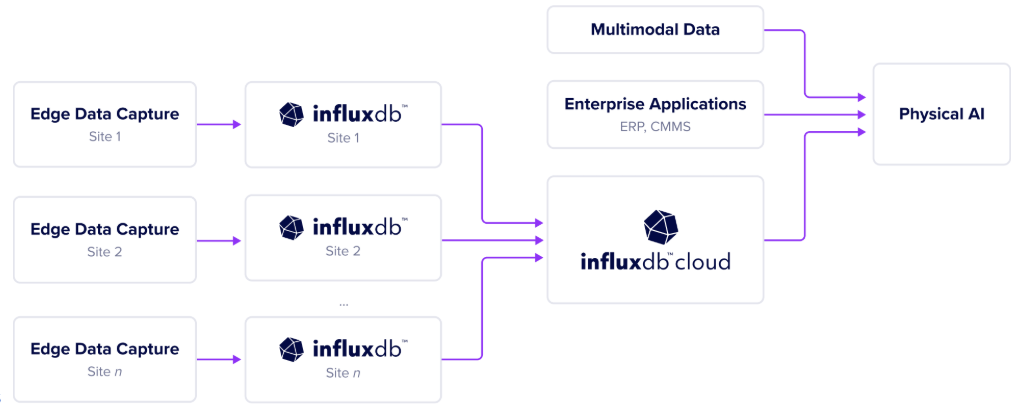
Physical AI enables machines and industrial systems to perceive conditions, reason about them, and act in the real world. In industrial settings, as part of an industrial AI strategy, physical AI models can help organizations identify risks earlier, optimize operations, and respond to changing conditions in real-time. Delivering these outcomes starts with training AI models on detailed historical…
Time series workloads rarely stay predictable for long. A system might begin with a few devices reporting a small set of measurements. As the fleet grows, new sensors come online, tags multiply, and query patterns change. A table that looked simple at the start becomes wide and sparse. A workload built around recent data expands into long-range analysis. As complexity grows, maintaining fast query…
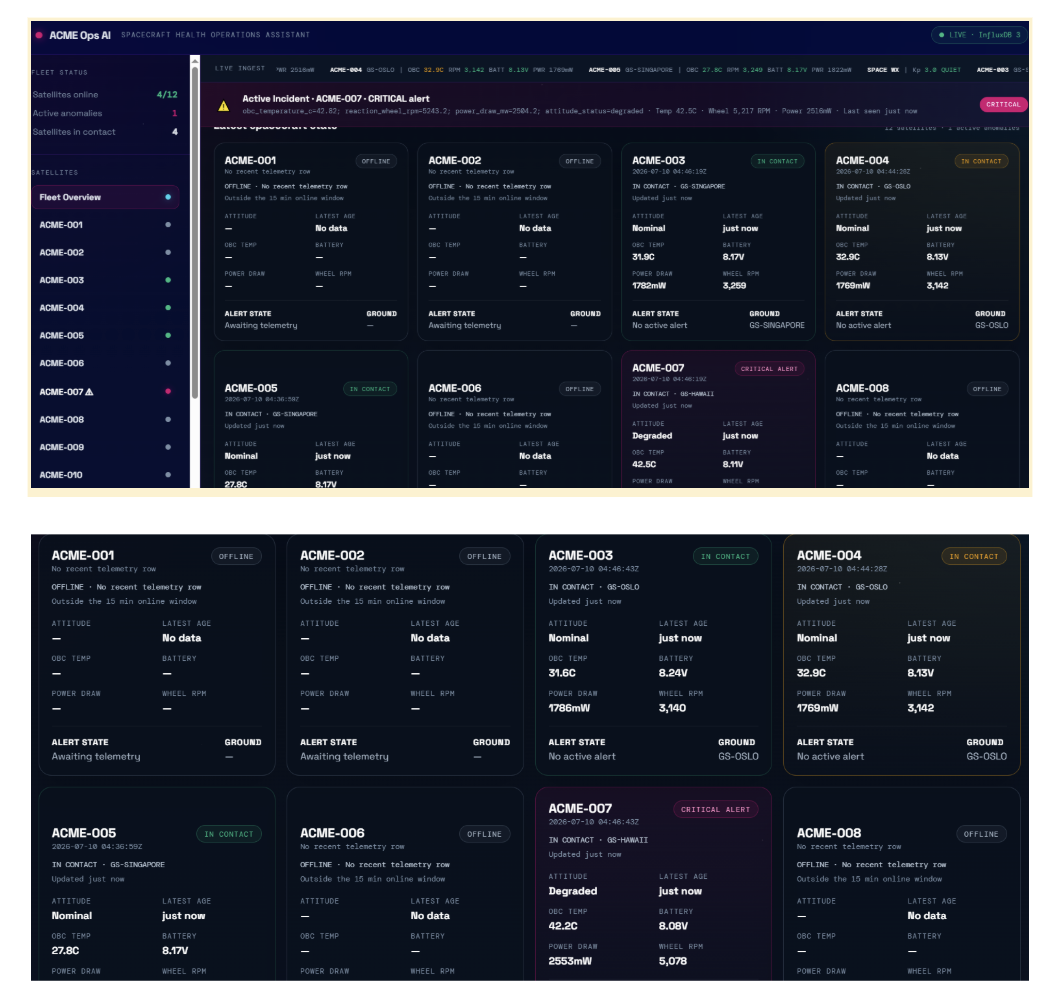
When a satellite is drifting toward a fault, operators don’t need another dashboard full of disconnected charts. They need to know what changed, what it means, and what to check before the next ground pass closes. That’s the idea behind our satellite telemetry demo: a live mission-control experience built on InfluxDB 3 . The demo monitors a simulated fleet of 12 satellites, continuously ingesting…
The InfluxDB team has released five new Processing Engine plugins. They range from making it easy to call a hosted ML model to pulling in stock market data in real-time. Every one of them can be activated with a few terminal commands. No external services or tools—they all run inside your existing InfluxDB instance. Here’s what’s new, when you’d reach for them, and a few quickstart examples to get…
Every month, satellite operators perform thousands of orbital maneuvers as recommended by LeoLabs’ data. They don’t do it to reposition satellites, they do it to avoid hitting things. With tens of thousands of active satellites and other debris circling the Earth, adding new devices to orbit comes with risk. Satellites are expensive, high-tech devices that require a massive investment to engineer…
A new feature-bearing release for Telegraf is now available: Telegraf 1.39 — Release notes You can find the binaries for the latest Telegraf release on our Downloads page. Many thanks to all the open source community members who contributed to this effort! New plugins These are the newest plugins, first available in this version: GNMI dial-out input ( inputs.gnmi_listener ) Receive GNMI dial-out…
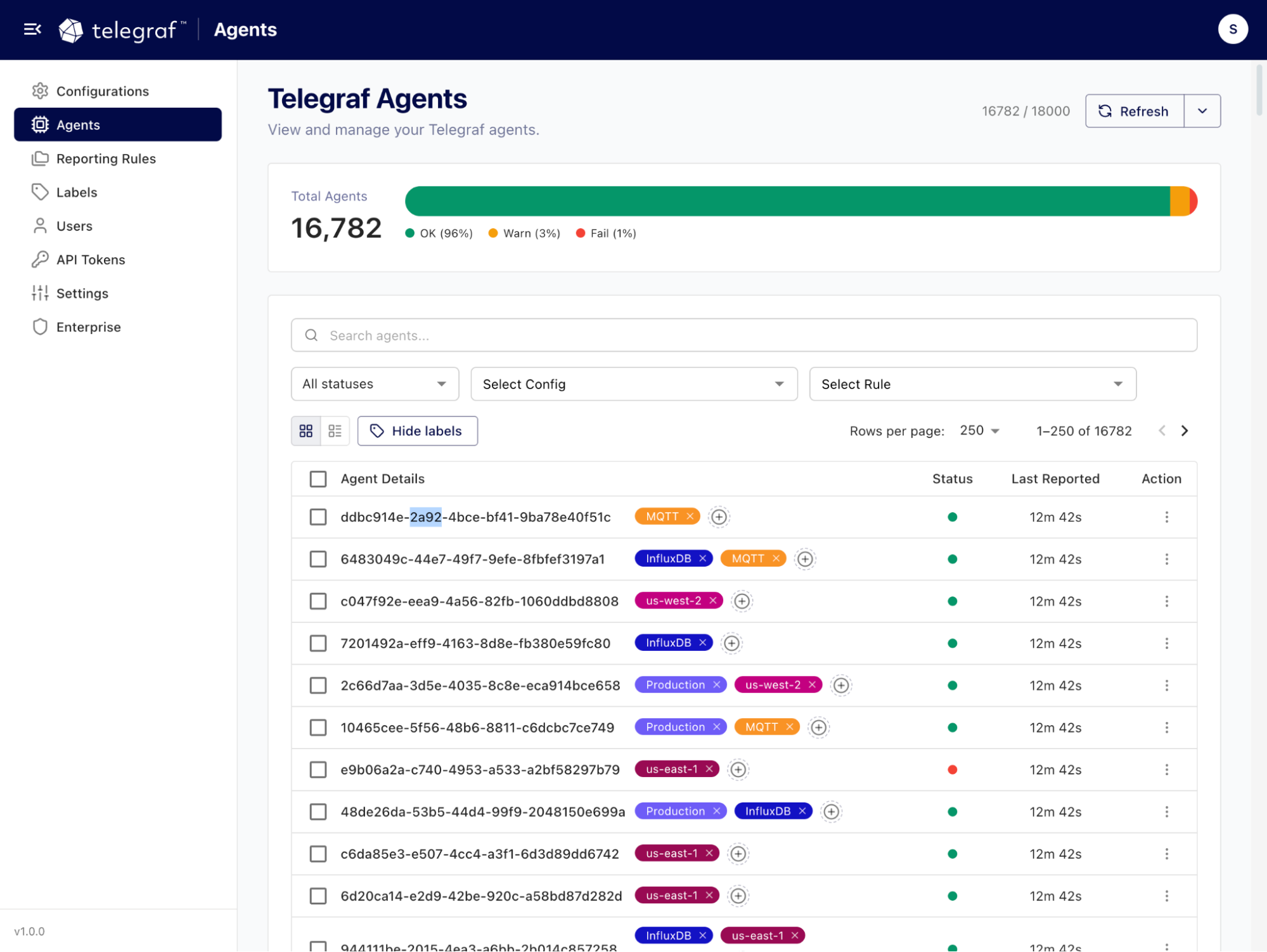
Here’s everything that shipped. Telegraf Enterprise reaches general availability Telegraf is the open source standard for collecting telemetry from infrastructure, applications, and devices. But what happens at scale? An enterprise running thousands of agents doesn’t have one collection problem; it has thousands of slightly different configs, no single view of agent health, and no safe way to roll…
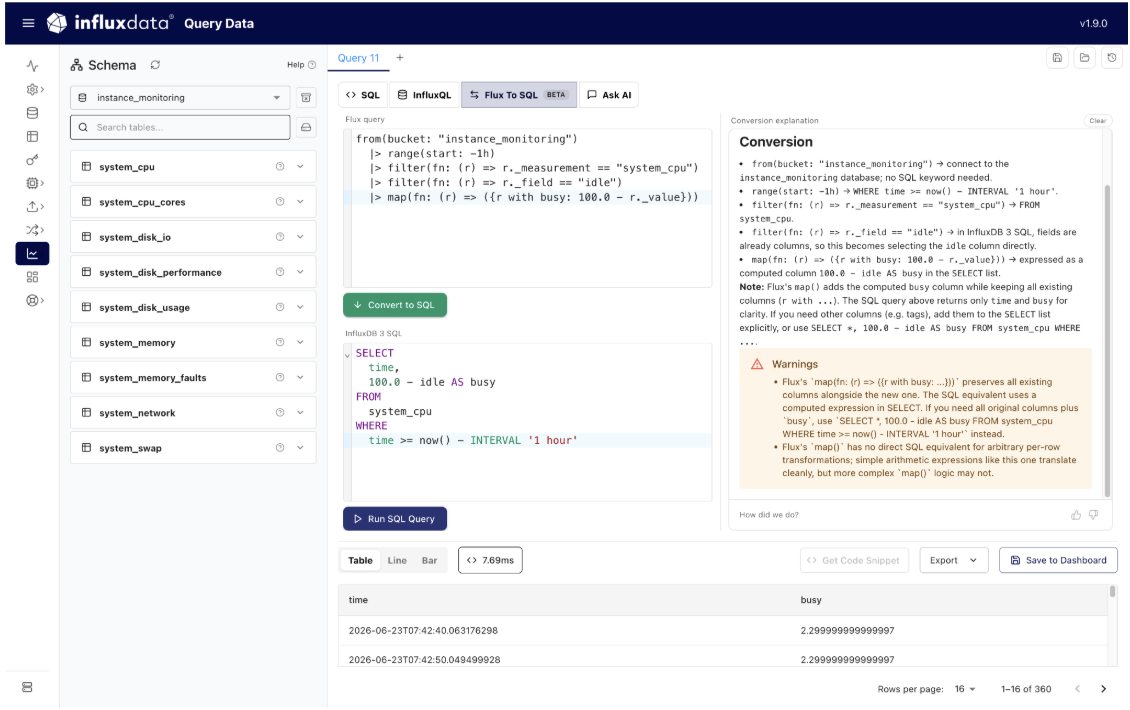
InfluxDB 3 Explorer 1.9 makes it easier to work with your existing queries. Whether you’re migrating Flux queries to SQL or you’ve been writing in InfluxQL for years, this release helps bring your existing queries forward instead of starting from scratch. For teams moving to v3 from earlier versions of InfluxDB, query migration is often one of the last major hurdles. Explorer 1.9 introduces an…
When a team uses an internal Slack channel for everything from contact form submissions to deployment alerts and server warnings, the notification engine quickly becomes critical infrastructure. When the same team builds that engine as a product for other teams to use, the bar gets even higher. Mumu is an all-in-one productivity platform for modern teams. While most companies stitch together…
Telegraf has become the standard for collecting telemetry across cloud, edge, and physical infrastructure. With more than five billion downloads and 400+ official plugins, Telegraf is the open source standard to connect virtually any data source to any destination. Over the years, we’ve seen Telegraf evolve from a lightweight collection agent into a foundational part of production infrastructure.…
Satellite operations depend on telemetry as the primary interface to systems that teams cannot directly inspect. Once a spacecraft reaches orbit, signals such as battery levels, temperature, signal strength, and fault codes become the foundation for understanding system health and maintaining control. Telemetry streams continuously, so the underlying data system becomes a critical control point…
In our last release, we introduced a beta of performance updates designed for heavier, more complex time series workloads. InfluxDB 3.10 expands that beta to include enterprise features that give teams more control as they scale and manage larger workloads in InfluxDB 3. This release adds end-to-end backup and restore, row-level deletes, bulk import from Parquet, user management, and an RBAC…
Getting InfluxDB 3 up and running is a pretty lightweight process with the installation script . Getting time series data into it is the next step, and for exploration, basic testing, or scenarios where you don’t have a stream of time series data ready to write, that can be a point of friction. That hurdle is particularly high when you want to test the rest of the system around the data you’d be…
Satellite mission operators depend on telemetry to understand spacecraft health, ground system performance, and mission status in real-time. Operation signals help teams identify risks, investigate anomalies, and keep operations moving. When a spacecraft enters safe mode or signal strength drops during a contact window, teams need trusted telemetry immediately. But mission data moves quickly…
Predictive maintenance is one of the most compelling use cases for time series data. Instead of waiting for equipment to fail or servicing it on a fixed calendar regardless of condition, you watch the live sensor data and act when it indicates that a failure is coming. That “watch the data and act” loop is exactly what the InfluxDB 3 Processing Engine was built for. In this tutorial, we’ll build a…
For many operational time series workloads, machine learning can’t operate in the historical way, where data is compiled once and models are trained offline. Sensor readings, infrastructure metrics, application telemetry, energy data, industrial measurements, and financial ticks all share a basic property: the next datapoint is more useful when the system can respond to it immediately (or at least…
Renewal notices don’t arrive with a subject line that says “modernization conversation enclosed.” They show up as a line item in procurement, usually with a larger number than the previous year. Most teams sign and move on. The ones that pause tend to find the renewal moment is a useful forcing function, not to rip out the historian, but to ask whether the current architecture can support what the…
A more reliable agent that learns your schema, queries your data, and investigates alerts - that’s what’s possible with this release of our MCP server v1.3.0. TL;DR This release enhances the InfluxDB 3 MCP server—which already allows AI agents like Claude and ChatGPT to read from and write to your InfluxDB 3 instance using natural language—with key dependability improvements, including protocol…