
Welcome to Episode 29 of Next in Line by Infinyte - a data-first, investor-focused series where we unpack India’s most exciting IPO-bound companies with crisp, data-backed drops.
It’s everything you need to stay one step ahead of the bell. No fluff, no noise, just smart, visual storytelling.
Because the best stories don’t start at the IPO. They start just before it.
Stay tuned, stay curious!
In September 2024, media reports citing an Income Tax Department probe brought a Hinduja Group restructuring into the spotlight. HGS, the group’s BPO arm, had sold its profitable healthcare business and, around the same period, merged with the loss-making listed media company NXTDigital. Tax authorities reportedly invoked the General Anti-Avoidance Rule (GAAR), alleging the structure was designed to reduce tax on the sale, and raised a demand of roughly ₹2,500 crore. HGS disputes the allegation and has challenged it before the Bombay High Court, which granted an interim stay in December 2025. The matter remains sub judice.
That dispute isn’t the focus of this story. What matters here is the listed company it left behind.
After the restructuring, NXTDigital was renamed NDL Ventures. With its operating business gone, it became a largely dormant listed entity holding a real estate parcel and treasury investments. Now, Hinduja Group is repurposing that same listed company to bring Hinduja Leyland Finance (HLF) to the stock market through a reverse merger—without a conventional IPO.
HLF is one of India’s larger vehicle-financing NBFCs, with nearly ₹72,000 crore of assets under management across commercial vehicles, passenger vehicles, used vehicles and housing finance. Despite its scale and improving asset quality, it has spent years as an unlisted subsidiary within Ashok Leyland.
The previous history of NDL Ventures and the HGS tax dispute relate to a different transaction and are legally distinct from the HLF merger. Here, the listed company is simply serving as the vehicle through which HLF will become publicly traded.
The real question for investors isn’t the structure itself. It’s whether the market will finally value HLF like a standalone NBFC or continue to price it as an overlooked subsidiary inside Ashok Leyland.
HLF has tried to go public twice before, in 2016 and 2018, and both attempts were shelved amid weak market conditions, the second one during the NBFC liquidity crisis that also hit IL&FS. This time, instead of waiting for another IPO window, Hinduja Group is taking a different route entirely.
The mechanics:
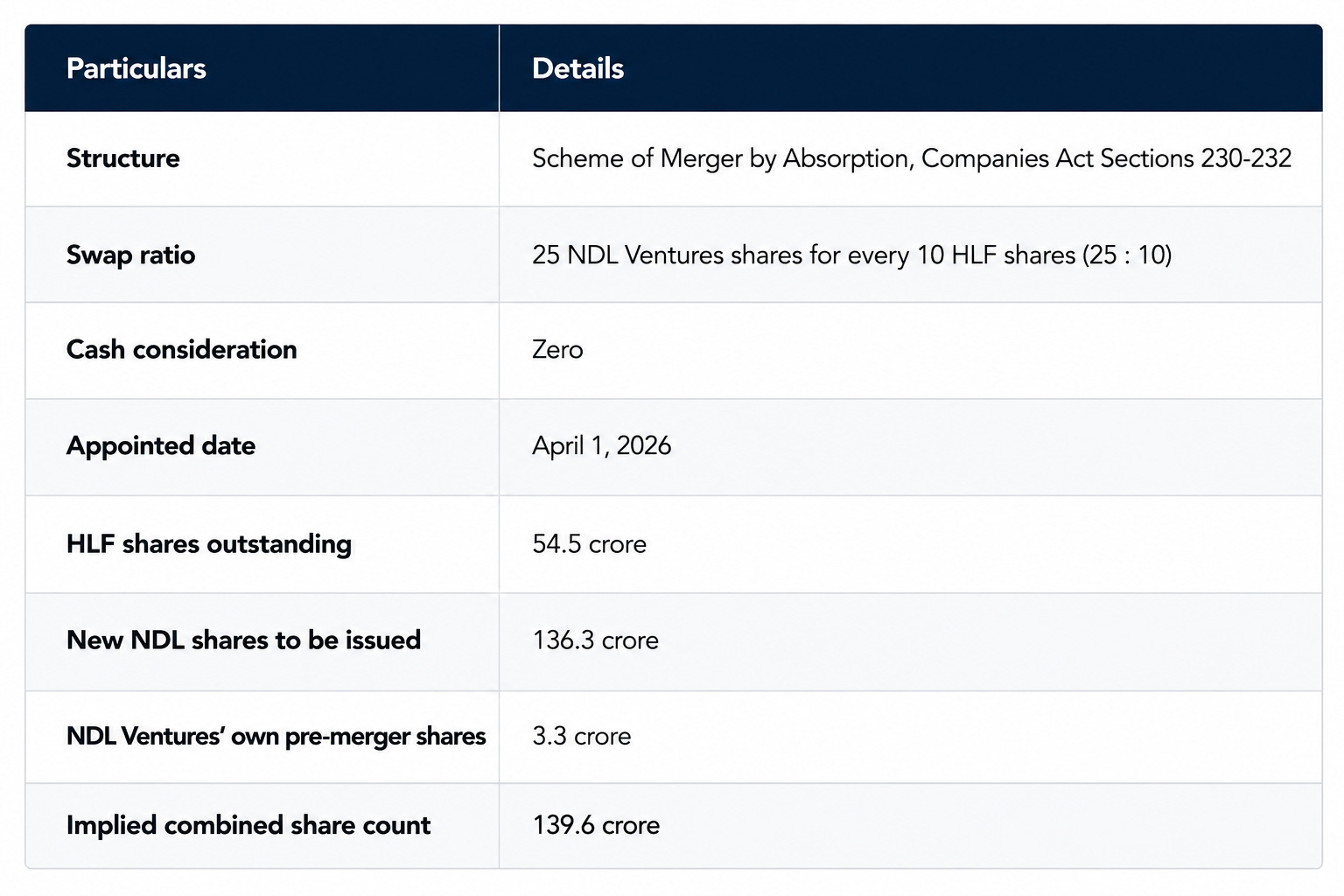
Ashok Leyland’s chairman, Dheeraj Hinduja, has been consistent since 2024 in saying that HLF’s true value wasn’t being reflected in Ashok Leyland’s own share price, and that the reverse merger was the way to address that. It’s a notable position for a promoter to take publicly: an acknowledgment that a meaningful part of the group’s value has been sitting unpriced inside a consolidated balance sheet, and a structural rather than a disclosure-based fix for it.
Three things about the setup are worth pulling apart before getting to the numbers:
1. The swap ratio fixes shares, not value. HLF holders aren’t being promised a rupee amount. They’re being promised 25 NDL Ventures shares per 10 HLF shares, and what those shares are actually worth depends on where NDL Ventures trades once the market starts pricing it as a real NBFC instead of a dormant shell.
2. The same listed company has now been used for two very different restructurings. NXTDigital evolved from a listed media company into the vehicle used for HGS’s corporate restructuring and has now been repurposed to list HLF. Reverse mergers through existing listed companies are becoming more common in India—Zepto, for instance, recently used a similar structure to shift its domicile from Singapore to India. What is less common is the reuse of the same listed company for two distinct group restructurings within a few years.
That said, the two transactions are fundamentally different. The HGS restructuring, which is currently under tax litigation, involved a reorganisation of businesses within the group. The HLF transaction is a reverse merger intended to take an operating NBFC public. Whether the earlier dispute has any bearing on how regulators or investors view this transaction remains an open question.
3. The credit story here has been ahead of the equity story. None of the uncertainty around getting listed shows up in HLF’s rating profile. All of it shows up in how the business has been valued while unlisted, at a fraction of what comparable listed NBFCs command.
What actually changed at HLF while the listing plan sat in regulatory process:
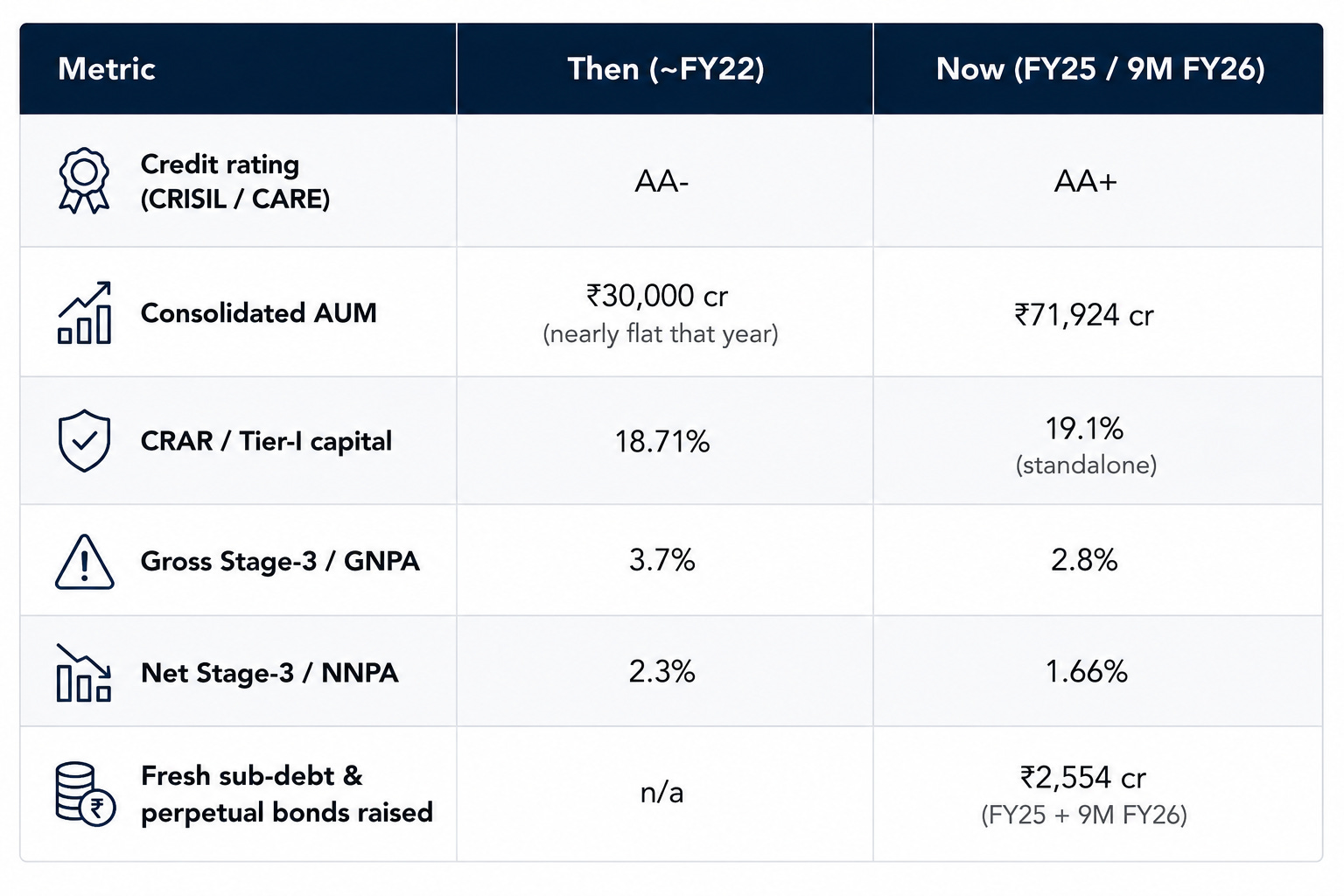
The business improved on nearly every metric while the listing plan spent four years in regulatory process, an asset quality and ratings trajectory that runs counter to the more familiar reverse-merger concern, where a weaker asset gets dressed up before being folded into a listed shell.
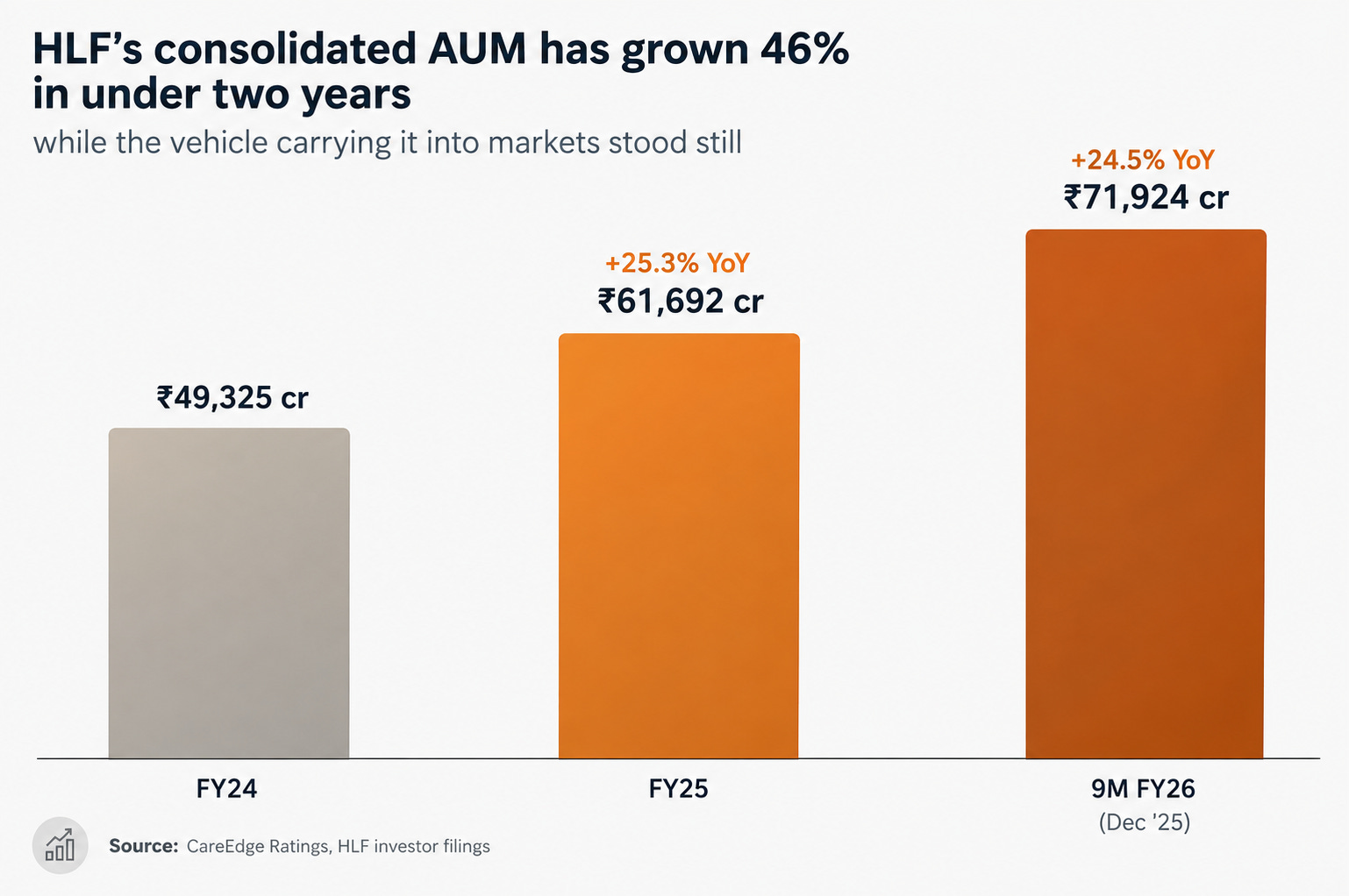
Start with the business actually being listed. HLF’s consolidated AUM has gone from ₹49,325 crore in FY24 to ₹61,692 crore in FY25, a 25.3% jump, and kept climbing to ₹71,924 crore by December 2025, still growing at roughly 24.5% year on year. Growth here hasn’t been the constraint. Getting to a listed structure has.
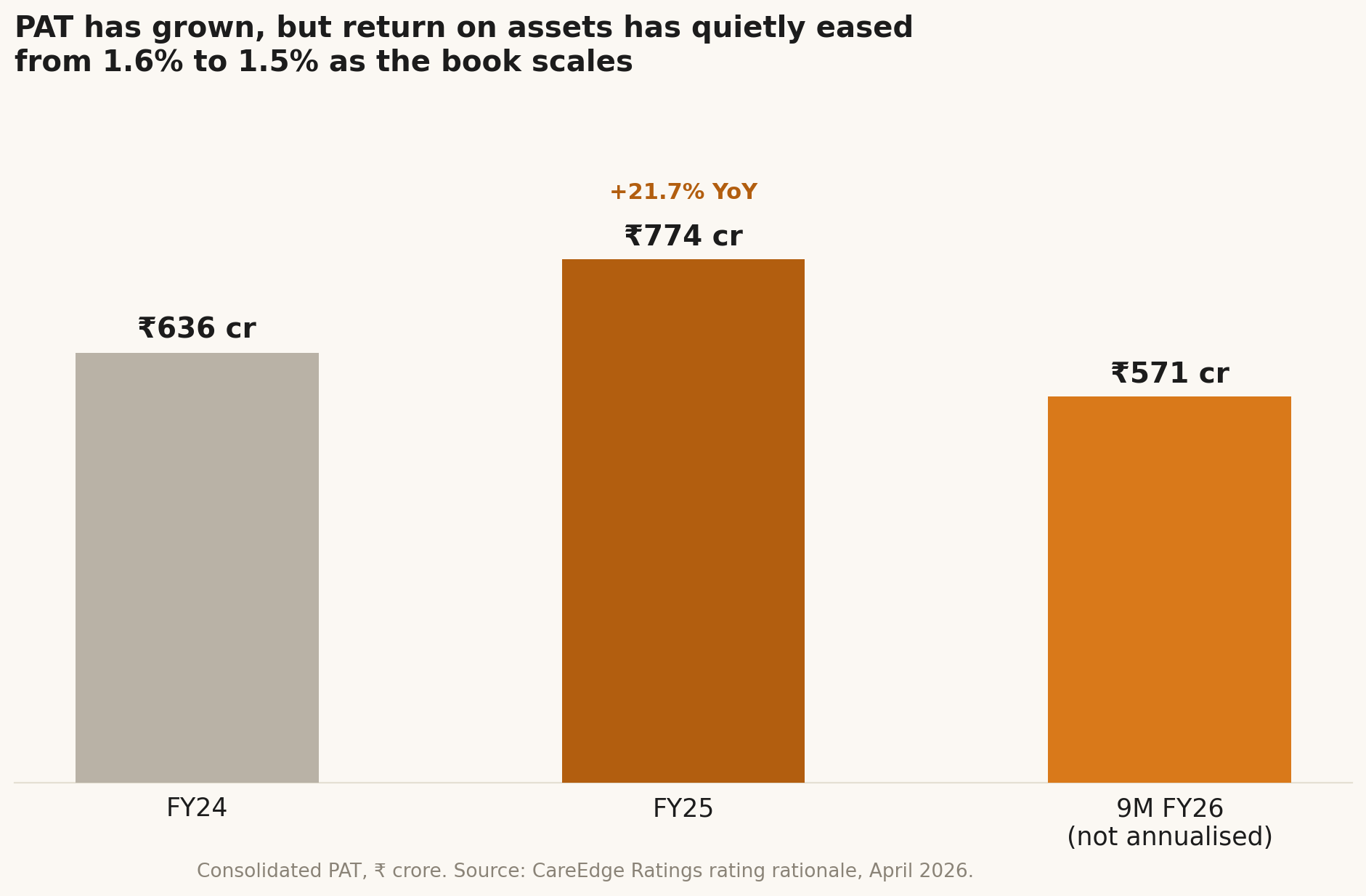
Consolidated PAT moved from ₹636 crore in FY24 to ₹774 crore in FY25, a 21.7% increase. Nine months into FY26, PAT sits at ₹571 crore on total income of ₹5,890 crore, broadly on pace with the prior year. Return on total assets has eased slightly, from 1.6% to 1.5%, a modest signal that the book is scaling a touch faster than profitability is compounding, worth watching once quarterly disclosure standards tighten under a listed structure.
Housing Finance, the subsidiary inside HLF, shows a similar pattern at smaller scale: AUM grew 15% to ₹15,937 crore in FY26 while PAT grew a slower 4%. That’s a fairly normal profile for a scaling housing-finance arm, and also the kind of detail that gets lost inside one consolidated number, and would likely get its own disclosure line once HLF is listed.
The share-price story so far has moved for a different reason than the operating numbers above.
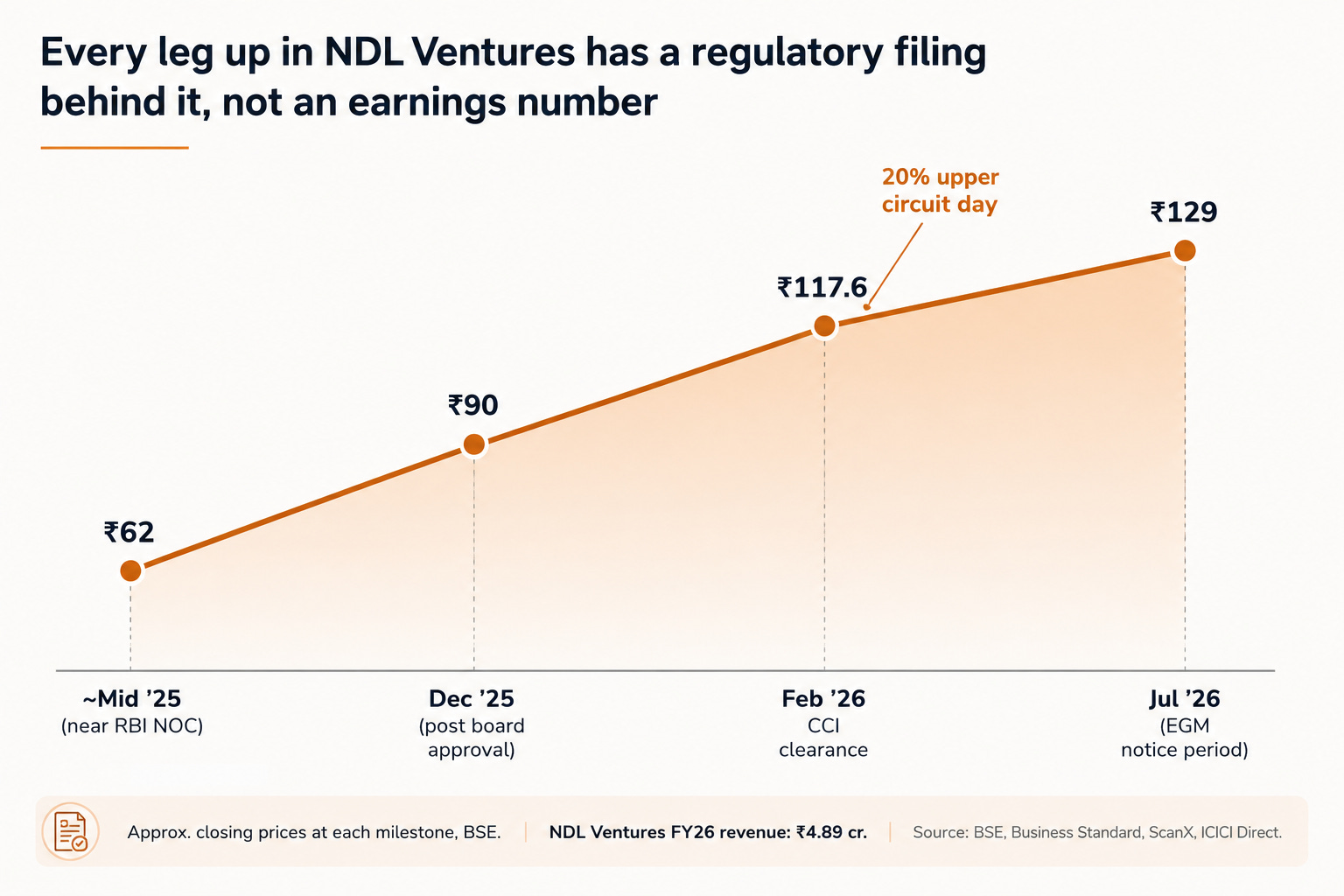
NDL Ventures traded near its 52-week low around mid-2025, ahead of the RBI’s no-objection certificate. It moved to around ₹90 after the November 2025 board approval, then to a 20% upper circuit at ₹117.60 the day CCI cleared the combination in February 2026, and to around ₹129-130 by early July 2026 as the EGM notice went out, an 84% one-year return on a business that generated ₹4.89 crore of FY26 revenue and ₹0.91 crore of PAT. On those figures, NDL Ventures was trading at a P/E of roughly 297x to 491x depending on the day, well above an NBFC sector average closer to 31x. That gap is best read as the market pricing in the pending HLF combination well ahead of its close, rather than anything about NDL Ventures’ own small existing business.
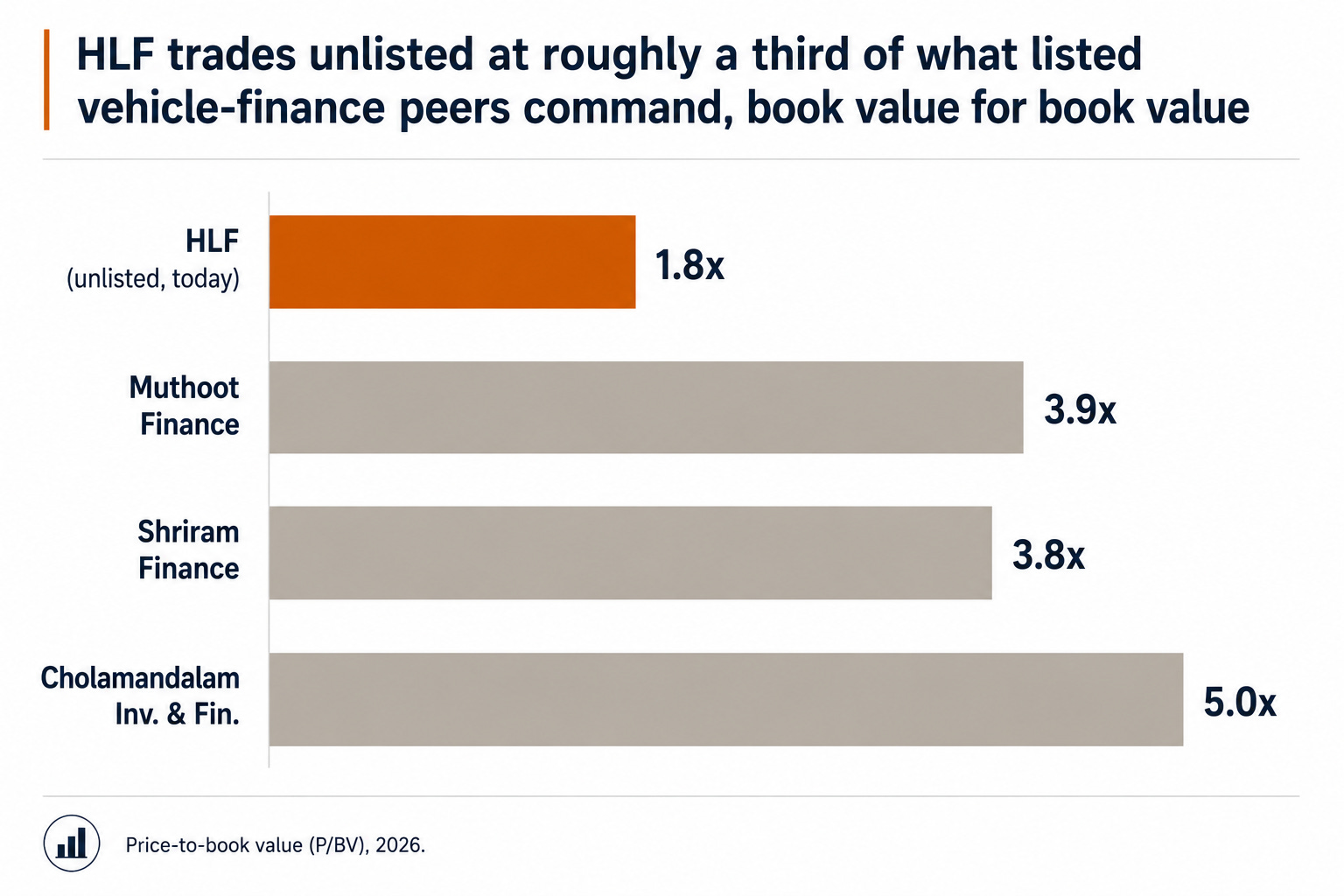
HLF itself has traded unlisted at roughly ₹230 to ₹265 a share through mid-2026, implying a market cap near ₹13,000 crore and a P/BV of about 1.8x. Listed peers in the same business trade at meaningfully higher multiples: Muthoot Finance around 3.9x, Shriram Finance between 3.7x and 3.9x, Cholamandalam Investment & Finance near 5.0x. If a listed HLF closes even part of that gap once it trades as a standalone NBFC rather than a private subsidiary, the resulting re-rating on book value is a significant part of the investment case, independent of any further AUM growth.
Even fully re-rated, a listed HLF would sit well below Shriram or Cholamandalam in scale. The unlock case here isn’t about HLF becoming the largest name in the room. It’s about a business already worth roughly thirty times its host shell being allowed to trade as what it actually is.
One more figure worth noting: what this route avoids in upfront cost. A conventional IPO at HLF’s unlisted scale, roughly ₹13,000 crore, would typically carry underwriting, legal and marketing costs in the 2% to 3% range, call it ₹260 to ₹390 crore, before any new shares are sold. A reverse merger trades that cash cost for a different one: several years of sequential regulatory approvals, from RBI to CCI to NCLT to a shareholder vote, and the pricing risk embedded in a fixed swap ratio, which as shown above was running at a modest discount the day it was set. It’s a genuinely cheaper route on paper. Whether it’s cheaper in practice depends on how the ratio performs once the shares are actually fungible.
HLF isn’t the only company bypassing the traditional IPO route, but not all reverse listings follow the same playbook.
There are roughly four variants currently in use. The domicile-shift merger, like Zepto’s move to fold its Singapore holding company into its Indian entity to enable a domestic listing. The legacy listed vehicle, where an old listed company evolves into an entirely different business over time, as with Religare Enterprises. The captive-subsidiary reverse listing, a large unlisted business merging into a related listed company, which is what HLF is doing with NDL Ventures. And the group restructuring, where assets move between listed entities, as in the HGS-NXTDigital transaction now under GAAR review.
The underlying demand backdrop is solid across all of these: CRISIL expects vehicle-finance AUM across Indian NBFCs to grow 16-17% annually to around ₹11 trillion by March 2027. What differs company to company isn’t the tailwind. It’s the route chosen to access public markets, and each route carries its own trade-offs in process, timing and price discovery.
A conventional IPO has institutional investors effectively negotiate valuation through book-building. A reverse merger fixes the exchange ratio upfront, largely between two boards under common promoter control, and the market only prices the combined entity after the transaction closes. That’s a different, less market-tested path to price discovery, not an inherently worse one for minority shareholders, and it’s a path Hinduja Group has now used twice, in two different contexts, within a few years.
RBI issued its no-objection certificate for the merger scheme in August 2025, more than three years after the plan was first floated.
Both boards approved the final swap ratio, 25 NDL shares for 10 HLF shares, on November 25, 2025, with Ashok Leyland touching a then-record high the same week.
CCI cleared the combination in February 2026, triggering NDL Ventures’ 20% upper circuit day.
NCLT Mumbai’s first-motion order came through on June 17, 2026, directing the companies to convene shareholder and creditor meetings, with secured creditors representing 92% of HLF’s debt having already signed off in advance.
CRISIL reaffirmed HLF’s AA+/AA/Stable/A1+ ratings in March 2026 alongside fresh subordinated debt and perpetual bond issuance of ₹2,554 crore raised across FY25 and the first nine months of FY26.
Not whether India’s vehicle-finance sector has room to grow, CRISIL has already answered that. The more specific, more answerable questions:
Re-rating. Does NDL Ventures converge toward HLF’s unlisted valuation once the merger closes, or does the modest arbitrage discount seen in November 2025 persist as merger-driven buyers exit into the listing?
Value unlock. Does the market eventually price HLF closer to listed NBFC peers.
Liquidity. How much public float remains after the merger, given a rough 59-73% estimated promoter stake in the combined entity, and is it enough for the re-rating case to actually show up in a liquid, tradeable price?
Disclosure. Does Hinduja Housing Finance, growing AUM faster than profit inside HLF, get broken out on its own once the combined entity is listed?
Regulatory context. Does the separate HGS-NXTDigital tax matter stay contained to that transaction, or does the shared corporate history of the shell draw incremental questions on this one, even though the two transactions are structurally different?
This isn't really a story about vehicle finance. It's about whether the market will finally value HLF like the standalone NBFC it is.
A note on the numbers above: several figures, the illustrative re-rated SOTP value, and the IPO-cost comparison are our own calculations built from disclosed stakes, swap ratios and public market data, not company or brokerage-published figures. They’re flagged as such in the text and should be treated as directional, not as a substitute for the actual scheme documents or a formal broker note once one exists on the listed entity.
Comments
Nothing yet. Say the first thing.
Sign in to join the conversation.