
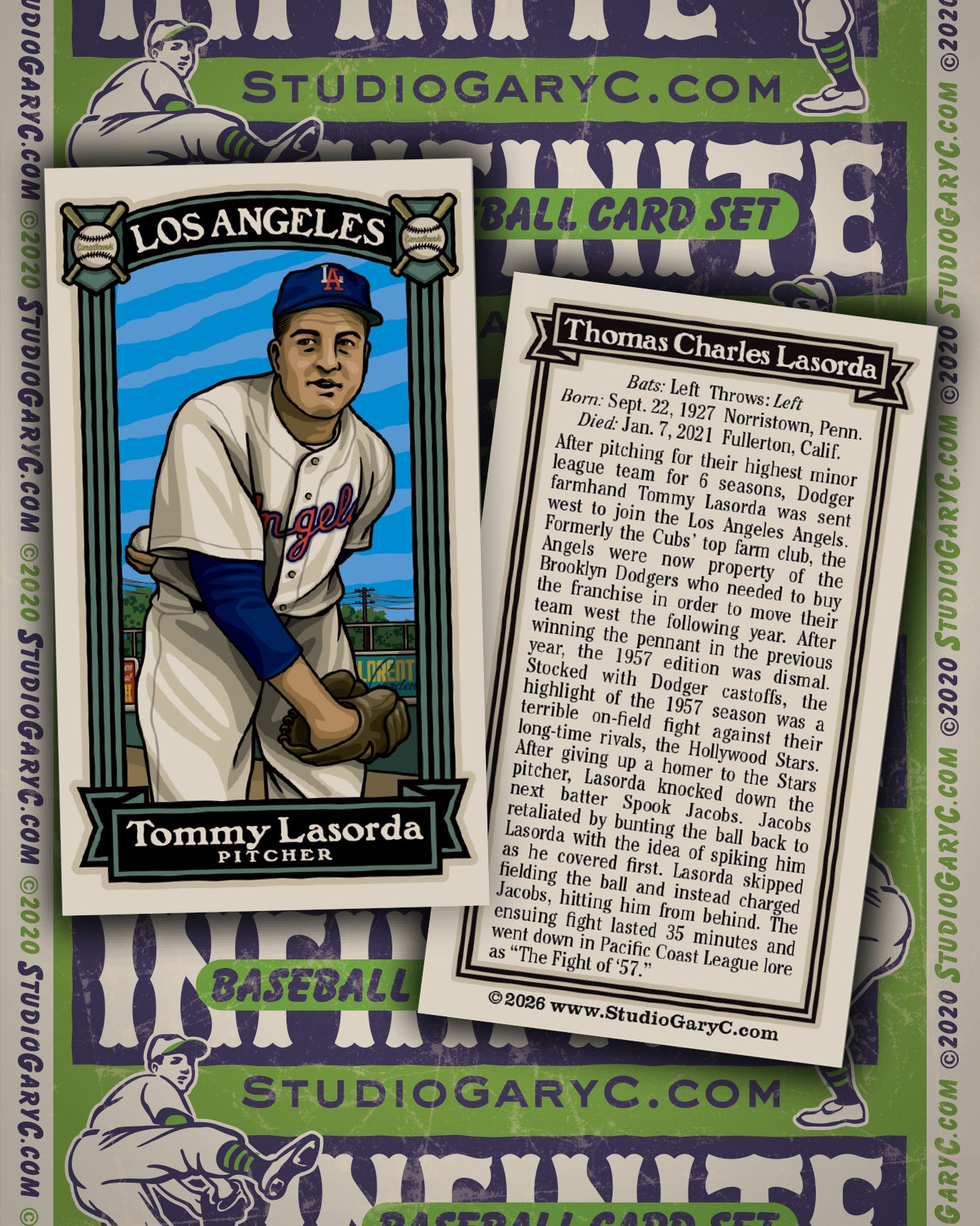
Tommy Lasorda watched the first five games of the 1955 World Series not from the Brooklyn Dodgers bullpen in Ebbets Field as he hoped, but on the TV set in his living room in Norristown, Pennsylvania. Lasorda began the ’55 season with his beloved Dodgers, but after four lousy innings in four games and an ugly 13.50 ERA, the lefthander was sent down to the minors. That his place on the Dodgers was taken by a bonus baby college kid who couldn’t hit the side of a barn with his fastball was a bitter topping on his slice of humble pie.
The frustrating thought that he had been so close to being there in the World Series must have been running on repeat through Lasorda’s mind when a telegram arrived unexpectedly. The wire was from Walt Alston, Brooklyn’s manager, asking if Lasorda could report to Yankee Stadium to pitch batting practice the next morning. The Dodgers were up three games to two, and southpaw Whitey Ford was slated to start the do-or-die Game 6 for the Yanks. Alston had been Lasorda’s manager in the high minors, and he figured that his left-handed pitches would help the Dodgers’ players get accustomed to what Ford would be serving up that afternoon.
As he drove the ninety miles up the Jersey Turnpike to Yankee Stadium, Lasorda left behind any animosity he felt about being demoted by the team. Loyalty meant everything to Tommy Lasorda; the Dodgers needed him, and he would be there for them.
THOMAS CHARLES LASORDA was the second of five sons born to Sabino and Carmella, Italian immigrants from the small town of Tollo in Abruzzo. The Lasorda’s settled in Norristown, a manufacturing town a few miles north of Philadelphia. Sabino worked in a meatpacking plant while Carmella ran the household. The Lasorda boys formed a tight unit known throughout their neighborhood as “The Big Five.”
As most brothers do, Tommy and his siblings fought amongst themselves, and Lasorda became quite adept at using his fists – and he wasn’t afraid to use them. In one story he told, he was a 15-year-old bellhop when three drunks began poking fun at the fancy monkey-suit of a uniform he wore. Not only were the drunks insulting him, but they were also insulting his employer. Even at an early age, loyalty meant everything to Lasorda, so he flattened two of his hecklers, and when the third pointed to his bandaged hand and protested, “you wouldn’t hit a cripple, would you?”, Lasorda KO’d him, too.
Around this time, Lasorda was even offered the chance to pursue a pro boxing career after sparring with an up-and-coming fighter and knocking him through the ropes. It was tempting, but baseball was where Tommy Lasorda’s heart lay.
As a young boy, Lasorda followed the Yankees, who were at the time in the midst of winning six world championships between 1936 and 1943. However, as a pitcher, it was Van Lingle Mungo of the Brooklyn Dodgers whom he idolized. That Mungo was a righthander, and he was a lefty, made no difference; Lasorda emulated the Dodgers pitcher’s big leg kick and adopted the nickname “Mung” in his honor.
Money was tight, and Lasorda later recalled that he and his friends would wait outside the local jail to catch balls the inmates hit over the wall in the rec yard. Bats were fabricated from discarded pick handles and scraps of wood. He obtained his first baseball mitt when a fight broke out at a local amateur ballgame, giving him time to swipe an unattended glove. That it was a right-handed model didn’t matter to the lefty Lasorda.
Though he later liked to say he barely made his high school baseball team, Lasorda was, in fact, a pretty good left-hander as a teen. In addition to playing varsity ball for Norristown High, the sixteen-year-old Lasorda pitched for the local Parks and Recreation All-Stars. While he didn’t have an overpowering fastball, he threw a good curve. The burning competitiveness and desire to win that would mark Lasorda’s professional career date back to these formative years, as demonstrated by his willingness to bean any player who dared to get a hit off him.
IN THE SUMMER of 1944, Lasorda pitched his sandlot team to a 5-4 victory over the Connie Mack All-Stars, a traveling team sponsored by the Philadelphia Athletics. The Connie Mack’s were a talent pool heavily scouted by East Coast teams, and many of their former players were now in the war-depleted major leagues. After the game, Lasorda was recruited by the team and pitched for them for the remainder of the summer.
Among the scouts following the Connie Macks was Jocko Collins of the Philadelphia Phillies. Collins took a liking to the husky southpaw and peppered the teen with contract offers throughout the fall of 1944. Like many sons of immigrant parents, Tommy Lasorda had to convince his father, Sabino, that playing a sport was a viable career. Fortunately, Sabino appreciated that his son had held many jobs throughout his youth and was no shirker when it came to hard work. Though he was a bit disappointed that his son was not pursuing higher education, Sabino ultimately trusted his son’s judgment. A $100 bonus sweetened the deal, and Sabino signed the contract allowing his boy to play professional baseball.
Tommy Lasorda’s first step on the baseball ladder was with the Class D Concord Weavers of the North Carolina State League. While the big-league Phillies were a terminally bad team, their lowest-level farm club was even worse. Lasorda’s 3-12 record mirrored the Weavers’ 34-79 last-place finish, but his strikeouts per 9-innings ratio was the best among the starters. He also batted .274 as a part-time first baseman, third-best on the club.
THOUGH THE WAR had ended in August, the draft was still in effect, and Lasorda was mustered into the Army that fall. He spent the next two years stateside, playing ball on service teams. While stationed at Fort Jackson in South Carolina, Lasorda moonlighted for a couple of local teams, first for Joanna Mills and then the Camden Chiefs, earning between $150 and $200 a week. On August 25, 1947, “Lefty” Lasorda struck out 13 on his way to a no-hit win over the Florence Red Caps.
Concurrently, Florence pitcher Jack Clifton pitched 8 2/3 innings of no-hit ball after giving up a single in the first inning. He was making such a good paycheck that he remained with Camden after his discharge from the Army, turning down the Phillies’ offer to pitch for their Rock Hill farm club.
Tommy Lasorda came out of the Army a fitter, more mature twenty-year-old. The Phillies assigned him to their Class C Schenectady team in the Can-Am League. Described as “a crafty lefthander with a good fast ball and tricky hook,” Lasorda struck out a record 25 batters in a 15-inning game against the Amsterdam Rugmakers, winning his own game by hitting an RBI single.
He then continued his Can-Am tear by striking out 15 in his next start, then 13 in the game after that. His performance against the Brooklyn Dodgers’ affiliate in the league, Trois-Rivieres, gained the attention of their manager, Ed Head. When Philadelphia left him unprotected during the off-season, the Dodgers snatched him up on Head’s insistence. Assigned to the Class A Greenville Spinners, Tommy Lasorda was now on his way up the ladder leading to Ebbets Field.
Early in the season, Tommy Lasorda met up with a longtime enemy of his: Buster Maynard.
Who the heck is Buster Maynard, might you ask?
Well, back when Lasorda was in eighth grade, he was standing with a throng of kids in Philadelphia’s Shibe Park, trying to get autographs from players as they walked to the clubhouse. One of them, a visiting New York Giants player, answered Lasorda’s request for an autograph by shoving the 14-year-old out of the way and into a wall. Lasorda noted the number 24 on his back, checked the scorecard, and learned that the player was Buster Maynard. He never forgot that.
Nine years later, Lasorda was on the mound facing the Augusta Tigers when the PA blared, “Now batting: Buster Maynard.”
Lasorda threw the first pitch at Maynard’s head, sending the old New York Giant sprawling in the dirt. Dusting himself off, Maynard stepped back into the box. Lasorda threw at him again. The two exchanged threats, then settled back into position. When the third pitch sent him diving for cover again, Maynard charged the mound, but players held the two apart before it came to blows. After the game, Maynard came looking for Lasorda. Instead of throwing a punch, Maynard genuinely wanted to know why this young punk had a blood vendetta against him. When Lasorda told him the Shibe Park story, Maynard took it in, then asked, “You’re serious, right?” When Lasorda nodded, the old ballplayer simply said, “Wow,” and walked away, shaking his head.
Besides finding old enemies on the field, he also found his future wife. During a home game, Lasorda met Joanne “Jo” Miller, a Greenville native. Jo’s parents dragged her to the park that day to keep her away from the guy she was dating, whom they did not approve of. As Lasorda later joked, “I’ll tell you what, if they knew she was going to meet me that night, they would have appreciated him a lot more.” The two married the next season and remained together until Lasorda passed away seventy years later.
AFTER A 7-7 record in Greenville, he impressed the Dodgers enough to be sent directly to their top farm team in Montreal. In his first year, Lasorda went 9-4, and the next year he led the team to the Governor’s Cup championship with a 12-8 record. These Montreal Royals teams of the early 1950s were packed with future Dodgers-in-waiting. Managed by Walt Alston, who would go on to manage the Dodgers for 23 years, the 1951 pitching staff boasted Joe Black (the next season’s National League Rookie of the Year), Jim Hughes, Bud Podbielan and Chris Van Cuyk, all of whom had serviceable careers in the majors.
Tommy Lasorda was immensely popular with the fans in Montreal. His teammates called him “Walkie-Talkie” for his nonstop jawing and expert bench-jockeying. He was also tough as nails, and International League hitters learned not to dig in against the loud-mouthed left-hander. He backed up his head-hunting fastball with his fists as well, leaving a trail of on-field fights in his wake. Lasorda was driven by the desire to win, and after another strong season as the ace of the Royals staff, he got his chance at the big leagues – but not with Brooklyn.
The lowly St. Louis Browns purchased Lasorda after the 1952 season, and although pictures were even taken of the eager lefty in a Brownies uniform, the deal fell through, and he was sent back to Montreal. Although obviously disappointed, Lasorda turned in yet another good season, going 17-8 and leading the team to the Governor’s Cup Championship, then to victory in the Junior World Series against the Kansas City Blues, the Yankees’ top farm club. By now, Tommy Lasorda had a respectable 52 wins and 25 losses for Montreal. He was perched on the top rung of the Brooklyn farm system, and it was just a matter of time before the big club gave him a chance.
He bore down and was 14-4 in ‘54. Former Montreal manager Walt Alston was now skipper of the Dodgers and, in August, he called Lasorda up to the big club. With Brooklyn in a do-or-die race for the 1954 pennant, Lasorda was eager to show what he could do at the major-league level.
He made his first appearance on August 5 against the Cardinals. He pitched three innings in relief, gave up 6 hits, including a home run, and had three earned runs pinned on him. He rode the bench for a full month, watching the pennant slip away from his beloved Dodgers.
Dying for a chance to help his team, he complained to Alston, who told the lefty that he had brought him up for his attitude, not his talent. His former skipper felt that Lasorda’s mouth was more of an asset to the team than his arm and had thought that the enthusiasm he brought to the clubhouse would help inspire Brooklyn to the pennant. This was devastating to Lasorda, and for the first time he harbored doubts about his ability to play at the major-league level.
By September, the Dodgers were out of the running, and Lasorda was able to pitch in two more games, throwing a total of four scoreless innings and giving up a single hit.
Lasorda made the big club in 1955 and almost immediately set a major-league record that still stands – but not the good kind. In the May 5 game against the Cardinals at Ebbets Field, Lasorda began the first inning by walking leadoff batter Wally Moon. He uncorked a wild pitch to Bill Virdon, sending Moon to second. A few more pitches missed, and he walked Virdon. A second wild pitch to Stan Musial advanced the runners. Lasorda managed to strike out Stan the Man but unleashed yet another wild pitch to Rip Repulski. As Moon tried to score, Lasorda blocked the plate and received a nasty gash in his right knee for the effort. He got the next two batters out, but the cut forced him to leave the game. Lasorda’s record of three wild pitches in one inning has since been matched but not surpassed.
Lasorda threw three more innings across three games, resulting in a nasty 13.50 ERA. In June, Alston informed him that he was being sent back to Montreal to make room for that bonus-baby college kid who couldn’t hit the side of a barn with his fastball: Sandy Koufax.
BACK WITH the Royals, Lasorda started off terribly, letting his disappointment get in the way of his pitching. Now 27 years old, he was coming to realize that his career was on the downswing. However, Lasorda began to discover that he had other talents besides pitching – he worked well developing younger players, and he had a natural leadership quality that drew others to him. Bolstered by his newfound talents, he started to pitch well, and by the end of the season, he helped Montreal to yet another International League pennant. And when Walt Alston sent word asking him to report to Yankee Stadium to pitch batting practice before Game 6 of the 1955 World Series, he did not hesitate – loyalty meant everything to Tommy Lasorda.
WHILE OTHER BALLPLAYERS took the winter off, Lasorda worked ceaselessly to hone his craft. From 1950 to 1960, Lasorda pitched in the winter leagues of Puerto Rico (5 seasons), Cuba (5 seasons), and Panama (1 season).
Pitching in the Cuban League in 1952, Tommy Lasorda’s fiery competitiveness got him into some international hot water. For some reason, Lasorda took a dislike to Marianao’s first baseman, a big Cuban named “Chiquitin” Cabrera. Pitching against him one afternoon, Lasorda recalled, “I turned him upside down a few times, then I hit him in the ribs. Here he was coming at me with a bat. Just as he was about to swing the bat, I threw my glove in his face and tackled him. I don’t know how I did it, but I lifted him up in the air and swung him around. That set off a dandy. The next thing I knew, I’m in court with Cabrera, who is really in a jam because he attacked me with a bat.”
“The magistrate asked me, ‘Do you want to press charges?’ and I told him, ‘No, just let me pitch to him again.’”
The next day, Lasorda was at the beach with his wife when a Cuban army officer ordered him to get in a car. He was brought to the presidential palace where Fulgencio Batista himself apologized for Cabrera’s actions. The Cuban president asked, “Is there anything we can do for you?” to which Lasorda replied, “Just let me pitch to him again.”
“The next time I pitched to Cabrera,” Lasorda remembered, “he knew what was coming. I let one go that turned him upside down and inside out, but he never said a word.”
Pitching for the Mayagüez Indios over in Puerto Rico, Tommy Lasorda became the winter league’s Iron Man, performing feats of stamina that seem mythical by today’s standards.
On January 4, 1953, the lefty threw two complete games, winning the opener 3-1, but losing the nightcap in the 10th inning, 2-1. Three weeks later, he beat Caguas in the first game of a doubleheader, then won the nightcap with four innings of relief work.
The next winter, Lasorda performed the unrivaled feat of pitching three games in 25 hours. On November 16, 1954, he won a complete game against Caguas, then lost a five-inning continuation of a suspended game from the previous week. The next day he threw another complete game win against Caguas. For those keeping score, that’s 23 innings, 2 wins – 1 loss, in 25 hours!
In his final winter season, Tommy Lasorda was back in Cuba with the Almendares Scorpions. His fine 8-3 season was highlighted by an eventful New Year’s Eve doing sentry duty with a rifle guarding the team compound from rioters as Fidel Castro’s revolutionaries swept into Havana.
Playing south of the border gave Lasorda the chance to compete with and against the game’s budding superstars, including Roberto Clemente, Hank Aaron, Sandy Koufax, and Willie Mays.
With his fluency in Italian, Tommy Lasorda was able to pick up Spanish quickly. When the non-English-speaking Roberto Clemente joined the Montreal Royals in 1954, Lasorda stepped in to assist him off the field, joining him for dinner and translating the menu items. This skill later gave him an edge over other managers when it came time to communicate easily with his Latino players. This was most evident during the early 1980s when the Spanish-speaking Fernando Valenzuela became the Dodgers’ ace.
THE BATTLES AND BOUTS OF TOMMY LASORDA
From the first time he held a ball, Tommy Lasorda became a fierce and uncompromising competitor. Winning and loyalty to his team were the two values he stayed true to his entire career. And with such temperament came conflict, something Lasorda was more than willing to resolve with his fists.
During Tommy Lasorda’s brief time with the Kansas City Athletics in 1956, Yankees pitcher Tom Sturdivant beaned a couple of the A’s batters. By the rules of baseball, retaliation was called for, but the A’s pitchers were too intimidated by the Yankees to do anything – all except Tommy Lasorda. Manager Lou Boudreau put Lasorda into the game, and he promptly drilled two of the New Yorkers. Yankees second baseman Billy Martin began yelling at Lasorda, and soon the two were charging at each other. Luckily, an umpire broke it up before blows were exchanged. The two became lifelong friends.
A few months before “The Fight of ‘57” in LA, Lasorda was at the center of another slugfest while pitching for the Denver Bears. Frustrated by blowing a five-run lead, Lasorda began throwing at every St. Paul Saint that stepped into the box. Saints batter Norm Larker took exception to the brushbacks and the two duked it out before both were ejected.
Lasorda’s combativeness continued after his playing days. On February 17, 1980, the Dodgers manager was filming an interview at the KNBC-TV studios in Burbank, California. Also there that day was Giants hitting coach Jim Lefebvre, whom Lasorda had canned from the same position with the Dodgers the previous season. The two met by chance in the hallway, words were exchanged, and the pair retreated to an empty studio to hash it out. The 51-year-old Lasorda refused to back down to the much younger and fitter Lefebvre and was punched in the mouth by the Giants coach before it was broken up.
As Tommy Lasorda got older, he focused his rage on mascots instead of ballplayers. Perhaps his most famous mascot bout was fought against the Phillie Phanatic in 1988. During a game at Veterans Stadium, the Phanatic brought out a dummy dressed in a Dodgers uniform and began defiling it before the Philly crowd. Lasorda charged out of the dugout and knocked the dummy down before turning his rage at the Phanatic. Fortunately, officials intervened, holding back the Dodgers manager as he screamed, “You don’t make fun of me or my ball club!”
The next season, the Dodgers were in Montreal when the Expos mascot, “Youppi!” moved close to the LA dugout and began annoying the Dodgers players. This time, instead of attacking the mascot, Lasorda convinced the third base umpire to eject the offending furrie – making it the first time a mascot was tossed from an MLB game.
It was inevitable that Tommy Lasorda would cross paths with the second-most famous MLB mascot – the San Diego Chicken. Lasorda bided his time to retaliate after witnessing the Chicken stomp on a Dodgers cap during his on-field routine. Later, when the two met in the hall outside the locker room, Lasorda grabbed the Chicken by its neck and threatened to squeeze until his eyeballs popped out if he ever did that to his team again.
ALTHOUGH THE DODGERS seemed to have given up on Lasorda, the Kansas City Athletics took notice and bought his contract. He was a big leaguer again, but not for long. He pitched in 18 games for the A’s in 1956, losing 4, before he was traded to the Yankees, who in turn sent him to their Denver affiliate for the remainder of the season.
He began 1957 with Denver, but made it known that he wanted to be traded back to the Dodgers organization. Here’s where loyalty comes in again. Once the Dodgers learned of Lasorda’s desire to return to the fold, the team traded an infielder for him and assigned him to their new farm team in Los Angeles. Thus, Tommy Lasorda found himself in Los Angeles one year before the Dodgers did.
AS A PRECURSOR to their planned move to LA, the Dodgers had to purchase the existing minor league team, the Los Angeles Angels. Longtime top farm team of the Chicago Cubs, the Angels were coming off their championship 1956 season, which many historians call the greatest minor league team of all time. However, after Brooklyn’s purchase of the team, the Cubs transferred all their talented players elsewhere, and Tommy Lasorda was assigned to bolster the Angels’ depleted pitching staff.
For decades, the Pacific Coast League was considered almost on a par with the major leagues, and many players actually refused to go to the big leagues because of the better playing conditions and salaries found out West. Rivalries were intense among certain PCL clubs, and in 1957, Lasorda inserted himself right in the middle of the biggest one, going down in Coast League history not for his pitching but for his temper.
The Angels had a long history of fights with their cross-town rivals, the Hollywood Stars. Already in the decade, there had been a number of on-field altercations, including a horrific televised riot in 1953.
In what became known as “The Fight of ‘57,” Lasorda was on the mound for the Angels and had given up a home run to Hollywood’s pitcher, Fred Waters. By the rules of baseball, the next batter, Spook Jacobs, had to go down. Not only was Lasorda pissed at giving up a homer, but to give one up to a fellow pitcher was just embarrassing. Lasorda, who never shied away from giving a batter a little chin music, fired a ball directly at Spook, who hit the dirt. Picking himself up, Jacobs said nothing and stepped back in the box.
Remember – this was the unwritten law of baseball, and Spook was cool with it.
On the next pitch, Spook bunted the ball back toward the pitcher.
The second unwritten rule of baseball says that after throwing at a batter, the pitcher had better expect a little retaliation. Lasorda, of course, knew this. Spook figured Lasorda would field the bunt and would have to stand on first base, giving him the chance to spike the shit out of the pitcher. But Lasorda didn’t field the ball. Instead, he charged at Spook and hit him from behind. All hell broke loose, and the ensuing fight lasted 35 minutes.
All in all, it was a terrible season for Lasorda and the Angels. In their final season in the Pacific Coast League, the team finished 6th, a far cry from their historic 1956 squad. Lasorda went 7-10, and the next season he was sent back to Montreal, where he began honing his skills as a team leader, assisting Royals manager Clay Bryant in running the team. He also had one of the best seasons of his career, winning 18 games.
But Lasorda knew his future was in managing, and from then on, everything he did was focused on attaining that goal. After retiring as a player in 1960, he began scouting for the Dodgers. In 1965, he was at the helm of the Dodgers’ Pocatello Chiefs rookie league club and began a steady rise through the organization’s farm system. Finally, in 1976, he replaced his former manager in Montreal, Walt Alston, as skipper of his beloved Dodgers.
Tommy Lasorda managed the Dodgers for twenty years, making the playoffs in eight of them and winning four National League pennants and two World Championships. It took a heart attack in 1996 to finally get him out of his Dodgers uniform. The following year, he was elected to the National Baseball Hall of Fame, and the Dodgers permanently retired his number 2.
Besides having a plaque in Cooperstown, Lasorda is enshrined in the baseball Hall of Fames’ of Cuba, Puerto Rico, and Canada.
Tommy Lasorda had one final turn as manager when he piloted the United States men’s baseball team to a Gold Medal at the 2000 Olympic Games, upsetting the much-favored Cuban team.
He passed away on January 7, 2021, followed nine months later by Jo, his wife of 70 years.
* * * * * * * * * * * * * * * * * * *
The World Series story that began this piece came from a small piece in the October 12, 1955 Sporting News, while many of the colorful anecdotes and minor league tales were found in Tommy Lasorda’s autobiography The Artful Dodger, written with David Fisher.
* * * * * * * * * * * * * * * * * * *
This story is Number 96 in a series of collectible booklets
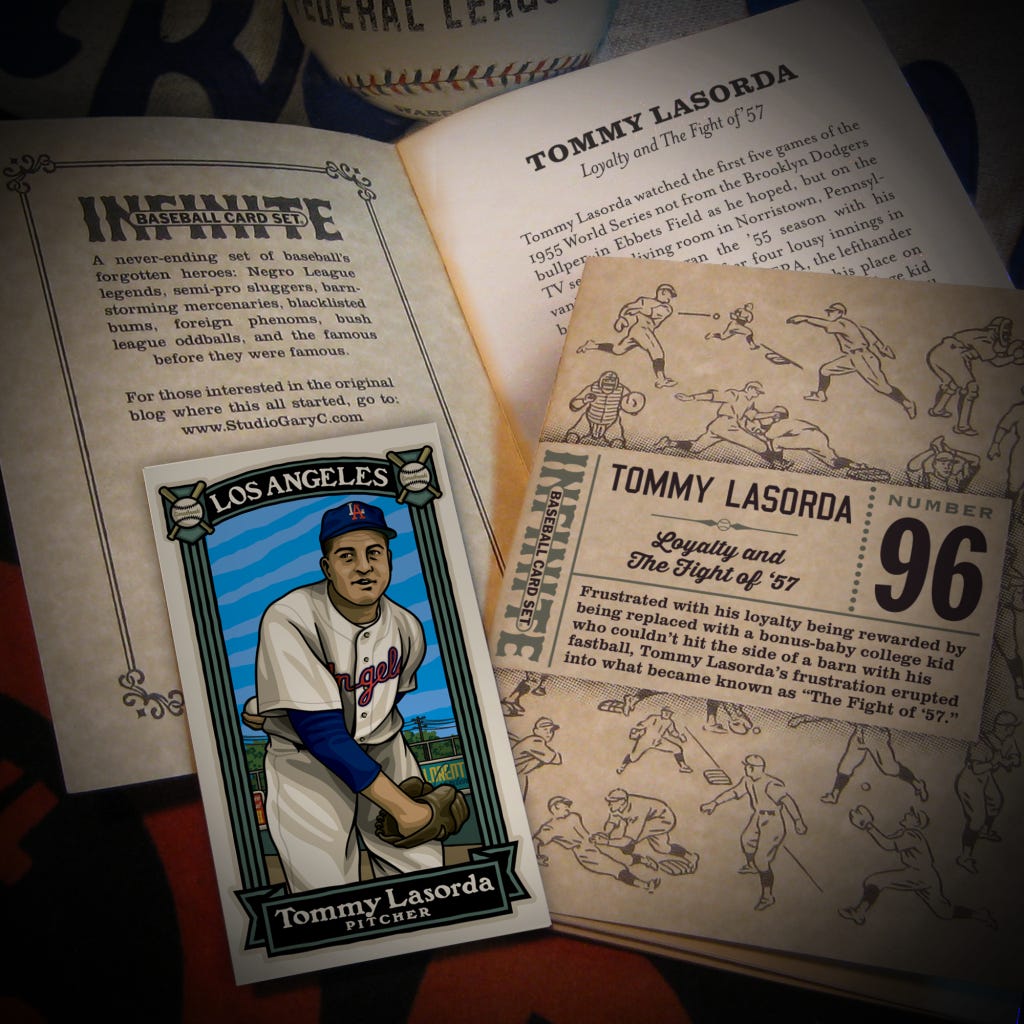
Each of the hand-numbered and signed 4 ¼” x 5 1/2″ booklets feature an 8 to 24 page story along with a colored art card attached to the inside back cover. These mini-books can be bought individually, thematically or collected as a never-ending set. In addition to the individual booklets, I envision there being themed sets, such as the series I did on Minor League Home Run Champions. You can order a Subscription to Season 8 as well. A year subscription includes a guaranteed regular 12 issues at a discounted price, plus at least one extra Subscriber Special Issue. Each subscription will begin with Booklet Number 090 and will be active through December of 2026. Booklets 1-89 can be purchased as a group, too.
No posts
Comments
Nothing yet. Say the first thing.
Sign in to join the conversation.