
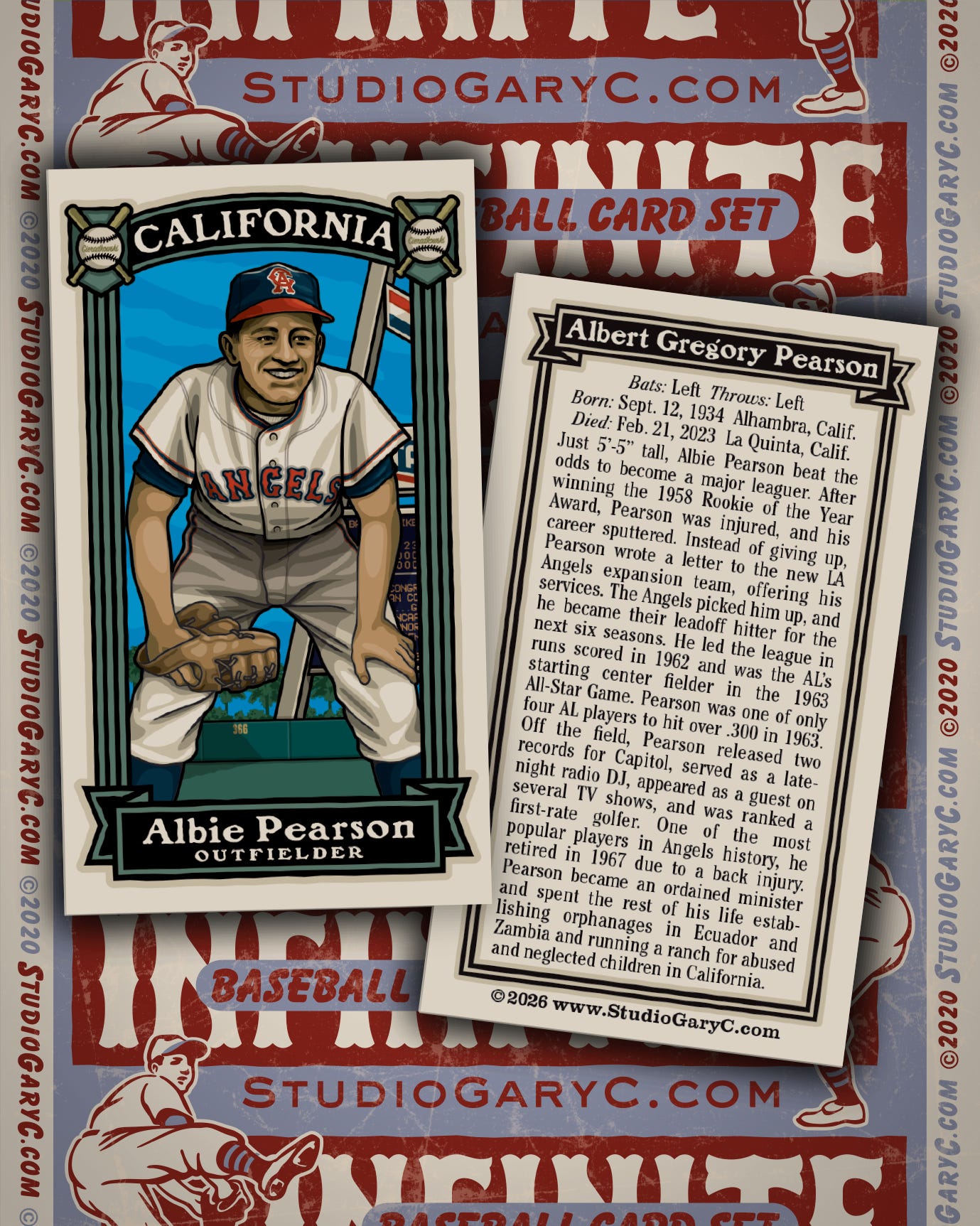
Fred Haney was still settling into his new position as general manager of the Los Angeles Angels, one of the American League’s two new expansion teams. Starting any ball club from scratch is tough, but to do that with a major league franchise is as close to impossible as you can get. There was no farm system to mine for talent, no working agreements with other clubs, heck, he didn’t even have a single scout he could dispatch to look for ballplayers!
One afternoon, while going through his mail, Haney came upon a letter that caught his attention. It was short and to the point:
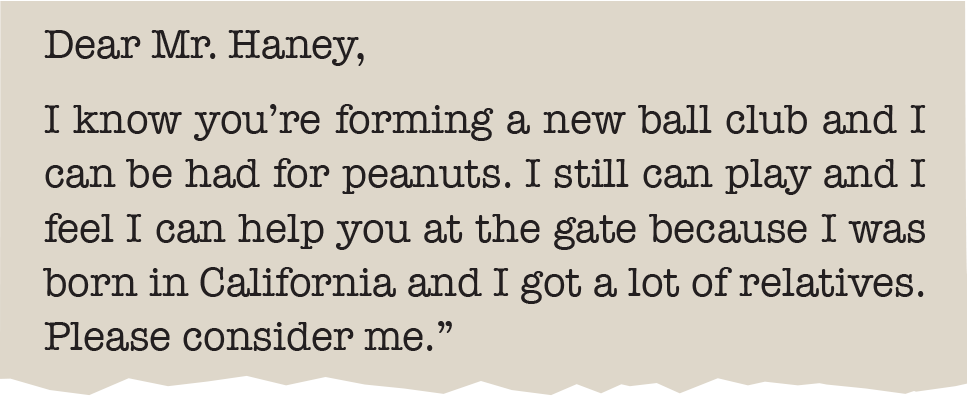
Haney figured it was probably penned by some crackpot poking fun at the American League’s newest GM, or maybe a last-ditch attempt to play pro ball by a middle-aged semipro from the sticks. But the name at the bottom of the letter kept Haney from tossing it in the circular file:

The Angels GM sank back into his desk chair and gave that name a think.
At 65, Fred Haney was the prototypical baseball lifer. Though only 5 foot – 6 inches, he had proved the naysayers wrong and hit .275 as a big-league infielder for Ty Cobb’s Detroit Tigers in the 1920s. After his playing days ended, he returned to the majors as manager of the St. Louis Browns and Pittsburgh Pirates before piloting the Milwaukee Braves to two pennants and a World Championship. He had worked behind the mic as a radio play-by-play man and later brought his schtick to TV as Lindsey Nelson’s partner on NBC’s Game of the Week.
Fred Haney had done it all and seen it all, and now he flipped through the pages of his encyclopedic baseball mind searching for the name signed at the bottom of this odd letter. Finally, he remembered.
Albie Pearson had won the Rookie of the Year Award with the Washington Senators back in the late 1950s – but beyond that, Haney could not recall anything else about him.
With more slots empty than filled in his spring training roster, the GM buzzed his secretary and directed her to dig up everything she could on this Albie Pearson fella.
ALBERT GREGORY PEARSON lived his life as boldly as his letter to Fred Haney demonstrated. He had to, for Albie Pearson never grew larger than 5’-5 3/8” and he spent his entire life proving that size was the last thing that mattered.
He was born on September 12, 1934, the only child of Albert and Virginia Pearson. Both Albie’s father and grandfather were short, but neither let that hold them back, especially in sports. Both father and son were professional bantamweight prizefighters, and Albert was a record-setting high school track star and the top hitter on his Pasadena City College baseball team. Even Albie’s 5-foot-tall mother, Virginia, was an athlete, playing third base for her school’s baseball team. Their examples fueled Albie Pearson’s relentless drive to succeed despite the odds stacked against him.
Since Albert was 5’-5 3/8” and Virginia barely brushed the five-foot mark, it was not surprising that their son Albie was slow to develop. Yet, at age 12, Albie was just 53 inches tall and weighed 62 pounds. Because of his size, the neighborhood kids shooed him away whenever he tried to join their games. Determined to fit in, Albie created his own bodybuilding regimen, which included throwing a three-and-a-half-pound brick around his yard, running a track-and-field course, and pitching dirt clods at a target drawn on the side of the family’s garage. Albie was spurred on by his father’s example and wise words of encouragement: “My dad always told me not to worry about my size. Two inches aren’t very much unless they’re on the end of your nose.”
When months passed without him gaining any height, the Pearsons took their boy to a specialist in Hollywood. The doctor determined that the boy’s body had stalled at a nine-year-old level and prescribed a course of hormone injections. Two years later, Albie was a more mature 5’-5” and 120 pounds. His personal backyard sports spa paid off, as Albie became a star athlete at El Monte High.
On the football team, Albie played halfback and was occasionally put in as quarterback, even though he could not see over his teammates’ heads. He compensated by rolling out of the pocket and throwing running passes. On the track team, he set an interscholastic meet record in the 100-yard dash – breaking the old record set by his father, Albert, twenty-five years earlier!
But it was baseball that really got Albie going. He was El Monte High’s ace pitcher, going 23-6 over two years of varsity ball. He capped off his senior season with a no-hitter against Whittier High and ended his high school career with a minuscule ERA of 0.83.
Yet when the big-league scouts began handing out contracts to his teammates, not one approached Albie. Despite his enviable record, no one was willing to take a chance on a 5’-5” pitcher. Incredibly, he did receive two college football scholarship offers. Eschewing the college gridiron, Albie spent a semester at Mt. San Antonio College before a professor accused him of being more interested in athletics than in psychology. Albie couldn’t agree more, so he dropped out after the Fall 1952 semester.
IN THE HALF-YEAR since he had been shunned by the big-league scouts, times had changed in Albie’s favor. Bobby Shantz, a pitcher 5’-6” and 150 pounds, had won 24 games for the Philadelphia Athletics that summer, shattering the idea that only big men could play pro ball. That winter, Albie drew interest from the Pirates, Dodgers, Browns, and Red Sox. Although he wanted at least $1000 to sign, he ultimately chose the Red Sox, who offered no bonus, but gave him $225 a month to play for their Class C farm team in San Jose.
Albie had cleared his first hurdle toward a baseball career, but many more lay ahead. When he reported to San Jose’s spring training camp, manager Red Marion exclaimed, “My gosh, they’ve sent me Bill Veeck’s midget.” Marion was referring to St. Louis Browns owner Bill Veeck’s publicity stunt two years earlier, when he sent the 3’-7” Eddie Gaedel to pinch-hit in a game. But Albie Pearson was no stunt; he was there to play. The next obstacle was of a practical nature: there was no uniform available in his size. Albie had to make do with the batboy’s wardrobe until a set in his size could be obtained.
Marion was skeptical that Albie would make good as a pitcher, but that became a moot point when several of San Jose’s outfielders failed to show up at camp. Albie, who batted over .500 in high school, volunteered to fill in. He was so successful that Marion made him his starting right fielder for good. He hit a robust .334, second-best on the team, and the fans voted him the club’s most popular player. He followed that with a steady rise through the Red Sox system, even leading the Texas League with a .371 batting average in 1956.
That earned him a promotion to the Pacific Coast League in 1957, the highest level of the minor leagues. Albie batted .297 for San Francisco in 1957 and was voted the fans’ most popular player again. As part of the Red Sox organization, he got to observe his idol, Ted Williams, up close. Albie later told Sports Illustrated, “I tried to do everything he did,” Albie recalls. “He told me I wasn’t him.”
Instead of getting the chance to roam the Fenway Park outfield alongside Ted Williams, Albie’s contract was sold to the Washington Senators in 1958. Knowing the hard road ahead, Albie made the bold move of writing to Senators owner Calvin Griffith to ask if he could report to spring training early. “I need a ton of work on certain parts of my playing.” He wrote. “There is no shortcut to being a winning ballplayer when you are 5 feet five…”
AGAINST ALL ODDS, he made the big club out of spring training. Albie Pearson had made The Show, but obstacles still remained.
Beyond the obvious size difference, Albie’s squeaky-clean lifestyle set him apart from his teammates. Albie said that when he was a six-year-old playing backyard baseball, God spoke the following words to him: “I want you to play on my team.” He became a devout Christian and was not shy about expressing it. After his first season of pro ball, he married Helen Zaha, a fellow parishioner at his church in El Monte, and started a family. By the time he made his MLB debut, Albie was the proud father of two daughters.
If being a married, devout Christian rookie didn’t put him in a league of his own, Albie neither smoked nor drank, and the strongest expletive to pass his lips was “rat fink.” One anonymous pitcher told a reporter, “He don’t drink, smoke or fool around. You can’t trust that kind.” Many players resented his goody-goody attitude, thinking it all an act. They peppered him with the usual nicknames like “Short Stuff” and goofed on the wholesome answers he gave in his many radio interviews.
Albie put a stop to the static from his teammates the only way he knew how: by playing hard. He covered the outfield with his surprising speed, and aggressive base runners soon learned to fear his rifle arm. When only slugger Roy Sievers had a better batting average on the Senators than Albie’s, the heckling from his teammates dried up for good.
Albie Pearson finished the year with a .275 average and won the Rookie of the Year Award by twice as many votes as the runner-up. But, of course, that’s when fate stepped in.
Thanks to a debilitating cold, Albie reported to spring training weighing just 126 pounds. A hernia further hampered his play, and he was barely hitting above .200 when the Senators dealt him to the Orioles. He didn’t do much better with Baltimore, and he spent the rest of 1959 with their farm team in Miami. The next season, Albie rebounded, hitting .301 for Miami, but he realized there wasn’t much of a future with Baltimore. But there was hope on the horizon: the American League announced that there would be two expansion teams for 1961 – and one would be placed practically in Albie’s Southern California backyard.
THAT’S WHEN ALBIE sent his letter to the new Los Angeles Angels GM Fred Haney. Whether Haney, who had been a 5’-6” infielder during his playing days, had a soft spot for another undersized ballplayer or simply needed bodies to fill his roster, Albie’s letter paid off: the Angels selected him in the final round of the expansion draft.
But as always, there was much to overcome before Albie could call himself a big leaguer again. The Angels’ spring roster was filled with dozens of aging major leaguers seeking a few more years in The Show. There were also dozens of minor leaguers, all hungry for a shot at the majors. Competition was stiff, especially in the outfield, but Albie was prepared to fight for a spot. “I always found if I could compete, I had to do the little things well. I had to run my engine at about 110 percent.”
At the Angels camp in Palm Springs, Albie did everything he could to improve his game. The new Angels manager was Bill Rigney, a baseball lifer who had been a utility infielder with the New York Giants. Rigney had a pet theory that mediocre hitters could improve by learning to hit to the opposite field, and the Angels skipper took a few of his recruits aside and tried teaching them how to do so. Learning this trick is tough and humbling, and one by one, Rigney’s protégés reverted to their old habits. And one by one, they were sent back to the minors – all except Albie Pearson. Despite his spring training average sinking below .200, the left-hander spent hours hitting to left field. Rigney was impressed by his tenacity and penciled him in as the Angels opening day right fielder.
It was with the Angels that little Albie Pearson became a big name. As the season progressed, he mastered opposite-field hitting – of his first 87 hits of the 1961 season, 25 were to left field. The combination of Albie’s miniature strike zone and 20/20 eyesight made him as much of a threat to get on base with a walk as he was with a hit. Rigney installed him as the team’s leadoff man, and by the All-Star break the Angels skipper was telling the sportswriters, “I said it before and I’ll say it again. Albie is the best leadoff man in the game.”
Albie Pearson was the runaway star of the newest American League team. On the field, his .288 batting average was best on the club, and league-wide, he finished 4th in on-base percentage and sixth in runs scored.
The next season, the Angels surprised the baseball world by making a serious run at the AL pennant. The bad-boy pitching duo of Dean Chance and Bo Belinsky won 24 games, and outfielder Leon Wagner pounded out 37 home runs. The team finished third with an 86-76 record and, to date, remains one of only two expansion teams to post a winning record in its second year of existence. Albie Pearson was switched to center field, and he led the AL with 115 runs scored.
1963 was even better – Albie led the league with 139 singles and was one of only four players in the AL to hit over .300 for the year. His .304 batting average ranked him fourth behind Carl Yastrzemski (.321), Al Kaline (.312), and Rich Rollins (.307). He was also named to the American League All-Star team and selected as the starting center fielder over Mickey Mantle. He had two hits in the Midsummer Classic, including the lone extra-base hit in the entire game.
THE OTHER ANGELS players respected Albie’s hard-nosed play and positive attitude. Manager Bill Rigney would have Albie room with some of his more troubled players on road trips, believing his clean lifestyle would rub off a little. Notorious nightcrawler Bo Belinsky was his bunkmate in 1963 and even tried Albie’s lifestyle for a week to see what it was like. Though Belinsky soon reverted back to late nights in clubs and pool halls, he had nothing but admiration for his roomie, telling a newspaper, “A lot of guys look up to the little man.”
As much as his teammates enjoyed playing with him, Albie was sometimes accused of being “a melodramatic” player or a “hot dog.” To this, he countered, “It’s difficult for a little man to be humble. I’m probably the littlest hot dog. I admit it. A little man always looks like he’s putting it on. It’s basically his nature, for as a small kid, he has always had to scrap to make his way. Even if he becomes a big-money tycoon, he remains feisty.” He refused to view his diminutive size as a handicap, telling a sportswriter, “Baseball is primarily a game of big men, but what the Lord takes away in stature, he makes up for it by giving the little fellow something else–that extra drive and heart.”
Off the field, Albie was the most popular Angel, especially with the kids. When he circulated among his fans, children gleefully ran up to him to see how they measured up against the diminutive all-star. His clean, God-fearing lifestyle made him a role model parents could approve of. His affable personality landed him his own late-night radio show on KPRO, where his trademark gimmick was spinning two records back-to-back for what he called a “double play.” He even cut two records for Capitol in 1961, his “Steve Lawrence-type” vocals backed by a lush studio orchestra. The record company wanted him to sing more modern tunes, but Albie turned them down, preferring easy listening to rock n’ roll.
Albie took his position as a role model very seriously. Because of his popularity and proximity to Hollywood, he was often asked to make guest appearances in movies and TV shows. He happily did so – provided the character he played did not go against his strict moral code. This cost him several roles that other players would have died for, but to Albie, his reputation was what counted the most.
In a 1962 Sports Illustrated feature, Albie told Gil Rogin, “I’m a firm believer in the Ten Commandments. I try to live by them without making myself obnoxious. I live my life as an example and I’m not ashamed of it. I want to be careful I don’t ruin my image as the little guy’s idol. I get letters from mothers telling me how proud they are of me because they haven’t seen my picture in a cigarette ad. I’m no prude and I don’t knock ballplayers who smoke and drink. I, too, live my life to the fullest, but I do it in a different way.”
Indeed, Albie Pearson might have been a teetotaler, but he had his indulgences. He drove to and from his country club home in Riverside to the Chavez Ravine ballpark (what Dodger Stadium was called when the Angels played there) in a new Cadillac convertible. His $75 alligator shoes and mod wardrobe would have made even Michael Caine envious.
Albie also excelled at another sport: golf. Far from it being a passive pastime for him, Albie played the links on a pro level, taking every opportunity to show off his skills at the many off-season celebrity tournaments he was invited to. In 1962, he and Wonderama TV show host Bob McAllister teamed up to win the Bing Crosby Pro-Am, and later that year upheld the dignity of his underdog expansion team by whipping their hometown rivals in the 1962 Angel-Dodger Invitational. He won the Baseball Players’ Championship in 1958 and 1965 and was runner-up numerous times. He compensated for his lack of height with custom clubs made with an additional 1-inch of length. He was proud of his 3 handicap and was thinking about turning pro after his baseball career ended.
THE BIG STAR AND LITTLE ANGEL
In a 2012 interview with the San Bernardino Sun, Albie Pearson looked back at his part in what turned out to be Marilyn Monroe’s last public appearance:
“In the summer of 1962 there was some sort of charity function at the stadium and I’m selected to escort a celebrity to home plate for a pre-game presentation. So I go out to the dugout and they tell me the person I’m going to walk to home plate is Marilyn Monroe.
Now I am nervous. So I ask, ‘Where is she?’ And it turned out she was standing over in the far corner of the dugout, completely in the shadows. And she’s pale and shaking and I’m thinking this can’t be Marilyn Monroe, the famous movie star.
Anyway, we’re called out to home plate and I thought I would have to drag her out of that corner. But once she hit that top step of the dugout she became Marilyn Monroe the movie star, smiling and waving. I was simply amazed at the transformation.
Well, we finish the presentation and I walk her back. Now, this whole time I never said a word to her and she never spoke to me. Once we’re back in the dugout, she turns back into this shy, withdrawn person.
As she’s leaving, she suddenly turns to me. And she says, `What is it you are trying to tell me?’ And I was just absolutely speechless. She looked so lost and lonely and I felt I needed to say something, but what do you say to Marilyn Monroe?
It was a haunting experience, but I went on and played that game. We finished the homestand and went on the road and, I think this was in New York, I go down to the lobby to get a morning paper and there’s the headline ‘Marilyn Monroe Commits Suicide.’”
THE ANGELS acknowledged Albies’ great 1963 season with a $33,000 contract, making him the club’s highest-paid player. Unfortunately, something was off in ’64, and his average slipped to .223. The Angels refused to give up on Albie and renewed his big contract. He responded by rebounding to a solid .278. With a decent farm system now up and running, the Angels were moving toward younger players, and Albie was often platooned or used as a switch-hitter to give the kids time to play. Still, Albie was expected to be a key part of the team once they moved to their new ballpark in Anaheim in 1966.
Unfortunately, during spring training, Albie ruptured two discs in his back while sliding into third base. Braces and extensive rehab failed to help, and Albie Pearson played his last game in July 1966. The next spring, the Yankees and Dodgers expressed interest in acquiring his contract, but Albie found the pain too great to overcome.
HIS BASEBALL CAREER was over, but Albie was not through as a role model. He and Helen’s family had now grown to five girls. Albie had been smart with his money, investing in several sporting goods businesses, rental homes, and a real estate development company. A comfortable post-baseball life awaited him, but Albie believed God had a higher calling in store for him.
In 1972, Albie was ordained as a Baptist minister. The former Angels all-star ministered to at-risk kids, drug-addicted hippies, and abused prostitutes. He established a nonprofit that set up churches and orphanages in Ecuador and Zambia and started several parishes in Texas.
In the late 1980s, he and Helen returned to SoCal to found “Father’s Heart,” an 11-acre ranch that housed abused, neglected, and abandoned boys ages 6 to 12. Albie coached the ranch’s Little League baseball and Pop Warner football teams. A 2020 profile in the Orange County Register reported that Albie’s Father’s Heart International Foundation was providing about 4,000 meals a week to children in Zambia whose parents had died of AIDS.
When Albie Pearson passed away at the age of 88 in 2023, he left behind an admirable record of accomplishments both on and off the ball field. He was the Angels’ first player to bat for the franchise, recorded the first run, and was the first to hit over .300. His career at-bats-to-strikeout ratio of 14.7 is the best in Angels history, and he’s still in the top 10 for single-season on-base percentage, runs scored, and plate appearances. Albie was an inspiration to smaller players and convinced scouts to take a chance on undersized prospects such as Zoilo Versalles, Joe Morgan, and Jose Altuve. The lives he and his institutions helped are too numerous to tally.
I’ll leave the final words to Albie, excerpted from a 1966 Los Angeles Times story by Jim Murray: “But most of all, I want to thank God for showing that, through simple belief, you can be a winner forever–regardless of height, weight, reach, swing, or what ounce bat you have to swing.”
*************************************************************************************
When I wrote that Albie Pearson was a popular player in his day, I wasn’t exaggerating. There was no shortage (ha!) of in-depth profiles of him in newspapers and magazines. This story was a fun one to research and write – we don’t come across wholesome sports figures like Albie very often. But boy-oh-boy, the world would sure be a much better place if we did.
* * * * * * * * * * * * * * * * * * * * * * * * * * * * * * * * * * * * * * * * * * * * * * * * * * * * * * * *
This story is Number 94 in a series of collectible booklets
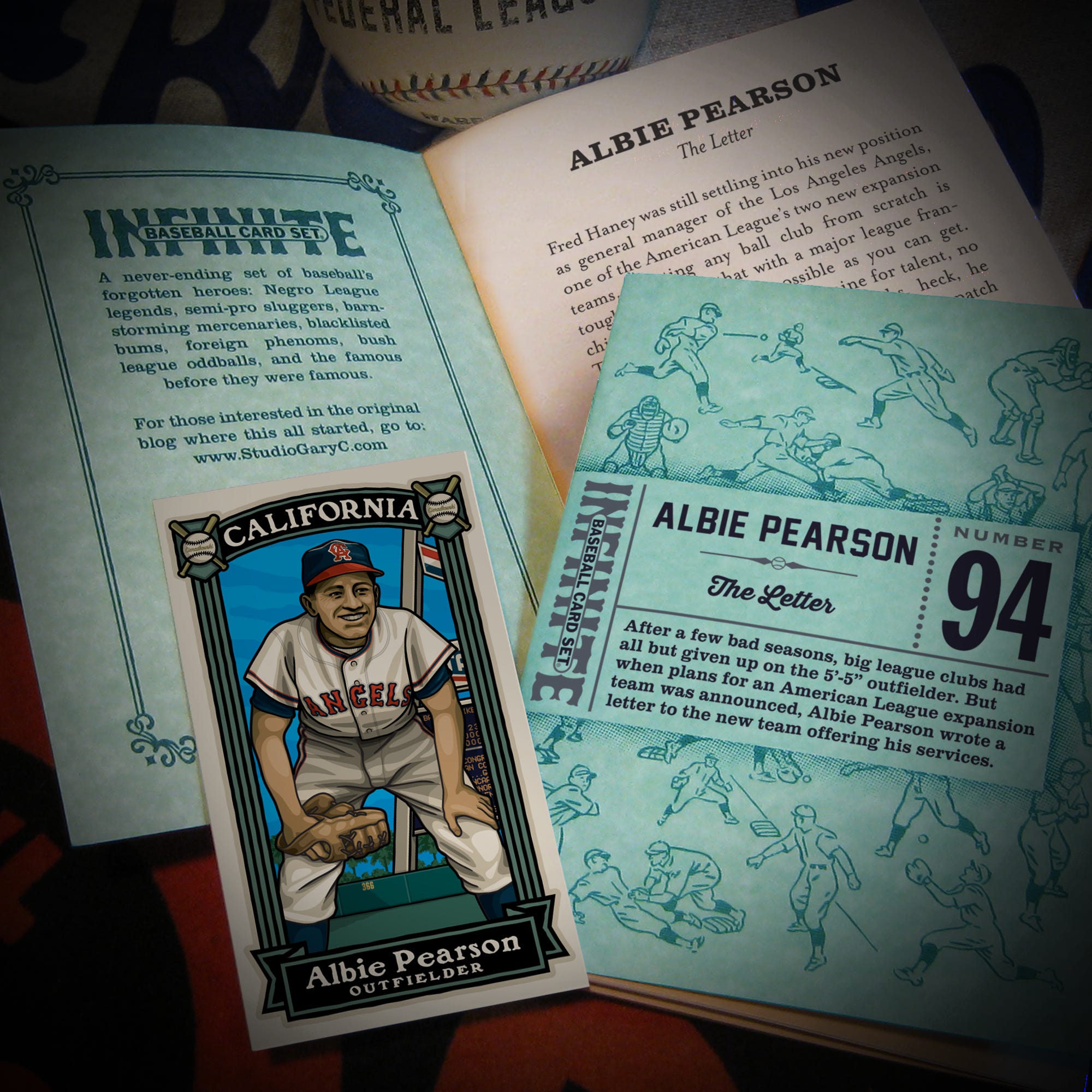
Each of the hand-numbered and signed 4 ¼” x 5 1/2″ booklets feature an 8 to 24 page story along with a colored art card attached to the inside back cover. These mini-books can be bought individually, thematically or collected as a never-ending set. In addition to the individual booklets, I envision there being themed sets, such as the series I did on Minor League Home Run Champions. You can order a Subscription to Season 8 as well. A year subscription includes a guaranteed regular 12 issues at a discounted price, plus at least one extra Subscriber Special Issue. Each subscription will begin with Booklet Number 090 and will be active through December of 2026. Booklets 1-89 can be purchased as a group, too.
No posts
Comments
Nothing yet. Say the first thing.
Sign in to join the conversation.