
Although many economists have cautioned about an impending banking crisis in Russia for a while, now the warnings are coming even from within government circles. In Russia, where the Kremlin frowns upon any admission of weakness, especially if it is related to banks, considering the nightmarish memories of the 1998 default, such a concession is very telling.
What does a banking crisis in Russia look like? How has it sprung into existence? How will it end? Can it be fixed?
Banking Principles. The Basics.
Banks are businesses. Their job is to make money by using other people’s. What banks do is take cash from people who have it and give it to people who need it. They charge the second lot a fee for lending them money, and this is how they pay the first lot for… well, lending them money. Without depositors, banks have nothing to lend. Without borrowers, banks have nothing to pay depositors with. It is a circle.
Problems start when either side of this arrangement breaks down. When depositors take their money out, banks lose the funds they need to lend and earn. When borrowers stop repaying their loans, banks cannot pay depositors back. Well, you get the idea.
What is happening in Russia is that the fish is rotting from both sides. People are withdrawing their money, so they are no longer lending to the banks. And those who owe money to the banks have stopped paying on their loans.
Another element of banking business is lending money to the government when it overspends. Normally, this is not the only avenue governments have. Countries routinely buy sovereign debt from each other in the form of government bonds and earn interest on them. You could say countries act as a bank to other countries.
Russia, however, no longer has access to foreign capital. Russia was already under certain sanctions pre-2022, but following the full-scale invasion of Ukraine, foreign investment fell off a cliff. Before 2022, private foreign investors owned about 22% of Russian government securities. That figure has fallen to around 3%. Even China is not lending Russia any money. Beijing refused to let Russia sell government bonds on the Chinese market.
Since foreign funding is not available, Russia has been borrowing money from its banks. But with banks haemorrhaging money, they cannot afford to lend any funds to the government. In fact, they are hoping that the government will bail them out.
As you can imagine, this is not a normal situation. So, what caused it?
Missing Quarter Budget
The short answer is war. Before 2022, Russia did not have a budget deficit, quite the contrary — it was one of the rare countries with a budget surplus. Similar to other oil-rich countries, the surplus went into the Sovereign Wealth Fund which was used as a reserve for rainy days. When the rest of the world emptied their reserves to bail out economies during the Covid standstill, the Russian government held strong and did not pay anybody a dime. As a result, by the time the war started, they had around 8.9 trillion roubles (roughly $113 billion) in liquid reserves. Currently that sum stands at around 3.5 trillion roubles.
Although 3.5 trillion roubles (circa $43 billion) might sound like a lot to work with, the budget deficit for 2026 alone is almost double this already, and the year is nowhere near the end. By all accounts, when you calculate the expected final deficit, the shortfall in the Social Fund which pays state employees and pensioners, and the deficits run up by regional governments, the total black hole in Russian finances is expected to reach 10 to 11 trillion roubles ($122 to $134 billion). Considering the entire Russian budget is about 44 trillion roubles, we are talking about a quarter of the budget missing.
This was driven by expanding military spending which currently officially stands at around 30% of the entire budget. Add security services and it reaches 38%. Factor in adjacent war-related spending hidden in other budget lines and the figure is well over 50%. We should also consider that it will not be the military side that suffers from the shortage.
Let’s use an old Soviet joke to illustrate this. To a boy’s question if the increase in vodka prices means his dad would be drinking less, dad replies ‘No, son, it means you will be eating less’.
Unproductive Cycle
When the full-scale war started, Western companies pulled out and sanctions disrupted imports. Despite Russia trying to become more self-reliant following the first wave of sanctions in 2014 after the occupation of Crimea, as a kleptocracy it was not suited for independent economic development. As a result, over a very short period most of the products Russians used, from food and medicine to machinery and spare parts, first disappeared from the shops, and when they were gradually brought back courtesy of Chinese supply lines, their prices had increased severalfold. Fewer goods were available, and those that were cost more. And voilà! We have inflation.
On top of this, a mass of war-related money was injected into the economy. It was not used to perpetuate a productive cycle — in other words, it was not used to make goods and thus earn more money, which could pay for the production of the next lot of goods. The money went into making things that were destroyed in Ukraine and could not be sold. Instead of strengthening the economy, it fed inflation.
There are two main ways to combat inflation: raise interest rates to make borrowing expensive and slow spending or cut government spending to reduce the amount of money entering the economy. Essentially, it is like cancer — you need to starve it by cutting off whatever is feeding it.
Cutting spending was not an option. So, the Russian Central Bank raised the interest rates. This made borrowing very expensive for everybody. Including businesses. At the same time, military spending continued unabated. The productive side of the economy was starved of cash, while the side that only consumed and did not create any value was flooded with it. Inflation remained unaffected.
Non-payments
As the government was battling the budget deficit, it naturally raised taxes and reduced concessions. High interest rates which at one point reached 21% made business borrowing unaffordable. High inflation meant the population had less money for purchases. And this was even before Ukraine took the hammer to Russia’s fuel industry and retail sector.
Construction stagnated and all but collapsed after subsidised mortgage programs were withdrawn in 2024. Money that construction companies borrowed from the banks was locked in property that either nobody was buying or that could not be finished due to lack of funds. In 2026, the government refused to bail out Samolet — oddly named after the Russian word for airplane — the country’s largest construction company with a 19% market share.
The current fuel crisis might claim another victim come autumn. Agriculture runs on credit — farmers take out loans to buy expensive equipment and repay them from the harvest. Gas stations have at times imposed limits of 100 to 200 litres per customer, while a single combine harvester burns hundreds of litres per day. In desperation, the Agriculture Ministry has offered farmers furnace oil as a substitute for diesel — fuel with sulphur content 90 times higher than what they used last year.
Much of Russia’s agricultural fleet runs on Western-made equipment, predominantly John Deere, designed for clean fuel. Furnace oil destroys filters, fuel pumps and injectors. It can run Soviet-era tractors. It cannot run anything modern. Even if the harvest survives, farmers may not be able to sell it abroad. Ukraine has been targeting shipping in southern Russia, and dumping produce domestically at rock-bottom prices will not cover production costs, let alone repay the loans. That is the money that the banks do not get back to repay their own creditors.
Before the war, overdue payments between Russian businesses stood at roughly 3 trillion roubles. That figure has since tripled to 9 trillion — and that only covers companies large enough to be captured by official statistics.
Added to this, a massive contingent of small and medium business owners who invested funds into stock have just seen it go up in flames when Wildberries warehouses were hit. If online warehousing is now a military target, the entire e-commerce model in Russia becomes unviable. Trade will have to move back to local shops, with higher costs and slower turnover. And more tax avoidance opportunities.
And this is just a small cross section of businesses that are suffering as a result of the catastrophic situation in the economy, the root cause of which is the war.
In the Soviet planned economy, roughly 17% of enterprises operated at a loss but were kept alive because the state needed their output. Today, 34% of large Russian companies are loss-making — worse than the USSR.
Money Under the Mattress
Traditionally, when the economy is struggling and inflation is clearly observable, people stop spending and start saving. Not this time though.
First, people have noticed that money buys a lot less than it did before. And then, as any former inmate of the USSR will tell you — one of the most dreaded words in the universe is ‘deficit’. In the USSR that meant you had the money, but you had nothing to buy — there were no goods in the shops. Russians are well conditioned by their recent history — they are expecting to have no money and nothing to buy at the same time. As a result, they buy what they can now, because later it might not be possible.
What makes saving in the traditional sense unattractive is also the fact that several government officials have publicly floated the idea of confiscating private savings to replenish the state coffers. Since this is exactly what happened in January 1991 as the USSR drew its dying breath, people in Russia are naturally well trained when it comes to skullduggery like this. Money has been leaving banks in large quantities. No amount of promises, or even banks raising deposit interest rates while loan rates are being lowered, can persuade them to bring their cash back.
In the last six months alone, 2.5 trillion roubles have been withdrawn. It started when the Kremlin shut down cellular coverage to disrupt Ukrainian drone attacks, inadvertently cutting off the digital banking services most Russians rely on. People withdrew cash to pay for things. Then they kept withdrawing. Smaller businesses discovered that cash transactions were a convenient way to avoid taxes. Cash payment discounts are becoming popular. Businesses and ordinary people are excluding banks from as many transactions as possible. Unlike before, when money taken out of banks would eventually find its way back through deposits, now once it has left, it does not return.
There are also indications that large sums of money are leaving Russia via cryptocurrency.
How Does This End?
For the banks to continue providing services, they need funds — the money they make from borrowing from one side and lending to the other. When this gap narrows or disappears entirely, banks cannot function. The more obvious the problem becomes to the population, the closer Russia gets to a bank run — when everybody tries to withdraw their money at the same time. No bank holds enough cash to pay all depositors at once.
The government has three options: print money, rob the businesses, or freeze ordinary savers’ accounts. A normal country would not get into this predicament. Be that as it may, the Russian government does not have the money to bail out anybody. In fact, they are hoping that the banks will bail out the government.
Some form of all three has been happening throughout the war years already. Putin’s oligarchs have been regularly paying ransoms for the right not to be thrown into cells (or out of the window). Fortunes have changed hands, old alliances have been redrawn, and even Putin’s close friend Rotenberg appears to have fallen out of favour.
According to some economists, freezing savers’ accounts might eventually be unavoidable as a short-term measure. But none of this works long term or covers the budget deficit.
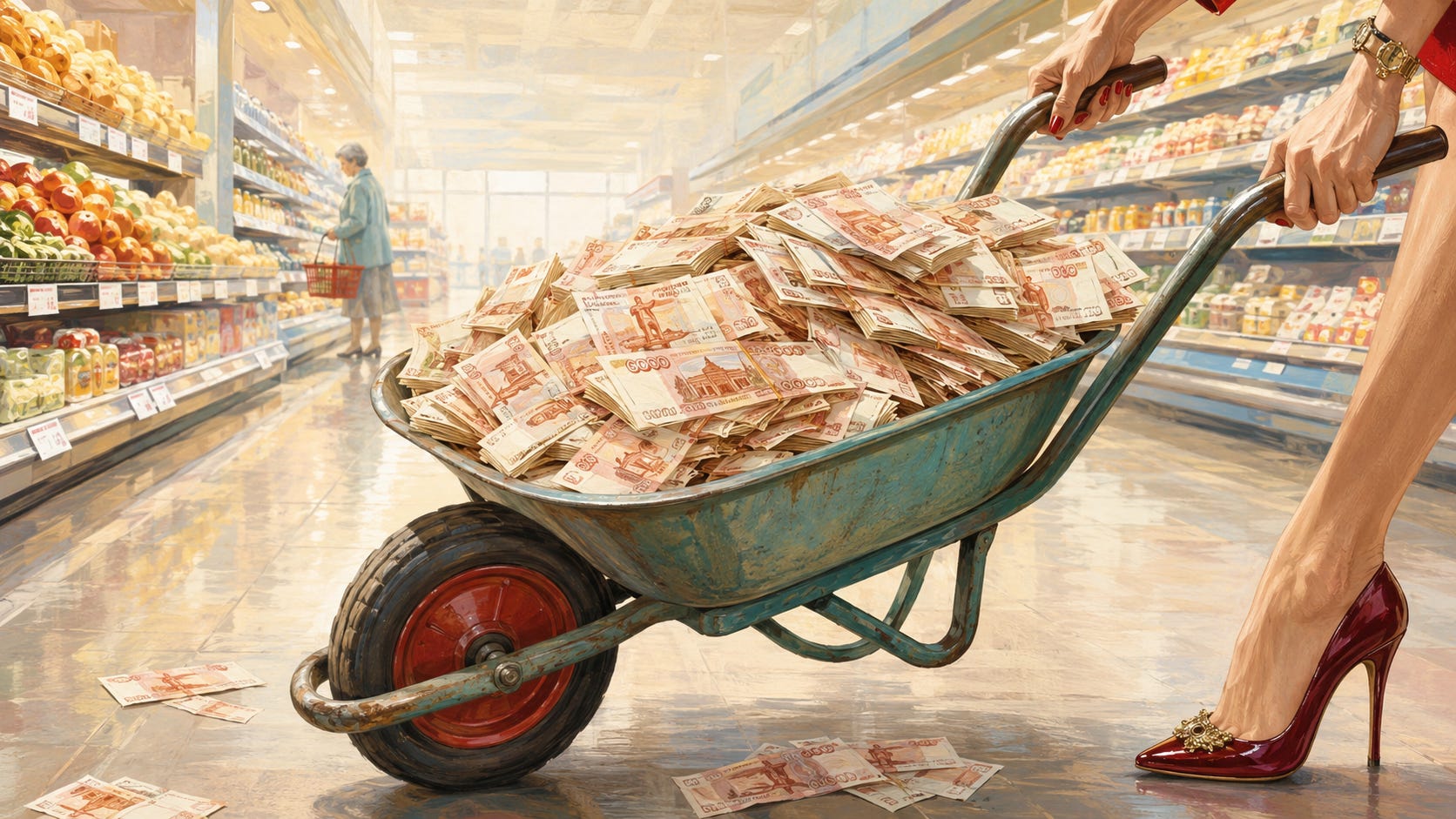
As for money printing, this has already happened. In January 2022, there were 65 trillion roubles in the Russian economy. That figure has since doubled to over 130 trillion. This is exactly what has fuelled the inflation. And yet this is the only recourse the Russian government has — they will have to print yet more money to bail out the banks. Eventually this might create hyperinflation. That is when you need a wheelbarrow to carry cash to the supermarket and hope that the prices have not gone up by the time you reach the cash register. Russians should remember this one from the 90s.
Can It Be Fixed?
As the Central Bank lends money to banks to bail them out, the banks lend to the government so the government can keep spending on the war. They keep bailing each other out. Each rotation creates more money, which again feeds inflation, which drives more non-payments and more withdrawals.
Ultimately, spending over half of the entire budget on trying to wipe out a neighbouring country is not a sound business model.
All dollar equivalents in this article are based on Russia’s official exchange rate, which is artificially managed through capital controls and restricted trading. The real dollar value of rouble-denominated figures is almost certainly lower.
No posts
Comments
Nothing yet. Say the first thing.
Sign in to join the conversation.