
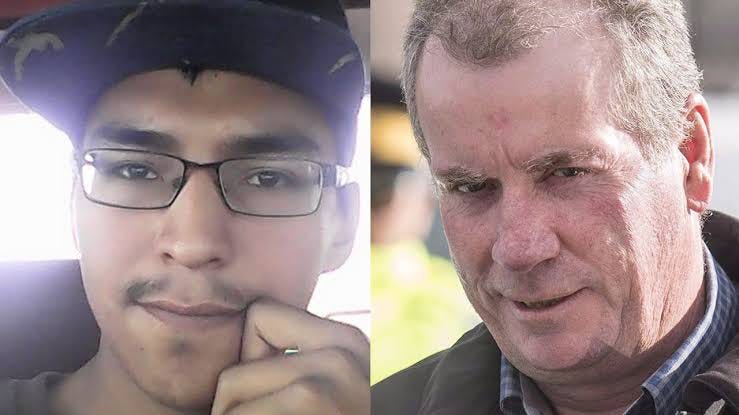
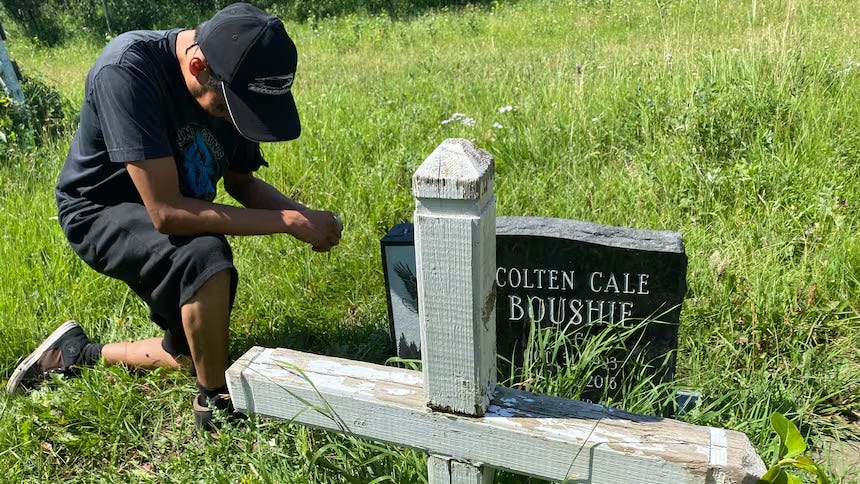
On August 9, 2016, Colten Boushie, a 22-year-old Cree man from Red Pheasant First Nation, was shot in the back of the head while sitting in an SUV on Gerald Stanley’s farm near Biggar, Saskatchewan. He had no criminal record. His mother, Debbie Baptiste, has described him as a kindhearted, loving young man who had dreams — dreams that were cut short. Stanley told the court his gun “just went off.” A jury believed him. Ten years later, I still don’t.
The media called it a defining moment for this country. Politicians called it a wake-up call. I call it something else: a magnifying glass held up to divides that were never actually hidden, just polite enough to ignore. What Colten’s death did wasn’t create the racism, the hate-filled social media pile-ons, the protests and counter-protests, the raw fury on both sides of a fence line that runs straight through this country’s history. It revealed what was already there, dressed up as rural common sense.
Tansi/Hello — thank you for being here!
I have 9, 432 readers. 601 paying. That is amazing, but there’s still a big gap. And it’s the weight I carry every day.
These stories exist because I refuse to let them disappear. I have spent 15 years on the ground; I have built the trust and repertoire that barely exists anywhere else. Which is why you won’t find this kind of coverage, the way I do it, anywhere else.
I need you in this with me NOW more than any other time.
That’s what truth and reconciliation looks like from where I’m standing.
Come step into the fire with me. Become a paying subscriber today:
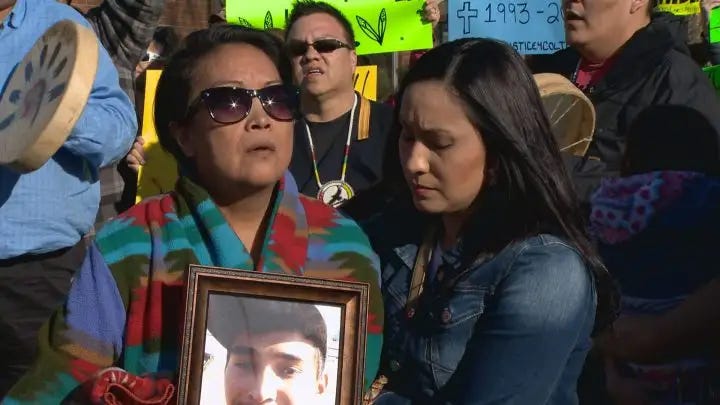
Colten’s body was pulled from the vehicle and left in the grass, unprotected, while it rained. His brother has said the family knew he was lying out there in a field and there was nothing they could do about it. Years later, an independent RCMP oversight commission confirmed that the RCMP racially discriminated against Colten’s mother, Debbie Baptiste, the night her son died, and botched the investigation itself — mishandling witnesses, delaying the collection of evidence, treating a homicide scene like it wasn’t quite a homicide scene. And the horror of when officers came to Debbie’s door to tell her that her son was dead, they asked her if she’d been drinking.
I think about Neil Stonechild, Rodney Naistus, Lawrence Wegner — the men Saskatoon police drove to the edge of the city in the dead of winter and left to freeze, Starlight Tours. I don’t think what happened to Colten came out of nowhere. It came out of a policing culture in this province with a long, well-documented history of deciding whose lives are worth protecting.
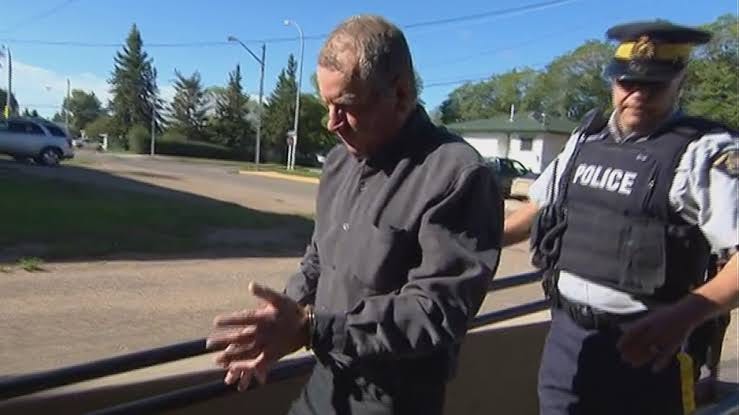
Then came the trial. Stanley’s defence used every peremptory challenge available to strike prospective jurors who appeared Indigenous — legal at the time, and it produced an all-white jury. That single fact was enough to push Ottawa to abolish peremptory challenges in Canadian law altogether within a year of the verdict. It was, in its own way, an admission: the system knew the deck had been stacked, and it only moved once the damage was already done. Stanley, meanwhile, was charged with second-degree murder and walked free on bail days later for $10,000 — less than the price of a decent used truck, less than what some farms around Biggar spend on a season’s fertilizer. That’s what a Cree man’s life was priced at while the system decided whether to call it murder. He was acquitted on February 9, 2018. I don’t know what Gerald Stanley is doing with his life these days. What I know is that he’s alive, and living it, and Colten isn’t.
Weeks after Colten died, a Saskatchewan farmer named Ryan McIntyre co-founded a Facebook page called Farmers with Firearms, about 40 minutes from Stanley’s property. Its whole premise was that rural property crime justified arming up and taking matters into their own hands if RCMP response times were too slow. McIntyre told CBC that he and others considered themselves as well trained as, if not better trained than, the police. “This is the way we have to live in the country,” he said of keeping guns for protection from theft. When asked directly whether he believed race played a role in Colten’s death, he waved it off, saying people throw around the word racist too easily now. The RCMP itself, asked to weigh in, put out a statement warning people not to take police matters into their own hands — the same institution that would go on to leave Colten’s body in a field in the rain.
That’s the irony sitting underneath all of it. A province full of men telling themselves they’re better equipped than the police to handle “threats,” building the exact justification a jury would later accept for shooting an unarmed 22-year-old over a flat tire and a wrong turn.
Share this story with a friend:
Here’s what gets me most. Stanley’s defence leaned hard on the idea that Colten and his friends were on his property to steal from him. Presumed thieves, before a word was said. That presumption sits on land that was never legally settlers’ to begin with — land opened up through the Dominion Lands Act of 1872, when the federal government handed 160-acre quarter-sections to newcomers for a $10 registration fee, while the Indigenous nations who had lived on and stewarded that same territory for generations were pushed onto reserves like Red Pheasant. Segregated. Kept from leaving without written permission from an Indian Agent. We were made into trespassers on our own homelands, and a century and a half later, a grieving mother’s son gets shot because he might have been one.
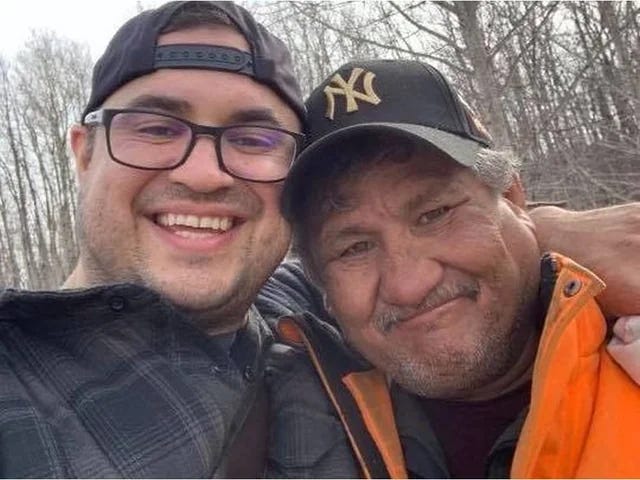
Four years after Colten died, on a rural road near Glendon, Alberta, farmer Roger Bilodeau assumed two Métis men driving home on a public road from a moose hunt were thieves. He chased them down in his truck and called his son Anthony to bring a gun. Anthony fired the shots that killed Jacob Sansom and Maurice Cardinal, men with families waiting for them. Anthony was convicted of second-degree murder and is serving a life sentence with no parole for 13 years. Roger, convicted of manslaughter, was handed 10 years, released to day parole in 2024, and has since been denied full parole — twice — with the board citing his continued distorted thinking about that night.
I don’t think that’s a coincidence. I think the acquittal of a man who shot an unarmed Indigenous man over a presumption of theft told rural Canada something about what it could get away with. Bilodeau’s sentence, like Stanley’s freedom, felt light against the weight of two dead men.
We’re supposed to be marking an anniversary. What it actually feels like is a country that hasn’t moved. Colten’s family has said that even now, every new article about him draws out the same hateful comments from people who never bothered to learn the facts. His brother buried him somewhere quiet, somewhere secret, because they couldn’t trust that even his grave would be safe from the same hate that followed him in life.
The racism, the injustice — it isn’t a relic of 2016. It’s structural, and it’s patient, and I believe it’s only a matter of time before it produces another Colten, another Jake, another Maurice, unless this country stops treating these deaths as isolated tragedies and starts naming what they actually are: blatant hate, racism, and indifference.
Rest easy, Colten.
Brandi Morin is a multi-award-winning Cree/Iroquois/French journalist from Treaty 6 territory in Alberta. She is the founder of Indigenous Insider on Substack and the author of the national bestselling memoir Our Voice of Fire.
Sources
- [10 years later, Colten Boushie’s family says stereotypes, mistruths still surround his death — CBC News](https://www.cbc.ca/radio/unreserved/colten-boushie-sask-shooting-10-year-anniversary-family-9.7298801)
- [Colten Boushie’s family wants him remembered for more than a murder trial — CBC/Yahoo News Canada](https://ca.news.yahoo.com/colten-boushie-family-wants-him-235025140.html)
- [Bail granted to Gerald Stanley, man accused in Colten Boushie shooting — CBC News](https://www.cbc.ca/news/canada/saskatoon/judge-deliberates-gerald-stanley-bail-1.3727944)
- [’He deserved a life:’ Colten Boushie’s mother demands change in justice system — Victoria News](https://www.vicnews.com/news/he-deserved-a-life-colten-boushies-mother-demands-change-in-justice-system/)
- [Supreme Court explains its reasons for upholding federal law on jury selection — CBC News](https://www.cbc.ca/news/politics/stefanovich-supreme-court-hearing-peremptory-challenges-1.6079973)
- [Why one Saskatchewan man says farmers need firearms — CBC Radio, Out in the Open](https://www.cbc.ca/radio/outintheopen/what-does-colten-boushie-say-about-us-1.4039219/why-one-saskatchewan-man-says-farmers-need-firearms-1.3923963)
- [Remembering Neil Stonechild and exposing systemic racism in policing — The Conversation](https://theconversation.com/remembering-neil-stonechild-and-exposing-systemic-racism-in-policing-128436)
- [Alberta farmer convicted in deaths of Métis hunters denied full parole — CBC News](https://www.cbc.ca/news/canada/edmonton/bilodeau-parole-hunter-deaths-1.7447189)
- [Alberta farmer convicted in deaths of Métis hunters has day parole extended — CBC News](https://www.cbc.ca/news/canada/edmonton/alberta-farmer-convicted-in-deaths-of-m%C3%A9tis-hunters-has-day-parole-extended-1.7374357)
- [Alberta man who killed Métis hunters sentenced to life in prison with no chance of parole for 13 years — CBC News](https://amp.cbc.ca/lite/story/1.6706222)
- [Life sentence with no chance of parole for 13 years handed man in killing of two Métis hunters in Alberta — APTN News](https://www.aptnnews.ca/featured/life-sentence-for-man-convicted-of-killing-two-metis-hunters-in-alberta/)
No posts
Comments
Nothing yet. Say the first thing.
Sign in to join the conversation.