
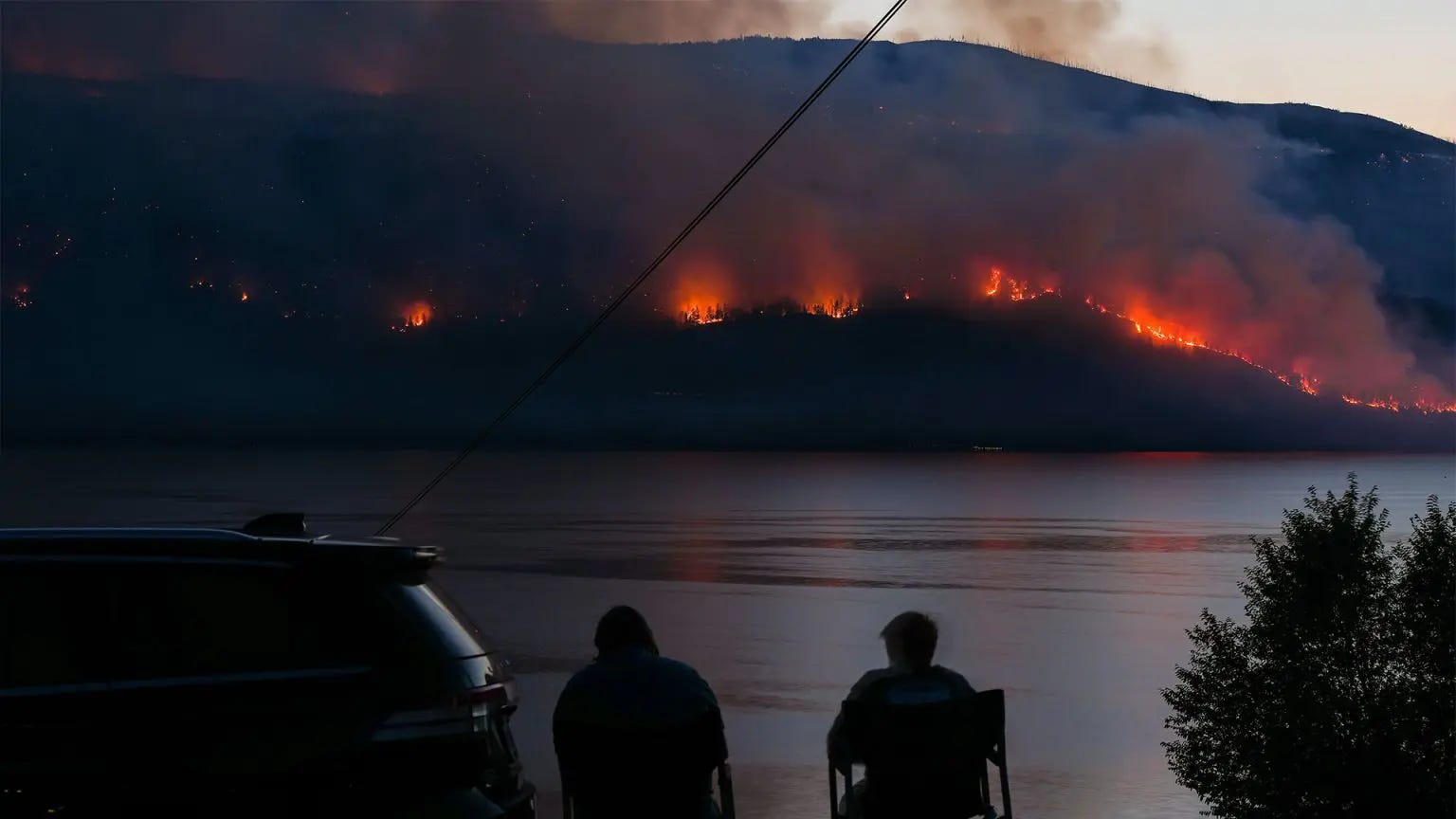
Chief Dan Wilson took a helicopter tour over his community on Monday and could barely recognize it from the air. “It looked like a war zone,” he said. The Bradley Creek wildfire had torn through the Okanagan Indian Band reserve near Vernon, B.C., destroying an estimated 230 homes — 30 of them belonging to band members, 200 more on the Westside. Some people had five minutes to get out. One member only had time to grab their cat. Others showed up at the evacuation centre without so much as their ID.
It’s being called one of the most devastating wildfire losses in Canadian history.
This year, wildfire has been plastered across headlines around the world. Unimaginable images — from Canada, to Spain, to France, to the United States — have shaken the masses.
But here in Canada, it’s Indigenous communities that keep getting hit the hardest.
Tansi/Hello — thank you for being here!
I have 9, 290 readers. 594 paying. That is amazing, but there’s still a big gap. And it’s the weight I carry every day.
These stories exist because I refuse to let them disappear. I have spent 15 years on the ground; I have built the trust and repertoire that barely exists anywhere else. Which is why you won’t find this kind of coverage, the way I do it, anywhere else.
I need you in this with me now more than any other time.
That’s what truth and reconciliation looks like from where I’m standing.
Come step into the fire with me.
Become a paid subscriber to Indigenous Insider, hiy hiy:
Since April 1, 76 First Nations have been impacted by wildfire. More than 8,200 people have been evacuated. Indigenous peoples make up roughly five percent of this country’s population and account for more than 42 percent of all wildfire evacuations. Some communities have now been pushed out of their homes more times than they can count on one hand.
This is because First Nations communities are disproportionately located in remote, fire-prone regions — the result of a reserve system that historically confined people to marginal land nobody else wanted. That legacy isn’t just symbolic; it’s structural. Dense boreal forest with decades of built-up fuel, no year-round road access, and no permanent firefighting infrastructure of their own means these communities are often defending themselves with garden hoses and volunteer crews while waiting hours — sometimes days — for provincial or federal resources to arrive. Remoteness doesn’t just mean longer response times. It means the land itself was set up to burn worse.
In Ontario, that gap has turned into open conflict between First Nations leadership and the province. At least a dozen First Nations have been fully or partially evacuated there this summer alone. Namaygoosisagagun (Collins) First Nation and Whitewater Lake First Nation were both largely destroyed — entire communities reduced to ash within hours. Chief Lawrence Wanakamik of Whitesand First Nation said his band manager flagged a large fire near Mathias Lake by mid-afternoon on July 13; a Ministry of Natural Resources helicopter went up, reported no fire despite heavy smoke, and a formal evacuation recommendation didn’t come until 9:30 that night — by which point community members were already leaving on their own. Ontario Regional Chief Abram Benedict called it “a catastrophic and systemic failure at nearly every level and at nearly every step of this process.” The Chiefs of Ontario are now formally calling for a public inquiry into the province’s wildfire response; so far, Premier Doug Ford’s government has offered only an internal review it says may never be made public.
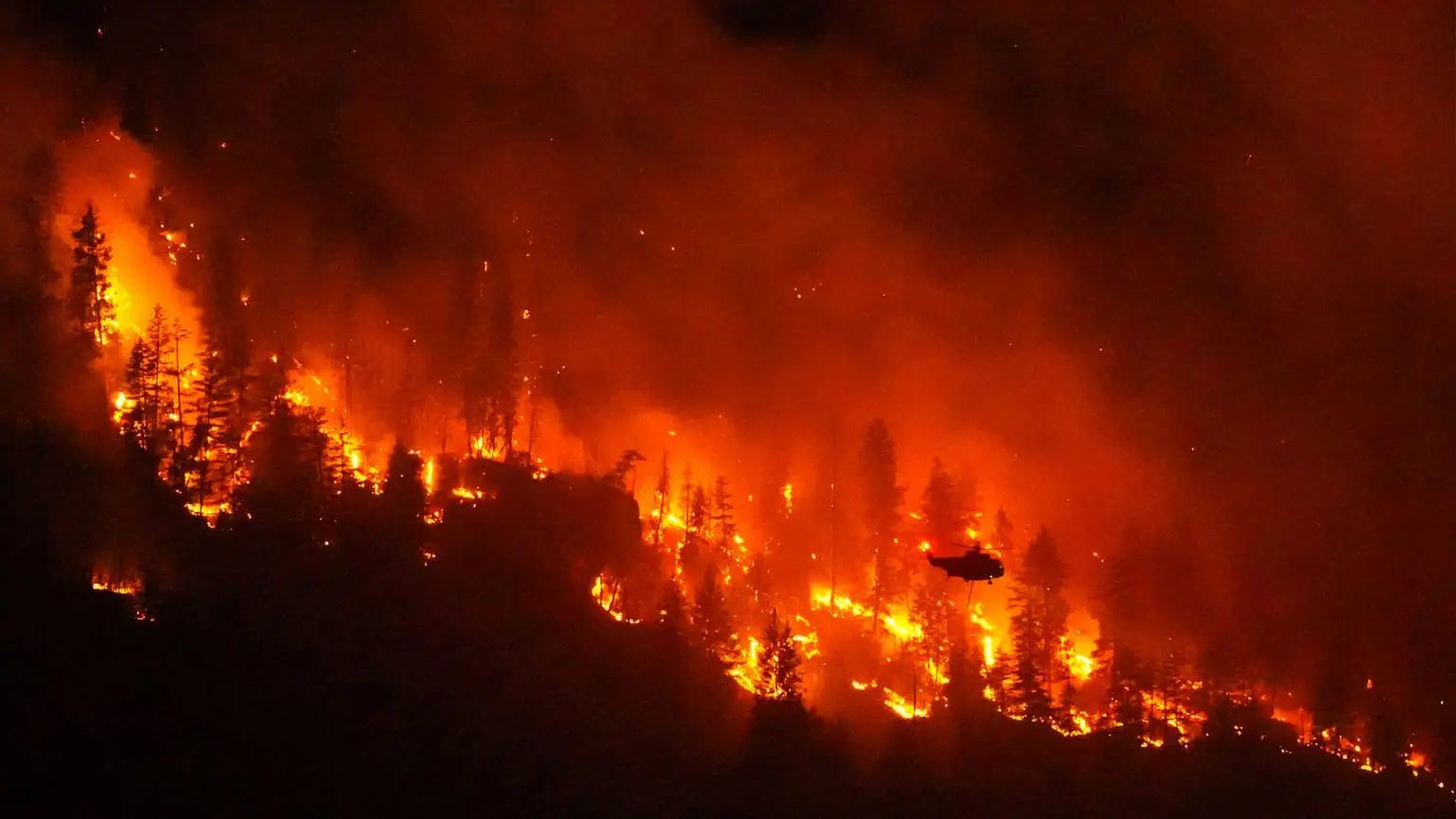
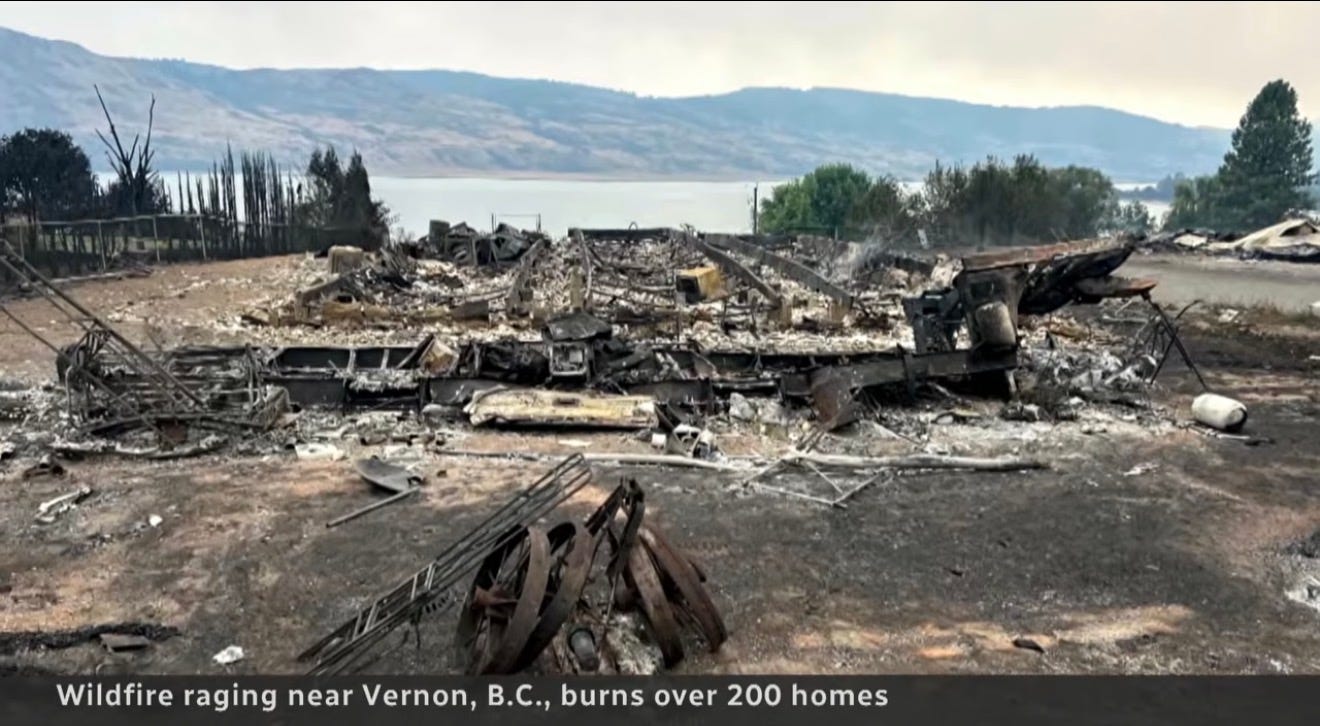
The Okanagan Indian Band isn’t some fly-in community accessible only by float plane. It’s near Vernon — a stunning, popular stretch of the Okanagan where wine country rolls out along the lake and orchards blossom every summer, a getaway thousands of people flock to every year.
And it burned anyway.
The images out of Bradley Creek look like something out of a dystopian film — monstrous orange flames consuming vast tracts of forest, whole neighbourhoods reduced to scorched metal and grey dust in a matter of hours. Except it isn’t a movie. It’s real, it’s happening right now, and it is devastating lives.
Some will deny the reason behind these unprecedented catastrophes — that the planet is boiling over, that what we’re watching is the direct result of the relentless ravaging humanity has inflicted on Mother Earth. And so, they scroll on.
I know we’re all exhausted. Overwhelmed, tired, maybe even a little numb — because these images have been hitting our timelines on repeat for months now, fire after fire, evacuation after evacuation, until they start to blur together. I get it. But this isn’t the moment to look away, and it isn’t the moment to let this become normal. The fires don’t need us to look away to keep spreading. And indifference sure won’t slow them down.
But the science isn’t ambiguous anymore. Climate change more than doubled the likelihood of the extreme fire weather that fuelled 2023’s record-breaking season, and it’s still loading the dice every year since — a warmer atmosphere pulls more moisture out of the forest floor, extends the fire season on both ends, and is now even weakening the overnight cool-down that used to slow fires while people slept. This isn’t a freak year. It’s the pattern.
Here’s what keeps getting lost in that scroll: Indigenous nations are on the front lines of this crisis, even though they didn’t create it. Indigenous peoples manage or live on traditional lands that hold roughly 80 percent of the world’s remaining biodiversity. Our people make up less than five percent of the global population — and yet their stewardship keeps deforestation rates lower, protects vital ecosystems, and preserves thousands of animal and plant species that the rest of us depend on too.
So how long can the guardians hold out?
This war has been waged on all of humanity, but Indigenous peoples didn’t start it. They hold the smallest carbon footprint on the planet and bear zero responsibility for causing climate change — and still, they’re the ones absorbing the consequences first. They’re watching the Arctic warm at rates the rest of the planet won’t see for decades. They’re being displaced by industrial resource extraction on their own territory. Their water and food sources are being disrupted in real time. And when it comes to the international climate adaptation funding meant to help communities weather all of this, they see only a fraction of it.
Some will say: climate change isn’t picking favourites, it’s burning everyone’s backyard this summer, so why make this specifically an Indigenous story? Because “everyone’s backyard” isn’t burning equally. It’s the reserves built on marginal land, without their own fire services, that go up first and hardest — and it’s the same communities that get the slowest response when they call for help. Disproportionate harm plus zero causal responsibility plus governments that keep showing up late isn’t a coincidence to be smoothed over with “we’re all affected.” It’s the story.
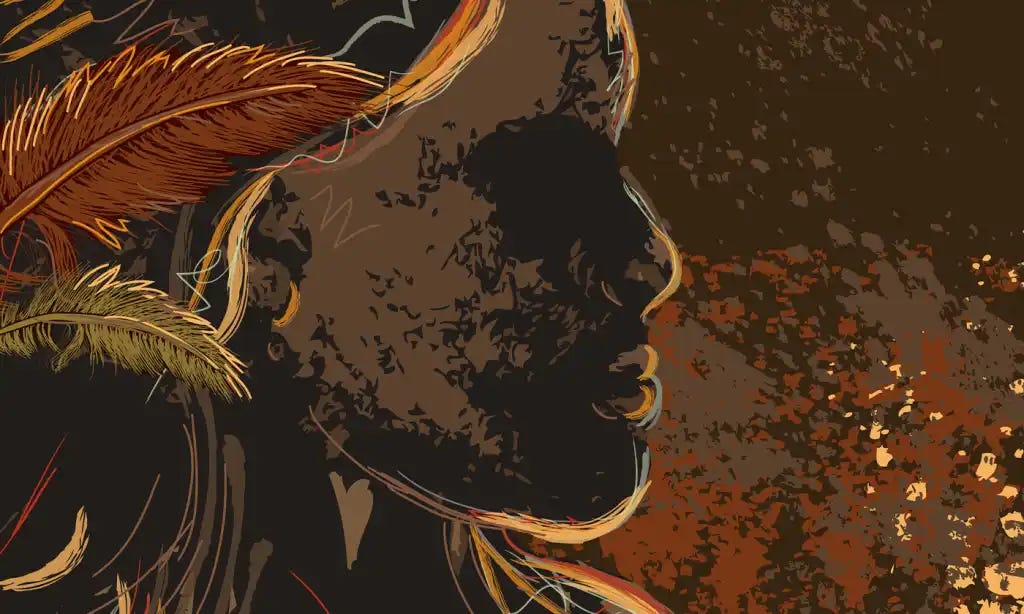
I’ve said this countless times, and I’ll keep shouting it from the rooftops if I have to; now more than ever, we need to return to the sacred. The world needs to protect what’s left. And that starts with standing behind Indigenous nations — before it’s all consumed by a colonial system built on extraction, greed, and everything that comes with it.
That means turning to traditional ecological knowledge — practices like cultural and prescribed burning that have managed fire-prone landscapes for millennia, knowledge that reduces fuel loads and prevents the kind of catastrophic, uncontrollable blazes we’re seeing now, and that’s been sidelined for generations in favour of colonial land management. It means backing the legal and grassroots land defense First Nations are already leading, from the courts to the front lines, because a healthy, intact ecosystem is a community’s first line of defense against fire. It means giving communities living closest to the risk direct decision-making power in emergency planning and response, instead of a phone call after the evacuation order’s already gone out. And it means requiring free, prior, and informed consent for any project — pipeline, resource development, or otherwise — that touches Indigenous land and territory, instead of a notification email sent after the announcement’s already made.
None of that is abstract. This fall, it looks like specific, answerable questions: Will Ontario release its wildfire debrief publicly, or bury it the way Minister Harris has signalled it might? Will the federal government fund community-controlled fire crews and cultural burning programs before next season starts, not after the next community burns? Will Indigenous leadership get a seat in the room when evacuation decisions are made, instead of a phone call after the fact? Those are the tests. This piece will be watching whether anyone actually passes them.
Chief Dan Wilson called the aftermath in Vernon “a war zone.” But this isn’t really a story about one nation’s happenstance, or even about a system failing to show up on time. It’s a warning, and it’s an urgent one. The land burning on the Okanagan Indian Band isn’t an isolated tragedy — it’s a preview of what’s coming for the rest of us, playing out first on the communities with the least power to stop it. A planet warming this fast doesn’t stop at reserve boundaries, and it isn’t going to check what treaty territory it’s currently torching before it moves on to the next subdivision, the next vineyard, the next city built too close to the trees. Indigenous nations are simply the first ones getting handed the bill for a crisis they didn’t create. Everyone else’s invoice is already in the mail.
Brandi Morin is a multi-award-winning Cree/Iroquois/French journalist from Treaty 6 territory in Alberta. She is the founder of Indigenous Insider on Substack and the author of the national bestselling memoir Our Voice of Fire.
Sources: Okanagan Indian Band Chief Dan Wilson (Global News, CP24, Castanet);
World Weather Attribution and Canadian Climate Institute climate attribution research;
Indigenous Services Canada wildfire evacuation statistics;
Chiefs of Ontario wildfire updates and public inquiry statement;
CP24 and APTN News coverage of the Ontario wildfire response;
CBC News coverage of Namaygoosisagagun and Whitewater Lake First Nations.
No posts
Comments
Nothing yet. Say the first thing.
Sign in to join the conversation.