
They said it couldn’t be done. They said LEGO was unprofessional. They said you can’t build the foundation of a Reconciliation Action Plan in a single day. This week at TMX - home of the Toronto Stock Exchange – the Indigenomics team did exactly that!
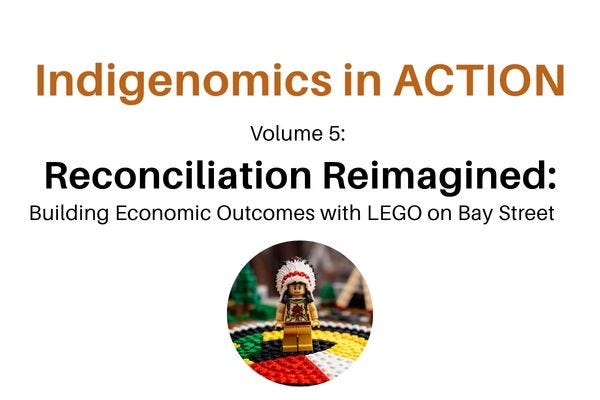
In the heart of Canada’s financial sector, corporate leaders stepped away from their every day meeting schedules, presentation decks and policy frameworks and entered a full-day strategic design process for advancing their company’s reconciliation action planning process. The session used LEGO® Serious Play, a facilitated methodology that applies structured model-building to support dialogue, problem-solving, insight development and strategic thinking. Led by our Indigenomics creative design partner Decidium, participants responded to carefully designed questions by building LEGO models that represent their ideas and process and shared the meaning behind their creations. This process brings individual and collective thinking into visible, enabling deeper insight and shared understanding for a team to advance their reconciliation action planning process.
On February 19, 2026, Indigenomics convened the inaugural Indigenomics LEGO DESIGN Reconciliation Action Planning Lab that was designed for participants to turn commitments and ideas into structured economic action. The objective was clear - design the structural foundation of a Reconciliation Action Plan grounded in Indigenous economic empowerment and aligned with corporate long-term strategy. By the end of the day, the architecture of the plans was visible, collectively understood, and ready for advancing into a structure for implementation.
Reconciliation as Economic Architecture
Reconciliation in Canada is moving into its next phase. Acknowledgement and commitment laid the groundwork and now economic reconciliation is taking structural form. The shift is moving dialogue and learning into integration and intention into measurable economic participation and outcomes.
Economic reconciliation lives within the mechanics of the economy. It is shaping how capital is allocated, how procurement pathways are structured, how ownership structures are designed and how participation is measured. It is embedded into investment criteria, partnership models, risk assessment practices, and reporting standards. These structural choices define economic power and long-term value creation. This is where economic outcomes are determined. Indigenomics recognizes that in building economic outcomes, reconciliation must be embedded within the systems that shape capital and markets. And when reconciliation does this- it reshapes the economic foundation of this country.
This was the premise of the convening at TMX. Bay Street is more than a geographic location; it represents the architecture of capital of this country. Decisions made in these rooms influence infrastructure development, energy systems, technological innovation, trade expansion, and national growth trajectories. Bringing Indigenomics to Canada’s financial core makes one thing clear- Indigenous economic leadership is not peripheral. It is foundational to the design and growth of Canada’s economy.
Building the Architecture of Economic Reconciliation with LEGO Serious Play
In designing corporate reconciliation action planning frameworks, the LEGO Serious Play approach recognizes that organizations are networks of relationships, priorities, assumptions, and structures. When those systems are examined solely through linear discussion, insight can remain constrained by hierarchy and habitual thinking. By building LEGO models, participants externalize their mental frameworks into models that help to transform implicit assumptions into visible structures, identify leverage points, explore interdependencies and test future states.
In this session participants began by constructing models that represented their understanding of economic reconciliation within their own roles. This ensured that every perspective entered the conversation — from governance to finance to sustainability to executive leadership. As the individual models were integrated, a comprehensive systems architecture became visible. In that moment, reconciliation shifted from an idea toward an operational design.
The methodology produced three important outcomes. First, it deepened shared ownership. Strategy was not delivered; it was co-created. Second, it clarified economic mechanics. Participants could see where alignment was strong and where design evolution would strengthen impact. Third, it accelerated commitment. When leaders physically build a shared model of the future, alignment moves from conceptual agreement to practical intention and outcomes. During this inaugural session leaders explored some questions such as ‘How do we structure partnerships that reflect long-term shared value?’ and ‘How do we measure Indigenous economic participation as a core performance indicator?’ By the end of the day, the foundation of a Reconciliation Action Plan was articulated through defined pillars, measurable objectives, and governance considerations aligned with long-term strategic design
From Impossibility to Activation
The assumption that foundational reconciliation work must be slow to be substantive reflects a conventional change model. When leadership is present and the methodology is rigorous, structural coherence can be established with clarity and speed. Systems-based design can create structural coherence in a focused and disciplined timeframe. When leadership is present and engaged, when objectives are defined, and when methodology is robust, progress can be both rigorous and accelerated. One day does not complete the journey. It establishes structural clarity. It defines pillars. It aligns leadership and it creates strategic design and momentum. At this session we witnessed what becomes possible when reconciliation is approached as an economic design challenge. The Indigenomics LEGO Serious Play methodology for reconciliation action planning serves as a tool that enables sophisticated strategic dialogue and depth.
Who wants to play Indigenomics? An Invitation to Build
The Indigenomics Innovation Design Lab is designed for boards, executive teams, financial, procurement and HR teams, capital market leaders, public sector agencies, and Indigenous Nations partners engaging in economic reconciliation action planning and partnership development. The process is immersive and rigorous and grounded in the $100 billion Indigenomics economy trajectory. Participants leave with a co-designed structural frameworks that can be translated directly into implementation planning across the organization.
Indigenomics Economic Reconciliation Design Lab – Building Economic Reconciliation Outcomes Through LEGO® Design
The Indigenomics Economic Reconciliation Design Labs are convening leaders who are ready to embed Indigenous economic empowerment at the center of their organization’s strategy. Through a structured LEGO® Serious Play design process, participants build the architectural foundation of a Reconciliation Action Plan grounded in designing leadership and long-term value creation. This is executive-level systems design that produces clarity, creates alignment. And establishes measurable economic reconciliation strategic direction. Through this process economic reconciliation becomes operational, structured and actionable.
This pilot session demonstrated something essential: when we treat economic reconciliation as a design imperative, when we engage with discipline and courage, a strong foundation for reconciliation action planning can be built with clarity and speed. The future of Canada’s economy includes Indigenous Nations as capital partners, owners, innovators, and system designers. The work is underway. The invitation is open- who wants to play Indigenomics? Let’s build!
Connect with us regarding upcoming Indigenomics Economic Reconciliation Design Labs in Vancouver and Calgary this spring at info@indigenomics.com or register at this link.
By Carol Anne Hilton
No posts
Comments
Nothing yet. Say the first thing.
Sign in to join the conversation.