
👋 Hello, Idris here! Welcome to this week's Indieniche newsletter. Each week, I feature tips and stories from successful self-made founders, share insights on building great products, talk about growing your business, and showcase essential tools to help you build and scale better.
If you've found this newsletter helpful, please spread the word to your friends and consider subscribing if you haven't yet.
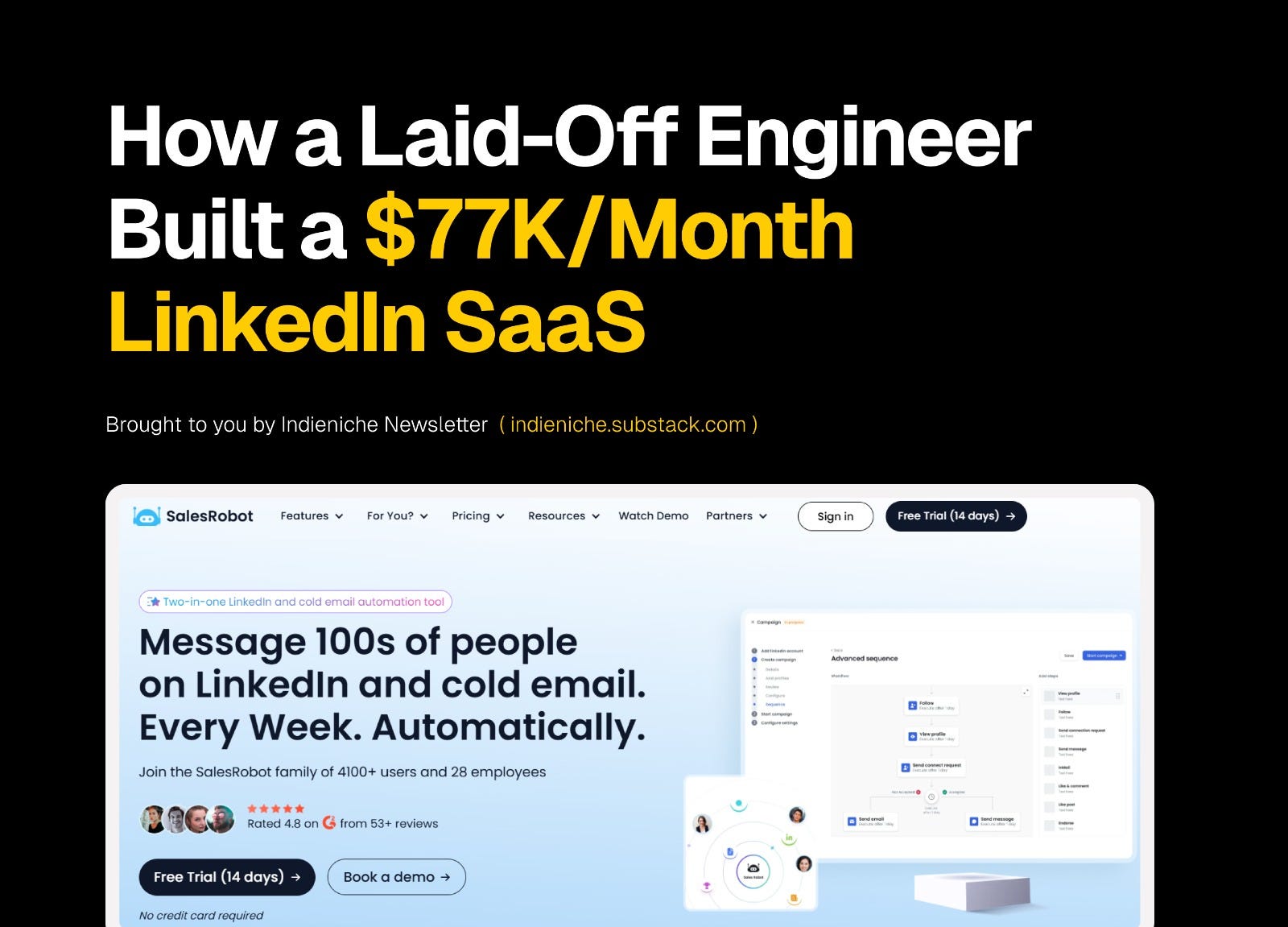
In this interview, Saurav Gupta shares how a simple Facebook outreach experiment became the foundation for a $77K/month SaaS business. Instead of building first, he spent time talking to frustrated users of a competing product and landed his first major customer before the product was even fully ready. He breaks down how SalesRobot grew through SEO, outbound powered by its own software, and why white-label agency customers became the company’s biggest retention advantage.
Saurav shares:
His backstory and how he started.
How he got his first free and paid customers for his product.
What was effective in attracting customers to his product?
His competitive advantages, what gives him an edge, and insights that have proven beneficial to his operations.
Which books, podcasts, or other resources have had the greatest impact on him.
Advice he'd offer to entrepreneurs who are just starting out.
I am Saurav Gupta. I run a company called SalesRobot, and my target audience is 18 to 50 year olds, mainly digital marketing agencies that want to white-label and sell a LinkedIn automation product.
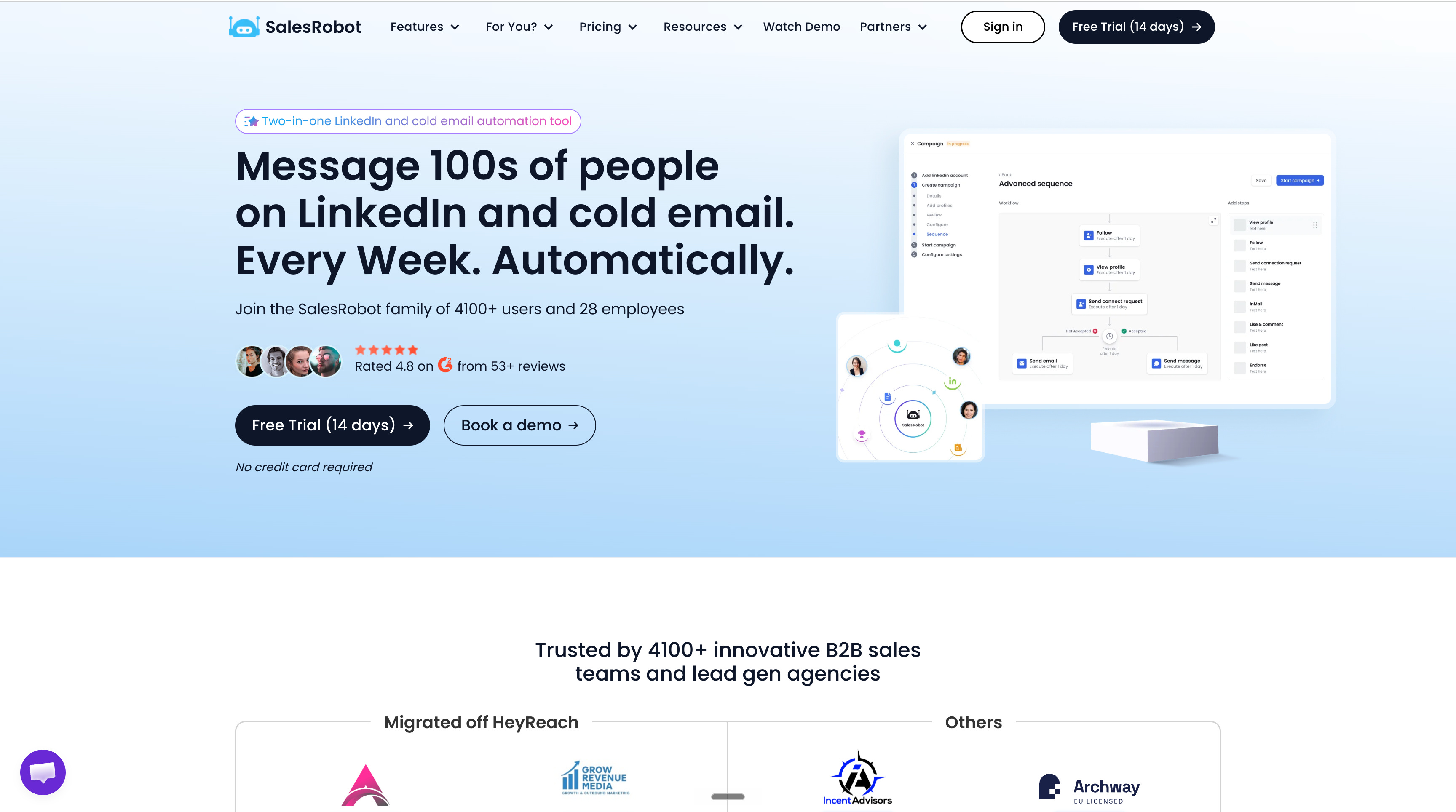
I’m a software developer by background. Back in 2020, I was working at a heavily funded cybersecurity startup when I got laid off during COVID.
At the time, this idea had already been sitting in the back of my mind for a while. I knew LinkedIn could be a massive lead generation channel for small businesses and agencies, but the tools available were honestly not very good.
I had also failed at a startup before that, and one thing I learned from that experience was how important sales is for any business. If you can help companies make more money or generate more leads, they’re usually willing to pay for it.
Sales tech was already crowded, but the ROI was obvious. So I thought it made sense to build something in that space, specifically a tool that could help agencies and small businesses get better lead generation results on LinkedIn.
I wrote the first line of code for SalesRobot in May 2020.

The interesting thing is that I didn’t start by building the product first. I wanted to find customers first before building. At the time, there was a LinkedIn automation tool called Dux Soup that a lot of agencies were using. I joined the Dux Soup Users Facebook group because I knew people there were actively dealing with this problem already.
The tool had a bad reputation. The UX was poor, it was buggy, and users constantly complained about LinkedIn accounts getting banned.
I went through their G2 reviews, studied the complaints, and started doing outreach manually from my own Facebook account. I messaged around 40 people a day with a simple question:
“Hey, have you started using Dux Soup for LinkedIn lead generation yet?”
No pitch. Just conversation.
One person replied at around 3 a.m. my time. He ran a lead generation agency in Manchester and was managing LinkedIn outreach for around 60–80 clients. They were paying Dux Soup roughly $4,000/month, but the tool kept disconnecting accounts and getting clients banned.
He literally had two people in a Zimbabwe call center waking up every day just to check whether the LinkedIn accounts were still functioning.
He told me, “If you can build something better, I’ll happily pay you the same amount.”
That became the starting point.
We basically co-built the first version together. I’d send him designs, get feedback, improve workflows, and keep iterating based on what his agency actually needed. After about three months of running it for free, he became our first paying customer at $3,200/month.
Today we have a team of 22 people. No co-founders.
We get around 30,000 monthly visitors.
The first few customers came from using our own product to sell itself.
Since SalesRobot is a LinkedIn lead generation tool, we used it for outreach and basically treated it as a live case study. We’d message people saying:
“Hey, I used my own tool to send you this message. Would you be open to doing this for yourself?”
That worked surprisingly well because people could immediately see the product in action.
Today we have around 550 paying customers and roughly 2,000 users on the platform overall. We don’t offer a permanent free plan, only free trials, and at any given time we usually have around 600–700 active trials running.

In order of effectiveness:
SEO
Outbound using our own tool
LinkedIn content and marketing
Right now the business is doing around $77,000/month in revenue. I want to grow it to at least $150,000/month. Hopefully, as we improve our marketing, we get there.
At the same time, we’re also working on a new AI-focused product in the same space called Kuron.ai. I think there’s a real opportunity there.
One of the biggest insights for us has been understanding retention and which customer segments churn less.
Cold outreach and sales tools usually have pretty high churn rates. For us, revenue churn is around 10% monthly overall, which means retention becomes extremely important.
What we discovered is that white-label customers tend to stick around much longer.
Agencies that resell SalesRobot to their own clients have significantly lower churn, under 2% monthly revenue churn, which makes that segment much healthier for the business long term.
That’s why we’ve been leaning harder into white-label deals.
We spend close to $15,000/month on tools.
Some of the main ones are:
Ahrefs
LinkedIn Sales Navigator
Claude and ChatGPT
Smartlead
Instantly
And obviously SalesRobot itself
Honestly, one of the biggest learning experiences has been watching competitors execute really well.
I follow Nick Velkoski from HeyReach quite closely. He entered this market around three years after we did and still managed to scale to roughly $15M ARR bootstrapped in just three years.
Watching that happen taught me a lot about execution, positioning, and growth strategy. Getting outpaced by a competitor can be painful, but it’s also one of the best learning experiences you can have as a founder.
Think strategically, but execute aggressively on whatever you’re working on right now.
A lot of founders try scaling too early before they’ve actually found strong product-market fit. You need time to wander around a bit, talk to users, and really understand where the opportunity is.
One mistake I made was growing the team too quickly.
I’d also say founders should spend a lot more time talking directly to customers and figuring out where there’s a narrow market segment they can dominate. Becoming number one in a smaller category is usually a much better strategy than trying to compete broadly from day one.
Not at the moment. Honestly, we’re probably a bit overstaffed right now.
Thank you for taking the time to answer these questions! What is your contact info if people would like to inquire about your services? You can add all your links.
You can reach me anytime here! I’m happy to respond.
Let me know what you learned from this interview and have a productive week! 🙏

A lot of founders waste months trying to look bigger than they are. Fancy branding, polished social media, pretending there’s a huge team behind the product. Most customers don’t care about any of that. They care about whether you understand their problem and whether the product actually works. Some of the strongest early stage products win because they feel personal. Fast replies, direct founder access, and obvious attention to customer pain points can beat a polished company with ten times the budget.
There’s a good chance you’ve seen beautifully designed screenshots on X or Product Hunt and assumed someone spent hours making them. A lot of founders are secretly using Shots.so instead. It’s a simple tool that lets you turn ordinary screenshots into polished mockups, social graphics, and launch visuals in minutes. If you’re constantly posting product updates, building landing pages, or preparing launch content, it saves an absurd amount of time and makes even rough MVPs look far more presentable.
What was originally sold as a side project before becoming one of the world’s biggest companies?

Do you have a product you'd like to share with our community of over 3,000+ indie niche founders?
Drop us a line detailing what makes your product stand out, whether it's a SaaS, marketplace, app, newsletter, or anything else innovative. We're eager to hear from you!
We will pick a product to feature in next week’s newsletter. Thanks for sharing and looking forward to hearing from you.
Comments
Nothing yet. Say the first thing.
Sign in to join the conversation.