
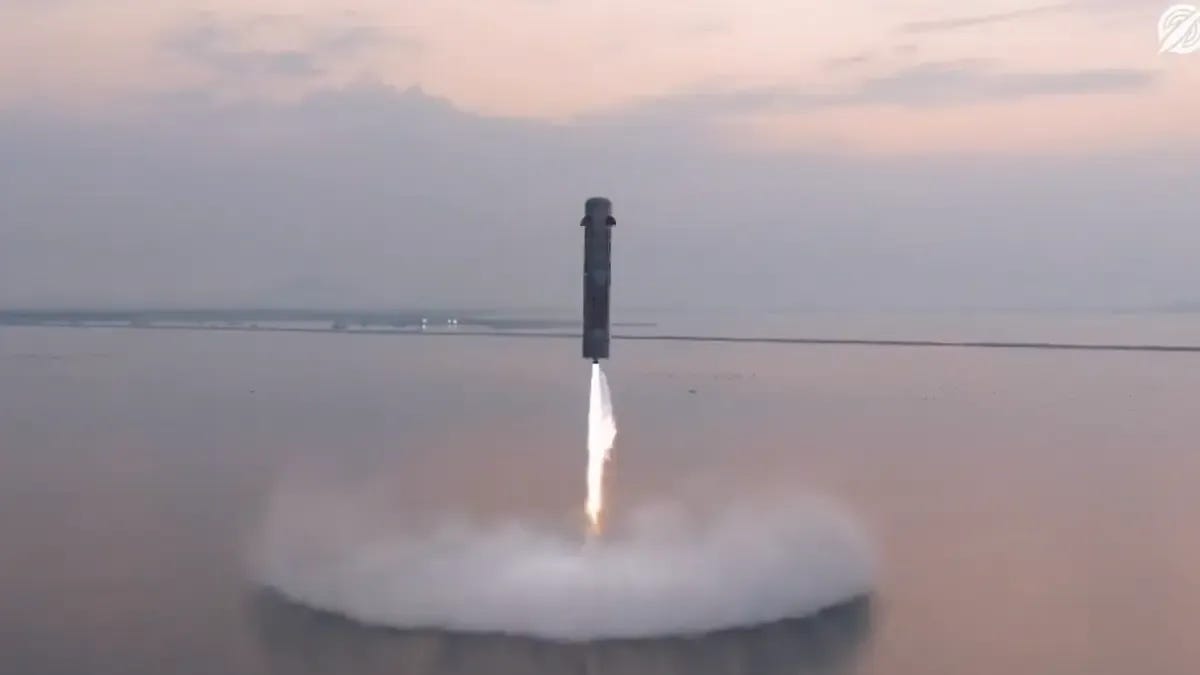
June 1st, 2025 — China just changed the course of space history.
For the very first time, a Chinese rocket — Nebula M1 by Deep Blue Aerospace — successfully executed a vertical landing on a sea platform. Yes, a floating platform. And yes, this feels eerily familiar to what we once only saw SpaceX do.
But here’s the difference: this time, it’s China. And they’re not following — they’re coming to lead.
Let’s decode what just happened and how this moment could be the opening scene of a Space Race 2.0.
What Just Happened?
Company: Deep Blue Aerospace
Rocket: Yanxingzhe-1
Mission: Vertical launch → 1km flight → Successful sea landing
The Win: It’s China’s first-ever sea-platform recovery. A milestone that puts them on the map for reusable launch tech.
A few years ago, this kind of precision felt like science fiction. Today, it’s becoming China’s new standard.
🌊 Why Sea Landings Matter (More Than You Think)
Landing a rocket vertically on a barge in the ocean is one of the most complex and risky maneuvers in aerospace. But here’s why it’s also genius:
It allows recovery from high-velocity missions (deep space, anyone?)
It reduces risk near coastal populations
It drastically lowers cost — and that changes everything
SpaceX pioneered this. China just proved they’ve learned the playbook — and they’re ready to remix it.
China’s Space Game: From Imitator to Innovator?
Here’s why this landing isn’t just a cool flex — it’s a signal. China could actually overtake SpaceX in the decade ahead. Bold? Maybe. But look at the ingredients:
1️⃣ Government + Startup = Velocity
In China, startups like Deep Blue, iSpace, and Space Pioneer don’t run alone. They move with momentum from the state — CNSA and CASC. It’s a hybrid model of agility meets scale.
2️⃣ Manufacturing Might
No one iterates hardware like China. Faster production. Lower cost. Less downtime. That’s how you scale rocket science.
3️⃣ Lunar and Martian Dreams
Human Moon landing target: by 2030
Joint lunar base plans with Russia
Eyes set on Mars — with infrastructure, not just exploration
While SpaceX balances Starlink, Tesla, and DoD contracts, China’s vision stays crystal clear: space dominance.
4️⃣ Ecosystem > Ego
SpaceX is powerful. But China is building an entire ecosystem of reusability, not just one rocket, one company, or one billionaire.
5️⃣ Focused Firepower
Where Musk’s empire is split across galaxies (sometimes literally), China is focused on one mission: to own orbit, moonwalk, and go deep.
What This Means for the World
This isn’t just about rockets. It’s about a shift in who leads the space narrative:
The space economy just went multipolar
Nations now have non-Western launch options
Reusability becomes global, not American-only
Innovation accelerates — because now there’s real competition
Final Thought
SpaceX disrupted the game.
China? They’re about to rewrite it.
What was once a solo sprint is now a global marathon — and China has just launched off the water, not just to chase, but to lead the next chapter of space history.
Comments
Nothing yet. Say the first thing.
Sign in to join the conversation.