An enterprise software factory is a system that repeatedly turns engineering intent into verified software. AI agents perform implementation and judgment-heavy work, while development environments, orchestration, deterministic checks, security policy, compute infrastructure, and human approval keep the process reliable. A coding agent can be one worker in the factory; it is not the entire factory.…
For a large team, “which CI platform is faster” rarely has a platform-shaped answer. Neither GitLab CI/CD nor GitHub Actions caches or distributes compute across an organization on its own, so past a certain point, queue time and redundant recompilation dominate regardless of which logo sits on the pipeline. What actually differs between the two […] The post GitLab CI/CD vs. GitHub Actions:…
Resources Blog Kleaf runs the main Make/Kbuild build inside one Bazel action. The detailed compiler commands remain nested inside that action. This creates a candidate process-level integration boundary that still requires kernel-scale validation. The practical problem Bazel remote execution distributes Bazel actions. Native Bazel C++ rules often expose one compile action per translation unit,…
Jenkins earns a specific kind of complaint that other CI platforms mostly don’t. It’s rarely “it’s slow,” at least not at first. It’s “we have someone whose real job has quietly become keeping Jenkins alive.” Patching executors. Tracking which of 1,800-plus plugins are compatible with which LTS release. Reading changelogs before an upgrade because the […] The post Top 7 Jenkins Alternatives for…
Resources Blog An Analysis of 120,000 Build Tool Invocations Across AOSP 15, 16 and 17 AOSP 17 Is Here. We Looked Beneath the Release Notes. AOSP 17 has arrived, and most of the discussion will focus on what changed in Android itself: platform behavior, APIs, security, compatibility, and device-facing capabilities. We looked somewhere else. Instead […] The post AOSP 17 Reveals Android’s Next Build…
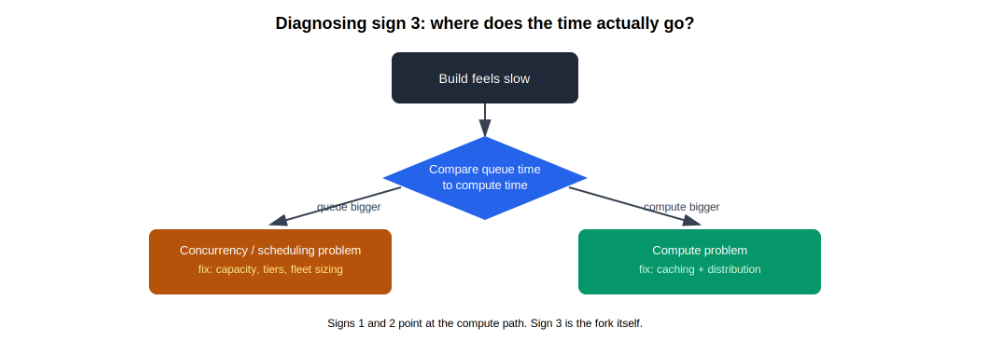
A slow pipeline doesn’t announce itself. It doesn’t fail a health check or throw an alert. It just gets a little slower every quarter, and the team adapts, one small workaround at a time, until the adaptations themselves become the bigger problem. Below are seven signs that adaptation has quietly become the norm, and what […] The post 7 Signs Your CI/CD Pipeline Needs Build Acceleration (Before…
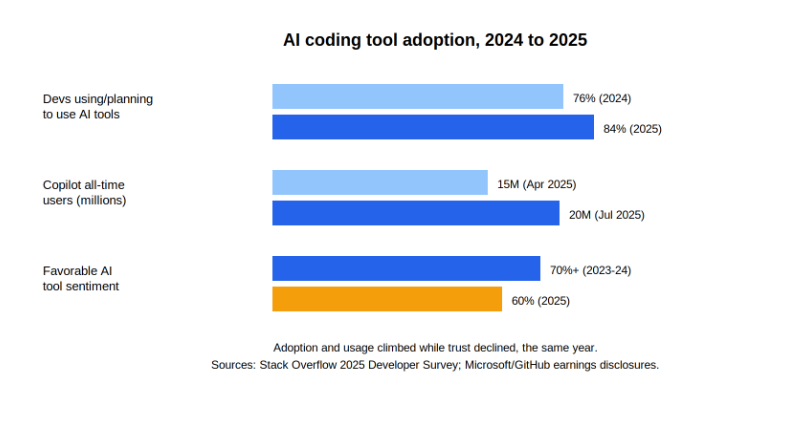
Independent reviewers on PeerSpot (peerspot.com/products/incredibuild-reviews) put Incredibuild at an 8.0 out of 10 average across verified user reviews, independent of anything in this piece. Twenty numbers, pulled from primary sources rather than each other, tell a consistent story: AI-assisted development has pushed code volume up faster than most CI/CD infrastructure was sized for, and the gap…
Part 3 of a three-part series. Part 1 covered Bazel’s history and architecture. Part 2 covered caching, remote execution, and the build supply chain. This final part is about adoption: when Bazel is worth the cost, when it is not, and how to get faster pipelines without turning build strategy into religion. Bazel is […] The post Bazel in the Real World: Gradle, Buck2, Incredibuild, and Adoption…
Disclosure: I work at Incredibuild. The first several sections below are evaluated on their own merits regardless of who’s writing this; the “Fix the runner, not the platform” section further down is where our own product enters the picture, and it’s labeled as such rather than folded in quietly. On impartiality: the migration-effort and pricing […] The post Top 8 GitHub Actions Alternatives for…
On objectivity: this piece has a dual role, comparing ten platforms neutrally and showing where our own product fits, and we’re not pretending otherwise. The per-platform strengths and native-caching details below are accurate independent of Incredibuild; the Incredibuild-specific claims are kept in clearly separated paragraphs and cited where the claim is checkable, so a reader […] The post Top…
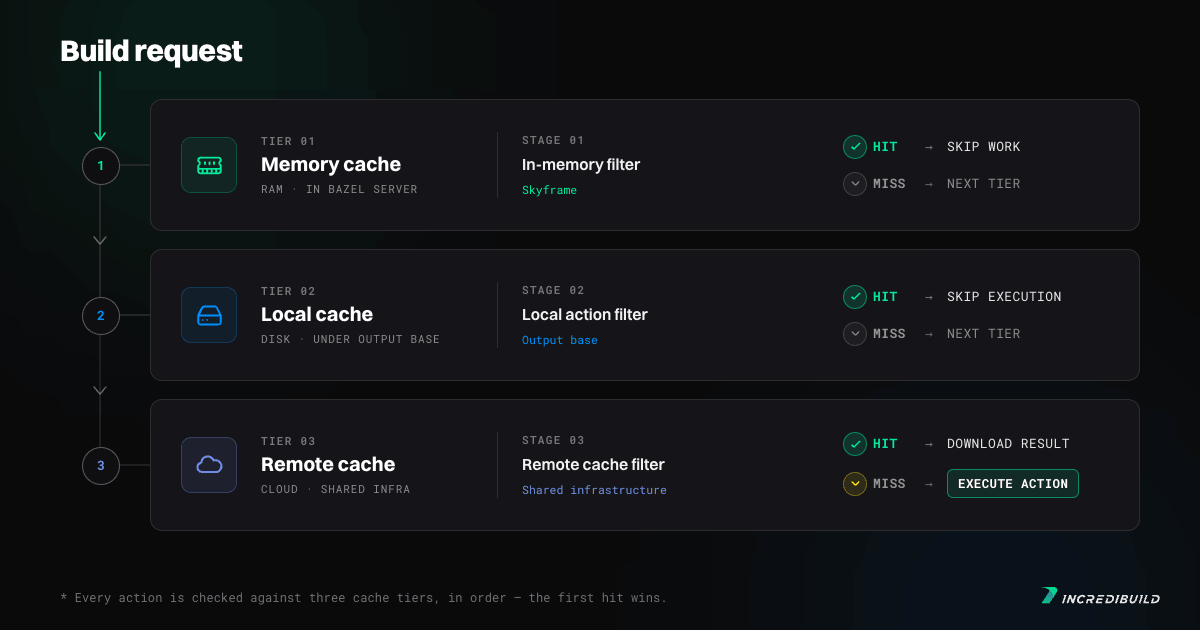
Resources Blog Part 2 of a three-part series. Part 1 covered Bazel’s history, architecture, and Skyframe’s incremental engine. Part 3 will cover adoption strategy against Gradle and Buck2, and where Incredibuild fits. For teams relying on BwoB (Build without the Bytes) and remote execution, the remote cache becomes much closer to load-bearing infrastructure. If an […] The post Bazel Caching,…
Resources Blog Part 1 of a three-part series. Part 2 covers caching, remote execution, and the software supply chain. Part 3 covers real-world adoption against Gradle and Buck2. This article stands alone. Bazel matters because it turns a build from a pile of scripts into a build graph, and once the graph is explicit, it […] The post Bazel, Inside and Out: History, Architecture, and Why It Matters…