
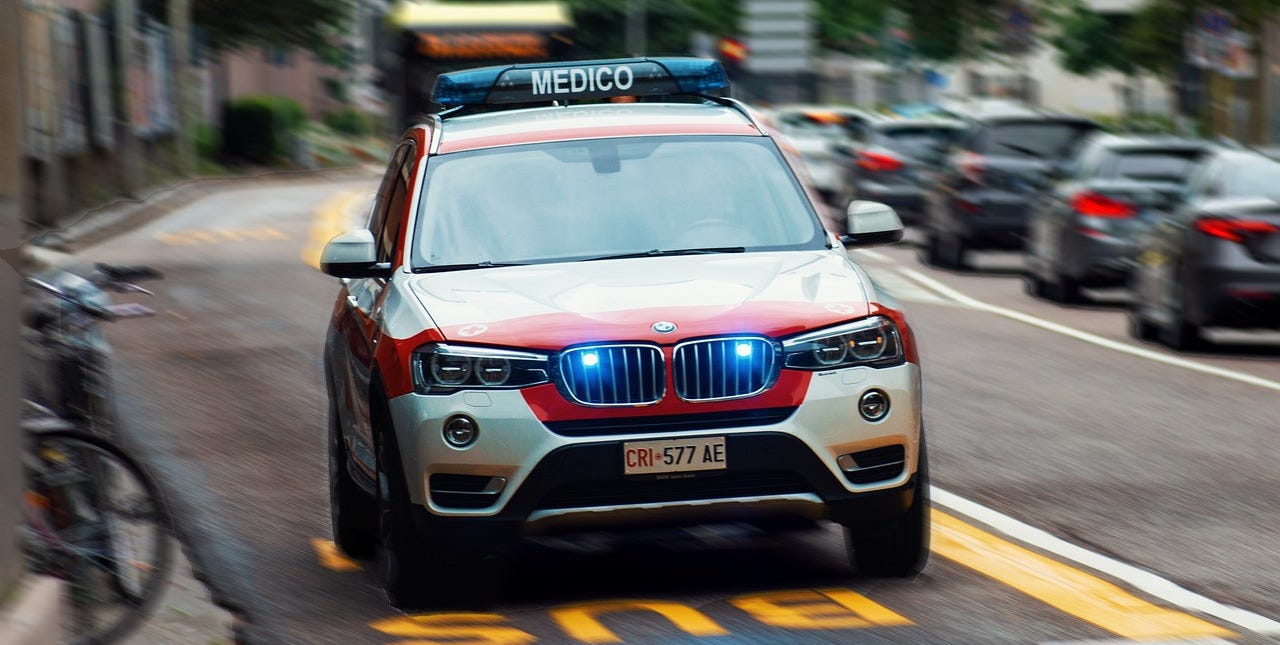
Why do the lights on an emergency vehicle flash the way they do? What should a siren sound like? Was that a white car or a black car? Martin Langham has the answers. This interview introduces the field of human factors, focusing mainly on accidents – why they happen, how to prevent them, how experts like him investigate them, and why AI could make the situation worse.
A car crashes at high speed in a tunnel, just after midnight. Three of the four passengers are tragically killed. One or more motorcycles may have been involved, and possibly a white Fiat.
The year was 1997, the car was a chauffeur-driven Mercedes, the tunnel was in Paris. The most notable passenger killed was Princess Diana of Wales, and the motorcycles were manned by pursuing paparazzi. Due to inconsistencies between the forensic evidence and eyewitness accounts, conspiracy theories quickly arose.
Enter Dr. Martin Langham, expert in human factors. He was called in by London’s Metropolitan Police to give his perspective on eyewitness testimony.
Langham calls himself “a psychologist that should have been an engineer, or an engineer that should have been a psychologist”. Welcome to the world of human factors, also known as ergonomics.
In fact, he was trained primarily in psychology, and went on to gain a PhD in “engineering psychology” – one of the few people in the world with such expertise. This explains why he quickly came to be called on by police departments, governments and their various security services, in the UK, US and EU.
We met years ago while working with one of those security services (sorry can’t say which one) on a counterterrorism project. I find his views and his stories fascinating – about things we take for granted, or we don’t think too much about, or we tend to overlook. It’s not for nothing that he calls human factors “the science of the bloody obvious”. You might detect his very dry British sense of humour.
Human factors sensibly starts with the human. Specifically, the human senses. Among other things, they tell us what’s in the world around us, how much of it, whether there is more or less than before, where it might be exactly, and whether it might be changing over time or from one place to another.
This is rooted in our evolutionary biology: like most animals, Langham notes that humans are designed for “foraging, fighting, fleeing, and…mating. Yet, we sit them in a car, to drive at speed.” We may have evolved to watch out for predators or prey, but not, he says, “to detect a road worker doing a repair on a bend.”
Human factors is “about understanding how human limits restrict how we deal with the built environment and complex systems,” Langham writes in a blog post. As a science, it relies on evidence and testing, and Langham has personally been involved in about 600 investigations. Someone once asked him, in how many of those he couldn’t find a cause. His response: “One.” [source]
How does that work exactly?
“Most of my call outs start with the phrase ‘You would not believe this but…’,” he says. For example: a military base. Winter. A guard post with a barrier to control vehicle access – a manually operated bar that swings up and down. Unfortunately, it crashed down onto an entering vehicle, causing a fatality.
There are many methods for investigating such an accident. Interviewing the guard on duty seems obvious. You could take a statement. Talk to”experts”. For more complex cases, maybe run a simulation. (FYI, Langham‘s description of a flight simulator: “Stay in the blue, avoid the green, land on the grey bits”).
Is any additional data available? Was there CCTV? (Note: it’s typically erased after 28 days.) Other contexts contain different types of data – a train records a number every 1/25 of a second on every one of the driver’s inputs. On aeroplanes, the flight recorder or black box (it’s actually orange) records voices as well.
Whatever your method, Langham stresses one important point: Most investigations stop at the how – few get to the why.
How did the fatality occur? Blunt trauma to the head caused by impact with a heavy object. Why did that barrier fall on the car? Well, it was winter, it was cold, and the guard decided to put on (non-regulation) gloves. In the icy conditions, the barrier slipped.
Langham relates another case in a blog post. A pedestrian is found dead by the side of the road after a collision with a van. How did they die? Simple – head trauma after collision with a van. How did this occur? It was nighttime, and the driver said it was too dark to see the running pedestrian. But why was a person out running in near total darkness without a light? Why couldn’t the van driver see them? Why that van, why that pedestrian?
Part of the answer comes from previous “human factors research into perceptual thresholds of how much light needs to hit the retina for the cognitive process to start,” Langham writes. Long story short, he reveals that in this case, the answer to why is that it was a murder disguised as a traffic accident. The root ‘why’ had to do with someone sleeping with a colleague’s partner.
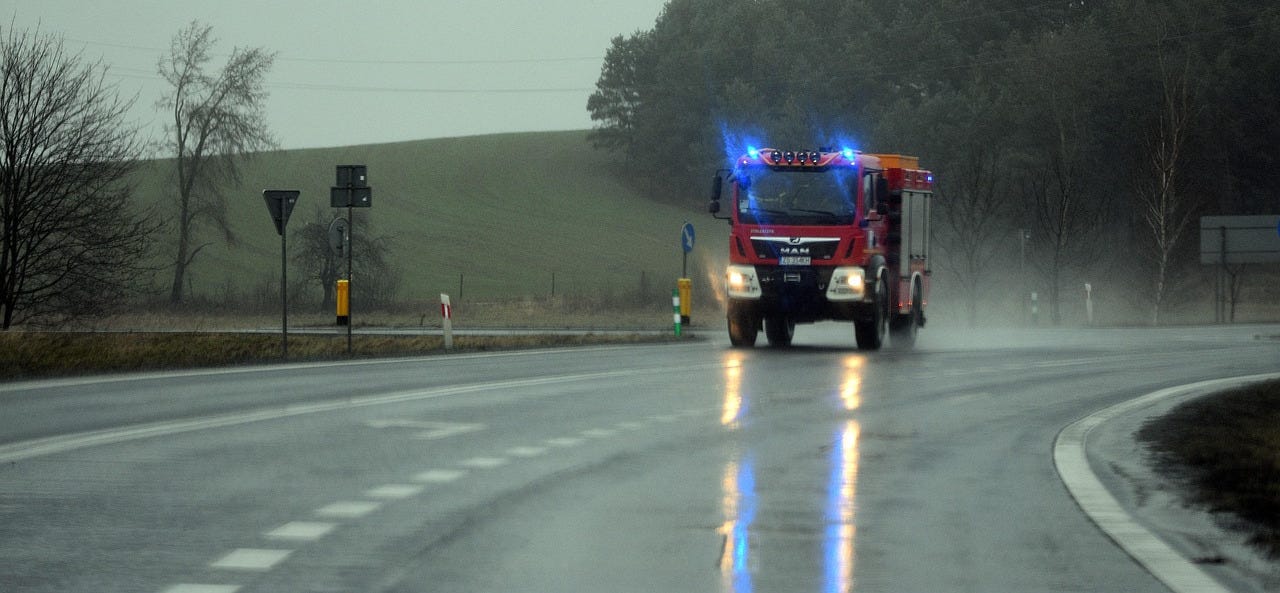
That brings us to causes. They typically fall into three categories: environment, equipment or system, and human. Environment can include factors like the temperature, features of the physical space, noise levels. Causes related to equipment typically come down to poor design – more on that in a moment.
As for humans, human error is the cause of accidents 95 percent of the time. “Irrespective of industry, location or activity,” according to Langham. People, he points out, tire easily, lose concentration, are easily distracted, and are “not exactly rational”. Sometimes they’re predictable, often not. Add in medication and intoxicants, age and experience. Given all that, “it’s amazing,” he observes, “how few errors occur and how a disinterested cave dweller (aka human) can work 12–18 hours, operate a machine (in many dimensions), and still get home safely at the end of the day.” [source]
So, there are accidents. Why do trucks hit low bridges, for example? Another clever human factors expert once asked Langham at a conference, “Well, why are your bridges so low [in the UK]?” Well, Langham replied patiently, they were built a long time ago (some dating back to Ancient Roman times), and the designers predicted different types of vehicles back then.
But what exactly is an accident? Seems an obvious question, but then we’re dealing with the science of the bloody obvious. Langham’s definition: “an unforeseen rare random event with multiple causes, where in one moment in time, something went wrong.”
Let’s unpack that. “Unforeseen” is what separates an accident from an incident (like the van murder above). “Rare” – thankfully, otherwise human life expectancy and population figures would be much lower than they are. “Random” is an interesting one – if there is some identifiable cause for every accident, that doesn’t seem very random. The point is that it’s a chance occurrence – that person/car/aeroplane/etc happened to be right there at exactly that time. Unforeseen, unpredictable. But possibly preventable.
One big issue is what’s called spatial and situational awareness – knowing what’s going on around you. This, somewhat relatedly, is how we’re all told to prevent crime: “Be aware of your surroundings.” But what does this actually mean in practice? If we attended to everything all the time, we would collapse from cognitive overload.
Let’s take another example: What do drivers do at intersections? How long do they search? Where do they look? This was Langham’s PhD research, and he came up with a surprising finding: More experienced drivers are more likely to have an accident, because they tend to look in the same places. Think about it: new drivers are much less likely to know where an unexpected hazard might come from exactly, so they tend to look everywhere. Over time, you wouldn’t possibly expect a vehicle to come out of there. “Inadequate visual search” is the technical term in the human factors literature.
Thus, “Looked but failed to see” is a major cause of accidents. From a human factors perspective, this is a visual task in a highly complex environment. The conspicuity of a vehicle or pedestrian (how conspicuous it is to a driver) is a main area of research. Conspicuous objects “do not require extensive visual search to be successfully detected,” notes one of Langham’s research papers dryly. Conspicuity is more than mere visibility, “which relates to the ease of detection when the observer is aware of the target’s location.”
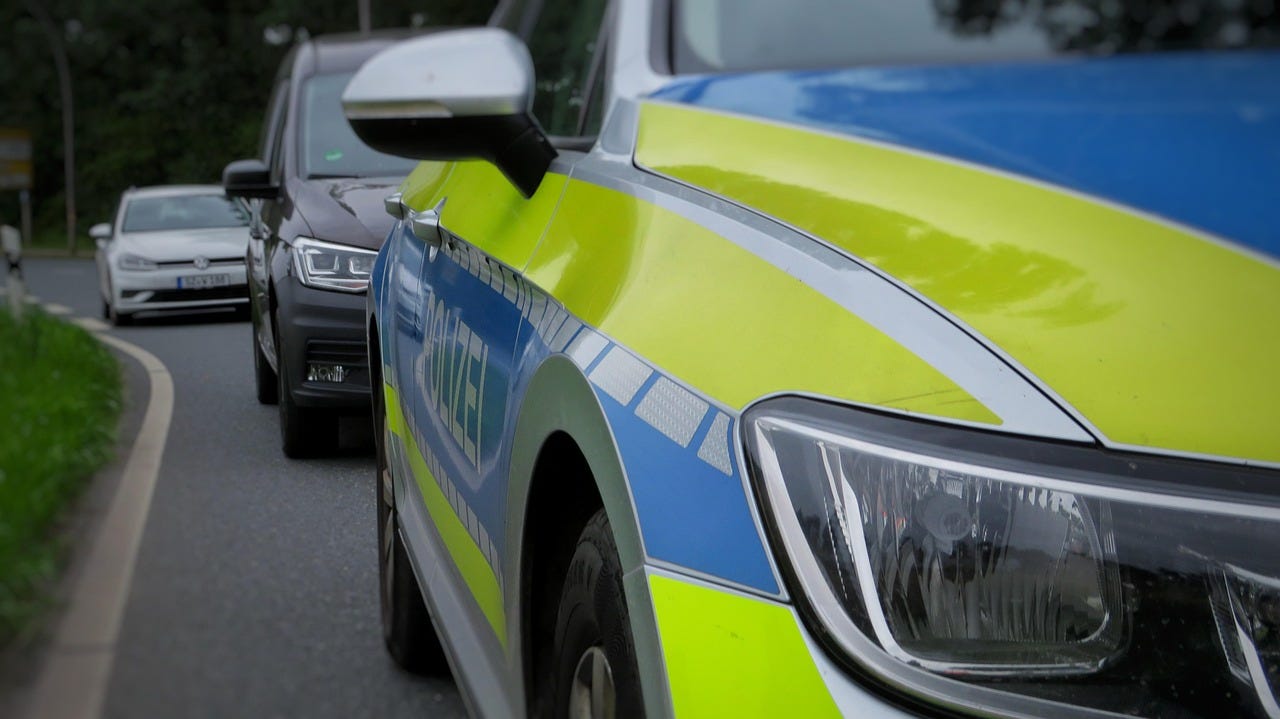
Drivers, for example, who collide with a vehicle parked on the side of a highway often claim not to have seen it before the collision. A seemingly obvious fix would be to make stationary vehicles more conspicuous. But studies with police cars – vehicles designed to be highly conspicuous – showed that this is not enough. A police car on the side of the road, parked in the direction of traffic – even with its lights flashing – might be interpreted by a driver as moving. Simply parking it at an unexpected angle, however, makes all the difference. Expectations, remember? [source]
Similarly with motorcycles – perennially difficult to see by drivers. And maintenance workers – the ones wearing high-viz vests. The simple use of bright, reflective clothing is not enough if the visual environment already contains a wealth of stimuli; it’s more about the motorcyclist’s/worker’s contrast with the surroundings. “Conspicuity is of interest,” notes the above research paper, “because it involves not only ‘bottom-up’ perceptual processes, but also `top-down’ cognitive processes, such as the expectations of the driver.”
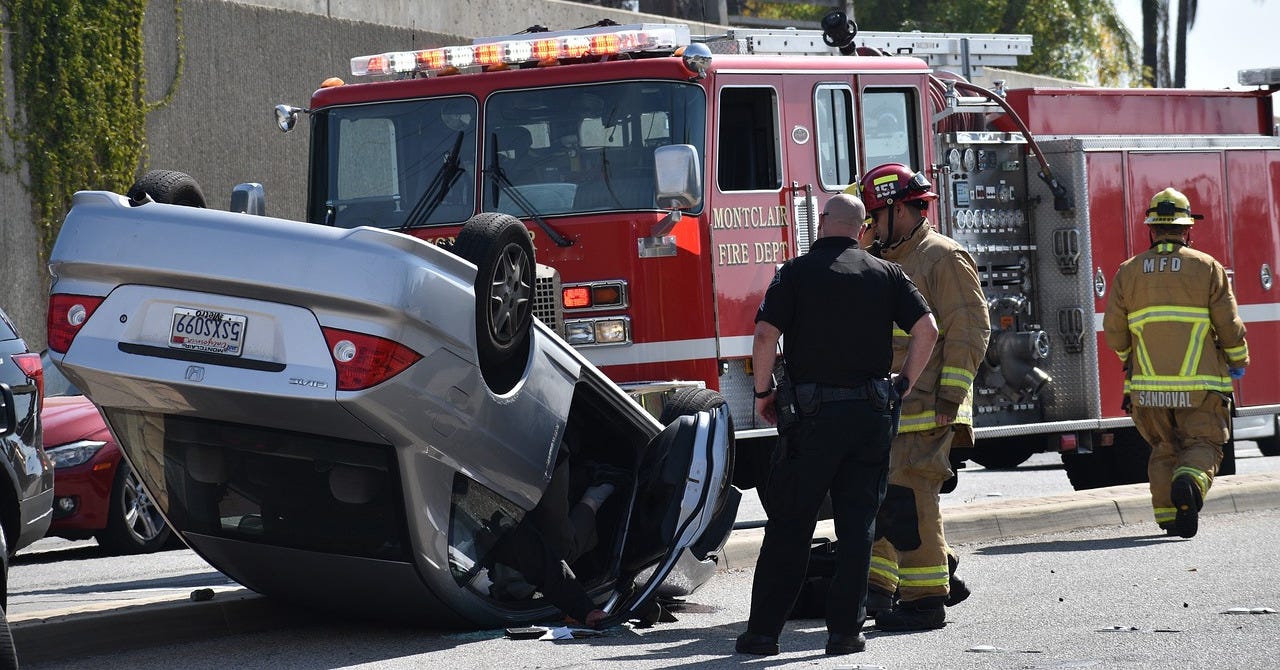
Let’s differentiate accident investigations from human factors research projects. An accident happens – why investigate? Again, seems obvious, but let’s again dig into the seemingly obvious. Asking why depends on who is asking. From a law-and-order perspective, the main reason for investigating is to find the perpetrator and prosecute.
But for the human factors expert, it’s different. “The only reason to investigate is to stop it happening again,” writes Langham. “In the words of the philosophers – Metallica – ‘nothing else matters’ (hopefully the reader is cognisant of rock music).” The best part of his job is when he can say to a family, “This is why someone’s died, it won’t happen again.”
The flip side of investigations is research projects. They look at known or potential hazards and suggest some preventive action – in order to reduce the number of post-accident (or incident) investigations. Compare two different types of high-viz vests and detect how far and how fast a driver can see them. Try and find the ideal reflective pattern for an emergency vehicle. How fast should the lights flash? How far away can you see them? What emergency sound gets people’s attention the most? Park a police car on the side of a road and strike it repeatedly with another vehicle. (Actually, that one is ethically dubious. But a driving simulator often doesn’t quite do it, Langham tells me.)
This constitutes the fun part of his job: “We always seem to throw one bit of metal at another and measure what happens.”
Here’s an example from the literature:
“37 regular drivers were shown film clips of a marked police vehicle, in which flash rate (1 Hz, 4 Hz) and pattern (single, triple pulse) were varied on the blue Light Emitting Diode (LED) roofbar. Results indicate a 4 Hz flash rate conveys greater urgency than a 1 Hz rate, while a 1 Hz, single flash combination was ranked the least urgent of all combinations.” [source]
I won’t go into the science of sirens, but you can read more here.
Fascinating stuff, but on the whole, research can be limited. Take, for example what is called sustained attention – “how long an operator can detect an event that is expected”. You can imagine all sorts of applications – besides driving, there is CCTV monitoring, various flying and train operating situations. Most of the research in this area was done in the 1950s, and measured how long American radar operators could look at a screen in search of Russian aircraft. The result, Langham writes: “What we know about vigilance and monitoring tasks is that humans are very poor at it – we miss things very easily.”
Another issue is expectancy in a research project. “You can’t tell someone they are going to see flashing lights, for example,” Langham tells me. A related issue is about the research subjects: You might be aware that most psychology research in the past 70 years or so has been done on university students in controlled conditions – like Langham’s lab at Sussex University, where he taught and researched for many years. “But a driver involved in an accident,” he tells me, “is more likely to be a 60-year-old chap who’s been driving several hours, in light rain, listening to the radio.”
Bringing us right back to accident investigations. The difference between investigation and research project is that the first is known as forensic human factors, the other simply as human factors. One looks backward and the other looks forward. Investigations tend to get all the attention, understandably, because something has happened. Who’s interested in preventive research? Who cares about What Ifs? Should near misses be reported?
And who is interested in doing human factors research? There’s a reason Langham has a dwindling number of colleagues. “Young people are not keen on doing the long hours, getting cold and damp,” he tells me. In addition to a postgraduate qualification, there are two extra years of police forensic training.
Maybe one answer lies in design research. This is actually a growing area – I mentored and supervised many students doing exactly this. And human factors is closely related to design research, for obvious reasons: Above I mentioned that one of the three types of causes of accidents is faulty or poorly designed equipment or systems.
Langham points to a clear issue: “The person who designs has never done the job, has never seen what the problems are.” This issue is common in architecture, lacking in what are called “post-occupancy studies”.
Example: Langham arrives at a security station to find all the alarms turned off. “Why?” he asks (of course). Well, they go off four or five times a day. “Well, why do they go off four or five times a day?” And so forth.
Example: There’s an alert in a control room. Half of the guards go north, and half go east. Why? “Half of them had the floorpan printed in portrait format,” he tells me, “and half had it printed in landscape.”
Related example: “How long,” Langham asks a group of guards, “will it take you to respond to an incident in Zone G4?” Two-thirds of them say it will take two to three minutes. The rest say one hour. Why? One group had the architect’s original plan for the facility, and the other group had a custom-designed walking guide. Each piece of paper was designed with a different scale.
Wayfinding and signage are a whole sub-area of research (and investigations, in the worst case). The person who designed something generally knows where things are. But a user might be stressed because they’re in a hurry or in an emergency situation. And what about multiple signs to find a destination, as in a hospital? You’re supposed to remember what that sign back there said, until you reach the next one.
Relatedly, a fascinating bit of Langham’s work involves removing safety posters. Example: A particular stairway in a train station is associated with a disproportionate number of accidents. How did they occur? Well, head and leg injuries from falling down the stairs. But why? Well, the staff answered, “There are stairs and people will fall down them.”
But why these stairs, this platform, and this many accidents? The staff replied that they put up posters above the stairs, “telling people how not to fall down them and how to use stairs (hold the handrail).” Having lived in the UK for 23 years myself, I can tell you that such posters – and announcements – are very common. They’re often disparaged as evidence of a “nanny state,” and they often stem from legal or regulatory requirements. In other words, when an accident occurs, the authority in charge doesn’t want to be held responsible. Remember why investigations are done from a law-and-order perspective?
It didn’t take too much digging for Langham to discover that the stairway in question leads to the platform where the commuter train into London stops. Incidents peaked during rush hour. The platform is connected to the ticket hall by a glass overpass, so passengers can see the train approaching. Accordingly, they start to run. Or in Langham’s words, “Observations indicate that people descend the stairs very rapidly when there is a train present at the platform.” He interviewed some of the injured. Their most common response was “I knew I would miss the train as I could see it at the platform, so I ran”.
The solution? Cover the windows on the glass walkway so that people can’t see the train approaching. And get rid of that poster: besides its bloody obvious advice, by placing it over the stairs, people tended to look up at it instead of down to see where they were going. Posters, Langham reports, “are the sign of defeat and result from only asking ‘how’.”
The outcome? No incidents in 12 years. [source]
One last design example. An engineer designs a piece of hardware, but never actually uses it in the field. At the inquiry after an accident, he says “I can use it. Even my daughter can use it, with practice.” This one reminded me of an encounter I had with an engineer at a technology conference, who told me (after a drink or two) “Forget the user – I know best!” (He used a stronger word than “forget,” actually.)
This raises a whole sub-area of human factors. Two, actually: Human-Computer Interaction (HCI), and Human-Machine Interaction (HMI). Langham makes a distinction between them with the following example: A crash involving a plane and one of those tug vehicles that tows planes around the airport. “An HCI person looked at the screen bolted to the tug, where information to the driver was displayed,” he says. “The theory was that the tug driver was distracted by the screen. It was fine. The HMI specialist said it must be the whole machine – the controls, the visibility from the driver’s seat – but all was fine. The HF person asked the tug driver, after doing the first two lots of tests again (HF people do things twice), ‘When did you last see a medical professional?’ The answer was the day before; that he had had ‘some jabs ready for his holiday’. The HF person was shown the leaflet given to the driver after the jabs, telling him that he might feel dizzy or tired and not to operate heavy machines. The driver did not think an aircraft under tow was a heavy machine.”
That prompts me to ask Langham about AI and automation – specifically autonomous vehicles. Their makers readily repeat that figure I mentioned earlier: 95 percent of accidents are attributable to human error. So might autonomous vehicles be safer?
AI actually featured heavily in his first degree, back in the 1990s. “AI will be doing this in two years,” he was told then. Today we’re told the same thing.
Let’s take a brief digression to return to the term “situational awareness”. I’ll first refine my definition from “knowing what’s going on around you” to knowing what is specifically relevant to pay attention to, from all the things going on around you, at a given time. I wrote a separate article all about attentional mechanisms with regard to information, and have noted that such mechanisms are also at the core of the current boom in AI.
As ever, language can subtly affect the meanings we make. You can pay attention to something, you can give your attention, you can devote attention to something or someone. Just as you can spend, set aside, or give your time.
“Situational awareness” was adopted by young San Francisco AI enthusiast Leopold Ashenbrenner in a 2024 blog post, to refer to what he thought was worth paying attention to in industry developments. Investors did pay attention, paid Ashenbrenner lots of money, and Situational Awareness quickly went from a blog post to a very large hedge fund.
In July 2026, Situational Awareness unravelled within 24 hours in a downturn in AI stocks, and most of its remaining assets were acquired by another fund.
Why am I telling you this? Because “situational awareness” applies equally well to the broader socioeconomic landscape as to your immediate surroundings. Aschenbrenner understood this, but like many Silicon Valley investors and engineers, he defines and quantifies “intelligence” as a singular quality that can apply equally to humans and computers.
If you have read any of my other writing, you know that I strongly disagree with this idea of a singular “intelligence”, and reject the notion that humans and machines can be directly compared. Aschenbrenner convincingly showed that AI had, thanks to GPT-4 from OpenAI (which fired him just before his blog post) surpassed the “intelligence” of a “smart high schooler”, and by 2030 or so will out-think us all.
In the growing pushback against commercial AI, it is becoming more widely known that the “intelligence” of AI is jagged – it can excel at narrow tasks like playing chess, writing convincingly human text, or designing new types of viruses, but it can simultaneously and spectacularly fail at simple arithmetic, or real-world tasks like fitting a sofa through a doorway. And it can be confidently wrong – known as hallucinating.
This brings us back to human factors – those real-world situations that may or may not be predictable. Despite ongoing work on AI world models and spatial reasoning, AI might learn how to drive a car in a rudimentary way, but it knows nothing about who is inside, and whether they might have had any medication recently, for example.
We shouldn’t focus on the technology itself, but its designers. And its users: in 2017 for example, a man was arrested for planning a bombing using a driverless car, and various scenarios have been imagined in which a fleet of autonomous vehicles is hacked – the cars as well as the humans become “bad actors” in such scenarios.
I would therefore suggest that “human factors”, like “situational awareness” applies equally well to the broader socioeconomic landscape around AI.
Regarding autonomous vehicles, “the question is,” Langham tells me, “does the AI make the same mistakes as the human? Where do the cameras or the sensors look?” Recall that research mentioned above about experienced drivers looking in all the usual places. Companies are designing autonomous vehicles but not the infrastructure that they run on – the existing human-created network of roads and highways. This means they have cameras and sensors optimised to look at road signs and road markings – these provide a common language between human and autonomous drivers, as artist James Bridle points out.
Furthermore, Langham points out, AI can not only act an autonomous agent, but is designed by those highly fallible and biased humans. So, a human designer might have no idea what a task or situation is like in practice, the AI has zero experience in the real world, and all its learning is based on what is expected. Thus it might seek short cuts that deal with the common, and not the unexpected.
Maybe there is hope: in weather forecasting, drug discovery and some other areas of science, researchers report that AI can crunch much more data than human scientists, and generate scenarios that humans might not have predicted or been able to model previously.
All of this points to the need for another sub-field of human factors, Langham thinks. “Overall we think Human Factors is valuable, Forensic Human Factors is vital, but will we need Computer Factors? And who will do the forensics when things go wrong?”
Let’s go back to human fallibility, then. Let’s go back to Paris, and that tunnel, on that night in 1997.
Conflicting eyewitness accounts were not surprising to Langham. “The worst creature on the planet to be a witness is a human,” he writes. (He adds that they also make terrible investigators, as they have biases and heuristics).
There’s more:
Although our vison is very limited, it’s further reduced as the signal from each eye is split and sent off down different channels into the mind where it arrives as a blurred upside-down image, via the retina, and the brain has to interpret what’s going on. Vison is more about conception than perception. That’s to say the mind controls what we see to such an extent – and this control is based on experience and expectation – that vision is limited [source]
An eyewitness account of an accident involves not only vision but memory. “Psychological research reveals that human memory is not an absolute recording of the events we perceived,” he writes in his report on the Princess Diana crash. This is because we construct memories, but then re-construct them later. “That is to say,” he wrote, “that we use our experience to fill in gaps in what we have perceived.”
Add in prior knowledge, and knowledge we might acquire later that might change a memory when recalled. These are called interference effects (recall bottom-up perception versus top-down cognition above). Now add in emotions, which can create a kind of tunnel effect for memory, “in which central details are enhanced and peripheral details are inhibited.“ In this case, eyewitnesses focused on the black Mercedes due to its speed, and the sight and sound and emotional impact of the crash, more so than the white Fiat or all those motorcycles (recall all that stuff about motorcycle conspicuity).
The opposite of tunnel memory may also have been involved, Langham noted: boundary extension.
“This exists when individuals are asked to remember objects seen in a picture. The subjects in experiments routinely include information that was likely to exist just outside the camera’s field of view. However, their cognitive system generates the surrounding ‘out of sight’ content based on their expectations or cues from the environment. The actual witnessed content – the speeding Mercedes and the self-generated content is, in memory, thought of as equally real.” [source]
Langham didn’t lead the full investigation in the Princess Diana case, only offered his expertise on eyewitness testimony. I am sure that if he had, he would have loved to say to the families (including the Royal Family), “This is why someone’s died, it won’t happen again.”
No posts
Comments
Nothing yet. Say the first thing.
Sign in to join the conversation.