
I want something like Google Trends but for Claude.
Google Trends launched 20 years ago, simply displaying the top searches being conducted in real time. With data collected over time, it can show which topics trended when – a bit like Google’s Ngram but less scientific.
For the most part, it’s always been a novelty. Google Trends itself trended for a while, then was largely forgotten. But it’s still around. It’s most useful for researchers or the curious to take the Internet’s temperature.
Now that AI chatbots are replacing Google search, wouldn’t you like to know how people are prompting them? Chatbots present a very personalized experience, but I don’t need to know about my own prompts – I can easily go to the history for that. I’m interested in what people are doing collectively – for my own anthropological curiosity, and to take the temperature of the AI-sphere.
What I’m talking about is different from news. Google also has its News app, which algorithmically aggregates the latest stories from various news outlets. There was some controversy around that, as news outlets saw unfair competition.
AI is the latest threat to journalism, with similar court battles. But the major news outlets are still around, and new hyperlocal or specialized efforts continue to sprout up. Human-edited news remains popular – and important – for two related reasons: trust, and serendipity. You value information from sources you have come to trust, and you appreciate a good editor’s judgement about what is newsworthy. Anthropologically, this goes back thousands of years – it’s related to cultural traditions of gossip.
An algorithm can only guess statistically whether you want “more like this” or something different. I look at the news from sources I trust, and that means I might pay attention to a story I might not have searched for or shown an interest in otherwise.
Enter social media, and the “filter bubble” effect that seems to have polarised us into different realities based on the information we’re exposed to. Chatbots can have the same effect but, in their case, individually confirming our biases. As a personal product provided by a business, a chatbot also keeps past data that I have input and that it has output in response, and references this data in subsequent prompts. So I understand when people say a chatbot “knows them” better than some other humans.
I am therefore not talking about a personalised news feed – what MIT Media lab called “The Daily Me” back in the 1980s. The lab’s founder, Nicolas Negroponte, said at the time:
I don’t read newspapers myself. My wife, Elaine, reads them and tells me what I need to know because she’s an expert on me. Artificial intelligence could do that, but in all the literature and programs I’ve come across I’ve never seen an expert system that pretended to be an expert about the user. (source)
Now a form of AI has arrived in the form of chatbots. But it’s still not an expert about any one person – though many companies are continuing to pursue such personalization efforts. The 2010s dream that Big Data would reveal insights about ourselves continues, now aided by systems that can easily aggregate all that data. But chatbots remain merely an aggregate of what lots of people have uploaded to the internet.
Therefore, I’m interested in what’s trending on a given chatbot platform. Most AI discourse is either about what it can do or what you can do with it. With my anthropologist hat on, I’m interested in what people actually are doing with it, as a cultural phenomenon.
This would have to be done by a specific AI company, because chatbot providers collect and hold their own data, and competition and privacy prevent them from sharing it with others (except for advertising – hello OpenAI). Individual AI consultants, influencers and promoters are eager to share their most effective prompts with you, but this is not what I’m talking about – I am curious what people are prompting, good or bad, effective or ludicrous.
I focus on Claude because it’s my chatbot of choice. Its maker Anthropic publicly points to an ethical “constitution” that feeds it, and employs a human philosopher to guide it. We know the company collects users’ chat data because it has released the results of some large-scale studies over the past couple of years.
In this one from 2024, data from a million conversations reveal general uses that are now well-known: coding, writing, and research. The study also identifies some culturally-specific patterns. Then in 2025, this study focused specifically on how people use Claude for emotional support, using data from 4.5 million conversations. The latest is a survey of 81,000 people across 159 countries and 70 languages using an AI interviewer, and simply catalogs what people want from AI.
Claude currently lists some suggestions below the prompt box based on these general uses: “Write”, “Learn”, “Code”, “Life stuff”, and something intriguingly called “Claude’s choice”, which seems closest to what I am proposing – or perhaps close to Google’s “I’m Feeling Lucky” button. ChatGPT has a suspiciously similar interface. I find all these interfaces and the overall functionality to be unfocused, reacting merely to what generates the most profit. And they’re clunky: Would the same person who prompts a chatbot to generate code be the same person prompting for “life stuff”?
I want to see individual examples, stories, even specific examples of prompts.
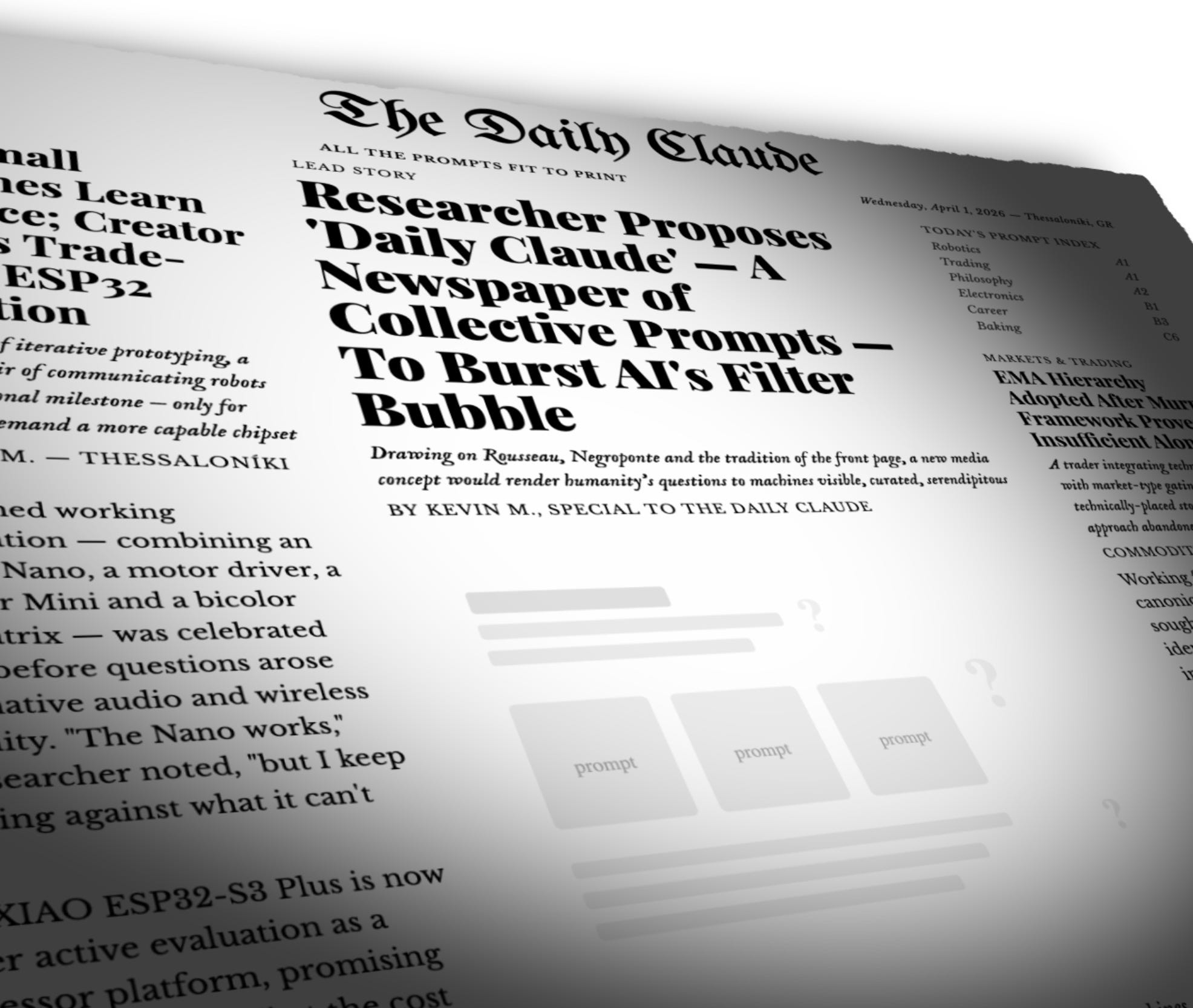
These would of course need to be anonymised and published with consent of users. I imagine an interface like a newspaper. In my book on 1990s “new media”, I describe (p.40) the front page of an analog newspaper (printed on actual paper) to be a great model of serendipity: a headline or a photo catches your eye and might take you down a rabbit hole.
This might be compared to how, in those optimistic early days of the Web, we talked about “browsing” or “surfing” as opposed to targeted search: looking at pages and following links to explore information we might not have been exposed to otherwise.
Then, this was exploited in the form of clickbait, content farms, and especially social media. The rabbit hole swallowed up any common culture, and it polarised and radicalised people. This explains some of the warnings coming from AI chatbot makers: chatbots combine the filter bubble with confirmation bias and an authoritative tone.
The “Claude’s choice” button below the prompt box shows, for me: “Explore memory techniques”, “Discover a new perspective”, “Consider environmental solutions”, “Discuss future technologies” and “Debate an ethical dilemma”. These indeed seem intended to address some of the negative consequences. Anthropic also provides a lengthy prompting guide and list of best practices.
Too much, too technical. Seeing other people’s prompts is something different, and it could help burst the filter bubble. It might show you some unexpected – even unnerving – ways that people are using chatbots.
The privacy issue is the biggest obstacle to what I am proposing. People’s prompts can be very revealing: health anxieties, relationship problems, creative blocks, financial stress. Obviously, individual prompts should not be shared verbatim, and even anonymised, aggregated prompts carry risk.
Therefore, in addition to anonymisation, what I am proposing would need to be moderated, edited and overseen by a human – who could interpret, add context and make prompts into stories. It wouldn’t replace your own chats, nor your favourite news outlet, but could contain valuable insights – both for users and for Anthropic. Not “The Daily Me”, but “The Daily Claude”. A media product for users, an anthropological research project for Anthropic and for academics, with ethnographic attention to how people are actually living with these systems.
There are some interesting philosophical implications – something we like to think about at Philosophy Machines. Ludwig Wittgenstein’s “language games” for example: If prompting behavior shapes how models respond and evolve, then the community of users effectively determines what these systems mean and what they’re for. Individual prompting feels autonomous, but it’s always shaped by — and in turn shapes —collective norms. Whose prompts count thus becomes a political question.
My proposed project might make explicit the public aspect of private prompting. Jürgen Habermas’ idea of the public sphere is a place private individuals reason together toward common understanding. Social media was supposed to democratise this, and arguably destroyed it instead. Prompting of chatbots is a highly personal, private affair. Yet it draws on collective norms, and conversely might shape the public sphere in a more subtle way, when we take what we’ve learned from chatbots and discuss it with other humans – either on social media or in person. Something like The Daily Claude might make these collective issues more public.
One more philosophical point: If chatbots are becoming an extension (or outsourcing) of our thinking, then they have the potential to disappear, as we intuitively reach for them as “ready-to-hand” tools, as Heidegger described – tools we use without thinking about them. Seeing other people’s prompts could instead keep the tool “present-at-hand” — visible, strange, worth examining. This kind of defamiliarisation has genuine philosophical and cultural value.
Regardless of these deeper implications, a simple newspaper-style feed of trending prompts, and stories associated with them, would simply be endlessly fascinating, and potentially even fun.
No posts
Comments
Nothing yet. Say the first thing.
Sign in to join the conversation.