

The industry is putting early career comms people in impossible positions.
Comms vacancies are asking juniors to perform strategic judgment before the industry has given them the conditions to build it. Which has forced early career people to position as “comms strategists”. Early career communicators now have “strategy” on their CVs, take courses, download frameworks, ask AI for campaign plans, follow X and LinkedIn experts.
They are simply playing the job market game.
But courses, frameworks, AI prompts, etc dont make a strategist.
Case in point, having sat on the other side of the interviewing process, I’ve noticed hiring managers apply more rigour when interviewing for a role that demands true strategic work. Nobody needing serious comms work would entrust their strategy to someone in the early innings of their career. I also dont think you should want that kind of responsibility that early on.
This is why apprenticeships were precious and insanely valuable.
Juniors had the opportunity to be bad at things for a while till they got better. You had access to more senior colleagues would sit with you and explain why your big idea is a mismatch for your campaign, and why your audience segmentation is out of sorts.
Instead, early-career comms people are now either expected to run whole comms functions too early, or locked out of job opportunities because every role now wants 5 years of experience (that’s not an exaggeration, I’ve been compiling job vacancies for the last 7 months and it’s a recurring pattern).
Due to economic forces and pressures on internal teams, apprenticeships (internships, management trainee programs etc) are becoming less common, unless you work in a comms or PR agency, and even those are fizzling out.
The industry is more or less creating the conditions for weaker comms.
Today, even though we have access to near infinite knowledge, courses, templates, and AI tools, people still struggle to deliver great comms. Which reinforces the point that the value of a communications strategist is the judgement they bring to the table.
There’s that word again, judgment.
We talk about judgment all the time, but we rarely explain how to build it. And yet, if you look closely, career progression in communications is largely a story of increasing judgment.
In lower-complexity environments, you can get away with “conveyor belt comms.”
Conveyor belt comms: You receive tasks, produce outputs, follow instructions, and optimize for delivery.
Judgment-led comms: You operate within a great deal of uncertainty and unknown unknowns. You’re required to diagnose the situation, interpret risks, manage trade-offs, advise people, and decide what not to do.
In conveyor belt comms, the decisions are mostly downstream, the margin for error is limited and you simply execute whatever is sent to your desk.
But the moment you step into a more complex role or inherit responsibility from someone more senior, your lack of judgment will quickly expose you.
I’ve worked across advertising, media, and communications. I’ve seen junior and senior professionals use the same frameworks but their outputs come out completely different. The difference is in judgment.
Fortunately, you can acquire judgement just like you can acquire knowledge. Here’s how I’ve been building mine over my career.
Deep learning gives you principles.
Real practice tests those principles.
Proximity to expertise corrects your blind spots.
Then the loop repeats.
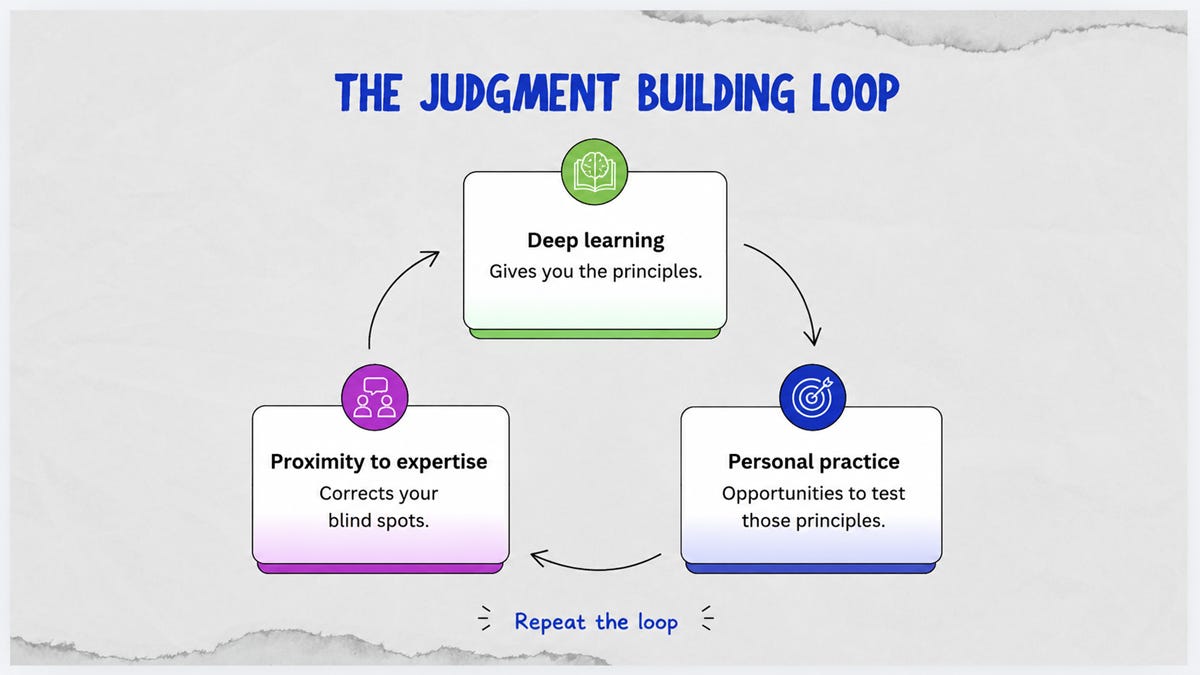
Learning is often lonely work.
Poring through case studies. Reading books, annual reports, strategy documents, policy briefs etc to understand how serious organizations frame their work. Keeping a swipe file of excellent headlines, posts, op-eds, campaigns, emails, speeches, and media pitches. Listening closely to interviews, panels, political speeches, or press briefings to study framing, persuasion, and messaging.
You’d be surprised by how many people dont do this or rush through it like a to-do list.
One advantage of deep reading and learning is that you encounter ideas in context. Beyond reading about the outcome and what worked, you understand why it worked, where it worked, how it could have failed, the different things people have experimented with, etc.
My friend would say, you read for the principle, not just the outcome. That’s a cool way of saying, sometimes the only thing you can extract from an idea is the principle and not the exact practice.
For example, from Sam Walton’s biography, I learned that he made sure every new Walmart store he opened introduced something different from the other stores. And it wasn’t just for the novelty factor, he practiced a discipline of continuous improvement.
You probably cant copy that literally but you can adapt the principle.
For example, I try to introduce something new into my LinkedIn posts each month. Primarily to avoid boredom while staying consistent with my voice. And downstream of that decision is realizing that, if it’s exciting for me, it will be exciting for my readers.
That’s what real learning looks like - you translate ideas and make them your own, not just imitate them.
One of the horrific things I’ve seen, asides from the decline in longform reading, is that more people now rely on book summaries and AI generated bullet points. People on twitter will tag @grok and tell it to summarise an article. This is a dangerous habit.
Summaries are useful for recall but they are terrible as a replacement for learning. The value of a good book is not just the idea it contains, it’s the repetition, the variation on the idea, the accumulation of examples and diverse context.
This is how the human mind internalises patterns. And also how I’ve built my judgement, through pattern matching and recognition.
Reading is the foundation for mastery. But the situations you face in communications work are rarely textbook. You cannot carbon copy strategies from a book or social media and expect them to work for you. No, you have to experiment in the real world.
So please, move from bookmarking posts and highlighting ideas to actually running experiments with them. Many of your experiments will fail and that’s okay. Document it, refine the idea and then try again.
Frameworks are not instructions. You should treat them like lenses and there is more than one way to interpret them.
The quality of ‘experiments’ you run is directly influenced by the quality of what you read. Ever since I missed out on an incredible job with a dream organization simply because I lacked the necessary judgment the role demanded, I’ve started taking my personal experiments very seriously to glorious results.
As you experiment and notice what works, two things start to happen:
- your intuition improves
- and you begin to trust your own thinking
This is the loop that leads to mastery in your comms career (or any other career if we’re being honest).
There are limits to what you can do alone.
At some point, you will get stuck in your own patterns. If you’ve been working for several years, you will find yourself repeating the same ideas, leaning on the same playbooks, and strategies, especially when some of these tactics were successful.
If you plan to stick to one organization in the same industry throughout your career, this may not be an immediate problem. But if you want mastery and a skillset that translates across any company or industry - nonprofit, private sector, government - you have to periodically unbundle what’s working to build something better.
This is where proximity to people with deeper expertise matters. They disrupt your loop. They expose you to playbooks and ways of thinking you wouldn’t have considered on your own or even from reading.
Get mentors, shadow experts and senior colleagues. Become a sponge and absorb as much wisdom as you can from them.
While the industry remains uneven in many ways, especially for early career comms people, and while we’re all figuring out how exactly AI fits into the future of our profession, I want you to remember that the core value of the comms strategist is judgment and if that’s your long term career goal, you should run this loop on yourself.
Let the AI supply the templates. As long as the strategic judgement sits on your side, the odds remain in your favor.
I’m a Hollywood Writer. It’s Not Over for Us
This piece by screenwriter David Scarpa is worth reading beyond the film industry. His point is that AI becomes most threatening when human creative work has already started behaving like a machine and I think that should make comms people sit up. If our work is only frameworks, templates, and familiar language, we will be out of a job soon enough. But if it is built on sharp observation, context, lived experience, and strategic judgment, AI becomes less of a replacement and more of a tool.
If you enjoyed reading this newsletter, please share with your network. Inclusion Notes keeps growing every week and it’s due to people sharing it with their friends and colleagues.
Comments
Nothing yet. Say the first thing.
Sign in to join the conversation.