

One of the questions I get very often is, “I’m stuck and feeling frustrated, what does a real career path in nonprofit communications look like? It doesnt feel like I’m making much progress.”
This question is only exceeded by “How do I work for an international NGO?”.
When I started my career, I remember googling for weeks and reading hundreds of blogs and Medium posts, just to get a coherent answer to these questions.
This is my attempt at an answer and is majorly focused on the nonprofit sector, even though some of it overlaps with the private sector.
Many comms people I know entered the profession purely on their writing skills.
In Taking Big Bets on your Comms Career, I wrote:
NGOs would hire fresh graduates who were handy with words to help them write blogposts, op-eds and proposals. Then the workload grows.
Creating and managing the social media account gets added to their plate, then launching a newsletter, then events, getting press coverage for the event, then ghostwriting speeches for the MD, then stakeholder management, and then crisis management.
This pathway has produced many senior comms people, me included.
While at first it feels like you are just being given more tasks, but what is happening is you are being introduced to the full machinery of communications. And as the NGO succeeds, your career begins to grow.
This is important, because nonprofit careers are often tied to funding cycles.
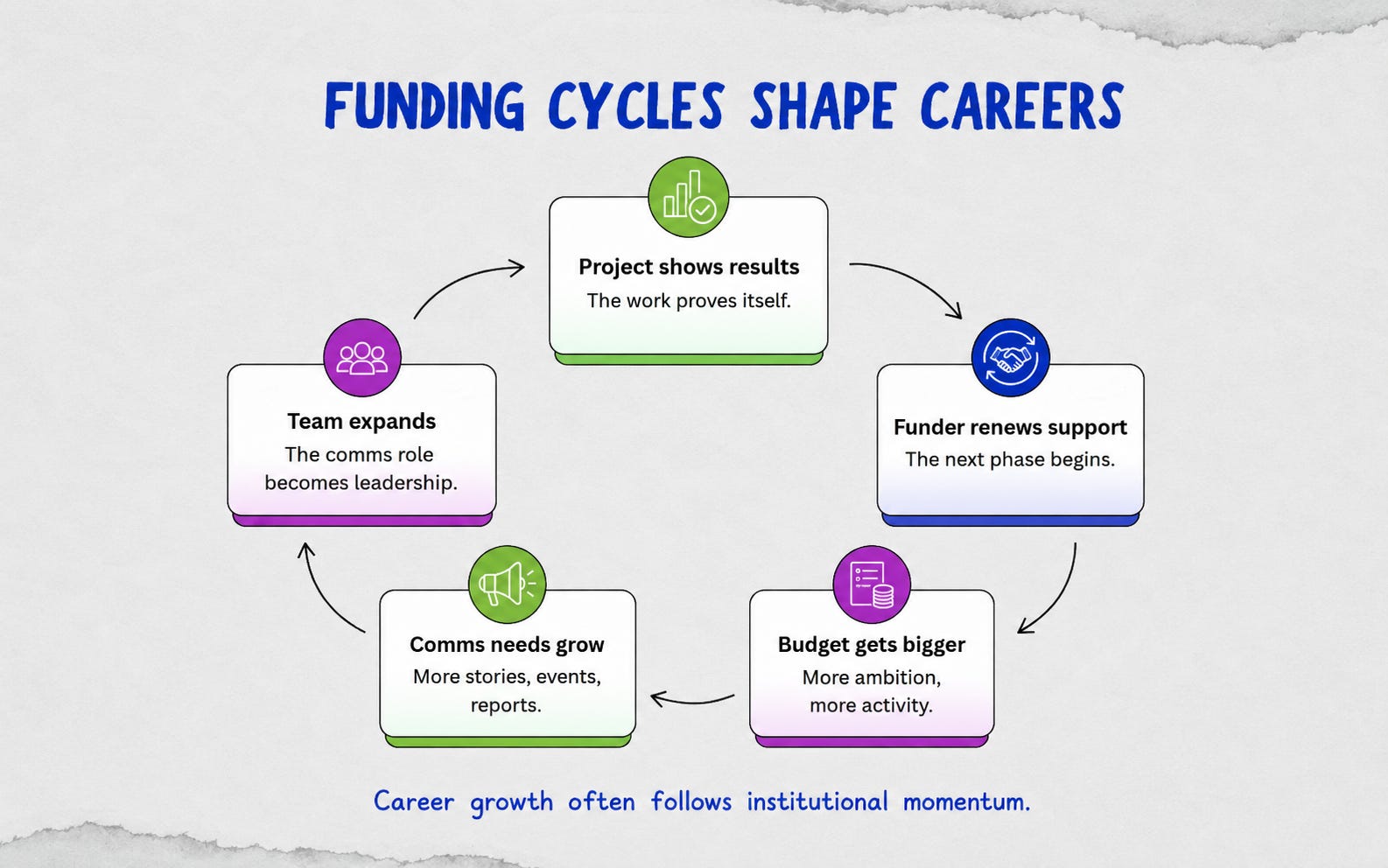
In the nonprofit sector, funders have a bias toward continuity. They often prefer to renew or expand work with organisations they already fund, especially when the project is delivering results. You could call it “phase two” funding.
If you are lucky, the NGO you work for impresses the funder. What then happens is the NGO gets “phase two” funding to scale what worked in the previous cycle.
A bigger project gets a bigger comms budget. And now you as the comms person gets to hire an extra hand. Assuming, of course, you’ve been strategically letting them know you need more capacity ahead of time.
If you’re a comms person working with a small but mighty NGO with a lot of potential, it’s on you to let your leaders know about your need for extra comms capacity, ideally before the next fund comes in. And make sure to remind support them when they are writing proposals.
Sometimes things do not pan out. Your NGO might keep struggling for funding, and you may be stuck as the only comms person for years.
But let’s say you picked a good NGO and they got more funding, meaning you go from a one person team to a team of 2-3, and now you manage a full time comms assistant and a graphic designer consultant.
This is where you start to exercise your leadership muscle. It’s not as glamorous as you think. Mostly, you learn how to brief people properly so they can execute without your extensive supervision. You also learn how to review their work without rewriting everything yourself, how to manage deadlines, how to protect the content quality you built when it was just you on the team. And so on.
After a few years, you eventually move on and get a not-so-entry-level job with a bigger NGO, and repeat the same dance.
Eventually, if you are lucky, you get a job with an INGO in your country: Oxfam, Mercy Corps, Doctors Without Borders, UNDP, CRS, WWF, BRAC, and the rest of the alphabet soup.
This is a big deal for your career.
Working in the local office of an international NGO means you are now inside (or close enough to) the multilateral ecosystem. ATS systems will no longer reject your CV like it is poison when you apply for international roles.
But you’re also now in the multilateral system, so welcome to bureaucracy 201. Here you learn that nothing is ever “just a blogpost”.
Some blogposts need input from the technical lead, approval from the programme lead, sometimes edits from the donor, clearance from the country office, and a logo and attribution check from global. Sometimes, someone will ask you to simplify the blogpost a bit more but the same person would also add four new acronyms to the draft.
By the time it is approved, the event it was promoting has been forgotten and everybody has moved on, including the organisers.
Compared to your early days when you were the alpha and omega of your organization’s entire digital ecosystem, here you’re just a cog in an often-times slow moving, big wheel. It’s a bit of a culture shock.
One understanding that helped me is that, in nonprofit comms, visibility is never simply visibility. It is donor management and partner politics. External comms products are proof that work happened, and sometimes acts as evidence for the next grant.
This is why one LinkedIn post can suddenly have twelve reviewers.
Communications jobs in the nonprofit space also have two major tracks: institutional comms roles and project-based comms roles.
An institutional comms role means you are working in the organisation’s official communications department. You report within the organogram, probably to a senior comms officer, head of comms, or director of communications.
These are the people with direct control over the organisation’s corporate channels: social media, newsletters, website, media relations, brand, leadership messaging, internal comms, and so on.
A project-based comms role is different.
It means a team within that organisation got dedicated funding to deliver a project. The project could be, for instance, a research programme in Nigeria. Maybe an adaptation project in Honduras, or a gender and climate initiative across three countries.
Depending on the size of the project and the funding, the institutional comms team may not have enough capacity to support it properly. So the project hires a comms consultant or comms specialist.
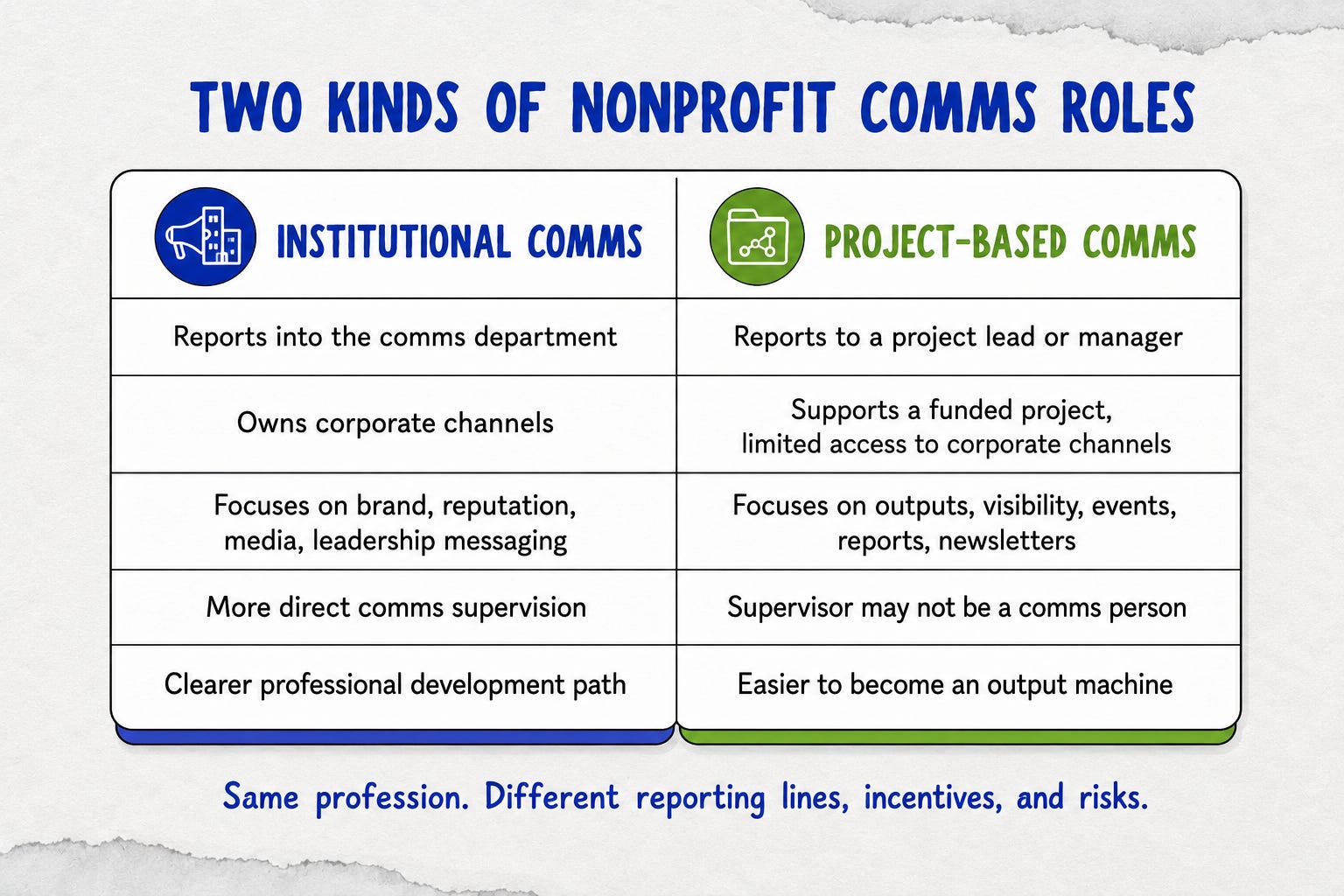
If you’re hired to support such a project, you will probably report to that project’s programme lead or project manager, not the Head of Communications.
This is the bedrock of comms consultancy in the nonprofit space. And it means many things for your career.
One of them is that the feedback you get may be quite pedestrian.
Your supervisor may not be a comms person. They are usually only interested in your outputs i.e. whether you sent the newsletter, whether the event has been announced on social media, whether you’ve designed the report and uploaded it on time, how many blogposts you’ve written this month etc.
They often are not too bothered about positioning, narrative, or whether you are growing into a better comms professional. It’s not malicious, comms is just not their area of expertise.
This is where a lot of comms careers plateau. And the dangerous thing is that you can look successful while plateauing.
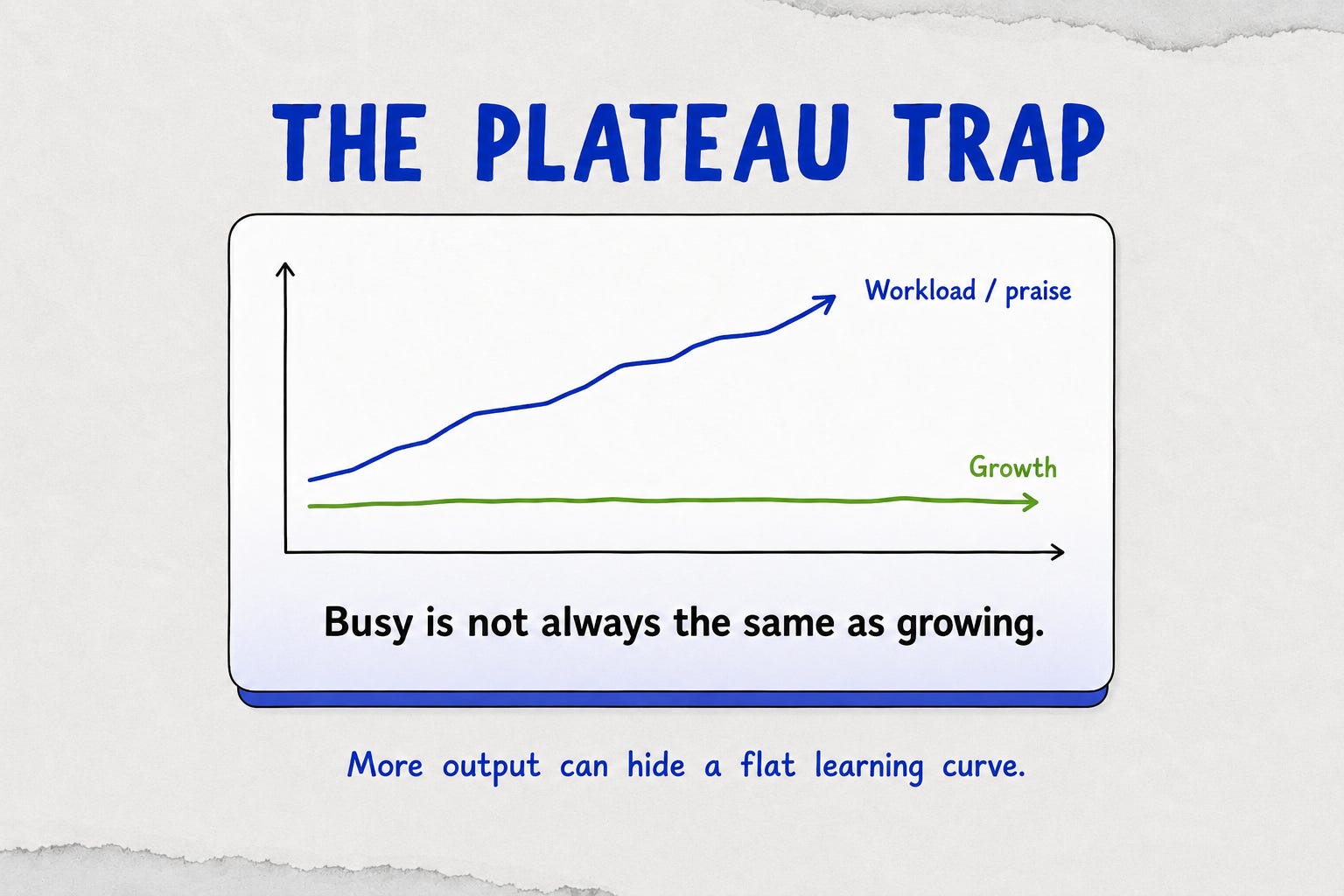
You can be as busy as ever and getting commendations from your colleagues. But you are still being used mostly as an output machine. And because nonprofit work feels meaningful, it can take longer to admit that the role is no longer stretching you.
It’s not strange to see people stuck as comms specialists, comms associates, or comms managers for many years.
Working as a comms consultant in the nonprofit space is also a mixed bag.
When it is good, it’s very good.
You can have multiple contracts with multiple NGOs, or even with different departments in the same NGO. You might be working with the gender team on promoting a research project while also supporting the policy team to plan and deliver a roundtable.
In good seasons, you’ll have multiple contracts, consecutive pay days, and without the restrictive overhead that can come with being a full-time staff in an INGO.
But the cons are real. For one, when there’s a budget crunch, consultants are often the first to go. So your job security is fictional.
The roles are also often poorly scoped. You might be hired to support a project at 60 percent FTE but end up working like a full-time employee. So it becomes 100 percent of the work at 60 percent of the pay.
This combination of overload and job insecurity is why many consultants eventually start looking for full-time roles.
Being a consultant with an INGO gives you proximity to where the action is. If you and the team work well together, and the project keeps getting funded, it is not unusual to be offered a full-time staff position.
Or at least, you leave with strong referrals.
Comms vacancies within INGOs usually expect INGO or multilateral experience which is why I said consultancies are a doorway.
When you’re mid-career, most of your career progression happens in two ways.
One: someone senior leaves, and if you have been around long enough and the leaders trust you, you get asked to step in.
Two: you leave for another organisation.
That is mostly how people get promoted.
If you are ten years into your comms career, you are probably considering / applying for roles with “senior” in the title (Senior Communications Officer, Senior Communications Manager, or Communications Lead).
But senior comms is a tricky place to be in the nonprofit sector.
In many organisations, there are not many layers between “Senior comms person” and “Head of comms.” Once you become senior, the next step is often not another natural promotion. You’re looking for the top job.
Complicating things further is how nonprofit roles are funded. In the private sector, a growing company can create new comms roles because the business is expanding. In nonprofits, new roles often depend on grants, donor budgets, new projects, or if the organisation restructures.
Project-based roles complicate this even further. A project can hire a Senior Communications Specialist because the donor budget allows for it, but that does not mean the organisation has a long-term leadership path for that person. You may be doing senior-level work, managing complex outputs, advising technical teams, and holding a lot of responsibility, while still sitting outside the institutional comms ladder.
This is also why titles can be misleading. In nonprofit comms, “senior” does not always mean you are being prepared to lead a department. Sometimes it simply means you are experienced enough to work independently and deliver without much supervision. You may have the title and the workload, but not necessarily the authority, budget, or progression path that should come with seniority.
So progression is not always a clean ladder. Your boss has to leave. A new project has to create a lead role. The organisation has to win enough funding to expand the team. Or you have to move somewhere else where the slot already exists.
This is why many strong nonprofit comms people remain “senior” for a long time. It’s because the structure around them has no obvious next step.
It’s a mistake to think that if you are very good at doing comms, leading comms is just the next step.
It is not exactly the same job.
Doing comms means you can produce the thing. Leading comms means you can tell whether the thing is needed at all.
And with a cap on resources (both human and financial), it’s your call on what those resources get channeled to.
As a comms leader, you are being trusted with the organisation’s reputation, relationships and public identity. You are trying to tell the strongest possible story without annoying the donor, distorting evidence, or burning out your team.
You are often the first person thinking about how to frame the project, and the last person still cleaning up the comms after everyone else has moved on.
When you finally become comms lead for an international nonprofit, you get closer to the dream that probably pulled you into the sector in the first place: shaping the stories of true change and impact and helping a serious organisation effect change in the world.
You get to influence which stories people finally hear, and how those stories are told. Some of my most fulfilling work, for example, has come from commissioning consultants to gather stronger evidence, so the best version of a story is what eventually gets published.
You are also a gatekeeper of sorts. The buck stops with you on which stories should be pushed, which ones need to be softened, and which ones should be left out entirely because they may create more problems than they solve for the organisation.
I know we comms folks complain a lot about the quiet nonsense that sits behind every “quick” announcement, and about how badly comms is misunderstood and underappreciated. But that irritation comes from care, not cynicism. Most of us are annoyed because we know comms can be truly transformational, more than people allow it to be.
So yes, nonprofit comms can be a real career path. But it is not always a neat ladder. You dont simply go from officer to senior officer to head of comms. It is a slow journey from producing things to exercising judgment.
And to me, that is the real communicator’s path: learning, over time how to care deeply about important stories without losing sight of the institution you work for, the evidence you owe the public, but more importantly, the people our work is meant to serve.
1000+ communicators read Inclusion Notes every month. Help us grow by sharing with your network.
Comments
Nothing yet. Say the first thing.
Sign in to join the conversation.