
When I started working on financial inclusion in 2017, mobile money was still an industry obsession.
We had more than 21 licensed mobile money operators but adoption was stuck around 1-2%. Mobile money startups were banking on the Kenya playbook and expected mobile money to also take off in Nigeria, but the fates (and CBN) said no.
What happened next is a case study in how innovation finds unexpected pathways.
Instead of mobile money, Nigeria's secret weapon turned out to be a trio of innovations:
mobile banking
NIBSS Instant Payment (NIP)
and eventually, agent banking/POS machines.
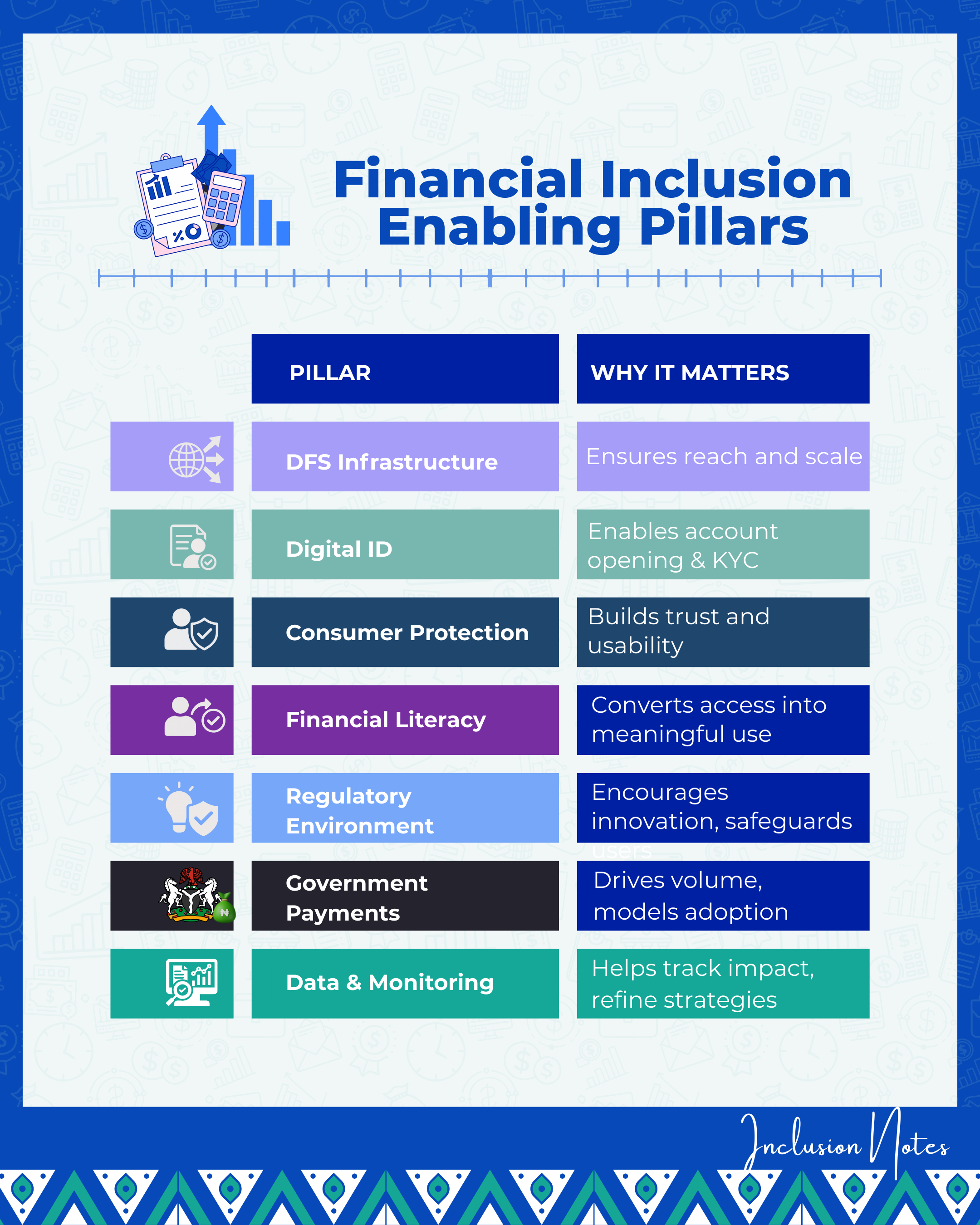
In spite of all the infrastructural challenges, financial literacy gaps and a bevy of issues bedeviling the nation, today ~74% of adults use financial services whether formally or informally.
That's just shy of the CBN's 2024 goal of reducing exclusion to 25%. But what's a 1% difference, eh?
But percentages don't capture the human drama of this transformation.
It's impressive we're here today. I recall vividly the drama when people lost access to their accounts until they registered for a BVN in 2015. Some banks were yet to even launch banking apps back then, you had to go physically to the bank and queue for hours. Today, the financial inclusion ecosystem has birthed a unicorn, and agent networks have exploded across the country.
It's been an interesting journey, to say the least. They say a picture is worth a thousand words so please enjoy the trip down memory lane:
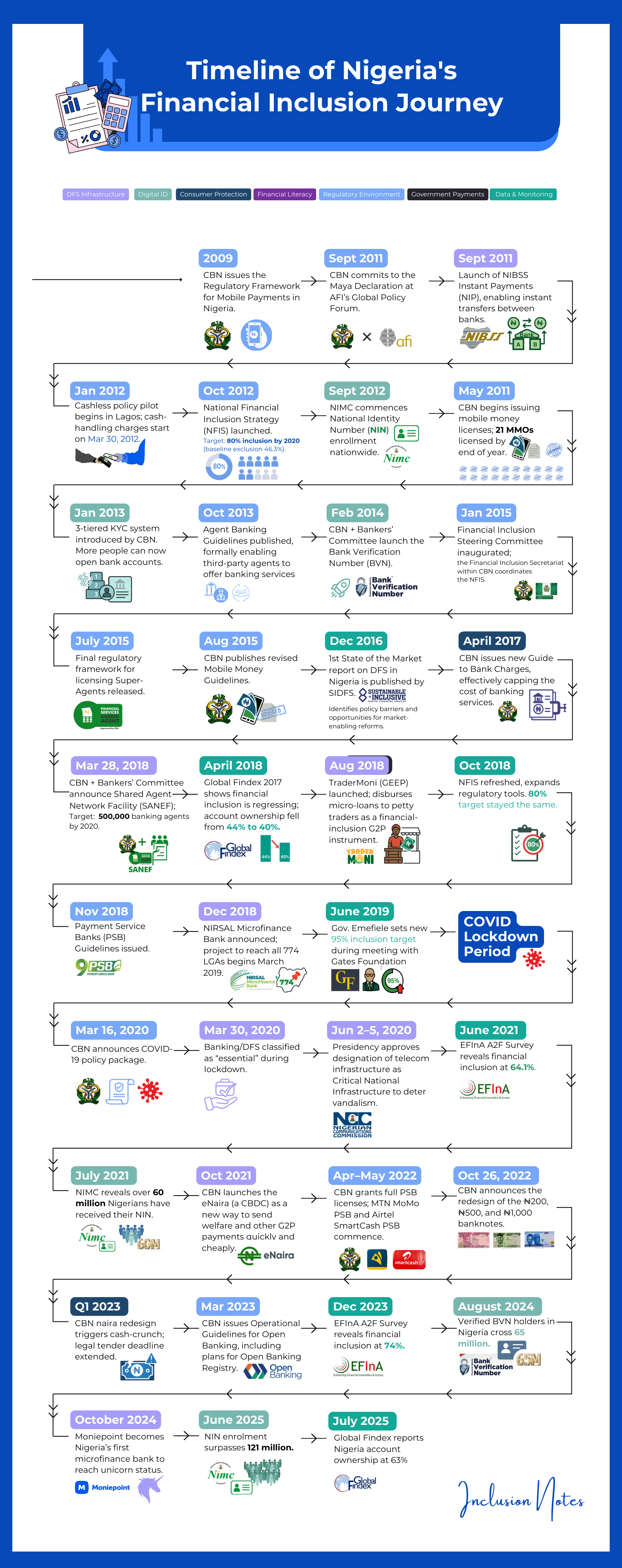
A few interesting observations:
Nigeria’s inclusion story is regulatory-led, and it mostly worked, (even though I'd argue we took the long but safer route).
NIP and Agent banking did a lot of heavy lifting for financial inclusion growth. In fact, NIP is the bedrock for a lot of innovation in the ecosystem today. Your banking apps, savings app, investment apps, PalmPay, OPay, it's all thanks to NIP.
Regulation + political will = IMPACT. This is evident in the growth of agent banking. The guidelines came out in 2013 but agents did not scale until the Bankers' Committee launched SANEF... in 2018! Policy is just documentation until champions with authority and resources buy in.
The year 2018 was particularly intense: so many policies dropped that year, I couldn't fit them all into the infographic. Sometimes change happens slowly, then all at once.
Policy whiplash is a pain in the ass - the 2022 currency redesign and the ensuing cash crunch showed how fragile financial inclusion gains are when cash substitutes are not fully ready.
What strikes me most about this journey is how wrong the initial assumptions were. Initially, we wanted to replicate Kenya's story in Nigeria's market, but Nigeria was busy writing its own playbook. A playbook fit for ~200 million people.
As network effects kick in, more people will get access to bank accounts. The focus needs to shift, from tallying accounts to turning those accounts into engines of economic participation.
After all, a bank account is not for decoration.
Comments
Nothing yet. Say the first thing.
Sign in to join the conversation.