
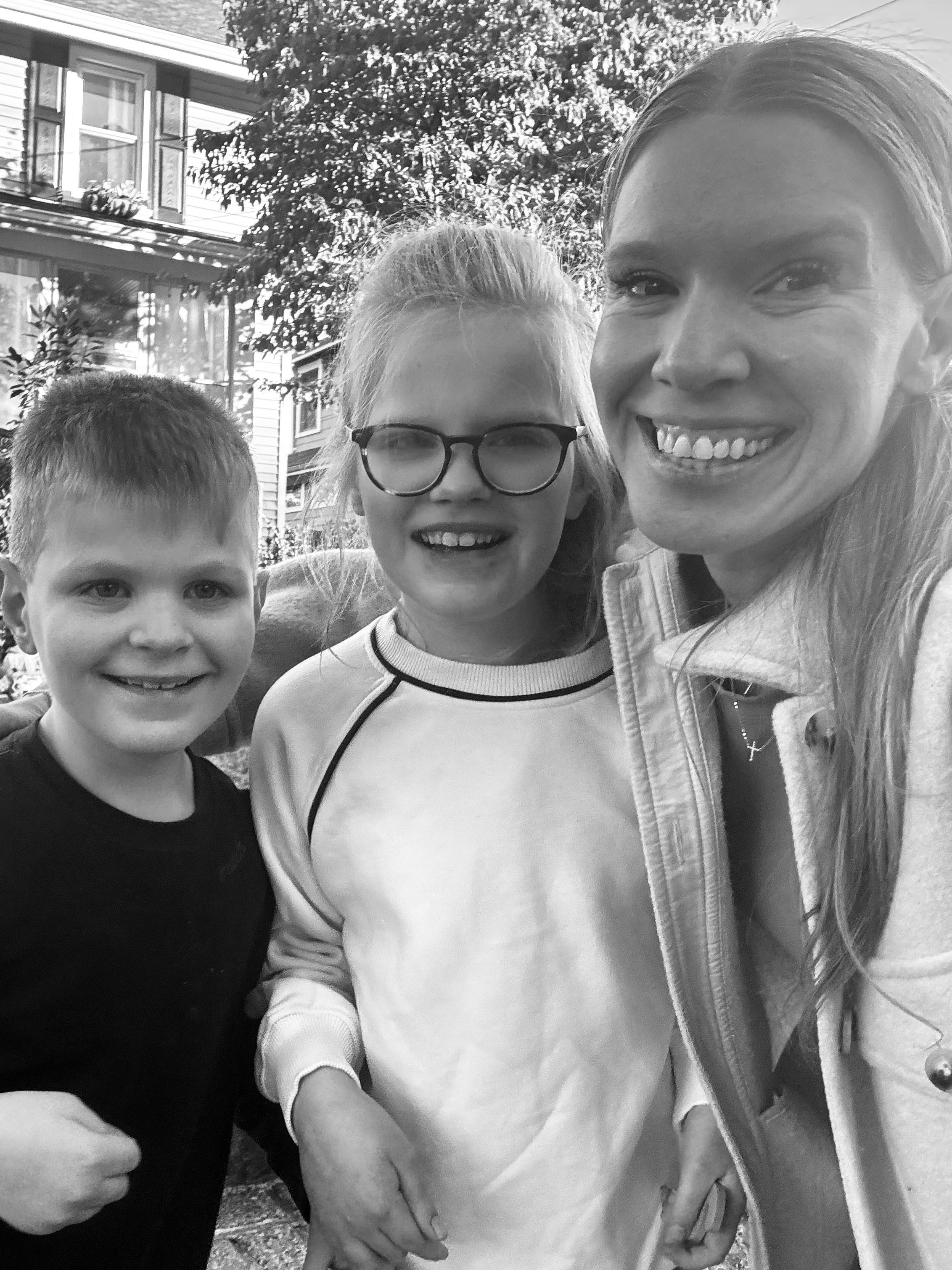
When my daughter Milly is in the bathtub, I can't let my attention wander. The same is true when my son Mack moves toward a street, or when I hold one of them steady through a medical procedure they cannot understand. Two of my children have profound, nonspeaking autism. Their care is intimate and physical, and it collapses time. Whatever I was thinking about five minutes earlier recedes. Whatever I planned to do next can wait. Only the person in front of me and what that person needs now remain.

Last week, I wrote about this for the National Catholic Reporter’s Soul Seeing series. In Autism and the Holiness of Now, I tried to describe how Milly and Mack have changed my understanding of presence. Before them, I thought of presence as a spiritual discipline: Put down the phone. Slow your breathing. Notice the light. Be grateful. It belonged to the category of practices I hoped would make me a better person.
Caregiving made presence less aspirational. It became a condition of loving my children safely and well.
Over time, that enforced attention began to alter the rest of my life. I became a better listener. I noticed more quickly when a friend said one thing and felt another. I grew less interested in the conversation I was rehearsing in my head and more available to the one actually taking place. This is one of caregiving’s quieter mysteries: The attention you give because someone requires it eventually changes the way you see everyone.
Then, on Sunday morning before my home woke up, I heard the Gospel of the Canaanite woman.
The story, in Matthew 15:21–28, is brief and difficult. A woman approaches Jesus because her daughter is suffering. She cries out for mercy, and at first he does not answer. Irritated by her persistence, the disciples ask him to send her away: “She keeps calling out after us.”
I have heard this passage many times. This year, I heard the disciples differently.
Their complaint has the familiar sound of an institution encountering a person who will not be efficiently processed. The woman has become a disruption. She is loud, repetitive and unwilling to accept the boundary placed in front of her. The disciples do not ask what her persistence might reveal. They want relief from the discomfort of hearing it.
I do not pretend that her circumstances and mine are the same. But I recognize the posture of a mother who keeps returning to a place of authority because someone she loves needs what the existing system has failed to provide. I know the strange combination of hope and humiliation involved in asking a stranger to look again at your child—to understand that the standard answer does not fit, that the ordinary accommodation is not enough, that what appears unreasonable from the outside may be the bare minimum required for safety or dignity.
Parents of children with significant disabilities become fluent in these encounters. We have them in schools and hospitals, with insurance companies and state agencies, in rooms where decisions are made by people who may never have met anyone like our children. We learn to explain the same reality repeatedly, changing the vocabulary but not the plea: This is who my child is. This is what my child needs. Please do not confuse the complexity of meeting those needs with permission to ignore them.
The repetition is exhausting. It can also make a parent look difficult. But withdrawing quietly carries its own danger. If I disappear from the conversation, the reality of my child may disappear with me.
This is why I have been thinking about the Canaanite woman while reading about the Interagency Autism Coordinating Committee, or IACC, the federal advisory body that helps shape national priorities for autism research, services and policy. The committee has released a 336-page working draft of its 2026–2028 Strategic Plan. After advocacy groups objected to an initial four-day review window, the public-comment period was extended to August 20.
Strategic plans are not natural objects of contemplation. They are long, technical and easy to regard as remote from family life. But documents like this determine which questions the federal government treats as urgent, which populations researchers are encouraged to include and which outcomes are deemed worth measuring. Eventually, the language of a plan can become the architecture of a grant, a study or a service. A family may feel its consequences years later without ever knowing where the chain of decisions began.
For families like mine, one question shadows the entire document: Will people with profound autism be fully visible in the research agenda meant to serve the autism population?
Historically, they have not been. Autism studies often depend on participants who can tolerate unfamiliar environments, follow complex instructions, complete standardized testing or describe their internal experiences. Those requirements make research more manageable. They also tend to exclude people with intellectual disability, limited or no spoken language, severe self-injury, epilepsy, sleep disorders and other complex medical or behavioral needs. One analysis estimated that only 6 percent of participants in autism research had intellectual disability, despite the substantial overlap between autism and intellectual disability.
The exclusion is not always the result of indifference. Sometimes it begins with a practical problem. A person cannot tolerate an MRI. A standard cognitive test cannot capture what she knows. A questionnaire assumes that speech is the most reliable form of communication. The research team lacks the staffing, time or expertise to adapt its methods. Each decision may be defensible on its own. Accumulated across years and institutions, however, those decisions create a body of autism research that does not adequately represent some of the people most profoundly affected by the condition.
Their absence then compounds itself. When people with the highest support needs are missing from studies, scientists know less about their medical conditions, their communication, their dangerous behaviors and the interventions that might improve their lives. The lack of evidence makes it harder to design services or justify funding. Families are left to navigate problems that the research enterprise has not made central enough to understand.
The new IACC draft gives me some reason for hope. Questions families have carried for decades appear more clearly within the federal frame: How should research address severe self-injury? How can communication be measured when speech is not the right measure? What medical conditions accompany the most disabling forms of autism? What becomes of children who need round-the-clock care when they reach adulthood and who will care for them when their parents no longer can?
Congress has directed the National Institutes of Health to ensure that autism research includes the entire autism population, explicitly including people with profound autism. The draft suggests that a boundary around what counts as central to autism research may finally be shifting.
But recognition in a document is not the same as commitment. Profound Autism Alliance has pointed out that although the term profound autism appears dozens of times in the draft, the plan does not give this population a dedicated section, budget line or measurable goals. Naming people matters. So does attaching responsibility, money and a way to know whether anything has changed.
This tension, between progress and insufficiency, is what brings me back to the Gospel.
The Canaanite woman does not prevail because institutions are always wrong or because persistence is itself proof of righteousness. Not every demand is wise, and no system can respond to every claim exactly as it is made. What her insistence reveals is more unsettling: A boundary that appears coherent from the inside may look very different when someone harmed by it is standing before you.
Sometimes the person experienced as an interruption is carrying information the institution needs.
Profound-autism families have been carrying such information for a long time. Our children expose the limits of research tools built around speech, compliance and conventional measures of cognition. They expose the limits of service systems that assume progress will lead steadily toward independence. They expose the fragility of policies that depend on parents providing skilled, round-the-clock care indefinitely and without collapse.
Our children make the work harder. Research costs more when protocols must be adapted. Services cost more when a person requires lifelong support. Policy becomes more complicated when independence cannot be the only respectable outcome. But difficulty cannot be allowed to harden into invisibility.
The profound-autism community is not asking researchers to turn away from anyone else on the spectrum. We are asking whether a spectrum this wide can be understood by disproportionately studying those easiest to recruit, test and interview. We are asking the autism research system to examine the places where its methods have quietly determined whose life is legible.
Caregiving has taught me that love often begins where a plan stops working. The loving response is not to pretend the plan was worthless; it is to recognize that the person in front of you matters more than your allegiance to it. People, ideas and things, always in that order.
This is what presence has come to mean for me. It is not simply mindfulness or gratitude. It is a willingness to let reality revise me and to notice when the framework I brought into a room is too small for the person standing there, and to enlarge the framework rather than diminish the person.
That is also my hope for the IACC plan. I hope researchers test its assumptions. I hope autistic people across the spectrum are heard. And I hope families raising children like Milly and Mack use the public-comment period to describe what no committee can learn from data alone: what it means to build a life around needs that many of our institutions still treat as peripheral.
Comments must be submitted by Thursday, August 20, 2026, at 5 p.m. Eastern. Families can review the advocacy priorities and find submission information here, or write directly to IACCPublicInquiries@mail.nih.gov
The mother in Matthew’s Gospel keeps calling out because silence would abandon her daughter to suffering. The disciples hear a nuisance. She knows she is carrying a truth they have not yet made room to receive.
My children have taught me to pay attention at precisely that moment: when an interruption begins to reveal where the work actually is, for all of us.
Thanks for reading INCHSTONES! This post is public so feel free to share it.
Sarah is the writer of INCHSTONES: The #1 voice of autism mothers & caregivers of children with profound nonspeaking autism.
Comments
Nothing yet. Say the first thing.
Sign in to join the conversation.