
Some appointments in Washington matter mostly to Washington. And then there are appointments whose significance is difficult to understand unless you have spent years sitting in examination rooms asking questions medicine still cannot answer.
I am the mother of two children with profound, nonspeaking autism. I live this life twice over: two children who cannot reliably tell me when they are in pain, what has changed inside their bodies, or what they need from the people responsible for their care. I also have a typically developing teenager, which means I have the wild and unusual privilege of seeing childhood unfold along very different neurological paths under the same roof.
I do not write about profound autism from a distance. I live it x 2. A daughter and a son.
On August 21, the National Institutes of Health announced that pediatric neurologist Dr. John Gaitanis had been selected to lead the Eunice Kennedy Shriver National Institute of Child Health and Human Development, or NICHD. Two days later, he assumed responsibility for an institute with an annual budget of approximately $1.7 billion, a staff of roughly 1,100, and some 2,300 research grants and projects across the United States and internationally. NICHD’s mandate is definitively enormous: maternal health, child development, reproductive health, intellectual and developmental disabilities, and research intended to understand not merely how conditions present, but what causes them and how medicine might prevent, treat, or ameliorate their effects.
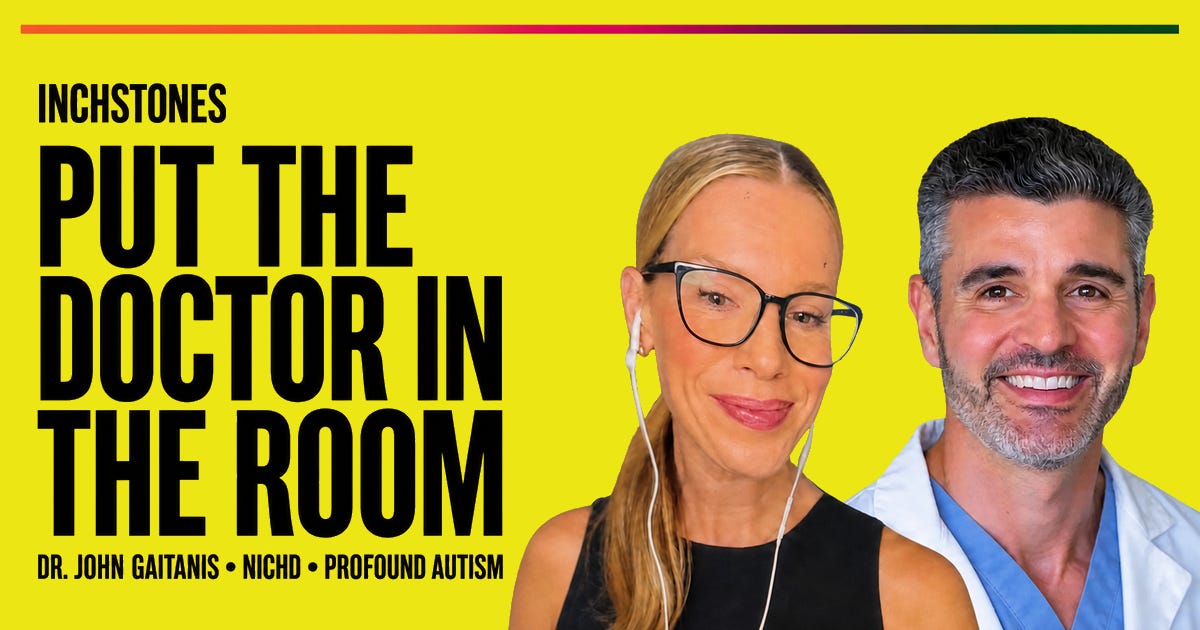
I have interviewed Dr. Gaitanis on the INCHSTONES podcast, and I should say plainly that I have enormous respect for him. I have come away from those conversations believing he possesses one of the most formidable clinical minds I have encountered in the world of profound autism. But his appointment matters to me not for brilliance in the abstract. It is where that mind has spent the past three decades. Where his feet and heart have been.
Gaitanis is not arriving at NIH after a career spent primarily examining autism from datasets or conference rooms. He is a pediatric neurologist. He trained at Brown, the University of Rochester, Boston Children’s Hospital and Harvard Medical School, and Beth Israel Deaconess. He has led child-neurology programs at Tufts and Brown. His career has been spent with children whose neurological lives do not fit neatly into one diagnostic box: epilepsy, autism, developmental regression, complex neurodevelopmental conditions, communication impairment. NIH highlighted his work advancing individualized care and approaches that support the health, communication, autonomy, and dignity of nonspeaking autistic people when announcing his appointment.
I have gone from being a mother who did not even know what ABA was when her first child was diagnosed to someone deep in the advocacy world. For years, I have watched the public conversation about autism become increasingly detached from the children whose disability is most profound. Autism can now describe an extraordinary range of human experience. Somewhere underneath that enormous diagnostic umbrella are children like mine: profoundly autistic, nonspeaking, living with whole-body motor-planning challenges and dependent upon other people for much of the architecture of daily life. There are families managing epilepsy, dangerous elopement, severe sleep disturbance, gastrointestinal problems, self-injury, feeding disorders, intellectual disability and communication barriers that make something as fundamental as telling another human being “I am in pain” extraordinarily difficult.
These children are looping their favorite shows because it’s the only predictability their nervous system can handle. These children require doctors. Lots and lots of doctors. More specifically, they require doctors who remain interested after the diagnosis has been made.
That is what has struck me most in my conversations with Gaitanis. He does not seem intellectually satisfied by the word autism when a child sitting in front of him is also experiencing neurological or medical problems. The diagnosis describes something important, but it does not necessarily explain everything happening inside that particular child’s brain and body. The clinical work begins there rather than ends there.
The NICHD supports research into autism susceptibility genes, neuropathology, endocrine, metabolic, and immunologic pathways, interactions between environmental variables and genetic susceptibility, interventions, prevention, and the etiology and treatment of conditions that commonly occur alongside autism, including epilepsy. NICHD also explicitly acknowledges developmental regression: some children lose language, play, or social skills they previously possessed, and researchers still do not know why some children regress or which children are likely to do so.
That last sentence should stop us.
We still do not know why.
For mothers of children with profound autism, those four words contain years of our lives. A typical life is spent wrangling with uncertainty because life is one journey into the unknown let alone that contemplative force of compounded uncertainty for families like mine. And it is why the person directing research matters.
NICHD’s own description of the director’s office says that it provides overall leadership, planning, direction, coordination, and evaluation of the institute’s research programs and helps determine how scientific information reaches clinicians, researchers, and the public.
And I want someone in that chair who has actually met these children.
I want someone who understands what epilepsy looks like outside the pages of a journal. Someone who knows that neurological disease does not always announce itself cleanly. Someone who understands that a nonspeaking child can possess a complicated internal life while lacking the motor or verbal ability to report it conventionally. Someone who knows that the history provided by the mother sitting beside the patient is not an irritating preamble to the clinical encounter but frequently part of the clinical evidence itself.
That last point is inseparable from the mission of INCHSTONES.
I have spent years arguing that mothers and caregivers of people with profound disabilities possess a form of knowledge our institutions chronically undervalue. I do not mean that maternal intuition should outrank science. I mean something both more modest and, I think, more consequential: maternal intuition should be allowed to provoke science.
A mother who says, “something changed in my child,” has not established causation. She has identified a question.
A caregiver who reports an unusual pattern has not completed a randomized controlled trial. She has supplied an observation.
The scientific response should neither be you must be right nor you are only his mother.
It should be: Tell me exactly what you saw. Bring me your care logs. Show me your data.
Then investigate it.
This is particularly important in profound autism because the ordinary hierarchy of medical evidence becomes complicated when the patient cannot reliably provide conventional self-report.
Medicine advances when those forms of knowledge meet.
And that makes Gaitanis’s appointment especially consequential at this particular moment at NIH.
The agency has begun an ambitious Autism Data Science Initiative, investing more than $50 million across 13 projects examining autism prevalence, etiology, genetics, environmental exposures, biology, treatments, services, and meaningful outcomes. Some of the projects involve enormous datasets; others move into human neural cells, organoids, biospecimens, maternal-health information, environmental exposures, and longitudinal clinical records. Two centers have been funded specifically to replicate and validate findings produced by the other teams.
Gaitanis did not create that initiative. NIH selected its projects before his appointment, and the initiative spans multiple NIH institutes. It would be inaccurate to suggest otherwise.
What matters is what comes next.
We now have a significant federal research effort willing to ask large questions about autism at the same moment that one of NIH’s most important child-health institutes is being led by a physician whose career has been spent close to the complicated neurological reality those questions are meant to illuminate. As a reminder, intellectual rigor and intellectual curiosity are not competing values, people. (And neither are acceptance and medicine.)
I can love my children without reservation and still want to know why their neurological development unfolded as it did. I can respect their dignity while wanting medicine to alleviate the things that make their lives harder. I can believe profoundly in their intelligence while asking why their bodies cannot always execute what they appear to understand. I can celebrate every inchstone while still wanting researchers to understand the barriers that make those inchstones so difficult to reach.
We need people willing to say we don’t know yet without treating those words as permission to stop looking.
That is why I am hopeful about Dr. John Gaitanis at NICHD.
Not because one brilliant physician will solve autism. He won’t.
I am hopeful because there is something profoundly important about placing a doctor who has spent decades looking at the individual child in a position to influence which questions American child-health research is brave enough to pursue.
Follow the evidence wherever it leads.
Let mothers tell researchers what they have observed without requiring science to accept those observations untested.
Let’s study regression, metabolism, immunology and genetics. Let’s study the enviroment and let’s study how they interact. Please, let us study communication in people whose speech does not reveal everything they know.
Study the children who are hardest to enroll, hardest to test, and easiest to leave out.
(And when the evidence contradicts what any of us expected, publish that too!)
The families I know are not asking NIH to tell us that we were right all along.
We are asking the country’s most powerful medical-research institution to remain curious enough to find out.
For the first time in a long time, I see reasons to believe the people being placed in the room understand the difference.
Sarah is the writer of INCHSTONES: The #1 voice of autism mothers & caregivers of children with profound nonspeaking autism.
Comments
Nothing yet. Say the first thing.
Sign in to join the conversation.