
Kelly Johnson founded Skunk Works, a secretive and highly effective advanced research department within the military contractor Lockheed (now Lockheed Martin). Skunk Works was responsible for planes like the U-2 spy plane, the SR-71 Blackbird, and the F-117 Nighthawk, and thus a significant fraction of American information and aerial dominance during the Cold War.
Of course, many research teams may not have the great fortune to have the same structural advantages as Skunk Works had during the Cold War. Nonetheless, they might benefit from some of the same operating rules as Skunk Works.
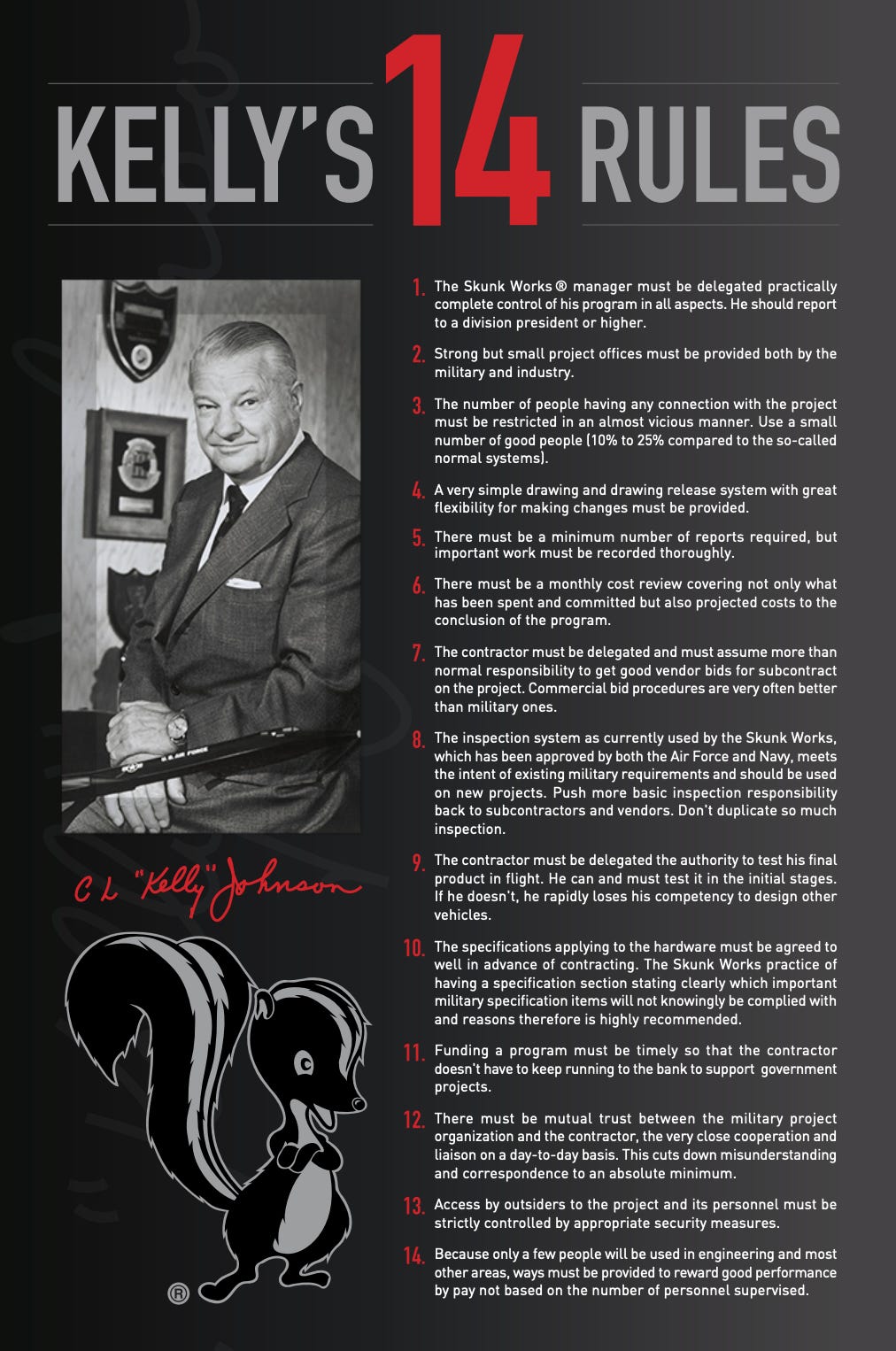
Kelly, Ben, and the rest of the Skunk Works team “lived and died” by the 14 basic operating rules1 that Kelly wrote in the 1940s. I’ve reproduced them below2:
The Skunk Works program manager must be delegated complete practical control of the program he manages.
Both the military and industry should provide strong but small, efficient, project offices.
Viciously restrict the number of direct stakeholders in a project. Use a small number of good people.
Keep a simple system for drawings and changes to drawings (what we’d today call version control)
Minimize the number of reports, but important work must be documented thoroughly.
There must be a monthly cost review covering what has been spent and committed, as well as forecasted future costs up to program conclusion. Don’t surprise the customer!
The contractor3 (Skunk Works) should be delegated responsibility and authority for managing their own subcontractor relationships and bids.
The default inspection system of Skunk Works has been approved by the Air Force and the Navy. Any further inspection should be efficient and not duplicate efforts.
Skunk Works should be delegated authority to test their own final products in flight.
Agree to specifications before signing a contract
The customer (government) should provide timely funding
There should be absolute trust and day-to-day communication between the customer and Skunk Works
Access to the project and its personnel should be strictly controlled
Pay should be allocated according to performance, rather than number of personnel supervised.
Unclear to me.
Pablo Picasso supposedly said: “When art critics get together they talk about Form and Structure and Meaning. When artists get together they talk about where you can buy cheap turpentine.”
What Picasso left unsaid4 is that “Form and Structure and Meaning” are more general principles that at least in theory can be broadly applicable to a wide variety of use cases, while “places where you can buy cheap turpentine” is the type of advice that is highly contextual and gets outdated very quickly.
In that regard, some of the 14 rules above appear to be timeless classics that can be adapted with ease in a wide variety of research and management settings. For example, aggressively reducing the potential number of stakeholders seems like a good idea for radically innovative research, as this allows for higher communication bandwidth and lower communication overhead.
On the other hand, some of the other tips seem more like “Turpentine Tips” that are highly contextual and very specific to running an advanced R&D department of a major US military contractor during the height of the Cold War.
I will leave it as an exercise to the reader to figure out which is which.
You can find various versions online. I tried to be succinct in my reproduction while keeping to the essential meaning of the rules as written (pg.51 in my paperback copy of Skunk Works by Ben R. Rich), which is itself different from the version you could find on the Lockheed Martin website or various online sources.
NB: I originally wrote this as an addendum for my more in-depth review of Skunk Works on my core blog. I decided these rules might be a useful reference as a standalone.
The “operating rules” just says “the contractor”. I believe it refers to Skunk Works/Lockheed themselves.
To be fair, this is in part because the entire quote is apocryphal, there is no record of Picasso ever actually saying this “quote.”
No posts
Comments
Nothing yet. Say the first thing.
Sign in to join the conversation.