
Contributing Authors
Tammy Hurst, RN, NC-BC
Katie Stafford, RN, NC-BC, Certified Hypnotist
Megan Babcock, BSN, RN, HWNC-BC, Certified Mental Health Coach, Brain Health Coach
Healthcare information has never been more accessible, yet many people feel more overwhelmed than ever when trying to improve their health and well-being.
As Nurse Coaches, we each work with individuals facing different challenges, but we consistently see the same pattern: people are not struggling because they lack information. They are struggling because lasting change requires support, self-awareness, and practical strategies that fit real life.
In this collaborative article, contributing Nurse Coaches share perspectives on why prevention, personalized support, and small sustainable actions matter more than ever. Together, we explore the challenges many people face, the value of person-centered care, and simple tools that can help individuals take meaningful steps toward better health.
If you have ever searched for ways to improve your health, lose weight, reduce stress, sleep better, or create healthier habits, you have probably discovered one thing quickly: there is no shortage of advice.
One expert says cut carbs. Another says eat more protein. Social media promotes supplements, detoxes, trackers, cold plunges, hormone hacks, and morning routines that somehow require more hours than most people have available. It can feel exhausting just trying to keep up.
Underneath all of it is a quiet thought many people carry every day: I should be doing better.
The truth is, most people are not struggling because they are lazy or unmotivated. They are struggling because they are overwhelmed. Nearly four in ten adults report feeling so stressed that they struggle to function on most days (American Psychological Association, 2024).
People are caring for aging parents while supporting adult children. They are managing careers, finances, relationships, households, appointments, medications, and responsibilities that never seem to end. Somewhere along the way, their own health moved to the bottom of the list.
When they finally decide it is time to focus on themselves, they often enter a health world that feels confusing and difficult to navigate.
They try the programs → They follow the plans → They start over on Monday → They lose motivation → They blame themselves.
What often goes unrecognized is the emotional weight of that cycle.
It goes far beyond food or exercise.
Many people carry years of disappointment from trying hard, starting over, and wondering why nothing seems to stick. They feel disconnected from their own bodies and frustrated by the gap between knowing what to do and actually doing it.
Perhaps most painful is the question that quietly lingers beneath the surface:
Why does taking care of myself feel so difficult when I am capable of taking care of everyone else?
The reality is that our bodies often whisper before they scream.
Fatigue. Burnout. Anxiety. Poor sleep. Weight gain. High blood pressure. Prediabetes.
More than 70% of adults report physical or mental health impacts from stress (American Psychological Association, 2024). Trying to determine what actually helps can begin to feel like a full-time job.
The problem is not a lack of information. It is that information alone rarely creates change.
Information is important, but information without support often leaves people wondering how to apply it. This is where personalized guidance can make a meaningful difference.
Healthcare has become increasingly complex. Information is available, yet many people feel more confused than ever about what they should do to improve their health.
Medical appointments are often short.
Questions go unanswered.
Recommendations can feel conflicting.
Individuals are expected to leave a brief visit and somehow translate medical advice into sustainable changes that fit within the realities of their everyday life.
At the same time, no two people are the same.
Even when two individuals share the same diagnosis, their experiences of that condition will differ. Their stress levels, family responsibilities, financial realities, support systems, beliefs, and health goals all influence what success looks like.
This is why personalized support matters.
Research has shown that person-centered care improves engagement, confidence, self-management, and overall well-being (Coulter et al., 2015; Coulter & Oldham, 2016). When people become active partners in their care, they are more likely to make meaningful and lasting changes.
This is where Nurse Coaches can make a powerful difference.
Nurse Coaches help bridge the gap between healthcare recommendations and daily life. They guide individuals in identifying their personal strengths and barriers to success, and in co-creating realistic goals tailored to their unique circumstances.
Unlike one-size-fits-all programs, Nurse Coaches recognize that health is about far more than symptoms.
Stress. Relationships. Sleep. Emotional well-being. Work demands. Life transitions. Daily habits.
These factors influence health outcomes every single day.
Many people wait until a serious diagnosis before building a stronger support system around their health. It is often after a diagnosis such as cancer, heart disease, or stroke that coordinated care teams, navigators, and additional resources become available.
Why wait until a crisis occurs?
Research continues to demonstrate that multidisciplinary healthcare teams improve outcomes through coordinated, comprehensive care (Shi et al., 2025). Nurse Coaches can become an important part of a proactive health and wellness team long before a crisis occurs. Through education, accountability, behavior-change support, stress-management strategies, and collaboration with healthcare professionals, they help individuals create sustainable habits that support prevention and long-term well-being.
If you are already navigating a health challenge, partnering with a Nurse Coach can also provide support and coordination throughout your journey.
Personalized support can help you understand your unique challenges and identify what will work best for you. It leaves you with something practical that you can begin using today.
The following reflection process can help you approach challenges with greater awareness, self-compassion, and intention. Because lasting change is rarely built through perfection—it is built through small steps taken consistently over time.
One of the biggest misconceptions about health is that transformation requires dramatic change.
Many people believe they need a perfect diet, an intensive exercise routine, a complete lifestyle overhaul, or extraordinary willpower to improve their health. When those expectations become overwhelming, they often give up before meaningful change has a chance to take root.
The research tells a different story.
Lasting change is built through small actions repeated consistently over time. Research on neuroplasticity demonstrates that the brain changes through repetition. As healthier behaviors are practiced, the neural pathways connected to those behaviors become stronger, making those actions feel more natural and sustainable over time (Puderbaugh et al., 2023).
This means lasting health improvements are built one small step at a time.
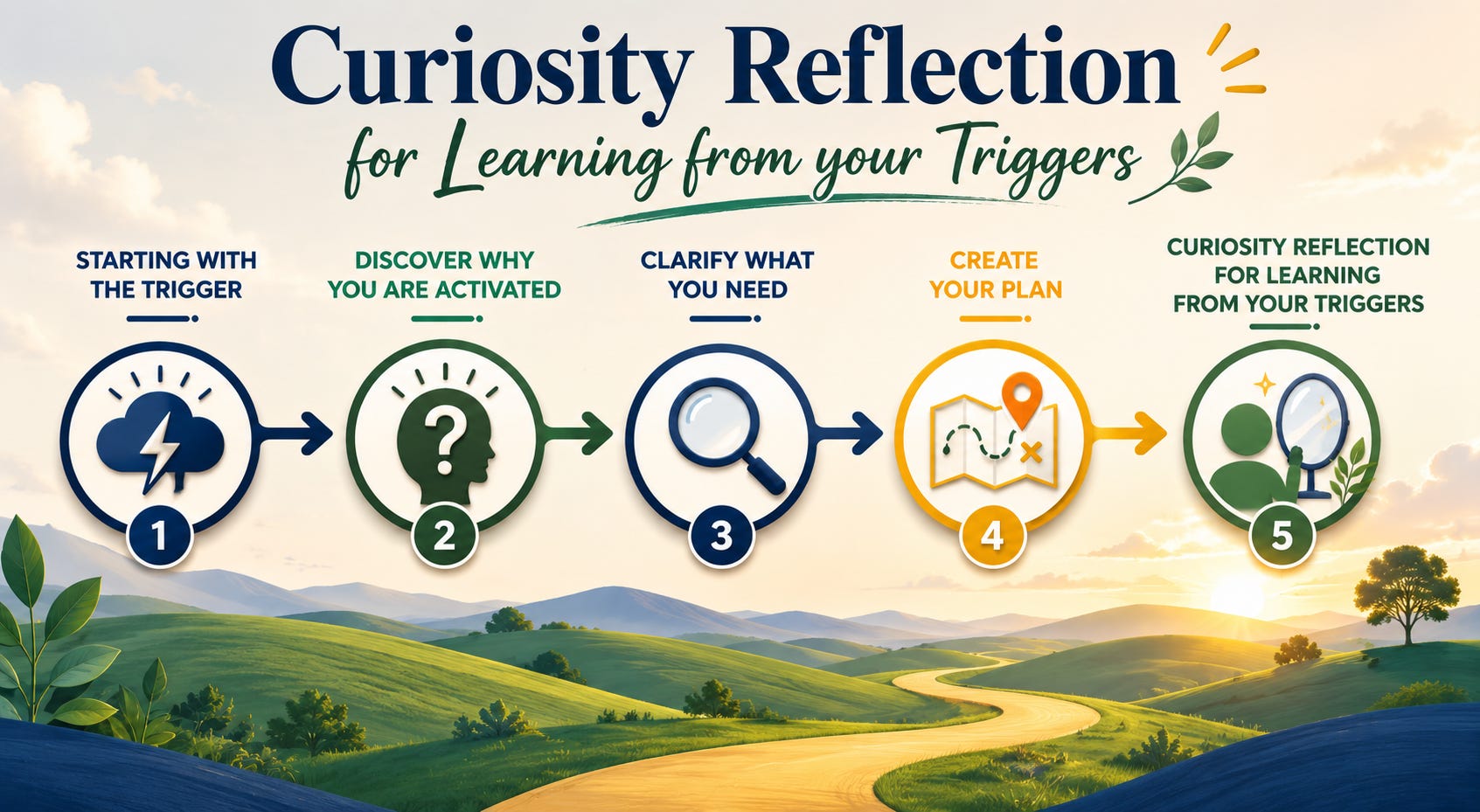
One of the simplest tools you can begin using today is a curiosity-based reflection process that can help you move from self-criticism toward greater awareness and intentional action.
When stress rises, many people immediately move into self-criticism.
Why can’t I get this together?
Why do I keep failing?
What is wrong with me?
Instead of criticism, try curiosity.
Begin with three simple questions: Why, What, and How.
This question is not about assigning blame. It is about gaining understanding.
One of the most effective ways to move beyond surface-level answers is to ask “Why?” five times. Often, the first answer we give ourselves is only the symptom, not the root cause.
Why am I feeling overwhelmed?
Because I have too much on my plate.
Why do I have too much on my plate?
Because I keep saying yes when people ask for help.
Why do I keep saying yes?
Because I do not want to disappoint people.
Why am I afraid of disappointing people?
Because I worry they will think less of me.
Why does that matter so much?
Because I have tied my worth to being helpful and needed.
What started as overwhelming was not really a time-management problem. It was a belief about worth and approval.
When we take time to understand what is truly driving a challenge, we are far more likely to create meaningful and lasting solutions rather than repeatedly reacting to the same symptoms. Research on root cause analysis suggests that identifying underlying contributors to a problem can help individuals move beyond repeatedly addressing symptoms and instead focus on factors that may be sustaining the issue (Singh, 2024).
This is where compassion becomes important.
Many people are incredibly compassionate toward others but become their own harshest critic the moment they struggle.
Imagine speaking to a close friend who was exhausted, discouraged, overwhelmed, or afraid. Most of us would respond with kindness, understanding, and support.
Yet when those same experiences happen to us, we often respond with criticism.
Dr. Kristin Neff’s research demonstrates that self-compassion is associated with greater emotional resilience, lower stress, improved well-being, and a greater ability to navigate difficult situations effectively (Neff, 2023).
Compassion is not avoiding responsibility.
Compassion is acknowledging your humanity while still moving forward.
Ask yourself:
What do I need right now?
Do I need rest?
Do I need support?
Do I need healthier boundaries?
Do I need movement?
Do I need connection?
Do I need more information?
Sometimes the most healing thing we can do is stop fighting ourselves long enough to listen.
Awareness without action creates frustration.
Once you understand why you feel the way you do and what you need, ask:
How can I take one step forward today?
Not ten steps.
Not a complete life overhaul.
Just one step.
Behavior change research consistently demonstrates that small choices accumulate over time and contribute to long-term outcomes. Repeated actions strengthen habits, and habits influence health, relationships, and overall well-being. While individual decisions may seem insignificant at the moment, the patterns created through consistent repetition often determine whether meaningful change occurs (Lally et al., 2010; Puderbaugh et al., 2023).
The question is not whether you can change everything today.
The question is: Which choice moves me forward?
Maybe that step is:
• Taking a ten-minute walk
• Drinking water instead of another soda
• Scheduling an overdue appointment
• Going to bed thirty minutes earlier
• Asking for help
• Saying no to one unnecessary commitment
• Taking five minutes to pause and breathe
Small steps create momentum → Momentum creates confidence → Confidence creates change.
Better health is rarely built through perfection. It is built through awareness, compassion, support, and small daily choices practiced consistently over time.
Together, we are building healthier individuals, stronger families, and more connected communities one step at a time.
If these conversations resonate with you, we invite you to join a growing community committed to improving health through prevention, partnership, and whole-person support.
Through this publication, Nurse Coaches from diverse specialties will share practical tools, evidence-informed insights, and realistic strategies designed to help you improve your health, reduce stress, build healthier habits, and create sustainable wellness.
You will find resources related to emotional well-being, stress management, prevention, resilience, caregiver support, chronic health concerns, lifestyle habits, and the many factors that influence overall health.
Our mission is not only to help individuals improve their health. It is to increase awareness of nurse coaching and the role nurse coaches play in helping people navigate life’s challenges with greater clarity, confidence, and support.
Whether you are looking to improve your health, support a loved one, prevent future health concerns, or simply feel better in your daily life, we hope this publication becomes a trusted source of encouragement and guidance.
You do not have to figure it all out alone.
Artificial intelligence was used to assist with editing, organization, and grammar review. All content was reviewed, revised, and approved by the contributing authors.
The information provided in this article is for educational purposes only and is not intended to diagnose, treat, cure, or prevent any disease. Nurse Coaching services do not replace medical care, mental health care, or advice from qualified healthcare professionals. Individuals should consult their healthcare providers regarding questions or concerns about their health and treatment plans.
American Psychological Association. (2024). Stress in America 2024: A nation recovering from collective trauma. American Psychological Association.
Coulter, A., Entwistle, V. A., Eccles, A., Ryan, S., Shepperd, S., & Perera, R. (2015). Personalised care planning for adults with chronic or long-term health conditions. Cochrane Database of Systematic Reviews, 2015(3), CD010523. https://doi.org/10.1002/14651858.CD010523.pub2
Coulter, A., & Oldham, J. (2016). Person-centred care: What is it and how do we get there? Future Healthcare Journal, 3(2), 114–116. https://doi.org/10.7861/futurehosp.3-2-114
Lally, P., van Jaarsveld, C. H. M., Potts, H. W. W., & Wardle, J. (2010). How are habits formed: Modelling habit formation in the real world. European Journal of Social Psychology, 40(6), 998–1009. https://doi.org/10.1002/ejsp.674
Neff, K. D. (2023). Self-compassion: Theory, method, research, and intervention. Annual Review of Psychology, 74(1), 193–218. https://doi.org/10.1146/annurev-psych-032420-031047
Puderbaugh, M., Emmady, P. D., & Tadi, P. (2023). Neuroplasticity. StatPearls Publishing.
Shi, Y., Li, H., Yuan, B., & Wang, X. (2025). Effects of multidisciplinary teamwork in non-hospital settings on healthcare and patients with chronic conditions: A systematic review and meta-analysis. BMC Primary Care, 26, Article 110. https://doi.org/10.1186/s12875-025-02814-0
Singh, G. (2024). Medical error prevention and root cause analysis. StatPearls Publishing. https://www.ncbi.nlm.nih.gov/books/NBK570638/
Thanks for reading A New Path to Health with Nurse Coaches Leading Change! This post is public so feel free to share it.
No posts
Comments
Nothing yet. Say the first thing.
Sign in to join the conversation.