
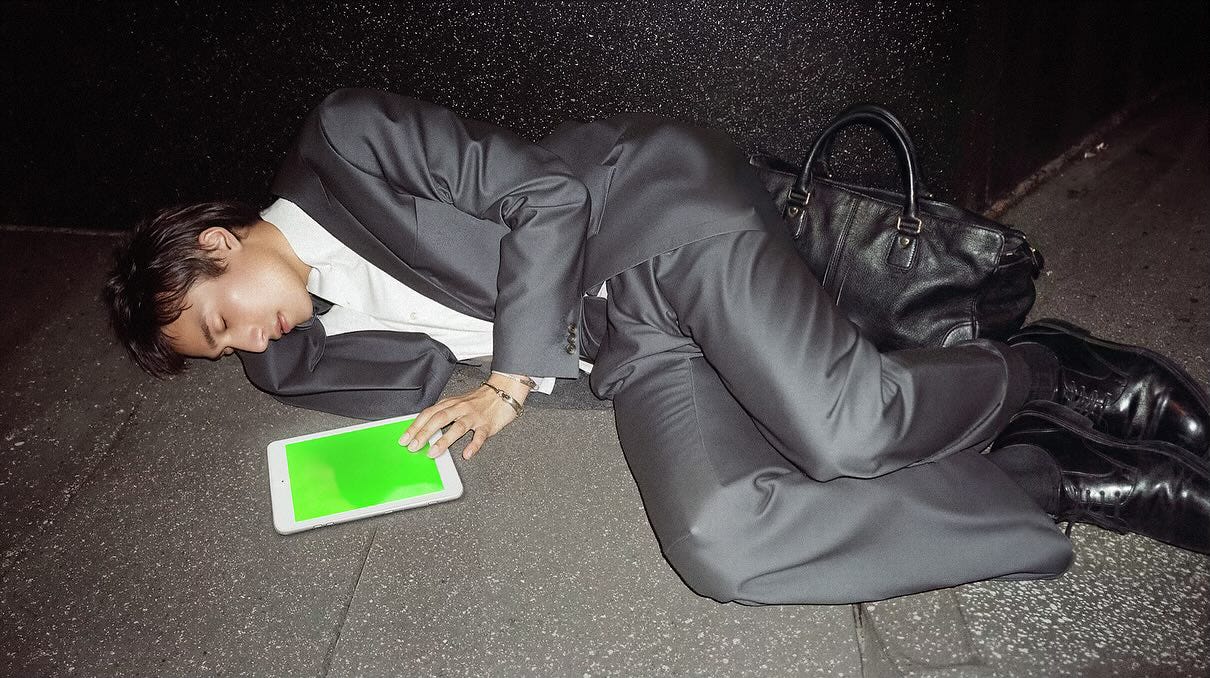
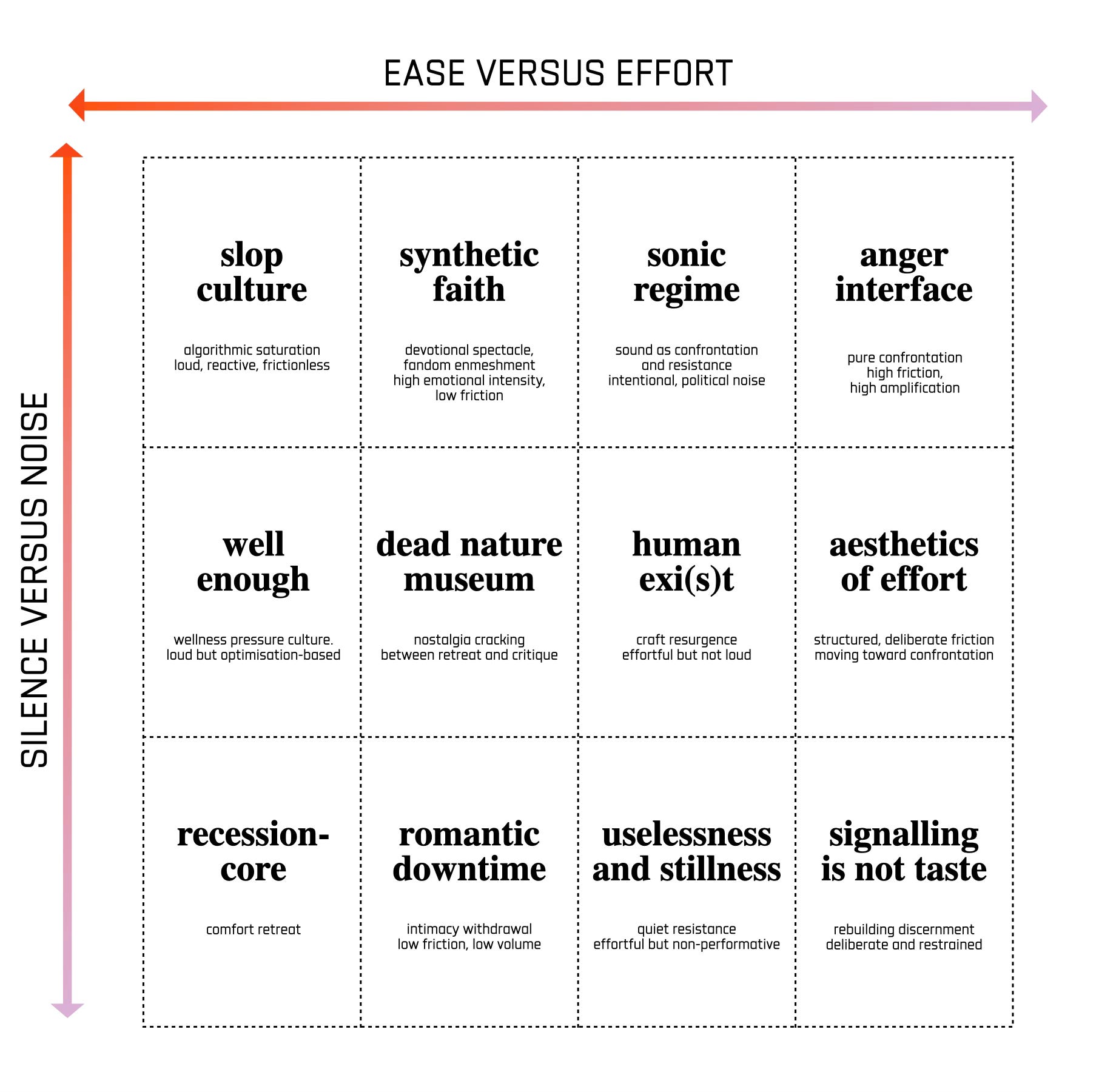
Culture is caught in-between. Between effort and ease, agency and automation, attachment and withdrawal. 2025 did not produce clear answers, but liminal states: moments where optimisation stalled and friction returned. What emerges is a shared hesitation: testing when to lean in, when to opt out, and when refusal itself becomes meaningful. Not a manifesto, but a field guide to staying unresolved while everything demands resolution.
2025 did not mark the end of doomism. The macro-context was so unbelievably charged with perma-hostility that it eclipsed almost every competing narrative. Crimes against humanity were memeified with grotesque ease, while the mentors of our world revealed themselves as unsubtle, unrepentant, absurd cartoon-grade villains. This wasn’t just a matter of vibes. Dictatorship, once universally villainised, became openly desirable for more than half of British Gen Z, and rage proved itself an efficient hook—anger-infused ragebait outperformed coolness-driven aura farming as the word of the year. But let's be nuanced here. Gen Z isn’t looking for universal truths. They went feral. They revolted in Morocco, Nepal, Peru, Bangladesh, and Madagascar, sometimes beneath anime-splashed banners. This was not doomism as previously understood, but a different strain of gloom altogether: one that pushed 2025 firmly into the year of anger.
↬↬↬↬↬ hoardiculture:
BEFORE YOU GET EXCITED ABOUT 2026 LET'S QUICKLY REMEMBER 2025 | 2025: The Year Everything Broke | The memefication of crimes against humanity | L’ère du concours de bites planétaire (fr) | And the Oxford Word of the Year 2025 is… rage bait | More than half of Gen Z believe the UK should be a dictatorship | The Gen-Z Movement: This is why we’re risking our lives to protest | ‘A symbol of liberation’: how the One Piece manga flag became the symbol of Asia’s gen Z protest movement | THE DIARY OF A HITMAN
From one word of the year to the next: AI slop. I felt it daily throughout 2025, worn down by an endless volume of work while resisting the temptation to surrender to ease by relying excessively on AI assistance. Let’s be honest: it is hard to laugh at dating-related memes that list “a fully developed frontal lobe” as a desirable trait while quietly cultivating a dependence on tools that actively produce slop and are proven to negatively affect cognitive abilities—unless I wear the Nike Mind brain-boosting sneakers, of course. No slop now tops my list of 2026 resolutions. Yet AI slop did more than saturate feeds or hasten the death of the image: it also triggered counter-forces, pushing underexposed culture to the foreground, reframing anonymity itself as a flex, and redefining the niche vs. the weird vs. the performative spectrum.
↬↬↬↬↬ hoardiculture:
Macquarie Dictionary Word of the Year for 2025. AI SLOP. | 2025 Word of the Year: Slop | WHY SO MANY A.I. LOGOS LOOK LIKE BUTTHOLES | Feeds, Feelings, and Focus: A Systematic Review and Meta-Analysis Examining the Cognitive and Mental Health Correlates of Short-Form Video Use | Nike’s first neuroscience-based footwear “designed from the brain down” | The Death of the Image Has Made Us Wake up to Reality | In Defense of the Em Dash | Underexposed Culture (fr) | HAVING NO FOLLOWERS IS THE NEW FLEX | THE NORTH FACE HAS A MESSAGE FOR YOU: GO TOUCH GRASS | are you niche, weird, or performative?
In 2025, AI did not simply evolve towards sloppiness; it produced a new form of suspicion by reversing the logic of fakery. Instead of exposing what was fake, culture began to hope for it—captured in the phrase “I hope it’s AI”, signalling a major semantic and psychological shift. AI became a mental refuge, implying a visual culture that deliberately avoids implicating humanity at all. As with any trend movement, opposing forces flourish. High-effort visuals returned to the feed, while craft resurfaced in unpolished, raw forms that foregrounded unmistakable signs of presence. What emerged was not nostalgia for craft, but a confrontation with the place of human touch in the face of AI’s omniscience. The question was no longer authenticity versus artifice, but whether a human signature was desired—or whether its absence felt safer.
↬↬↬↬↬ hoardiculture:
Craft against the machine | 𝑴𝑨𝑳𝑶𝑪𝑪𝑳𝑼𝑺𝑰𝑶𝑵 | Craft is our Language by Bottega Veneta | You’ve never seen anything like this fragrance | THE SHAPE OF THINGS TO COME | Franco-Algerian artist paints 20,000 covers in 24 hours non-stop | the more ai I see, the more I crave imperfection
If you felt cornered by a crisis of meaning in 2025, it may be because the lie has become industrialised—operating as a collective plant for value production. “How, and at what cost, do we manufacture values, principles, and meaning—what we once called quality—[...] in a world that no longer believes in value, principles, or meaning, but only in scale?” asks philosopher Raphaël Liogier when portraying homo industrialis—us. Faith and belief flared up last year. Catholicore surged, amplified by Rosalía’s LUX, a work of art to me. Fandoms functioned as escape rooms of devotion from brutal realities. Objects of worship multiplied: Labubus, Dubai chocolate, Stanley cups, angel numbers, cybersigilism. Hardcore enmeshment. My favourite story: Buddhist communities across Asia turning to pop culture—going as far as hosting a dating reality show in a temple—to prove the contemporary relevance of belief in a society starved of meaning.
↬↬↬↬↬ hoardiculture:
God is SO back | Is South Korea’s ‘Buddhistcore’ Aesthetic a Fad or a Spiritual Awakening? | Welcome to the church of content | The realities of being a pop star. | Joanna Kuchta: Disappearing Acts and Digital Divinities | What’s in a Screenshot? A look inside designer Maya Man’s esoteric internet research | So the Labubu and Dubai chocolate fads — what was that all about? | «Success» : Raphaël Liogier la tête dans le bidon (fr)
Did our wellness routines go too far? In 2025, the question was finally raised—and, I won’t lie, it felt like a relief after years spent documenting hardcore wellness in my consultancy work, a mode that resembled unwellness disguised as aspiration. I watched friends get sick from Ozempic-like injectables in the name of thinness—now back on the runways. Skincare routines spiralled into excess, doing more damage than good, to both skin and mind—hello dermorexia. Running slipped beyond the act of exercise or mental health care, mutating into a collectively sanctioned terrain of pressure, performance, and validation. From one radical position to another, former cultural high grounds—veganism, cigarette-free identities—began to erode, no longer unquestionable. Perhaps the real failure of wellness culture is not excess, but its inability to tolerate deviation.
↬↬↬↬↬ hoardiculture:
Skinny Legend: Ozempic, Body Politics and Unwellness as Aspiration | WELLNESS CULTURE IS NOW PEDDLING EXTREMISM | Dermorexia: Is our obsession with skincare becoming a disorder? | Is fitness culture making us sad and boring? | Le running, nouveau terrain de jeu du paraître et de la pression sociale ? (fr) | Payer pour faire courir des gens à sa place (fr) | When did having hobbies become a flex? | Shapewear for your face while you sleep. Has Kim Kardashian taken it too far? | The Periodic Fable | The Rise of the Wellness Anarchist | POST-VEGAN: How Gen Z Made Meat Cool Again | Where have all the vegans gone? | Why Smoking Is Making A Comeback — And What It Means For Your Health | Pop Culture Takes Up Smoking Again | The story behind the Cross cigarette adapter from Chicago N2 | FULL SERV.ING A system for staying nourished in the chaos
The thirties. A relentlessly discussed phase of life. Often framed as the condition of a generation born into a world that no longer exists, they cast doubt over nearly every aspect of adult identity. A recent study has made a point: our brains don’t actually “peak” or enter adulthood until around the age of 32. I turned 32 last month, finally catching up with what neuroscience considers adulthood. The good news is that I spent much of 2025 revisiting the so-called good old days—not because the thirties feel punitive (they feel closer to heaven, to me), but because familiarity proved unusually functional. I’m not immune to trends, and I slid easily into recession pop: a soft, comforting return to cultural signals historically aligned with economic downturns. Less indifference than strategy, it felt livelier than Pantone’s Cloud Dancer white, and suspiciously effective as a collective antidote to permanent fatigue.
↬↬↬↬↬ hoardiculture:
the year we thought nothing happened | AI, politics, and stagflation: The forces driving worker fatigue | Maybe We Need Recession Pop Right Now | The ‘recession pop’ revival is a nostalgia myth | Adolescence lasts into 30s - new study shows four pivotal ages for your brain
Heterofatalism. Post-love. Quiet divorcing. Tinder leave. Future faking. Dating fatigue. An entire ecosystem of intimacy collapsed into an inventory of neologisms. Whether single or happily pursuing some form of attachment under trendy labels, no one escaped the fact that relationships came under sustained scrutiny in 2025—to the point where even having a boyfriend became debatably embarrassing. In that context, Serena Smith’s argument—that relationships, or the absence of them, should not function as flexes or identity markers—felt like a rare, well-calibrated relief. The shift was less about rejecting love outright than about recognising its friction. In this era of normalised complexity, romance feels increasingly misaligned with contemporary conditions, and automated intimacy and parasocial bonds register as oddly more reasonable.
↬↬↬↬↬ hoardiculture:
THE 2026 DATING REPORT | modern dating feels like | Dating is political | The relationship recession | Une vague de célibat déferle sur le monde (fr) | L’ex, cette relation sous-cotée, ou l’ère de la Post Love Relationship (fr) | Tinder leave is the hottest new work perk in Asia | ‘Quiet’ Divorcing | La Guerre de Sexcession (fr) | La flemme de l’effort relationnel (fr) | Chat GPT Therapy, AI Boyfriends, and the Rise of Automated Intimacy | Is Having a Boyfriend Embarrassing Now? | It’s not the boyfriend that’s embarrassing… It’s his behaviour | The Trouble With Wanting Men | Love is not embarrassing | more lovers, less situationships | For the Love of Love | Émotions Histoire Culturelle et Etymologies de nos sentiments (fr) | Shaping Desire: How Hinge Captured Souvenirs of Love
For years, I treated nostalgia as a counter-mechanism; a reliable escape hatch from the noise, violence, and incoherence of the present. But this refuge came at a cost, and I’m convinced that we cannot retreat into the past forever. Nostalgia hardened into a formula: a low-risk aesthetic, endlessly replicated, optimised for recognition rather than invention. What began as solace slowly became an alibi, allowing culture to stall while appearing active. In this sense, nostalgia stopped being about memory and turned into infrastructure. As in the dystopian fiction of Boualem Sansal, 2084: The end of the world, it resembles a dead nature museum: perfectly preserved, meticulously curated, and fundamentally lifeless. A place where the past is embalmed rather than questioned, and where creativity circulates without ever moving forward. In 2025, this logic finally began to crack. Nostalgia was no longer received as a safe cultural shortcut, but increasingly scrutinised as a limiting, even regressive reflex.
↬↬↬↬↬ hoardiculture:
Nostalgia for the Present | Why Are We Doomed to Keep Reliving the ’90s? | Marina Abramović: ‘Everything new is always criticised’ | Is nostalgia ruining the future of football? | How nostalgia is killing creativity in football | Trashy Clothing’s SS26 signals a nostalgia fatigue | earthy-flavored | Books/articles that deal with nostalgia critically?
There was a time when good taste was slow—cultivated through attention and an ability to place things in context. It hasn’t vanished, but it has become harder to access and absurdly easy to counterfeit. Somewhere between rising costs, viral aesthetics, and hyper-legible branding, discernment collapsed into trend literacy, a confusion I continue to resist even as my work revolves around making sense of trends. Today, taste is less about judgement than signalling: what objects say about belonging, proximity, and lifestyle, and how instantly readable that signal is to others. But this logic is starting to erode. When everything signals, nothing distinguishes. Ownership no longer concludes a transaction; it initiates a new form of labour, where the self becomes the display surface. What once felt like isolated excesses now reads as confirmations of a system running out of discernment. Taste won’t be recovered by louder cues, but by restoring the conditions that made judgment matter.
↬↬↬↬↬ hoardiculture:
A Social Critique of the Judgement of Taste | Does Anyone Really Have Taste Anymore? | From consuming the product to becoming the product. | Why Good Taste Became a Luxury | This is What Good Taste Used to Cost and Why Most People Can’t Afford it Today | Why Everything Looks Like a Factory Now | What Would it Take to Build the Next Vitra? | AVAVAV PRESENTS A SALES RACK SATIRE FOR SS26
If 2025 marked the moment the image finally collapsed under its own abundance, sound emerged as its uneasy successor. As AI image generation scaled into the hundreds of millions, audio began to feel like the last fortification of perception: not yet fully automated and still capable of demanding attention (even passive) rather than glances. This may explain the renewed investment in listening: audiophile bars holding their ground, my friends resolving “to remain musically curious,” and the opening of Audeum in Seoul, the world’s first museum dedicated entirely to audio. Yet sound is far from neutral. From sonic weapons and cultural appropriation to festival culture staged on contested land, audio operates as both an instrument of control and a site of resistance. What pulses beneath this moment are fugitive frequencies: signals that refuse visibility, commodification, and capture. Sound, unlike the image, still knows how to escape.
↬↬↬↬↬ hoardiculture:
Kengo Kuma designs the world’s first dedicated audio museum in Seoul | Charting today’s sonic politics and fugitive frequencies | Aestheticised, algorithmised and appropriated: Welcome to the ‘habibification’ of house music | WHAT DOES YOUR HOMETOWN SOUND LIKE TO YOU? 01, 02, 03
I entered 2025 working on one of the most absorbing client projects I’ve had, exploring the visceral relationship between nature and society, and where outdoor culture might be heading next. While interviewing a friend for the project, he described getting lost in nature as an essential anti-capitalist, almost punk act: one in which just walking refuses to produce, optimise, or perform—a pointed contrast to running culture, which has perfected the fetishisation of hyper-performance. The same friend later launched a podcast—one I devoured—dedicated to tracking temporary but obsessive pursuits, from hunting Space Invaders mosaics in city streets to watching every episode of an obscure 1980s Franco-Belgian documentary. Hobbies turned into acts of quiet resistance. Uselessness and stillness as forms of soft rebellion.
↬↬↬↬↬ hoardiculture:
Why is hanging out so hard? How we lost the art of the last minute plan | In Defense of Temporary Obsessions | Fixette podcast (fr) | stillness mode | Peut-on encore simplement jouer dehors ? (fr) | TikTok is turning gardening as a quiet act of resistance | IC3PEAK: “Not yelling is the most radical thing you can do” | Where the f**k has Ester Manas been these past few months | Outdoors Encounters
Ease has long been sold to us as liberation. Faster, smoother, frictionless, until comfort itself hardened into stagnation. Yet in 2025, effort began to re-emerge—not as morality, but as aesthetics. Dating culture exposed the contradiction: intimacy promised on demand collapses, even as thinkers like Boris Cyrulnik remind us that attachment only endures through daily labour. Last autumn’s rhetoric of “locking in” reframed self-improvement as containment: a way to stabilise the self as external systems falter. Effort migrated into form: deep attention as leisure, long books resisting scroll culture, running clubs swelling with participants. Fashion followed suit as domestic-core translated care, repetition, and maintenance into discipline. Even bodies shifted: toned arms replaced abs, less about peak performance than sustained, visible effort. In a world automated, assisted, and optimised to the point of erasure, effort stopped reading as inefficiency and began to function as dissent.
↬↬↬↬↬ hoardiculture:
Why is everyone so obsessed with ‘locking in’? | La flemme de l’effort relationnel (fr) | What is ‘having-a-life-core’? How being busy became a fashionable luxury | Why strong, toned arms are the new abs (and how to get them) | How Toned Arms Became a Status Symbol—And an Impossible Standard | The Paradoxes of Feminine Muscle | In Praise of Friction | MIU MIU SPRING/SUMMER 2026 At Work | ASHLEY WILLIAMS S/S 26
Comments
Nothing yet. Say the first thing.
Sign in to join the conversation.