
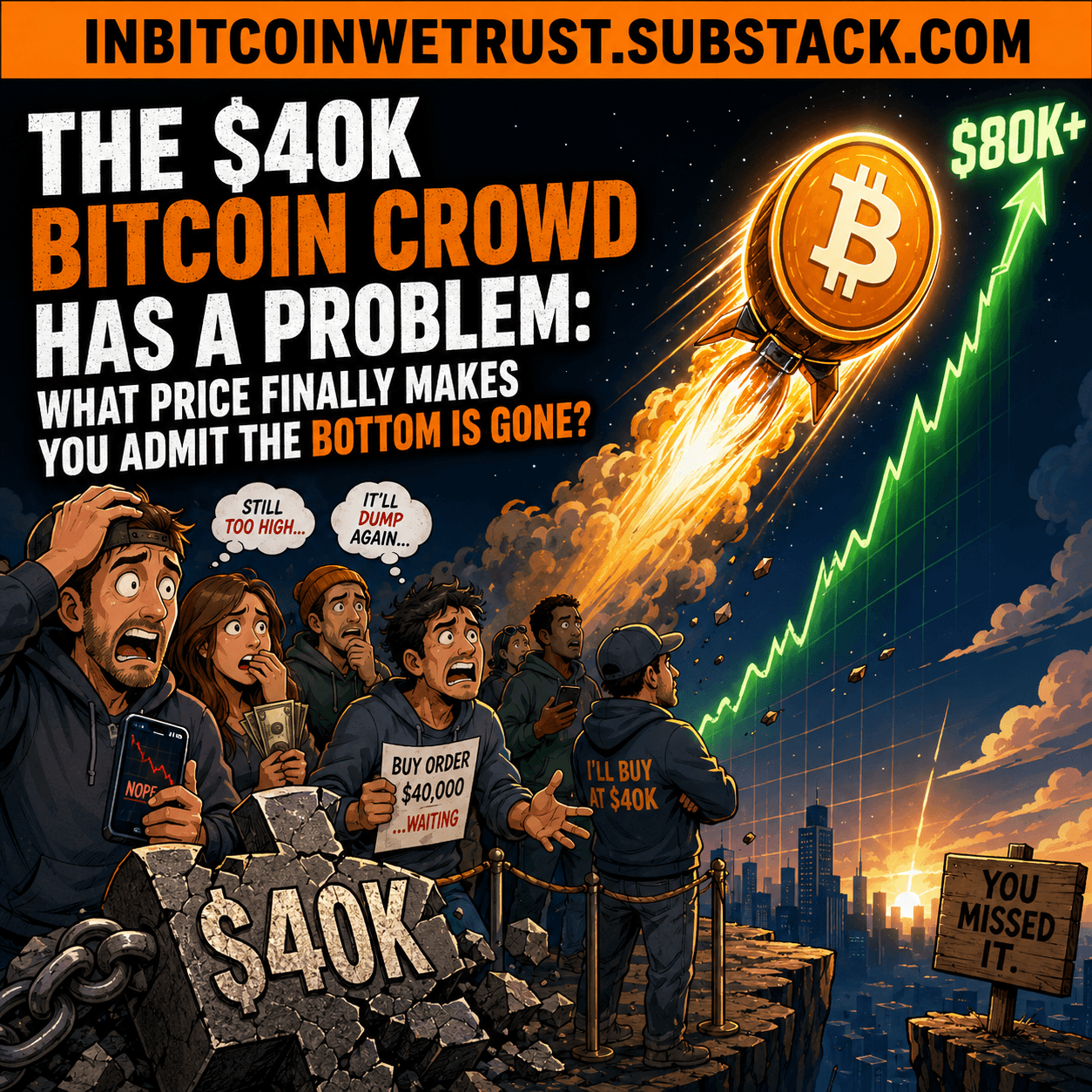
Bitcoin is above $80K, yet thousands of investors are still mentally anchored to a price that may never return. The real question is no longer whether Bitcoin can fall. It is whether you know what would make you change your mind.
There is a particular kind of pain that only Bitcoin can produce.
It is not losing money. It is watching Bitcoin rise while you are sitting on cash waiting to buy it cheaper.
At $64,000, you were cautious. At $58,000, you wanted $50,000.
At $50,000, you started thinking $40,000 was inevitable.
Maybe $35,000. Maybe even $30,000 if the macro situation deteriorated.
So you waited. You told yourself you were being disciplined. Patient. Rational.
Then Bitcoin turned around.
$60K. $65K. $70K. $75K. $80K.
And suddenly the problem changed.
You are no longer waiting for Bitcoin to become cheap. You are waiting for Bitcoin to validate the price you already decided it should reach.
Those are two very different things.
And this week, a simple question appeared on Reddit that perfectly captures the psychological trap:
What would you say to people who are still waiting for $40,000 Bitcoin?
That question is more interesting than it looks.
Because the real question isn’t:
Will Bitcoin ever trade at $40K again?
Nobody knows.
Bitcoin absolutely can crash. It has crashed before. It will crash again.
The real question is much harder:
What would have to happen before someone waiting for $40K admits that their thesis might be wrong?
That is where things get uncomfortable.
Because for many investors, the answer may secretly be: Nothing.
They aren’t waiting for new information anymore. They’re waiting for the market to agree with them. And markets don’t care.
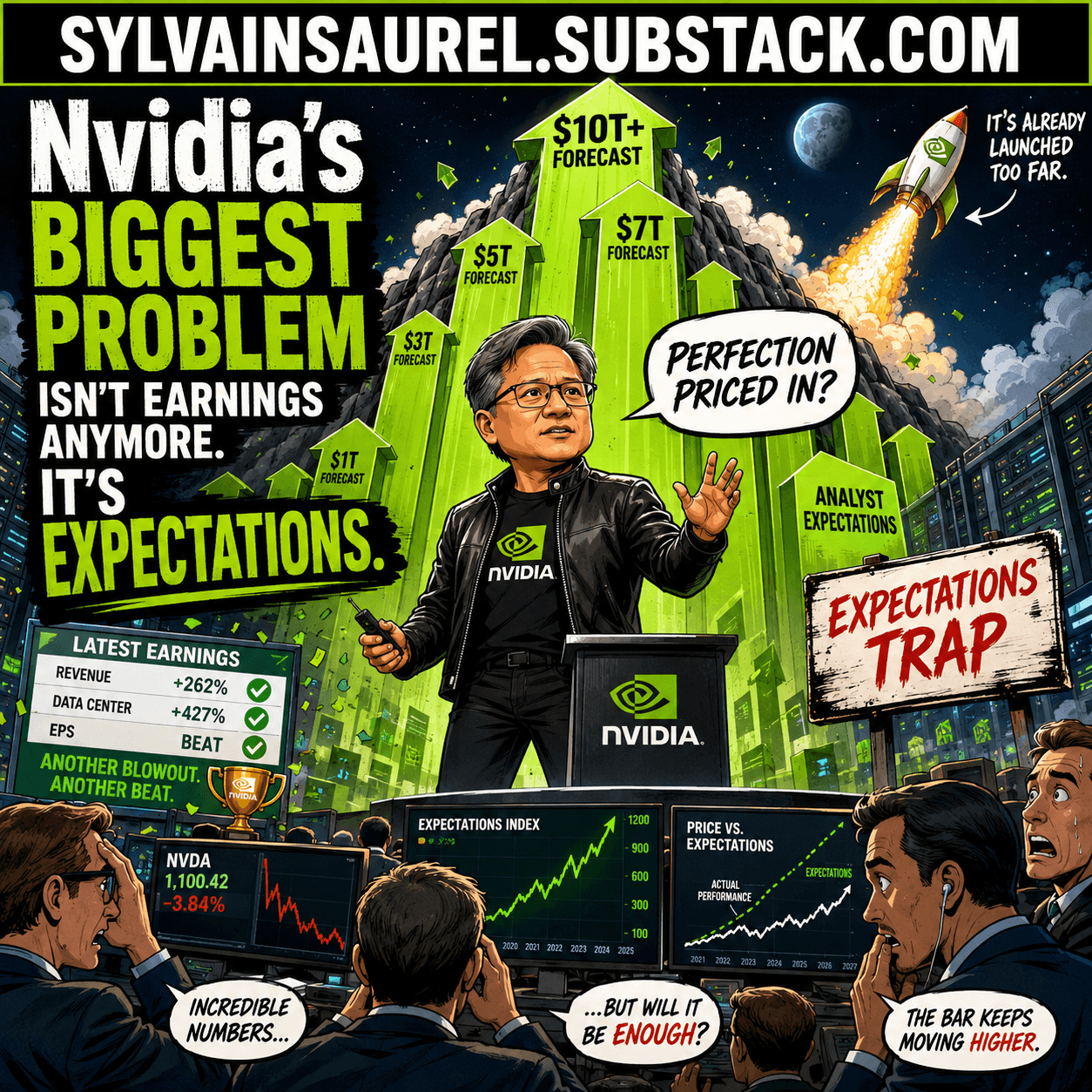
Nvidia can beat earnings, raise guidance, and still disappoint — because Wall Street is no longer pricing success; it’s pricing perfection.
This is one of the strangest things humans do with markets.
We turn numbers into beliefs.
$40,000 starts as a possible entry point.
Then it becomes a target. Then an expectation. Then a conviction. Eventually it becomes an identity.
“I’ll buy Bitcoin at $40K.”
Sounds harmless. But once you’ve repeated that sentence enough times, buying at $65K feels like admitting you were wrong.
Buying at $75K feels worse. Buying at $80K feels almost humiliating.
So you don’t.
Not necessarily because Bitcoin is unattractive. But because the market has moved too far away from the story you built in your head.
This phenomenon has a name in behavioral finance: anchoring.
Humans attach themselves to an initial reference point and then evaluate everything relative to it.
Bitcoin at $80K therefore doesn’t simply look like Bitcoin at $80K.
It looks like:
Bitcoin at twice the price I promised myself I would pay.
That distinction matters enormously.
Because the market has no obligation to revisit your anchor.
There is an old psychological asymmetry in investing.
People obsess over buying too high. They think much less about never buying at all.
Imagine two investors.
Investor A buys Bitcoin at $65K. Bitcoin briefly falls to $55K. They feel terrible. For a few weeks, every financial instinct tells them they made a mistake.
Investor B waits for $40K. Bitcoin never reaches it. Instead, Bitcoin eventually moves toward $100K. Investor B never technically “lost” money.
There is no red number on an account. No realized loss. No embarrassing transaction. Nothing to screenshot.
But economically?
The missed upside can dwarf Investor A’s temporary drawdown.
This is why cash can be psychologically deceptive.
Cash makes indecision feel free. It isn’t.
Every portfolio position has an opportunity cost. Even doing nothing. Especially doing nothing.

America’s debt crisis is no longer about an abstract $40 trillion balance — interest is now swallowing nearly one-fifth of federal revenue before Washington funds anything else.
This sentence should probably be printed above every trading desk:
The market does not owe you your price.
It doesn’t care that you missed $50K.
It doesn’t care that you were traveling when Bitcoin touched $55K.
It doesn’t care that your favorite analyst promised another capitulation.
It doesn’t care that a chart looked bearish.
It doesn’t care that the four-year cycle said one thing.
It doesn’t even care if your analysis was perfectly reasonable when you made it.
Markets evolve. Information changes. Probabilities change.
Your responsibility as an investor isn’t to predict the future perfectly. Nobody can.
Your responsibility is to update. That sounds easy. It is incredibly difficult.
Because updating your thesis means occasionally admitting:
The market is telling me something I didn’t expect.
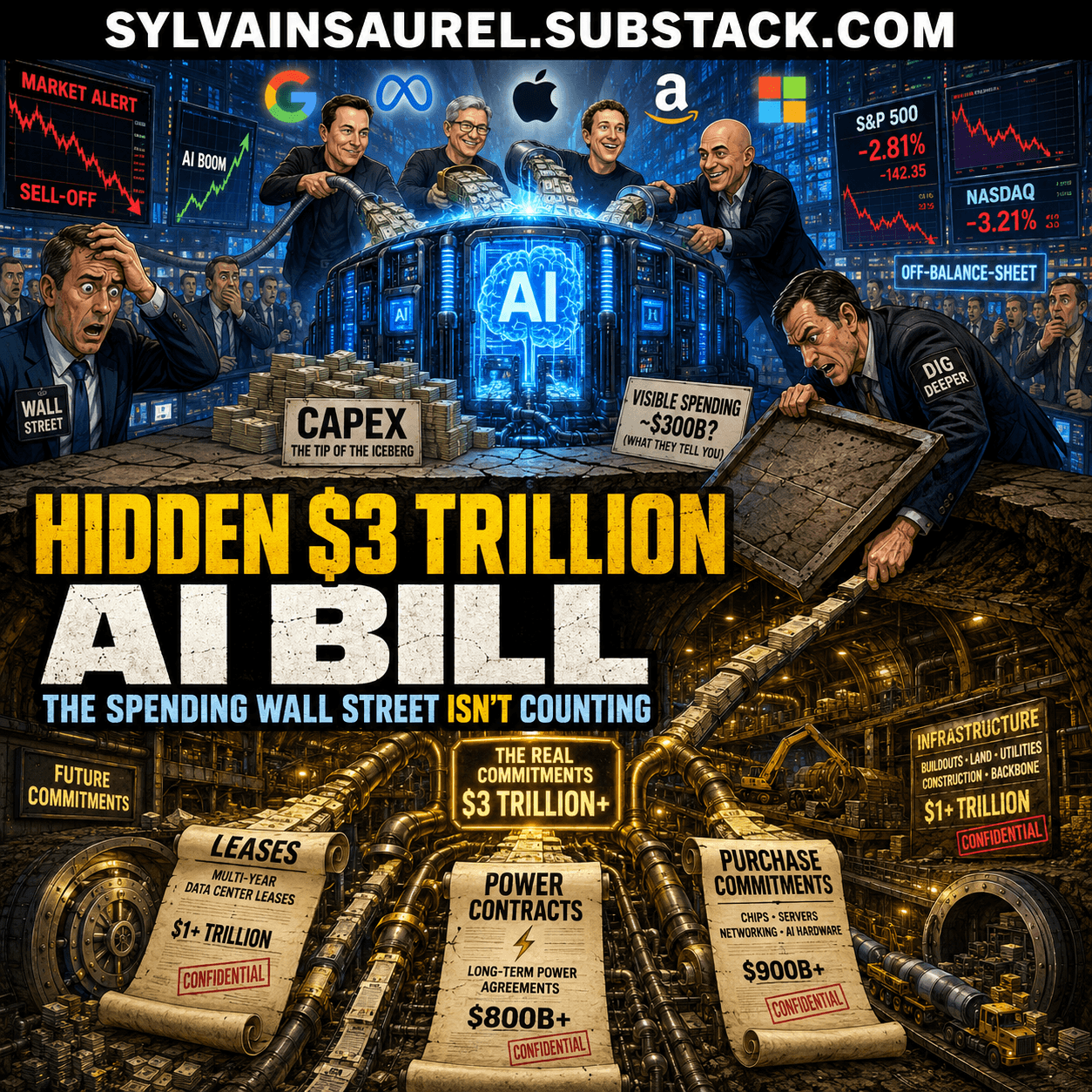
Big Tech’s AI boom goes far beyond capex — trillions in future commitments are turning the AI race into a massive balance-sheet test.
This is important.
People waiting for $40K aren’t necessarily stupid.
There were legitimate reasons to expect another major Bitcoin drawdown. Bitcoin is one of the world’s most volatile major assets. A 30% decline would hardly be historically extraordinary. A recession could have changed liquidity conditions. A major deleveraging event could have triggered forced selling. ETF flows could have reversed. Equities could have fallen.
A geopolitical shock could have caused a temporary flight toward dollars. Mining economics could have deteriorated. Regulatory conditions could have changed. Plenty of things could have driven Bitcoin lower.
The problem isn’t believing $40K was possible. Of course it was possible.
The problem is quietly transforming:
“$40K is possible”
into:
“$40K is inevitable.”
Those sentences are worlds apart.
Investing happens in probabilities. Social media happens in certainties. And unfortunately, people often build portfolios using the second.
This is where the $40K crowd faces its hardest question.
Suppose Bitcoin goes to $85K. Do you still wait?
What about $90K? $100K? $120K?
At what point does your thesis expire?
Most people never define this. That is dangerous.
Before making a market prediction, every investor should ask:
What evidence would prove me wrong?
If your answer is “nothing,” you don’t have an investment thesis. You have a belief system.
Imagine someone says Bitcoin is going to $40K. Bitcoin reaches $70K.
They say: “Still waiting.”
It reaches $80K. “Bear market rally.”
$90K. “Massive bull trap.”
$100K. “Blow-off top incoming.”
$120K. “Now the crash will be even bigger.”
Notice what happened.
Every new data point gets absorbed into the original prediction. Nothing can invalidate it. That means the prediction has stopped being useful.
Bitcoin has a fascinating way of converting skepticism into demand.
Not because Bitcoin persuades everyone intellectually. But because price eventually forces people to reconsider.
Consider the investor waiting for $40K.
At $60K, they feel intelligent. At $65K, patient.
At $70K, mildly uncomfortable. At $75K, annoyed.
At $80K, nervous. At $90K, they start checking Bitcoin more often.
At $100K, something changes.
Now they’re no longer asking:
“When can I buy Bitcoin cheaply?”
They’re asking:
“What if I never get another chance?”
Fear has flipped direction.
Originally, they were afraid Bitcoin would crash after they bought. Now they’re afraid Bitcoin will rise without them.
Same person. Same asset. Different price. Completely different emotional response.
This is why bull markets are so psychologically powerful.
Price doesn’t merely change portfolios. Price changes beliefs.
This paradox appears in almost every market cycle.
When an asset is collapsing, nobody wants it. When it is surging, everyone wants it.
Think about how absurd this is.
Comments
Nothing yet. Say the first thing.
Sign in to join the conversation.