
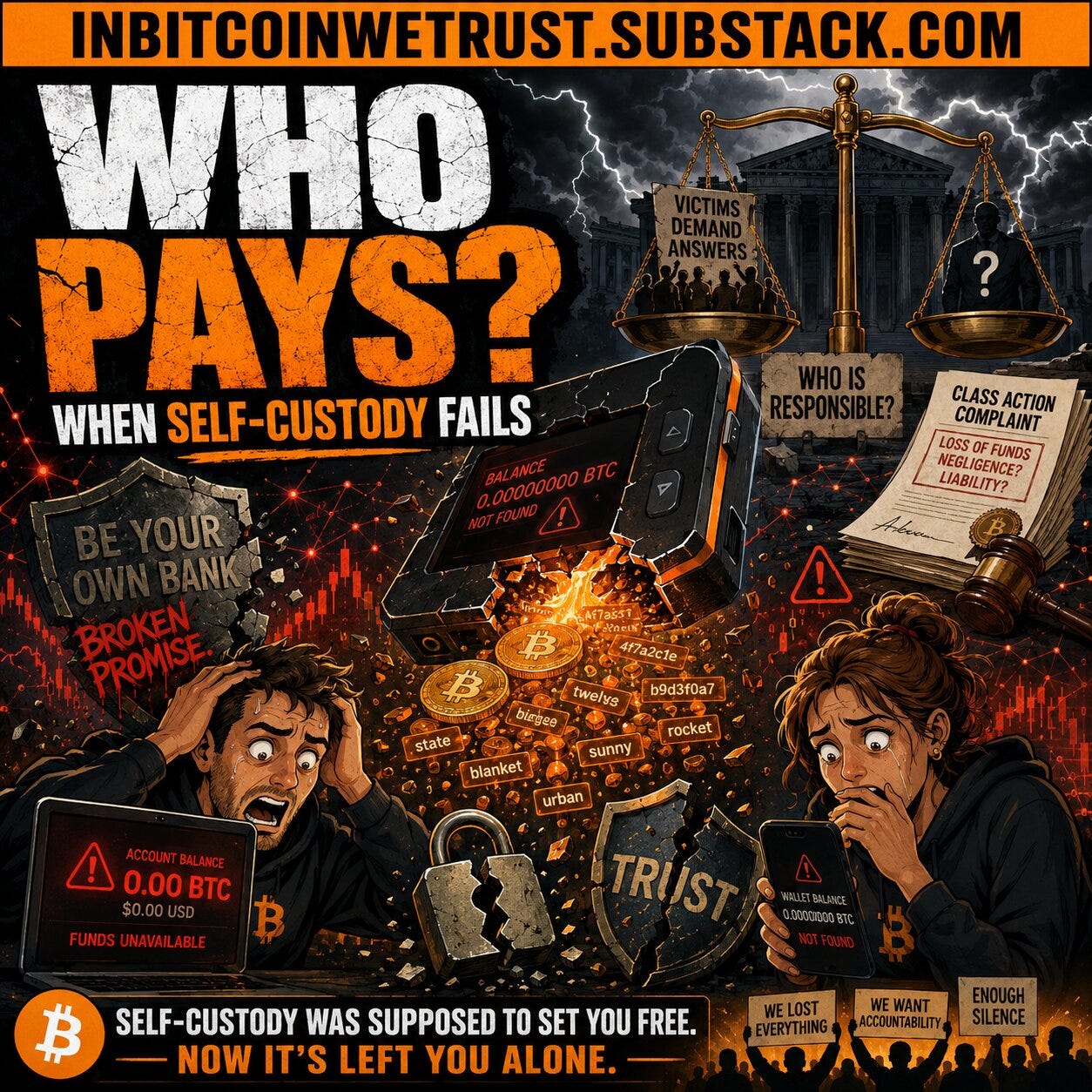
Bitcoin promised to eliminate trusted third parties. The Coldcard disaster has exposed a much harder question: what happens when the device you trusted to protect your sovereignty becomes the source of the failure?
There is a sentence every Bitcoiner eventually hears.
“Be your own bank.”
It sounds empowering.
And it is.
Hold your own keys. Eliminate counterparty risk. Stop trusting exchanges. Stop depending on banks that can freeze your money, governments that can debase it, or institutions that can fail while taking your savings with them.
Bitcoin gives you an exit.
But there has always been a second half to that promise that gets discussed much less enthusiastically.
When you become your own bank, you also inherit the bank’s responsibilities.
Lose your seed phrase? Your problem.
Send Bitcoin to the wrong address? Your problem.
Give your recovery words to a phishing website? Your problem.
Forget your passphrase? Your problem.
There is no help desk capable of reversing the blockchain. There is no “forgot password” button. There is no chargeback.
Bitcoin does not care.
For years, that brutal finality has been presented as part of the price of sovereignty.
Then Coldcard happened.
And suddenly the neat philosophical distinction between personal responsibility and manufacturer responsibility became much harder to defend.
Because what if the user did everything right?
What if the seed remained offline?
What if nobody photographed it?
What if nobody typed it into a computer?
What if the hardware wallet was never physically stolen?
What if the user followed the security model they were sold?
And the weakness existed inside the device itself?
That is the question now moving through the Bitcoin community.
And some victims are beginning to ask another one:
Who pays?
The first stage of the Coldcard crisis was pure panic.
Bitcoiners opened wallets. Balances had vanished. Addresses that had sat untouched for years suddenly moved. Security researchers began connecting the incidents. Attention focused on Coldcard-generated seeds.
Then came the technical explanation.
A vulnerability in Coldcard firmware could cause affected wallets to generate seed material with drastically less entropy than users reasonably expected.
Coinkite now acknowledges that seeds generated on affected firmware can be at risk. On Mk4, Mk5, and Q devices created before the fixed releases, the company says affected seeds contained roughly 72 bits of entropy instead of the expected 128 bits. Older Mk2 and Mk3 versions also contained a vulnerable generation path.
This is not the usual hardware-wallet nightmare.
An attacker did not necessarily need to steal the physical device.
They did not necessarily need the PIN.
They did not necessarily need to trick the user into revealing the recovery phrase.
The problem existed at the moment some recovery phrases were generated.
Block’s engineering team independently traced the issue to Coldcard firmware and documented a vulnerable path dating back to 2021, with additional reseeding behavior introduced in 2022. Researchers say they identified the root cause while investigating user losses on July 30, 2026.
Bitcoin Optech responded with an unusually direct warning: users with potentially affected Coldcard-generated keys should move their funds to an unaffected wallet as soon as possible. At the time of its August 16 article, estimated losses had already reached 1,596 BTC.
Coinkite has since released fixed firmware for the affected Coldcard models.
But there is a brutal catch.
Updating the firmware does not fix an existing vulnerable seed.
Users must generate a new seed and migrate the funds.
For those who discovered the problem before an attacker did, that is painful but manageable.
For those who discovered it afterward, there is nothing left to migrate.
Their Bitcoin is gone.
And now some of them are organizing.
A Reddit thread from an affected Coldcard user asks whether victims have contacted lawyers or authorities and explicitly raises the possibility of collective legal action. The poster says they believe victims may have to organize if Coinkite does not compensate them.
This is the moment the Coldcard story stops being only a security story. It becomes a legal story. A philosophical story.
And possibly one of the most important tests the self-custody industry has ever faced.
Bitcoin culture has developed an unusually strong doctrine of individual responsibility.
That makes sense.
Bitcoin removes intermediaries precisely by making ownership cryptographic.
Possession of the correct private key gives you control.
The protocol does not care whether those keys were stolen, inherited, guessed, coerced out of you, accidentally published, or forgotten.
At the network level, there is no customer-support department.
There cannot be. That is a feature.
But Bitcoiners have sometimes allowed that protocol-level truth to expand into something much broader:
If Bitcoin is lost, the user must have done something wrong.
That logic breaks down when a commercial security product generates defective cryptographic material.
Imagine buying a high-end safe.
You place your valuables inside. You keep the combination private. You follow every instruction.
Five years later, you discover the manufacturer accidentally produced an entire batch where the combinations could be derived from a narrow, predictable set.
A thief exploits that flaw and empties your safe.
Would the manufacturer’s response simply be:
“You chose to store valuables inside a safe. You accepted the risk.”
Most people would consider that absurd.
Yet Bitcoin makes the situation stranger because the manufacturer never actually holds your funds.
Coldcard does not custody Bitcoin. Coinkite cannot reverse a transaction.
It does not possess a database where customer balances can simply be restored.
Bitcoin’s architecture has removed the obvious recovery mechanism.
But removing the recovery mechanism is not necessarily the same thing as removing legal responsibility.
And that distinction could now matter enormously.
Comments
Nothing yet. Say the first thing.
Sign in to join the conversation.