
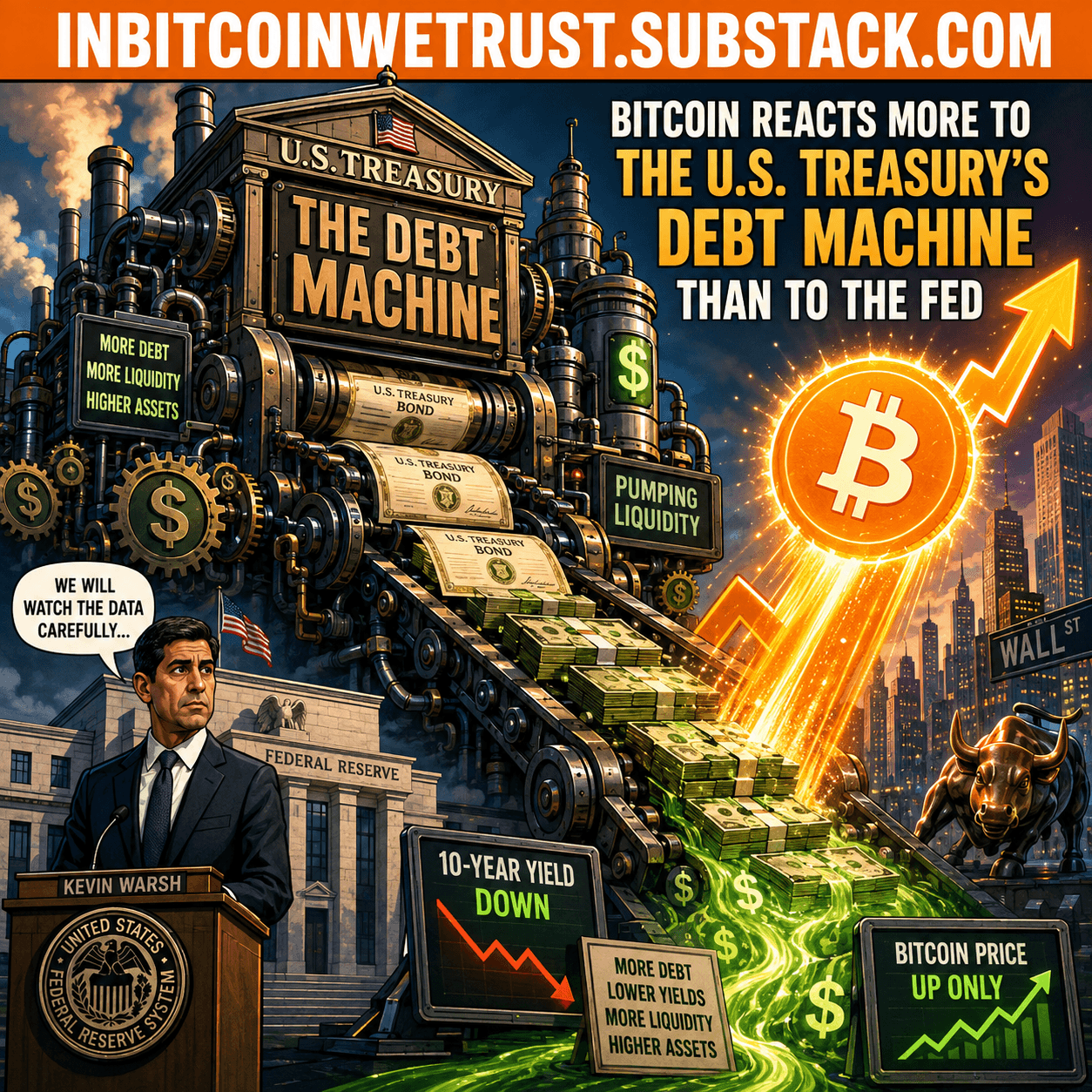
For years, Bitcoin traders have been trained like Pavlov’s dogs.
Fed meeting? Watch Bitcoin.
CPI print? Watch Bitcoin.
Jerome Powell speaks? Watch Bitcoin. It will be the same with Kevin Warsh now.
Rate cut probabilities rise? Buy.
Rate hike probabilities rise? Sell.
The Federal Reserve became the sun around which virtually every macro Bitcoin narrative revolved.
And for good reason.
Cheap money helped inflate risk assets. Quantitative easing flooded the financial system with liquidity. Higher rates crushed speculative appetite. Dollar strength mattered. Real yields mattered.
So Bitcoiners learned a simple equation:
Fed liquidity up = Bitcoin up.
Fed liquidity down = Bitcoin down.
But something important is changing.
Bitcoin just delivered another reminder that the Fed is no longer the only institution capable of moving the liquidity environment.
The U.S. Treasury is becoming impossible to ignore. And that changes the macro game.

How Washington is sacrificing the fiat system to win the global AI arms race — and why hard assets are your only escape.
This is understandable.
The Fed controls the policy rate. It influences the cost of money throughout the financial system. When the Fed cuts rates, borrowing usually becomes cheaper. When it expands its balance sheet, reserves can increase. When it tightens monetary policy, liquidity conditions generally become more restrictive.
Bitcoin’s history is filled with examples of this relationship.
The post-COVID monetary explosion coincided with one of Bitcoin’s most spectacular bull markets.
Then inflation arrived. The Fed tightened aggressively. Liquidity vanished. Bitcoin collapsed.
The lesson seemed obvious.
Bitcoin was a liquidity trade. And the Fed controlled liquidity.
Except that statement was always incomplete.
The Fed controls part of the liquidity machine. The U.S. Treasury controls another enormous part.
And as federal borrowing grows, that part matters more.
Think of the Treasury as the financing department of the largest debtor on Earth.
It has to decide:
How much debt to issue.
When to issue it.
Whether to issue bills, notes, or bonds.
Which maturities to emphasize.
How much cash to hold.
When to rebuild that cash.
When to spend it.
How to manage older, less-liquid securities.
How aggressively to conduct buybacks.
Those decisions affect markets. Sometimes enormously.
If the Treasury suddenly issues hundreds of billions of dollars of debt, investors have to buy it.
Where does the money come from?
Potentially:
cash.
money-market funds.
bank deposits.
reverse repo balances.
other assets.
That can change financial liquidity.
Now reverse the mechanism.
If Treasury spends down its cash balance or conducts operations that improve market liquidity, conditions can loosen.
This is why sophisticated macro traders increasingly watch something Bitcoin Twitter rarely cared about ten years ago: Treasury plumbing.
Spark vs. Ark: Solving Bitcoin's Last-Mile Scaling Problem.
·
Jun 22

These last months, I can tell you that the narrative surrounding Bitcoin has fundamentally shifted. We are no longer debating whether Bitcoin CAN scale; we are actively engineering HOW it scales. The first era of Bitcoin was about establishing decentralized scarcity. The second era, spearheaded by the Lightning Network, was about proving that off-chain payments were viable. Now,
The latest example is perfect.
The reaction was immediate.
Comments
Nothing yet. Say the first thing.
Sign in to join the conversation.