
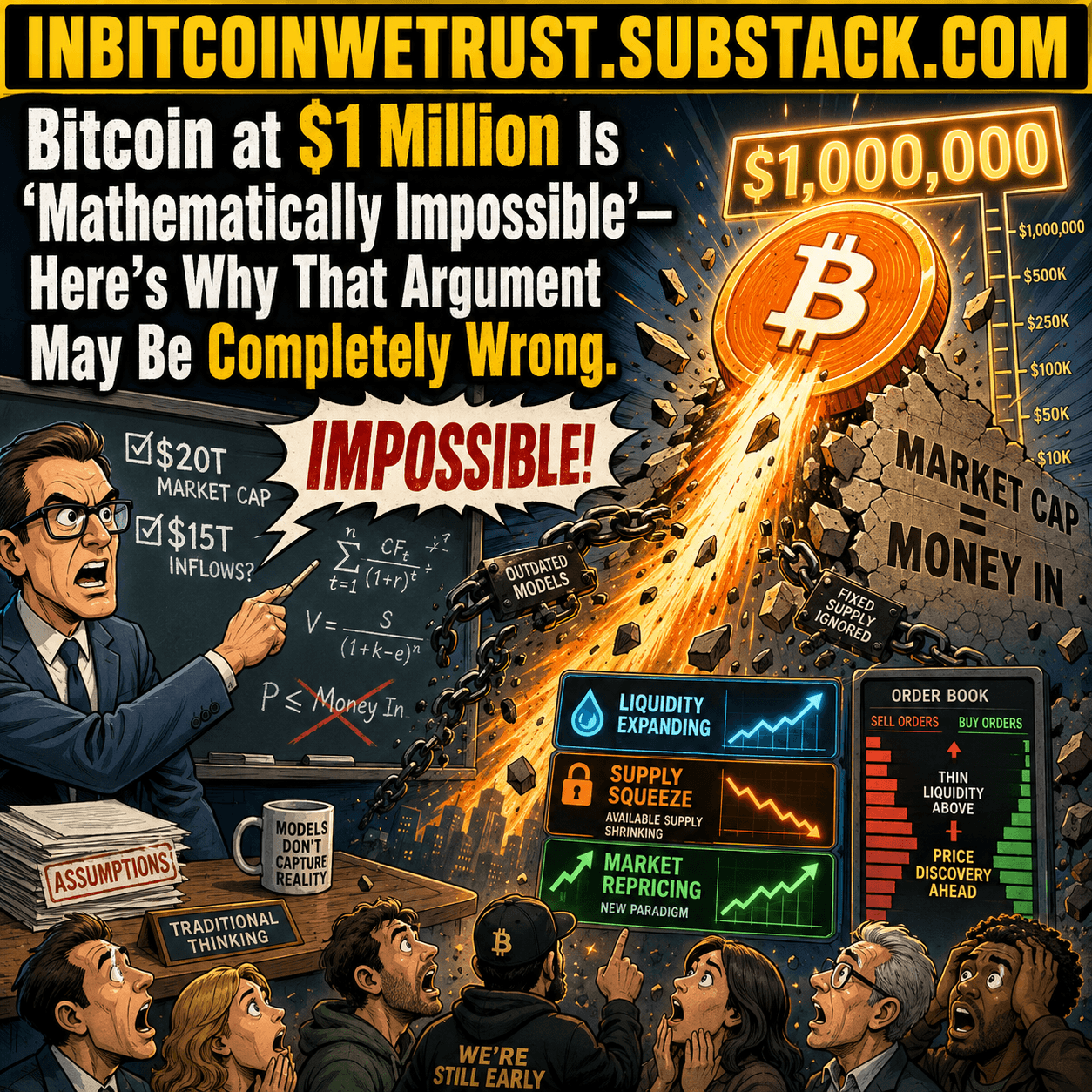
10x Research says Bitcoin would need roughly $15 trillion of new capital to reach $1 million by 2030. The number sounds devastating — until you realize market capitalization is not the same thing as money flowing into a market.
Someone just declared Bitcoin at $1 million mathematically impossible.
Not unlikely.
Not excessively bullish.
Not absurdly optimistic.
Mathematically impossible.
That is a powerful phrase.
And it is exactly the kind of phrase that travels.
Markus Thielen, head of research at 10x Research, recently challenged the increasingly popular prediction that Bitcoin could reach $1 million before 2030.
His argument appears devastatingly simple.
Bitcoin was trading around $64,000 when he made the claim, with a market capitalization near $1.3 trillion. A Bitcoin price of $1 million would imply a valuation approaching $20 trillion.
According to Thielen, Bitcoin would therefore need roughly $15 trillion of additional capital inflows over the next four years—a sum comparable to roughly one quarter of the value of the entire U.S. stock market.
Game over? Not quite.
Because there is a huge problem hidden inside this apparently airtight calculation.
Market capitalization is not capital.
And an asset does not need one new dollar of investment for every additional dollar of market capitalization.
That distinction changes everything.
It does not prove Bitcoin will reach $1 million by 2030.
It does not make $1 million inevitable.
It doesn’t even make it probable.
But it means the phrase “mathematically impossible” may be doing far more work than the mathematics can actually justify.
And understanding why takes us directly into one of the most misunderstood aspects of financial markets:
How prices are actually created.

The Great AI Paradox: How Cheaper, More Efficient Chinese Models Could Be Fueling—Not Killing—the West’s Explosive Demand for Nvidia Compute.
Before attacking Thielen’s argument, we should acknowledge something important.
His broader skepticism is completely reasonable.
Going from roughly $64,000 to $1 million would require Bitcoin to increase by more than 15×.
At approximately 20 million circulating bitcoins, that would push Bitcoin’s headline market capitalization close to:
$20 trillion.
That’s enormous.
Bitcoin would move from a large alternative asset into the absolute top tier of global stores of value.
The amount of wealth choosing to hold Bitcoin would have to increase dramatically.
Institutional participation would probably need to expand.
Bitcoin would likely need to capture significantly more demand currently flowing into gold, bonds, equities, cash or real estate.
Something structural would have to change.
So if Thielen’s argument were simply:
“$1 million Bitcoin by 2030 is an extremely aggressive forecast.”
I would have little disagreement. But that’s not the interesting claim.
The interesting claim is:
It is mathematically impossible because Bitcoin needs approximately $15 trillion of new money to get there.
That is where things become much shakier.
Because markets don’t work like giant savings accounts.
This is perhaps the single most important concept in this entire debate.
Market capitalization is calculated very simply:
Current price × circulating supply.
That’s it.
Suppose an imaginary asset has 1 billion units.
Yesterday, the last traded price was $10.
Market cap: $10 billion.
Today, buyers become more aggressive. Available sellers disappear. The marginal trade occurs at $15.
The market capitalization is suddenly $15 billion.
Did investors inject $5 billion into the asset?
No. They didn’t need to.
The entire supply was simply repriced based on the latest marginal clearing price.
This is how virtually every traded asset works.
Apple doesn’t need hundreds of billions of fresh dollars entering its shares every time its market capitalization increases by hundreds of billions.
Every existing share isn’t simultaneously purchased at the new price.
A relatively small portion of the outstanding supply trades.
Those trades establish the price applied to all shares when calculating market capitalization.
Bitcoin works the same way.
And Bitcoin has an additional peculiarity:
A very large percentage of its supply may not be available for sale at any given price.
That matters enormously.
This misconception is everywhere.
People look at Bitcoin’s market capitalization and imagine there must somehow be an equivalent mountain of dollars sitting underneath it.
There isn’t.
Comments
Nothing yet. Say the first thing.
Sign in to join the conversation.