
When you spend 2 weeks in a training camp, life becomes very simple: you train, eat, talk about training, talk about food, and prepare for the next session while still digesting the previous one.
At some point, you enter a strange high, a biological kind of high.
Your body is tired, but also awake. Your legs are heavy, but your mind feels great. You are hungry all the time, sleepy at strange moments, and somehow deeply alive. It is probably the result of stress, recovery, hormones, neurotransmitters, the social component and the chemical rebalancing the body needs to go through to keep handling the load.
I have never done drugs, and I stopped drinking alcohol almost 20 years ago, so my comparison is not very scientific, but I imagine some substances must try to create something similar. Training camp does it legally, and with more pasta.
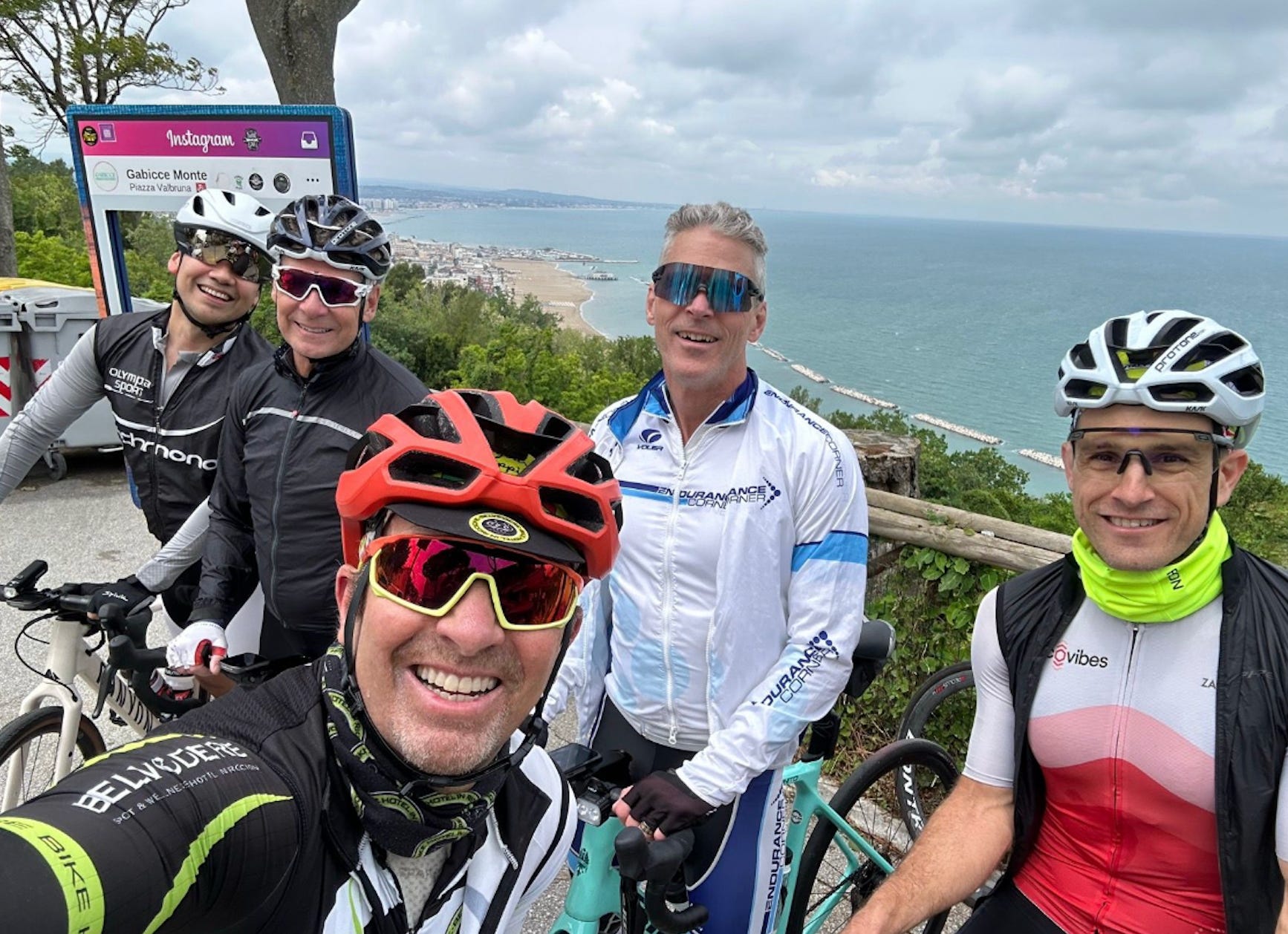
Italy was far more than 64 hours of training in 2 weeks. The real highlight was the group: strong athletes, no need to prove they were strong, everyone doing the work that fit their own thing, their own goals, their own season, and their own long-term progression.
There was the “magical table,” as some of us described it. Coffee rides with or without coffee. Long rides. Even longer rides. Big plates. Some Red Bulls. And an almost suspicious amount of calories going in and out every day.
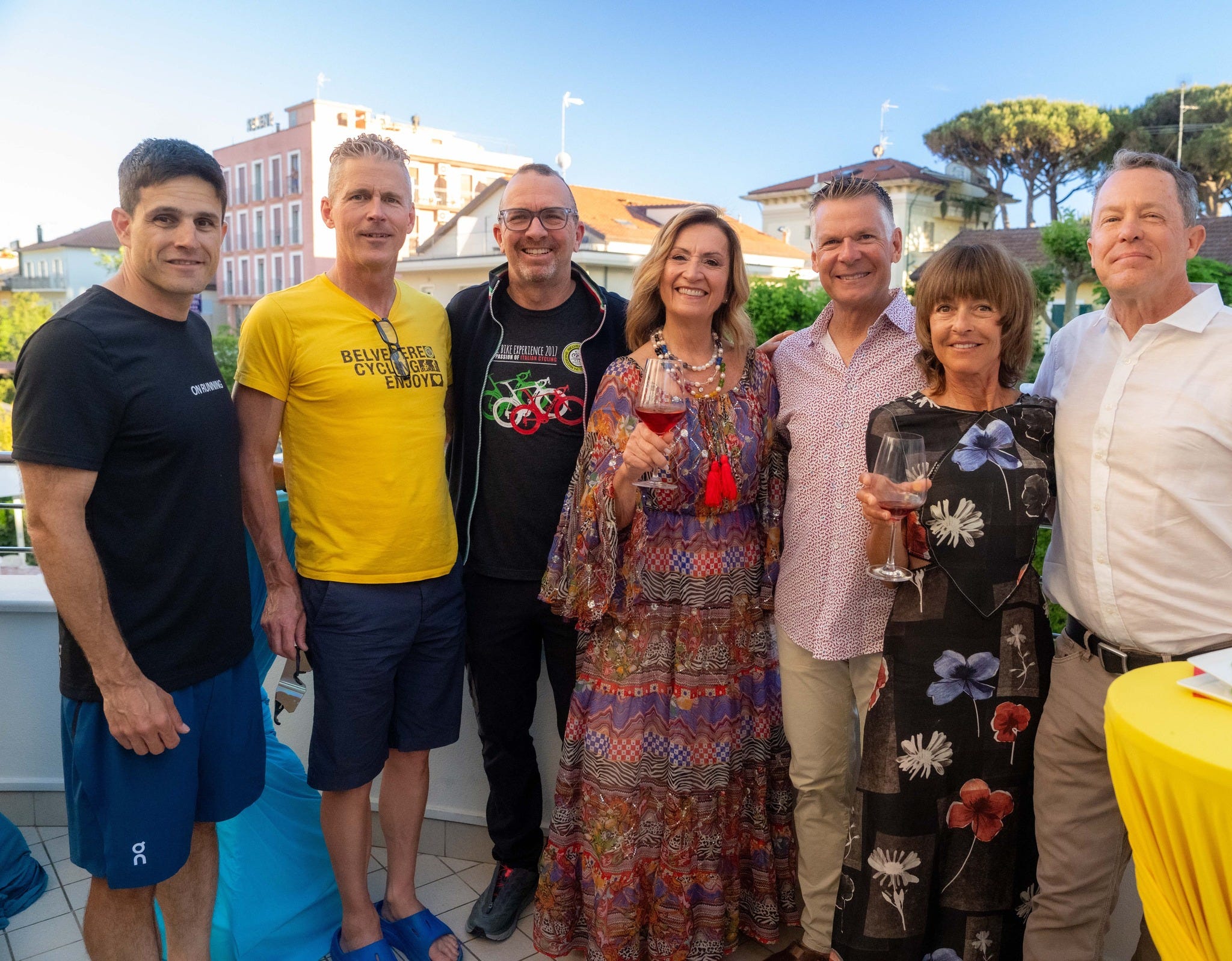
That is what I love about training camps with extraordinary athletes: there is no need for ego, and there is nothing to prove. Everyone moves forward at their own speed and in their own direction.
Now, to the point.
To close the camp, some of us signed up for the Nove Colli Gran Fondo.
Nove Colli is part of Italian cycling culture. It starts in Cesenatico, the hometown of Marco Pantani, and takes riders from the Adriatic coast into the hills of Romagna. The name means “nine hills,” and that is exactly the spirit of the route: long, rolling, beautiful, and demanding, with repeated climbs that slowly collect interest on your legs.
You do not just ride the route, you enter an Italian cycling story, and because this is Italy, the chaos has style.
Somehow everyone is moving everywhere, nobody seems fully sure what is happening, and yet the whole thing works, usually dangerously close to your front wheel. In all seriousness, Italians ride really well. They descend, corner, move through groups, and survive chaos with impressive skill.
But pull on the front on the flats? Never. Absolutely never.
And of course, there was the very civilized schedule of waking up at 3:00 a.m. to start riding at 6:00 a.m., because apparently most endurance athletes are not fully happy unless breakfast feels like a medical emergency.
I would argue that I am pretty fit year-round, especially at this time of the season, only a few weeks away from my main peak for Ironman.
But sometimes the body reminds you that there is more to performance than peaks, numbers, fitness, beautiful expectations, and well-designed plans.
Sometimes the day changes.
And when heat enters the game, the rules change with it.
The day started early, very early. Most of us woke up around 3:00 a.m.
By 4:15 a.m., we were already moving toward the event because we were staying some distance away from the start area near Rimini. We arrived around 5:00 a.m. The race started at 6:00 a.m.
At that hour, heat was not yet the dominant factor. The first 2 or 3 hours felt relatively normal.
I started way at the back because the corrals are organized based on previous years times, and first-timers are sent to the back, the place where optimism goes to warm up.
That meant, for me, some massive power spikes from the start just to catch better groups, cyclists everywhere, a few crashes, and the constant need to move forward and stay near stronger riders. I did not want to be swallowed by the chaos at every roundabout, descent or narrow section.
In an Gran Fondo, positioning is key, particularly early on.
My perception of effort matched the numbers: heart rate made sense, power made sense and my body felt like it was doing what it was supposed to do. It was not easy, but it was familiar, the kind of “moderate-hard” I understand well.
But the tricky thing about heat is that it does not always attack immediately. Sometimes it waits. It gives you 2-3 good hours, like it did with me, particularly when races start early in the day.
It allows you to believe that everything is under control, and then the environment changes faster than your body can adapt.
That day, Europe was hit by a sudden wave of heat. It was one of the first truly hot days of the season. The first hot day is often more dangerous than a hotter day later in the summer because the body has not yet built the adaptations needed to handle the thermal load.
I was fit, but I was not heat adapted.
And for a guy like me, with a well-earned bad reputation in the heat, that is basically a punch in the face.
Fitness and heat readiness are related, but they are not the same thing.
High-volume training helps, when you have spent years teaching your body how to handle stress, you can usually absorb many kinds of stress better. But volume does not magically install air conditioning in you!
You can have a strong engine and still have a poor cooling system, and you can be prepared for the event while being completely unprepared for the environment.
Heat adaptation is a skill you practice ahead of time.
On the bike, my tempo range is roughly 260 to 300 watts.
That is a familiar area for me, it is not easy, but it is known. It is the kind of effort where you are working, but you are not yet negotiating with your soul.
Early in the event, holding that range felt “normal”, then, after around 3 hours, something changed.
The numbers did not collapse, my heart rate was still under control, my power was still OK, my fueling was excellent, my need for fluid suddenly started to raise, but there where not aid stations everywhere…
I ended up averaging around 135 grams of carbohydrate per hour, I drank approximately 8 liters of fluid during the event. In the first 2 bottles, I had my usual sodium strategy, around 1,200 mg of sodium per liter, plus the corresponding carbohydrates.
From the outside, this looks good, and it was good… the fueling helped, the sodium helped, the fluid helped. Without them, the day could have gone much worse.
But even with good execution, the perception of effort started drifting upward…
The same 260 or 280 watts no longer felt like the same 260 or 280 watts, the watts were the same, the cost was not.
This is where many athletes get confused, they look at the bike computer and think:
“My heart rate is okay”
“My power is okay”
“I am eating”
“I am drinking”
“So why does this feel so hard?”
The answer is simple: heat changes the price of the work.
In normal conditions, your cardiovascular system is mostly solving one major problem: delivering oxygen and fuel to the working muscles. In hot conditions, it has to solve 2 problems at the same time.
It still has to feed the muscles
It also has to send blood to the skin to remove heat
The body becomes a negotiation:
Muscle wants blood
Skin wants blood
Gut wants blood
Brain wants safety
The heart is in the middle of the argument
At some point, the same external output becomes internally more expensive, that is what I felt.
After the event, I reviewed the file with AC, and it looked relatively good.
The Gran Fondo distribution was actually very solid. Most of the climbing sat in the 260–290W range, and I used the descents and high-speed sections well to coast, save energy, and avoid wasting watts where they do not really buy much time.
The one place to be careful was the harder climb around the 6-hour mark, where I spent a meaningful amount of time above 300W. After that, heart rate did not come down as easily, which likely contributed to the ~7% decoupling toward the end. Here is the actual file so you can check it out…
Comments
Nothing yet. Say the first thing.
Sign in to join the conversation.