
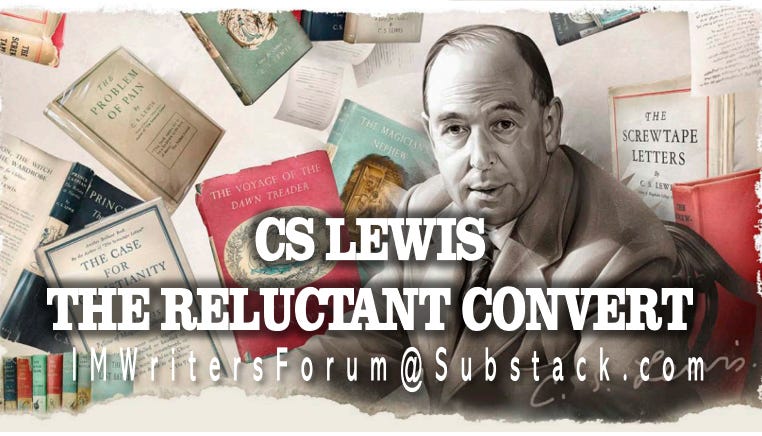
Lewis did not devise an argument for the existence of God or an argument for what kind of God exists, or an argument for why Jesus must have been God in the flesh. Instead, he unfolded the reasons by which he slowly came to believe that Jesus is the Son of God. In Mere Christianity, one of my favorite reads, Lewis doesn’t argue to facts of God; he does, however, express the ideas and the conflicting positions in a simple, straightforward fashion. He said it is Mere Christianity.
Dr. Stephen Phinney
The Most Reluctant Convert features award-winning actor Max McLean as the older Lewis and Nicholas Ralph – breakout star of PBS Masterpiece’s All Creatures Great and Small – as young Lewis. Beautifully filmed in and around Oxford, this engaging biopic follows the creator of The Chronicles of Narnia from the tragic death of his mother when he was just nine years old, through his strained relationship with his father, to the nightmare of the trenches of World War I to Oxford University, where friends like J.R.R. Tolkien challenge his unbelief.
Written for the screen and directed by two-time Emmy and BAFTA winner Norman Stone (BBC’s Shadowlands), The Most Reluctant Convert brings to life the spiritual evolution of one the 20th century’s sharpest minds and keenest wits.
Clive Staples Lewis was born in 1898 and died, a week before his 65th birthday, on November 22, 1963. From the time he was fourteen until his early thirties, Lewis was an atheist, someone who does not believe in God. He was also a materialist, believing that nothing exists besides physical matter. In the 1940s, Lewis gave a series of talks on the BBC that later became one of his most famous books, Mere Christianity. Before the second set of talks, Lewis told his radio audience: It’s not because I’m anybody in particular that I’ve been asked to tell you what Christians believe. In fact, it’s just the opposite. They have asked me, first of all, because I’m a layman and not a parson, and consequently, they thought I might understand the ordinary person’s point of view a bit better. Secondly, I think they asked me because it was known that I’d been an atheist for many years and only became a Christian fairly recently. They thought that would mean I’d be able to see the difficulties – able to remember what Christianity looks like from the outside.
Some people have the mistaken impression that Lewis did not experience the ordinary pains of life. He did. As we learn from the film, Lewis lost his mother at a young age and had a complicated relationship with his father. He was sent to a series of dreadful boarding schools and later became wounded in World War I.
“One of the most persistent misconceptions about the man C.S. Lewis is that for the greater part of his life, he lived safely cloistered away from the typical cares and burdens of normal everyday life... Such a portrayal is troubling simply because it is not true. In fact, anyone who knows the facts knows that it is far from the truth.”
Lewis reports that he hopes to correct “one or two false notions that seem to have got about.” There was speculation that his mother’s death had affected Lewis’ religious beliefs. He sets the record straight, explaining: “My mother’s death was the occasion of what some (but not I) might regard as my first religious experience.”
Flora Lewis died of cancer when Lewis was nine. The failure of Lewis’ prayers for her recovery did not produce a loss of belief because there was no genuine belief there in the first place. Lewis did not view God as Savior or even as Judge but merely as a sort of Magician who – if asked properly – would grant a request. After a proper request, the young Lewis expected this genie-like Magician to go back into his bottle until needed again.
“Little by little I became an apostate” in his infamous quote. One of the biggest factors in Lewis’ loss of faith was the lack of guidance from older, mature Christians. Left on his own to struggle with life’s big questions, Lewis stumbled out of faith and into serious atheism that lasted until his early thirties. Lewis says that he became an apostate not all at once or dramatically but little by little. In letter twelve of The Screwtape Letters, Screwtape explains, “Indeed the safest road to Hell is the gradual one – the gentle slope, soft underfoot, without sudden turnings, without milestones, without signposts.”
On Sunday, December 6, 1914, Lewis went home to St. Mark’s in Belfast to commit what he confesses to being one of the worst acts of his life. Fearing to speak up against his father’s wishes, Lewis, who was now sixteen and a staunch atheist, was confirmed as a member of the Church of Ireland. Cowardice drove him into hypocrisy, he reports in Surprised by Joy, and hypocrisy into blasphemy.
In the diary entry for April 27, 1926, Lewis notes that a colleague named Weldon, who taught philosophy, stopped by his room for a chat that went late into the night. “We somehow got on the historical truth of the Gospels,” Lewis records. This conversation appears to be the one Lewis refers to in Surprised by Joy, where he describes a visit from a militant skeptic who remarked, “All that stuff of Frazer’s about the Dying God. Rum thing. It almost looks as if it had really happened once.”
Lewis’ late-night conversation with Weldon, coming as it did in 1926, did not at this point lead directly to his acceptance of Christianity and that final step did not happen until five years later in 1931. So why does Lewis include this episode here among the steps that led him to believe in Theism? This admission coming from this particular person forced Lewis to reexamine his position on what he thought was possible.
We come to one of the most famous lines Lewis ever penned: “In the Trinity Term of 1929 I gave in, and admitted that God was God, and knelt and prayed, perhaps that night the most dejected and reluctant convert in all England.”

Lewis became a joyous Christian who was known for his laughter. This conversion, as Lewis explains, was to indwelling Theism, not Christianity. Lewis will later describe his conversion to Christianity in a very different way – neither dejected nor reluctant, but like someone who, after a long sleep, becomes aware that he is now awake. Lewis writes:
Lewis joined his fellow parishioners to receive communion, culminating in his return to belief. Over the next three decades, Lewis would work tirelessly to assist others in their faith journey – writing books, speaking on the BBC, and sending personal replies to the hundreds of people who wrote to him for help.
One answer is found in the depth to which Lewis truly believed the statement we hear near the end of his life story – that every day, to some degree, we are helping those around us to one eternal destination or the other. His legacy today has a profound impact on Christian thinkers, as well as those who enjoy his famous stories.
Comments
Nothing yet. Say the first thing.
Sign in to join the conversation.