
Podcast Version:
0:00
-14:16
The American judicial system.
It used to be something we could count on. As the ultimate determiner of truth.
But is it still?
Among the innovative designs of the United States Constitution was the “separation of powers,” an integral part of the great experiment that is the United States of America. Our Founding Fathers created three separate and co-equal branches of government—the executive, the legislative, and the judicial. Each has a unique role in our system of government, and each has limitations to its authority.
The genius of our Founding Fathers in establishing a system of three separate and coequal branches of government was in recognizing that it is the checks and balances of such a system that serve to preserve our liberty. . . . [P]reservation of liberty is why legislatures enact laws and why it is up to the executive to sign them (or not). And it is why the judiciary defers to the legislature on matters of public policy. Without question, such a system creates certain inefficiencies in government. After all, it would be much easier if a benevolent dictator could simply rule by decree without having to endure the inconvenience of others’ input. But those inefficiencies are there by design; they are the natural and intended consequence of our system of checks and balances. And those inefficiencies are therefore the price we willingly pay so that we may live under the banner of freedom in the United States of America.
Alexander Hamilton, in Federalist No. 78, said that the judicial branch of government, lacking “influence over either the sword or the purse,” was “the weakest of the three” branches of government. But he stressed that our liberties depend on the judicial branch respecting the boundaries of its authority:
[T]hough individual oppression may now and then proceed from the courts of justice, the general liberty of the people can never be endangered from that quarter; I mean so long as the judiciary remains truly distinct from both the legislature and the executive. For I agree, that “there is no liberty, if the power of judging be not separated from the legislative and executive powers.” And it proves, in the last place, that as liberty can have nothing to fear from the judiciary alone, but would have everything to fear from its union with either of the other departments.
So, the role of the judicial branch is a limited one. It is to interpret (not make) the law, and to apply the law to the facts of the cases as they arise. Judges are not policymakers, because policymaking falls within the purview of the legislative and executive branches of government. And judges should have no personal or policy agenda. They should not seek to achieve any particular outcome but should simply be fair and impartial arbiters of disputes. As our Founding Fathers recognized, our liberty depends on it.
But today, those who are unable to achieve their desired goals through the policy-making branches of government all too often turn to the courts, as if the courts were simply an alternate pathway to achieving policy objectives. And all too often, in the modern era, they find (indeed, they seek out) activist judges who are all too willing to accommodate them. Judges who have forgotten (or never learned or, worse, simply don’t care) that when they put on their black robes, they should take off their advocates’ hats. Judges who instead have their eye on the outcomes they prefer, and who play policymaker to achieve them. Judges who, under the cloak of a robe, act as mini-legislatures to impose policy preferences by judicial fiat. And who, in the process, threaten our very liberty.
As Justice Antonin Scalia of the United States Supreme Court once observed, judicial forays into policymaking result in a government that is “not only not the government of laws that the Constitution established; it is not a government of laws at all.” He quoted the Massachusetts Constitution of 1780, which aptly stated:
In the government of this Commonwealth, the legislative department shall never exercise the executive and judicial powers, or either of them: The executive shall never exercise the legislative and judicial powers, or either of them: The judicial shall never exercise the legislative and executive powers, or either of them: to the end it may be a government of laws and not of men.
When judges overreach—when they assert authority that is properly that of the executive or legislature—they convert our government into a government of men and not of laws. Indeed, policymaking under the guise of judicial decision-making is simply tyranny by another name.
Our Founding Fathers rose up against such tyranny. They established a government of laws and not of men.
And the foundation of that government of laws was . . . the law of God.
On June 7, 1776, it fell to Richard Henry Lee of Virginia—one of the great orators of the Continental Congress, and an ardent and early advocate for independence—to put forth a resolution declaring the united American colonies to be “free and independent states.” Lee was a particularly devout Christian who believed that religion was so essential to a free American society that the citizenry should have a legal obligation to support it. In 1784, he wrote to future President James Madison—the Father of the Constitution:
Refiners may weave as fine a web of reason as they please, but the experience of all times shews Religion to be the guardian of morals—; And he must be a very inattentive observer in our Country, who does not see that avarice is accomplishing the destruction of religion, for want of a legal obligation to contribute something to its support.
John Adams (who was later elected the second President of the United States) quickly seconded Lee’s resolution of independence. Adams had long maintained that liberty was a right “derived from our Maker.” He wrote that if a “nation in some distant region” would “take the Bible for their only law book,” “what a Eutopia—what a Paradise would this region be!” He declared that “religion and virtue are the only foundations” of government and human society, and that “all men are born free and equal, and have certain natural, essential, and unalienable rights,” and that all “shall be equally under the protection of the law.”
Debate on the Lee resolution ensued, and a committee was formed to draft a statement of independence. The committee was comprised of Adams, Benjamin Franklin, Roger Sherman, Robert Livingston and—as a compromise candidate—a young Thomas Jefferson. The committee named Jefferson as its principal drafter, and Jefferson thus became known as the author of the resulting Declaration of Independence.
Jefferson’s foundational words invoked the right of a free people “to assume among the powers of the earth, separate and equal station to which the Laws of Nature and of Nature’s God entitle them.” “[A]ppealing to the Supreme Judge of the world for the rectitude of our intentions,” the Founders declared:
We hold these truths to be self-evident,
that all men are created equal,
that they are endowed by their Creator
with certain unalienable Rights, that among these are
Life, Liberty and the pursuit of Happiness.
And as they set out to establish a new form of government based upon the rights bestowed upon them by God, they pledged:
And for the support of this Declaration,
with a firm reliance on the protection of divine Providence,
we mutually pledge to each other
our Lives, our Fortunes and our sacred Honor.
The United States Constitution was drafted at the Constitutional Convention in 1787. In setting forth a tripartite governmental structure, the Constitution described the liberties it assured as “Blessings” from One greater than ourselves:
We the People of the United States,
in Order to form a more perfect Union,
establish Justice, insure domestic Tranquility,
provide for the common defence, promote the general Welfare,
and secure the Blessings of Liberty
to ourselves and our Posterity, do ordain and establish this
Constitution for the United States of America.
Proclaiming that our individual liberties and unalienable rights are “blessings” from “God,” “endowed to us by our Creator,” our Founding Fathers appealed to the “Supreme Judge of the World,” invoked the authority of the “Great Governor of the World,” and with “a firm reliance on the protection of divine Providence” gave birth to a new nation unlike any that had gone before it, the United States of America.
But the America envisioned by our Founding Fathers has faded with the shaking of its God-centric foundation. And the cracks in that foundation emanate in part from modern-day America’s distortion of the judicial system as our Founders intended it to be. From America’s forgetfulness of our Founding Fathers’ grand vision. From its disrespect for the separation of powers. From judicial overreach into the executive and legislative arenas. From policymaking under the guise of judicial decision-making—tyranny by another name. And the result has been a loss of our liberties.
Perhaps most fundamentally, the cracks in the foundation of America’s judicial system result from modern-day America’s obliviousness to what was central to our Founding Fathers’ vision of America—the certitude that our rights and liberties come from God. That America can be sustained only by adhering to the principles of virtue and morality. Principles that derive from religion and on which the Rule of Law undergirding our judicial system was built. And by our judicial system’s distortion of Jefferson’s call for a “wall of separation” between church and state. By our courts’ twisting of Jefferson’s clearly intended meaning—to protect churches from encroachment by the state—to instead somehow mean the opposite—that we must eradicate of religion from the public square.
President Adams’s cousin, the firebrand Samuel Adams—known as the Father of Democracy—declared that religion and liberty were “intimately connected,” “interwoven,” “cannot subsist separately,” and “rise and fall together,” and observed that “those who are combined to destroy the people’s liberties practice every art to poison their morals.” Again, this Adams knew that equal justice under the law flowed from the “equal and impartial liberty” that “all men are clearly entitled to, by the eternal and immutable laws of God and nature.” Put another way, “all men are equally bound by the laws of nature, or, to speak more properly, the laws of the Creator. They are imprinted by the finger of God on the heart of man.”
Alexander Hamilton, in his The Farmer Refuted essay, similarly spoke of the “natural rights of mankind” as “dictated by God himself, and as investing all men with an “inviolable right to personal liberty.” Quoting the inestimable legal scholar, Sir William Blackstone, author of the Commentaries on the Laws of England, Hamilton declared that “the first and primary end of human laws” is “to maintain and regulate these absolute rights of individuals” that are “vested in them by the immutable laws of nature.” Hamilton declared that because “civil liberty” is founded in “natural liberty,” which is “a gift of the beneficent Creator,” it “cannot be wrested from any people, without the most manifest violation of justice.” Hamilton summed up the inextricable link between justice under the law and our God-given liberties, this way:
The sacred rights of mankind are not to be rummaged for, among old parchments, or musty records. They are written, as with a sun beam, in the whole volume of human nature, by the hand of the divinity itself; and can never be erased or obscured by mortal power.
In his essay, A Defence of the Use of the Bible as a School Book, Benjamin Rush, a signer of the Declaration of Independence from Pennsylvania, said:
We neglect the only means of establishing and perpetuating our republican forms of government, that is, the universal education of our youth in the principles of Christianity, by means of the Bible; for this divine book, above all others, favours that equality among mankind, that respect for just laws, and all those sober and frugal virtues, which constitute the soul of republicanism.
Fellow-Declaration-signer George Wythe of Virginia, the first law professor in America and Jefferson’s legal mentor, declared that “justice is appointed of God, the golden rule of all order throughout the universe,” and that he who “knowingly acts against justice, is a rebel against God, and a premeditated murderer of mankind.”
James Wilson, a future Justice of the United States Supreme Court and a signer of both the Declaration of Independence and the United States Constitution, wrote in his Lectures on Law that “the law of nature is universal. For it is true, not only that all men are equally subject to the command of their Maker; but it is true also, that the law of nature, having its foundation in the constitution and state of man, has an essential fitness for all mankind, and binds them without distinction.”
Hamilton could have been speaking to modern-day American society when he said:
The fundamental source of all your errors, sophisms and false reasonings is a total ignorance of the natural rights of mankind. Were you once to become acquainted with these, you could never entertain a thought, that all men are not, by nature, entitled to a parity of privileges.
Americans today would do well to take Hamilton’s advice.
And Madison’s:
This belief in a God Allpowerful wise & good, is so essential to the moral order of the world & to the happiness of man.
And George Washington’s:
Of all the dispositions and habits which lead to political prosperity, Religion and morality are indispensable supports. . . . Let it simply be asked where is the security for property, for reputation, for life, if the sense of religious obligation desert the oaths, which are the instruments of investigation in Courts of Justice? And let us with caution indulge the supposition, that morality can be maintained without religion.
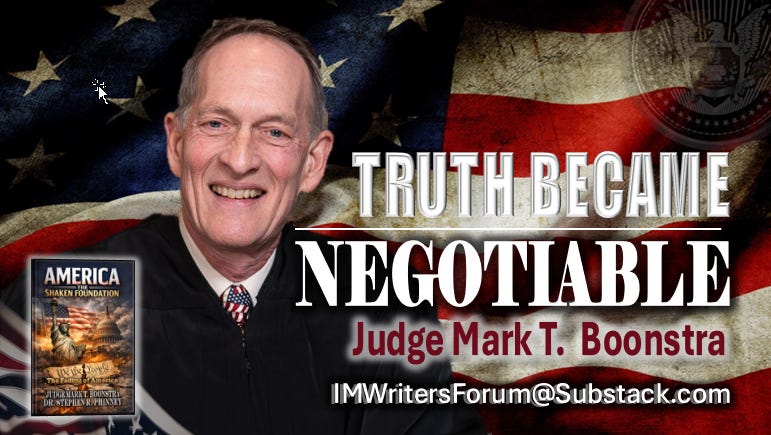
Truth must not be negotiable in America’s judicial system. To regain the truth, we must once again respect the Rule of Law and the separation of powers. We must re-instill in our judges a respect for the limitations of their authority. We must rid the judiciary of the tyranny of policy-making masked by a black robe.
And most fundamentally, we must renew America’s understanding of the source of our natural rights—our Creator—and demand that our society—and our judicial system—re-store the indispensable supports of religion and morality. Only then can we secure a sturdy foundation for discerning truth and achieving equal justice under the law.

Mark’s Substack | Visit Mark’s Website
In a culture drowning in confusion and compromise, Dr. Phinney and Judge Boonstra are boldly advancing a Christ-centered vision of Identity Politics—your donation fuels this mission to restore truth, justice, and biblical identity in every sphere of influence.

Comments
Nothing yet. Say the first thing.
Sign in to join the conversation.