
The survival rate of 46% after hemorrhagic shock (due to severe blood loss) in trauma patients paints a grim picture in these globally uncertain times.
This statistic underscores our vulnerability in the face of adversity, but adversity often brings out the best in innovation!
What about creating an epi-pen to stop bleeding in seconds?
This is what Joe Landolina achieved with VETIGEL®, a transformative medical product that he developed with his team at Cresilon in Brooklyn.
In the realm of trauma care where time is key, the conventional methods of controlling severe bleeding typically require several minutes - minutes that often make the difference between life and death.
VETIGEL® is what we call a hemostatic gel (a complicated term to say that it helps control bleeding) designed to stop bleeding within just three seconds.
The way it works is that the gel promotes and accelerates the normal blood clotting mechanism, using a plant-based material that mirrors the body's natural clotting matrix. When applied to a wound, it instantly creates a mechanical barrier, accelerating the body’s hemostatic process and significantly reducing the time it takes to stop bleeding. Be it in the operational room, at home, or on the battlefield, you can easily imagine the potential of such a solution!
As you might have guessed, Joe joined us in episode 25 to talk about their incredible story, sharing how Cresilon gave birth to VETIGEL® and the mechanics of such medical prowess. A surprising encounter with a prodigious entrepreneur, building his path on resilience and adaptability, with the long-term vision to transform bleeding control in humans!

We may never have a cure for cancer, but a new type of drug, called radio-conjugates, is grabbing the attention of oncologists.
The charm of these drugs resides in their super-selective behavior: they are made of a mix of radioactive particles with molecules that hunt down cancer cells, allowing them to deliver radiation right where it's needed.
Certain patients with advanced metastatic prostate cancer saw significant improvement in their condition after only three radio-conjugate treatments delivered within a year (see below).
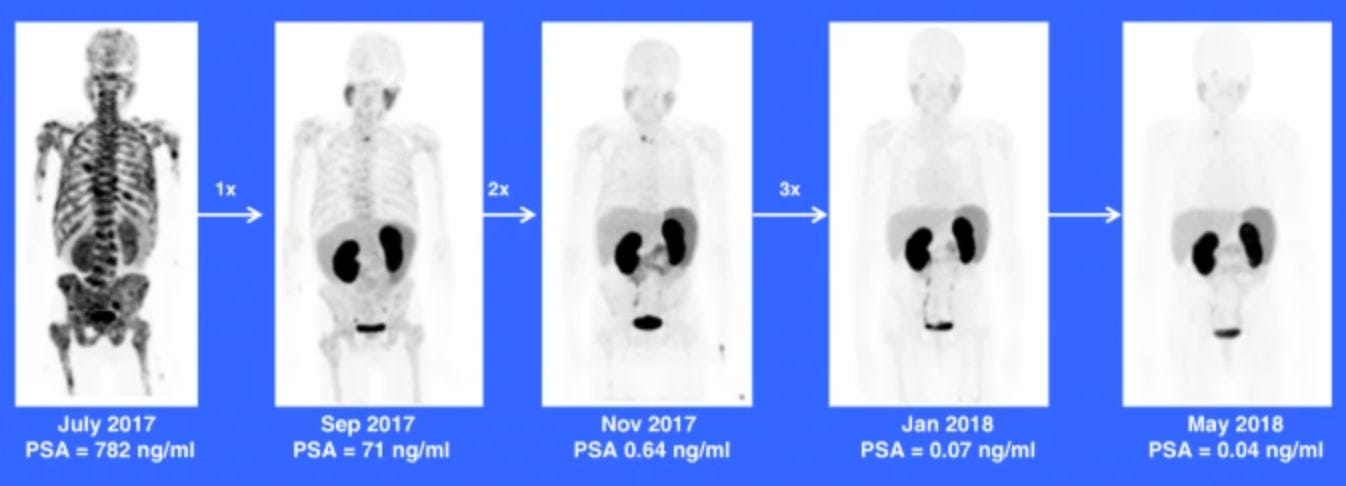
This excitement around radio-conjugates also translates into real investment initiatives from big names like AstraZeneca and Bayer. Drugs like Lutathera and Pluvicto - which have gained FDA approval - are showing encouraging outcomes in clinical trials.
As the industry grows and technology advances, radio-conjugates are set to become an element in the arsenal against cancer, promising treatments that are more effective and safer for patients!
Can you imagine a world where organ shortages are a thing of the past? This might not be as far-fetched as you think. In fact, we might be on the cusp of a new era with xenotransplantation.
Put bluntly, it involves taking animal organs and transplanting them into humans, while of course overcoming the natural strong immune response through genetic engineering, immunosuppression, and tolerance induction.
Only a very few number of such procedures in humans have happened at this stage, where modified pig hearts were transplanted into patients with terminal heart disease. For now, recipients were able to live up to two months past the surgery, which proves that in the short term, it may constitute an option for these patients who cannot benefit from human heart transplants (e.g. due to other vascular diseases). An encouraging yet surprising move forward to tackle organ shortages!
Ancient civilizations like the Egyptians and Greeks set the stage for medical practice by using herbs to treat various ailments. For example, in ancient Greece, they used mandrake roots which contain strong substances like hyoscyamine and scopolamine. These substances could calm patients or even make them hallucinate, facilitating harmful medical procedures at the time.
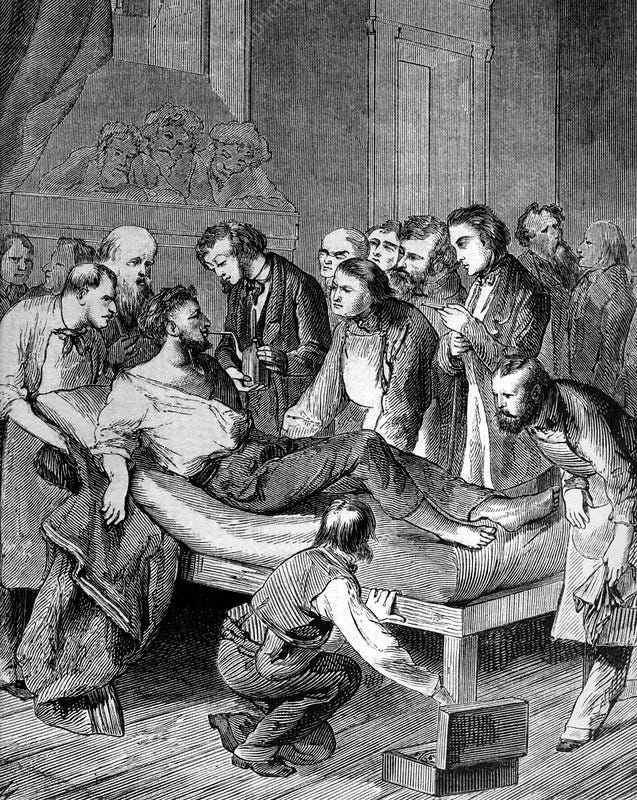
Fast forward a few thousand years, Dr. William Morton (an American dentist) showed how diethyl ether could be used in vivo to induce unconsciousness and thus perform complex surgical interventions, increasing dramatically patient outcomes and comfort. This marked the transition to modern anesthetic techniques, providing a more scientific and humane approach to surgery and patient care!
#team - I’ve been working for a few weeks on Impulse with great support from Abderrahmane and Ellen, two Master’s students from the Life Sciences Faculty at EPFL, who will continue supporting the podcast. There’s more exclusive content to come newsletter-wise and through other channels very soon, so stay tuned!
#cross-promo - we are running a cross-promotion campaign with Science For Care, a podcast democratizing key medical advances in short well-narrated stories. Produced by MedShake Studio and Healthtech For Care, the first two seasons are worth the listen! 🎙️
#conference - I’ve been invited as a Thought Leader to Health.Tech, one of the largest healthtech events in Europe, held on June 5 and 6 in Munich. Two days to think and act together on the future of health. You can get 20% off any tickets with the code MATHIEUC_20. Will I see you there? 👋
Have a great day!
Mathieu
Sharing this newsletter is the best way to help me. Send it to your partner, a friend, a colleague, or someone you know who will be delighted to read all this medical tech stuff!
If you’re looking for the previous releases, it’s here.
If you’d like to subscribe, it's over there:
Comments
Nothing yet. Say the first thing.
Sign in to join the conversation.