
Some things in your life will let you know immediately if you neglect them. Miss a deadline and someone emails you within the hour. Skip a payment and a notification finds you before dinner. Forget a meeting and your phone won’t let you forget it happened.
Other things don’t work that way essentially. They just go quiet.
Your health doesn’t send a warning the first time you skip sleep for a deadline. It waits. The closest relationships you have don’t file a complaint the first time you’re distracted during a conversation that mattered to them. They just quietly recalibrate what they expect from you. Even your own mind doesn’t interrupt you to say it hasn’t had a still moment in weeks. It just gets a little louder, a little harder to sit inside of, until you stop noticing the noise as noise at all.
So every day, without ever consciously deciding to, you make the same trade. You save the thing that would bounce back anyway, and you let the thing that can’t be replaced take the hit instead. Not once. Repeatedly. Until it becomes the shape of your life rather than a choice inside it.
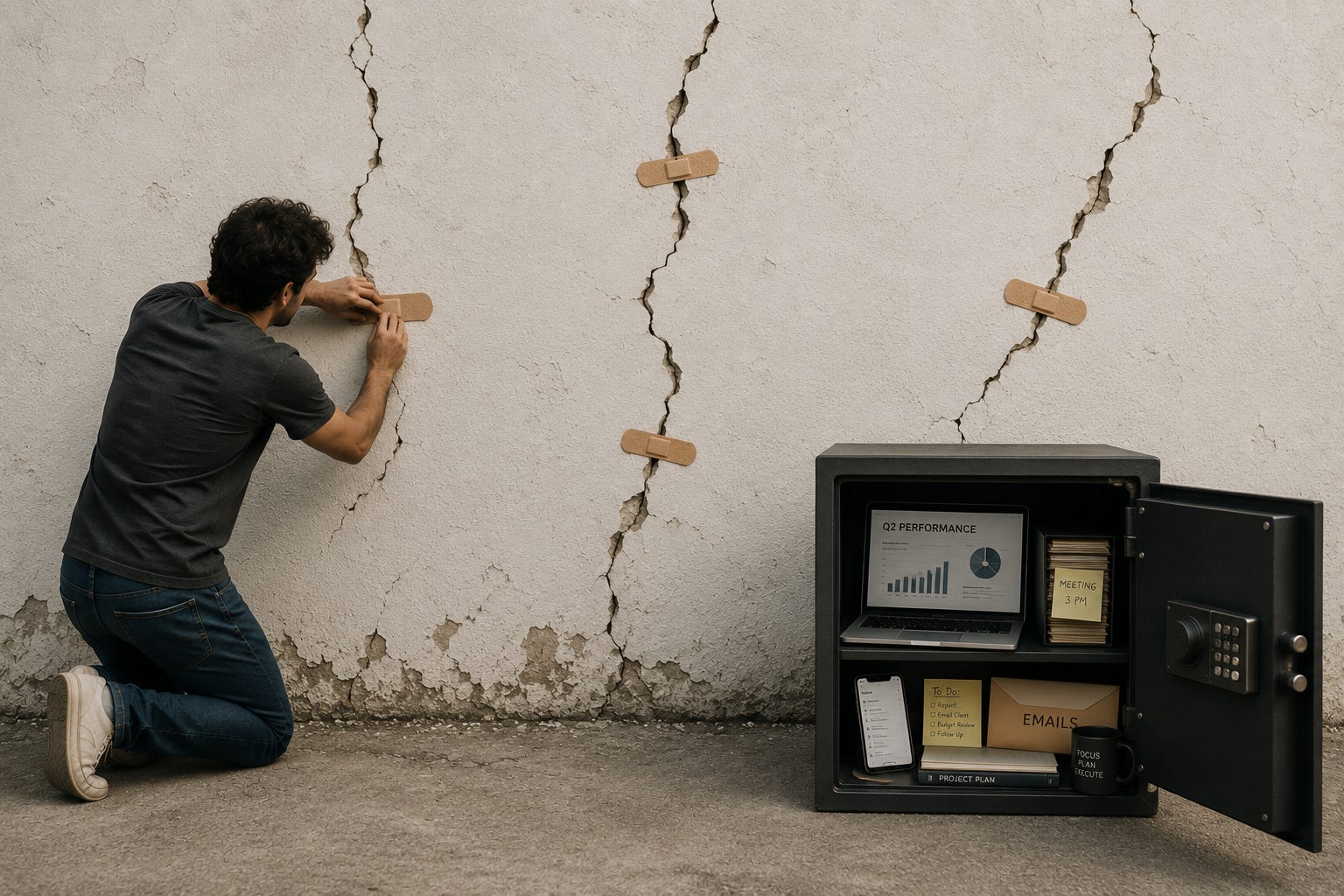
We Save the Rubber on Purpose, Even When We Don’t Mean To
Think about how your average day is actually structured. Every notification, every deadline, every request from someone else arrives with its own built-in urgency. It says, in effect, deal with me now or there will be a consequence you’ll notice immediately. Your job is very good at this including your inbox that is also very good at this. Even your phone, sitting there doing nothing, is engineered to feel urgent the second it lights up.
None of that is a conspiracy. It’s just how anything gets your attention quickly: by threatening to cost you something you’ll notice right away. So you protect it. Every time. Because the alternative feels, in the moment, like carelessness.
Meanwhile nothing in your health, your relationships, or your peace of mind is built to compete on those terms. A body that needs rest doesn’t interrupt a meeting. A friendship that’s drifting doesn’t send a push notification. So it loses. Not because you value it less. Because it never got a vote in the moment the decision was actually made.
Sometimes the Unimportant Is Disguised as Glass
It gets more complicated than “urgent equals unimportant,” though. Some of what feels like “the important thing” is really just the thing dressed up to look that way, which is exactly what makes this trade so easy to keep making without noticing.
A reputation for being endlessly available can feel like responsibility, when it’s really just anxiety wearing a work shirt. A packed schedule can feel like proof you’re doing something meaningful, when it’s sometimes just a way to avoid sitting still long enough to notice what’s actually missing.
Status, appearances, the fear of falling behind, these disguise themselves as essential. Really they’re just rubber with better branding, and rubber dressed up as glass is the easiest kind to protect at the wrong cost.
What It Actually Costs You
Here’s the part that makes this trade so dangerous: the price of choosing rubber over glass doesn’t show up on the day you make the choice. It shows up later, and by then it doesn’t look like the result of a decision at all.
Relationships rarely end in a single afternoon. They erode through hundreds of small moments of being physically present and mentally somewhere else, each one a tiny piece of glass you decided wasn’t worth catching that day.
Health rarely goes in one bad week. It’s the accumulation of years spent treating your body like it would wait indefinitely for its turn, because for a long time, it did, and every one of those postponements felt harmless in isolation.
Your own mind doesn’t unravel in one chaotic day. It’s the slow loss of the ability to sit inside your own thoughts without needing a screen or a task to distract you from them, one skipped, quiet moment at a time, until the noise starts to feel like your natural resting state rather than something you built by choosing it, repeatedly, over stillness.
None of this shows up as a single mistake you could point to and regret. It shows up as a pattern, one you only recognize once you’re already deep inside it, looking back at a decade of choosing whichever thing was making noise that day.
Deciding Before the Moment Arrives
The hardest part isn’t knowing, in theory, what actually matters. Most people could list it without much thought: health, the people closest to them, some version of peace. The hard part is remembering that list in the exact moment something loud is demanding your attention and something quiet is simply waiting its turn, asking for nothing.
You can’t rely on the moment itself to protect the glass, because the moment is rigged in favor of whatever is making noise. The only thing that seems to work is deciding in advance, before you’re mid-deadline or mid-distraction or mid-excuse, what you already know you’re not willing to trade away, no matter how loudly the rubber is asking to be saved first.
Not because the loud things don’t matter. Most of them genuinely do. But they were never the fragile ones. They were always going to bounce.
The glass isn’t.
Already subscribed? Hit reply and tell me: what's one piece of "glass" you've been treating like rubber?
Comments
Nothing yet. Say the first thing.
Sign in to join the conversation.