
I’ve been off to a good start with The Imp of the Possible, publishing nine pieces—the last one a rather meaty essay on Macbeth—over the course of the newsletter’s first four months. Although there are new essays in the works, including one on the figure of the bedsheet ghost that I hope to post soon, other projects have lately made such demands on my attention that I haven’t been able to publish here with the regularity I’m aiming for. One of those projects is a full-day seminar I’ll be teaching on April 11, devoted to Henri Bergson’s ideas on morality, mysticism, and technology.
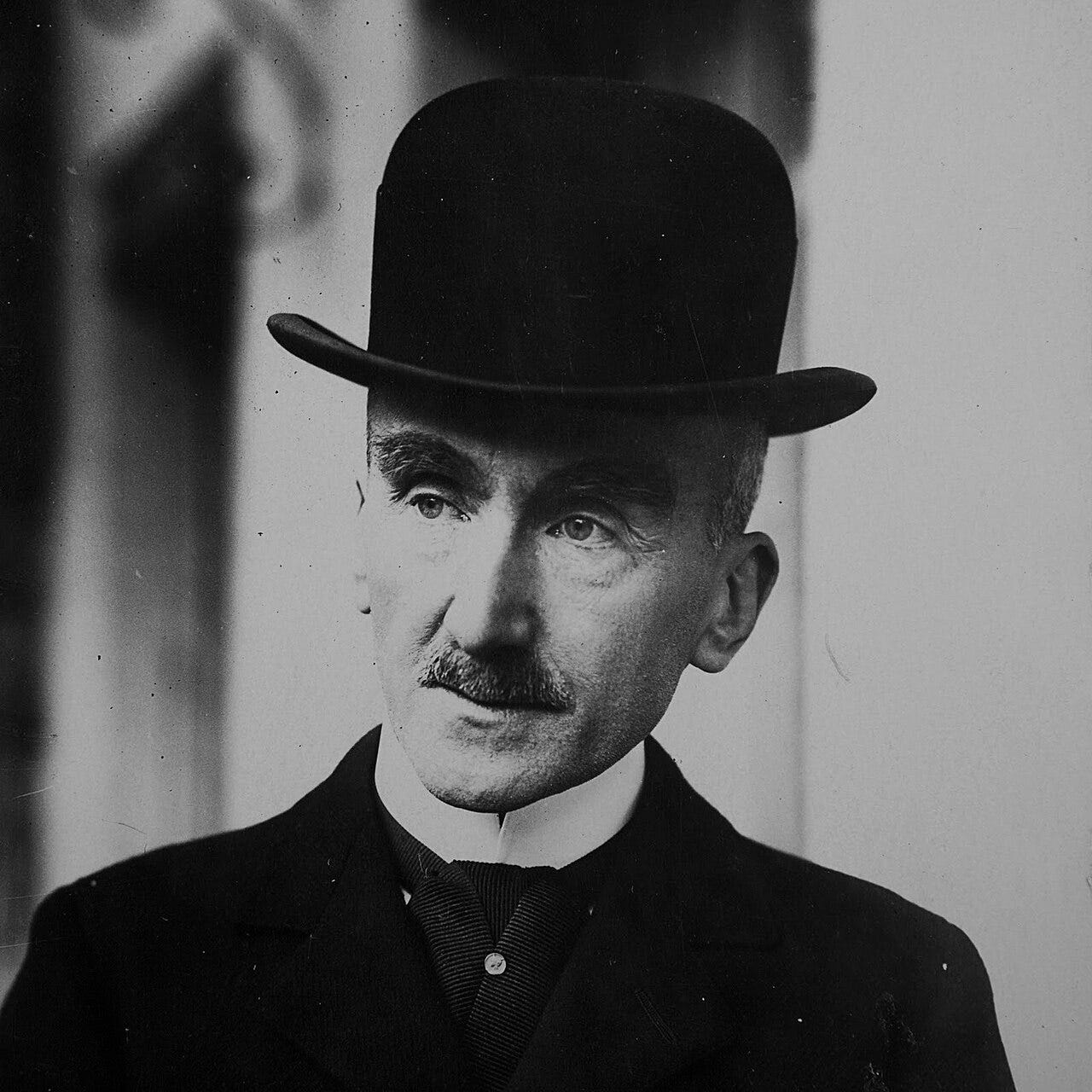
I taught a five-week course on Bergson late last year on Weirdosphere, the learning platform Phil Ford and I launched with Dawn Hillman in 2024. Bergson is having a moment right now, and part of my aim with next week’s talk will be to highlight why I think this is good news for anyone who, while remaining alert to the various existential threats we face today, refuses to swallow the poison pill of cynical defeatism that certain vested interests have decided it would be a good idea to dispense like candy from all those beneficent machines in whose soft glow we have been condemned, of late, to toil and plod. Anyway.
The seminar will take place on the Mutations virtual learning community, where I first began offering online courses several years ago. With Phil Ford currently teaching what, by all accounts, is a remarkable course on music and the tarot on Weirdosphere, this feels like the right moment to revisit an old haunt and join Mutations founder Jeremy D Johnson for an engagement with a thinker who matters to both of us. Indeed, Jeremy has already published an excellent essay on Bergson’s philosophy in view of next week’s event.
My focus will be Bergson’s final major work, The Two Sources of Morality and Religion. A rather spirited example of late style, this is the book where le bergsonisme crystallizes into its final form… and is transfigured in the process. Like his earlier books, it reads less like a treatise than like a kind of thought novel. Reading Bergson is always like going on an adventure, a journey “there and back again,” culminating each time in the disconcerting sense that one has come home to a subtly yet radically changed environment.
By the time he began work on The Two Sources, Bergson had already published three major works, each addressing a distinct philosophical problem. Time and Free Will (1889) concerns consciousness and agency; Matter and Memory (1896), the relation between mind and body; and Creative Evolution (1907), the problem of the nature and origin of life. The last provoked some controversy at the time it appeared. In attempting to think the evolution of species in terms irreducible to mechanism, Bergson pleased neither side of the evolution/creation debate. Scientists smelled superstition in the claim that life evinces a creative impetus irreducible to physical causation. Meanwhile, religious critics perceived in Bergson a vitalism that seemed to subordinate morality to an impersonal drive, like Nietzsche’s will to power. Although Bergson appears to have taken the first set of criticisms in stride, the second weighed on him, especially in the aftermath of the First World War. He resolved that his next work would confront the problem of morality head-on.
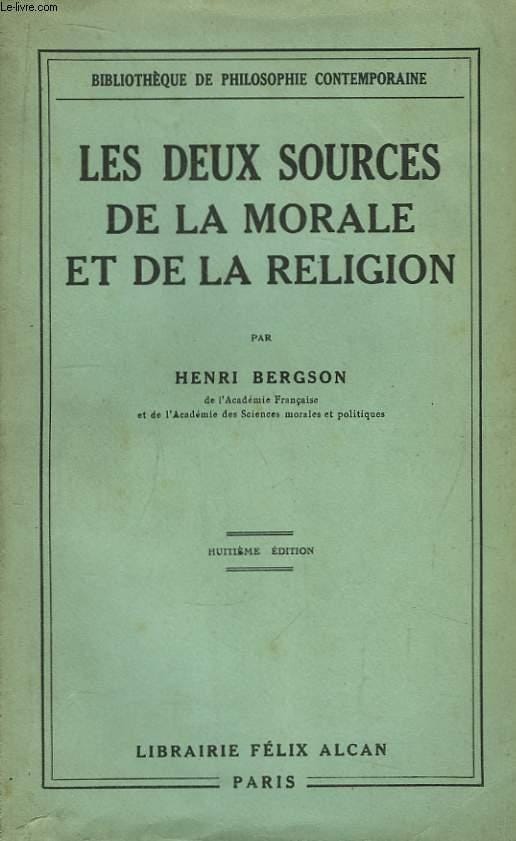
The Two Sources of Morality and Religion took more than twenty years to complete. By the time it was published in 1932, Bergson’s reputation had waned, due in part to his well-known (and consistently misunderstood) dispute with Einstein over the nature of time. The intellectual climate had also shifted while he wrote: French philosophy was increasingly influenced by German thought, with Heidegger and the phenomenologists directing the conversation away from the old French ideal of clarity and precision. As a result, the book received comparatively little attention. It was only later, thanks in part to the intervention of Gilles Deleuze, that the work gained a measure of philosophical relevance, though never nearly as much as it deserved. To this day, The Two Sources is read less often and less closely than the earlier books. Which is a shame, since it is here that the central intuition that had guided Bergson’s thought from the beginning finds its fullest expression in a bold and comprehensive vision.
That vision can be sketched out in a few propositions, developed across his career and recast in new light in the final work:
At the root of reality lies a creative impetus.
This impetus operates in universe without being reducible to its laws.
All living beings express this force; in humans, it displays the vertiginous freedom of its inmost nature.
The human being is, in principle, free, and morality arises on the basis of this freedom.
In practice, however, humans remain bound by fear and need. Only a transformation—what Bergson calls the “open” morality of the mystic—can align human action with a universal love.
Reading this summary in 2026, one might easily mistake Bergson for another quasi-mystical thinker of the fin de siècle, a precursor perhaps of later New Age platitudes. What sets him apart, however, is the rigour, sobriety, and meticulous care of his argumentation. If a summary fails to convey the work’s full force, it is because it presupposes that we already know what we mean when we say “creation,” “freedom,” “morality,” “mysticism,” “love.” But Bergson, like any great philosopher, does not deal in prefabricated notions. He fashions his ideas into novel concepts, and in doing so, washes off the dull coating of banality, revealing the mysterious realities that hide behind familiar words. The French speak of le choc Bergson—the Bergson shock—for a reason. Few thinkers, read closely, have the power to recalibrate our sense of the real as thoroughly as he does.
If you’re interested in attending my upcoming seminar on Bergson’s last book, visit the Mutations website to read more and register. Should the price be too steep for you, don’t hesitate to reach out via direct message.
No posts
Comments
Nothing yet. Say the first thing.
Sign in to join the conversation.