
I’ve been reading and thinking about Moby-Dick in preparation for the Weirdosphere course I’ll be teaching with Erik Davis starting next week. In case you don’t know him, Erik is the author of Techgnosis, High Weirdness, and the always engrossing Burning Shore substack. He has come several times on Weird Studies, and formerly hosted the now-legendary podcast Expanding Mind. In my excitement about this collaboration, I felt compelled to write a few words on Melville’s strange book here, by way of trimming the sails for what is sure to be a memorable voyage.
In the old days, we crucified our prophets. Today we let them die in abject poverty. “Though I wrote the Gospels in this century,” Herman Melville once wrote Nathaniel Hawthorne, “I should die in the gutter.” He ended up doing both, dying in the gutter with his gospel1 neatly stowed in oblivion, pending rediscovery decades after his death. Truly, I can think of few novels that come as close to the tenor and timbre of scripture as Moby-Dick does. It’s an evangelical book, and like others of that kind it asks a new question for every answer it provides. Even on this third reading, I found myself opening it with faintly febrile fingers, as I might the bible or the I Ching—which is to say, as though the stakes of reading it were sky-high. Moby-Dick is a work of prophecy and mystagogy, the kind of book you can’t interpret without baring something of your soul. Tell me of the white whale, and I will tell you who you are.
Some prefatory remarks, then, sure to be reexamined over the next six weeks with Erik and our motley crew.
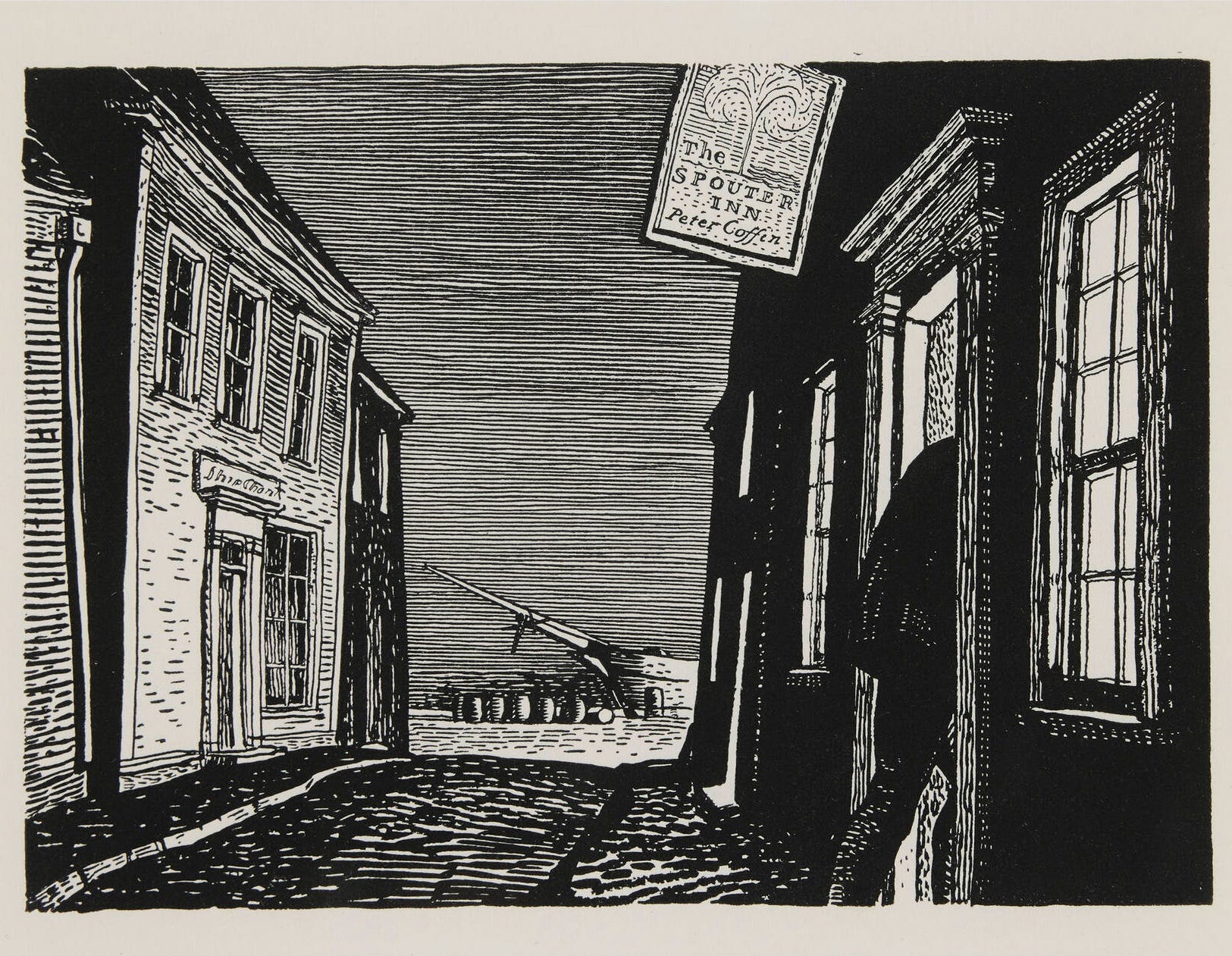
For a book which, according to many commentators, rejects every notion of the divine or the absolute, negating all transcendence in the name of an closed universe devoid of intrinsic sense and meaning (Camus described Melville as a “painter of the Absurd”), Moby-Dick is unexpectedly full of magic and wonder. Nor do you have to read many pages to find it. In the second chapter, Ishmael is looking for a place to sleep in the whaling town of New Bedford. He investigates the inn at the centre of town but finds it too expensive. (Besides, its name, The Crossed Harpoons, makes it clear he is not welcome). He then makes his way “by instinct” into the seaward quarter, where the change of scenery occasions a sudden shift in atmosphere: “Such dreary streets! blocks of blackness, not houses, on either hand, and here and there a candle, like a candle moving about in a tomb.” Ishmael, in other words, has entered the land of the dead. Every sight is a warning, telling him to turn back.
Heedless, he comes to the inn where he will stay. The sign above the door reads “The Spouter Inn,” along with the innkeeper’s name, Peter Coffin. “Coffin?—Spouter?” Ishmael thinks. “Rather ominous in that particular connexion.” But a man has to sleep, and common sense soon chimes in: Coffin, he reasons, “is a common name in Nantucket, they say, and I suppose this Peter here is an emigrant from there.” The pun—spouter in, as opposed to spouting out—seems lost on him. What he is being told, whether he knows it or not, is that he is not about to just go whaling; Jonah-like, he is about to spout into the whale.
A few chapters later, after he and his friend Queequeg decide to ship out on the Pequod, Ishmael meets a madman who prophesies a doomed voyage. As a matter of fact, there are many prophets in Moby-Dick, and all of them prove legitimate. The term “predestinated” occurs five times in the novel, and after multiple readings it remains unclear to me whether interpreting this term in its Presbyterian, double-predestination sense really gets to the bottom of it. The proliferation of signs and omens seems to make little sense unless we acknowledge the possibility—never seized by Ishmael, but logically implied—of getting the message and changing course. Melville’s own broadly Calvinist assumptions notwithstanding, there is a reading of Moby-Dick that plunges us into a sacramental cosmos, one that asks to be divined in light of a moral law and spiritual freedom that are more than an epiphenomenal fog hovering above the frothing churn of physical processes.
This vision persists despite many characters’ tendency to explain away the various instances of enchantment that occur. Near the end of the book, for instance, the Pequod is assailed at night by ghostly cries from the deep. The crew take these to be the complaints of drowned sailors, and thus a portent of doom. Ahab, however, wants to keep morale up now that they are nearing their objective of confronting the white whale. When the crew reports the phenomenon in the morning, Ishmael tells us that the captain “hollowly laughed, and explained the wonder” away. The rocky islands she ship passed in the night, he says,
were the resort of a great number of seals, and some young seals that had lost their dams, or some dams that had lost their cubs, must have risen nigh the ship and kept company with her, crying and sobbing with their human sort of wail.
Nothing to see here, in other words. Move along. Of course, we who are familiar with the story know that even if seals are responsible for the spectral cries, another sign was sent. Recall the joke about the flood victim who, upon arriving in Heaven, complains that God never answered his prayers to be rescued. “I sent you a truck, a boat, and a helicopter,” God replies. “What more could I have done?” As the anthropologist E. E. Evans-Pritchard learned in his work with the Azande of Central Africa, magic doesn’t trump causality. On the contrary, magic is often causality producing meaning in spite of itself.
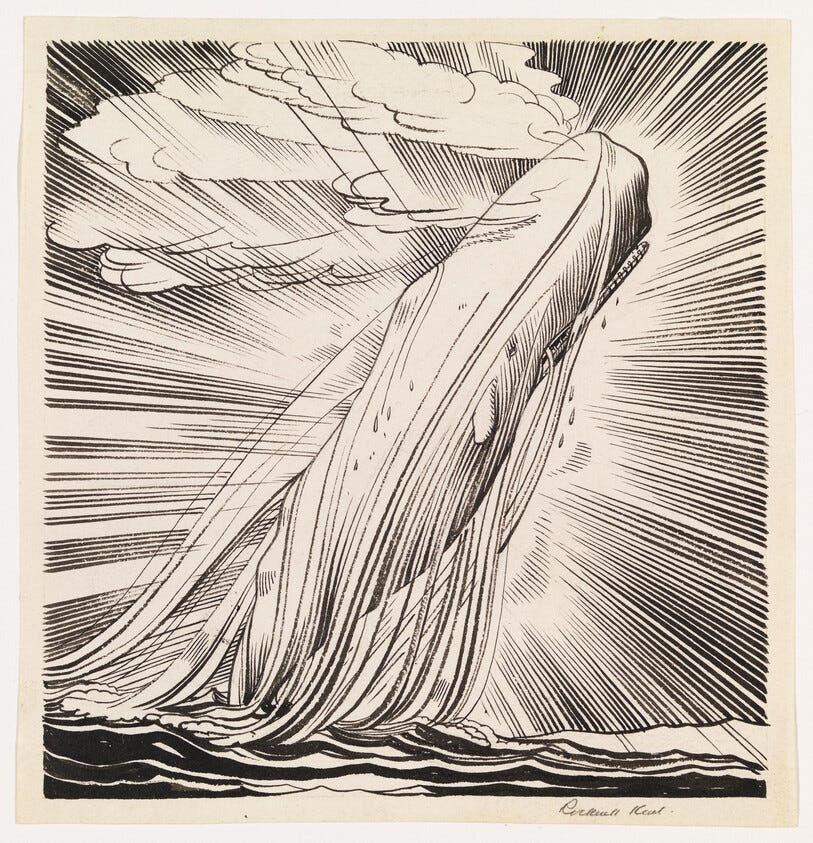
One of the questions that haunt Moby-Dick is whether the world is legible—that is, whether it is a text given to us, or merely a Rorschach blot onto which we project our personal fancies. Ishmael puts it starkly in the chapter entitled “The Doubloon”: either “some certain significance lurks in all things,” or else “all things are little worth, and the round world itself but an empty cipher, except to sell by the cartload, as they do hills about Boston, to fill up some morass in the Milky Way.” To the characters in the novel, the question is as unanswerable as it is to us readers of Moby-Dick, which may be why so many commentators have seen in the book an “anti-Bible,” a scripture of ultimate absurdity and nihilism.2
I confess that there were several moments during my latest reading when I felt that tightening of the throat that accompanies intimations of utter futility. Melville is nothing if not unflinching: he takes you right to the edge and then gives you a cruel nudge. But the presence of all those signs and wonders suggests a deeper reading, one in which the world attains to the sacramental, and the tidal wave of Ahab’s theocidal rage breaks up against a towering crag of joy. “My hosanna is born of a furnace of doubt,” Fyodor Dostoevsky once said of his faith. Melville may not have said the same, but art emits a signal that no author can drown out: a pedal tone of mirth, boundless as the open sea, that rings out more euphoniously for being offered a counterpoint of fear and trembling.
Near the end of the novel, the death-stalked Pequod crosses paths with a ship called the Bachelor. Blessed with good winds and good luck, its mariners are homeward bound, their hull spilling over with blubber and sperm.
“Come aboard, come aboard!” cried the gay Bachelor’s commander, lifting a glass and a bottle in the air.
“Hast seen the White Whale?” gritted Ahab in reply.
“No; only heard of him; but don’t believe in him at all,” said the other good-humoredly. “Come aboard!”
It’s a testament to Melville’s genius that one feels a pang of sadness as that blessed ship disappears over the horizon, leaving Ahab’s crewmen to their fate. You feel there is another novel Melville could have written, about the Bachelor rather than the Pequod. It would have been a less revelatory novel, no doubt, boring and hardly deserving of the attention Moby-Dick continues to command. But might it not have been as full of truth?
There’s still time to enroll in Hunting the White Whale: A Course on Moby-Dick. Details on the Weirdosphere learning platform.
Thanks for reading. This post is public so feel free to share it.
The word gospel comes from Old English gōdspel, “good news.” Evangelion is “good news” in Greek.
See, for instance, Viola Sachs’ wonderfully pareidolic La contre-bible de Melville: Moby-Dick déchiffré (1975).
No posts
Comments
Nothing yet. Say the first thing.
Sign in to join the conversation.