
This piece, first published in the North American Review (and republished here with new annotations), came back to mind this week as I obsessively watched a series of YouTube “reactions” to the Canadian avant-garde rock duo Angine de Poitrine. In case you haven’t heard, Angine de Poitrine (French for “chest pains”) is a duo from Saguenay, Québec, who perform in elaborate costumes. That such experimental, technically prodigious, and thoroughly odd music could slip through every algorithmic net and achieve international acclaim would be inexplicable if the results weren’t so danceably compelling (which, given the microtones and irregular time signatures, is itself hard to explain). While listening to their famous KEXP live set for the sixteenth time, I noticed that commenters seem split between thinking “this is the most human shit I’ve heard in a year” and “this is music from another planet.” One YouTuber observed that Angine gives us music as insects would make it if they could master the guitar and drums. It is when we catch the human in its unrepeatable, unpredictable singularity that we remember there is no knowing the human.
My fascination with Brutalism began during a film location scout at the Ontario Science Centre in 2012. At one point, we found ourselves at the back of the property, where the building plunges into a verdant ravine of the kind Toronto should be better known for. The juxtaposition of the great grey slabs with lush greenery, and the presence of so many creepers and glyph-like streaks of water erosion on the gunmetal concrete, left me momentarily speechless. I wondered: If Brutalist surfaces are so featureless, could it be because they are waiting for nature to complete them with inscrutable frescoes and bas-reliefs? From then on, I was able to appreciate even the most unsightly Brutalist architecture simply by imagining it reclaimed by the elements.1
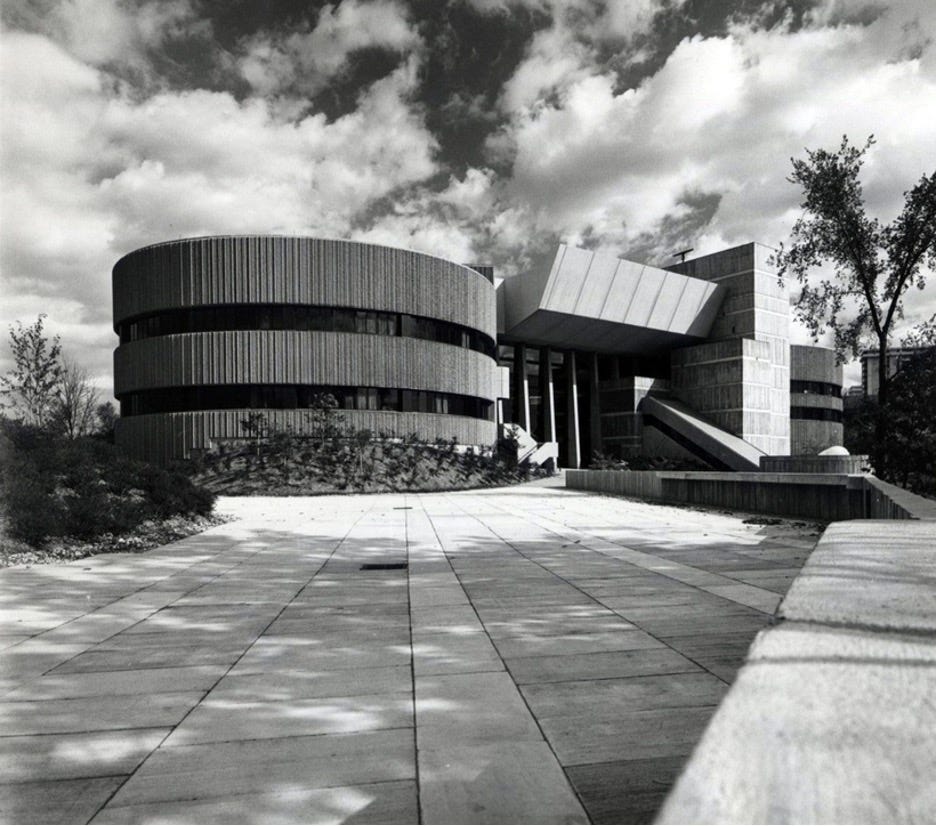
The Ontario Science Centre, however, is far from unsightly. It is a masterpiece of the modern sublime, conceived by the Canadian architect Raymond Moriyama in the 1960s as a monument to the science-fiction aspirations of the mid-twentieth century. Like all the great Brutalist projects, it presented itself from the start as a kind of singularity, an interloper from a world yet to come, tethered to the past only by a gossamer thread of dream. Of course, by the time I scouted the location, that thread had long been cut; the building seemed less the herald of a viable future than a cenotaph for an age that had died before being born. The effect was nostalgia for a future firmly rooted in the past. Combined with the spatial elements of invasive verdure and steady erosion, this temporal vertigo conspired to generate a powerful symbol in my imagination. It dawned on me that there was something special about Brutalism. I’ve been thinking about it ever since.
Medieval castles were military installations, ostensibly no more enchanting to their original occupants than an air force base might be to us now. It took the Romantics to see, in the ruins of obsolesced fortifications, the haunting beauty that had always inhabited them. Likewise with Brutalism, these structures that once seemed to hypostatize power, industry, and bureaucracy now convey nothing so clearly as the ephemeral nature of all things, even those institutions which, at the height of their glory, present themselves as the consummation of earthly history.
A case in point: the Ontario government is determined to do everything in its power to demolish the Science Centre in order to make room for (you guessed it) condominiums. The rationale on offer, unsurprisingly, is safety, but I suspect the real reason lies in that collective disgust that has always plagued Brutalist architecture, a repugnance whose almost reflexive nature prevents us from attributing it solely to aesthetic taste and demands that we think of deeper, and stranger causes. My impression is that, consciously or not, the provincial government has been purposefully neglecting the building’s maintenance for decades, in a patient wait for the moment when it finally fails the safety checks.
At the time of this writing, the building is shut down indefinitely and the public outcry continues.2 Commendable though the resistance to the government’s decree may be, however, it strikes me as too sentimental, too insistent upon “cherished memories” and “community impact,” to be anything more than a temporary obstacle to the unbridled march of fiscal efficiency. And while I stand with those who argue for the repair of the concrete roof, which a government-hired research firm has conveniently concluded is at imminent risk of collapse, it is for entirely different reasons. The integrity of the OSC should be maintained, but only to reduce the gradient of its inevitable decay, the better to savour the tragic wonder of this masterwork of Brutalist design.
Perhaps it is only after an age ends that we can see it for what it was. Looking at it today, Brutalism embodies the poetic truth of the era now passing away. It was never just an architectural style, and its widespread reputation as the shunned offspring of better-regarded architectural movements is beside the point. It is conceivable that someday, the period extending from the bombing of Hiroshima to the fall of the Berlin Wall will be called Brutalist in the same way we associate the seventeenth century with the Baroque. What is more chillingly Brutalist than the very concept of a cold war? Television is a Brutalist medium, and not just because it takes the form of a solid cube with a single window. The films of Stanley Kubrick and Andrei Tarkovsky, the fictions of Samuel Beckett, the paintings of Mark Rothko and Pierre Soulages, the choreographies of Pina Bausch: Brutalist art, all. When Phil Ford and I, in a conversation with the occultist Duncan Barford on our Weird Studies podcast, described the imaginal landscape of the Canada of our childhood as “points of light” scintillating in Beckett’s “dark vast,” we were approaching the brutal heart of our former lifeworld. Drive-ins are Brutalist, as is ham radio, and The White Album. I’m operating in the realm of intuition here, but it is so.
Alison and Peter Smithson, the British founders of Brutalism, said something very important at the outset of the style: they said that Brutalism wasn’t an aesthetic at all, but an “ethic.” Paradoxically, more aesthete words have never been uttered. No doubt the vision behind Brutalism was a utilitarian and political one, as motivated by yearnings for a better and more beautiful world as it was by the budgetary constraints of postwar Britain. From an ethical viewpoint, Brutalism was about creating a world that we moderns could live in—a functional world made for human movement and human dreams. In aesthetic terms, however, it always bore witness to the mystery of the human. How else would a style predicated on adapting space to human needs result in such inhuman buildings? Le Corbusier famously described houses as “machines for living in.” His influence over the movement notwithstanding, Brutalism reverses his logic. The buildings become the living thing, and humans, the machines that circulate within them. There is an alien dimension to this architecture which, if you honour its purported ideal, turns the human into something we can no longer say we quite understand. Shades of Tarkovsky and Kubrick, to be sure, but shades also of some proto-Brutalist artists worth considering.
The horror fiction writer H. P. Lovecraft, for instance, was a Brutalist avant la lettre. I’m thinking specifically of the novella At the Mountains of Madness, with its descriptions of non-human, prehistoric ruins that a group of American explorers discover in the wastes of Antarctica:
The nameless stone labyrinth consisted, for the most part, of walls from 10 to 150 feet in ice-clear height, and of a thickness varying from five to ten feet. It was composed mostly of prodigious blocks of dark primordial slate, schist, and sandstone—blocks in many cases as large as 4 × 6 × 8 feet—though in several places it seemed to be carved out of a solid, uneven bedrock of pre-Cambrian slate. The buildings were far from equal in size; there being innumerable honeycomb-arrangements of enormous extent as well as smaller separate structures. The general shape of these things tended to be conical, pyramidal, or terraced; though there were many perfect cylinders, perfect cubes, clusters of cubes, and other rectangular forms, and a peculiar sprinkling of angled edifices whose five-pointed ground plan roughly suggested modern fortifications.
The campus of the University of Ottawa, my alma mater, contains a Brutalist complex consisting of terraces, levels, and open-air corridors connecting the concrete monstrosities. It all seems like an attempt to approximate the city of the Elder Things from Lovecraft’s story. And now we’re onto something: If Brutalism is a humanism, it is a humanism that leaves the human in suspense, making no final claims as to what the human might be or what it might become. Even as it explicitly evokes a utopian future of the kind that inspired the science fiction of its time, Brutalism implicitly invokes something weirder, murkier, post-human, something which, somehow, comes to light only when the buildings mature and nature begins to swallow them up again.
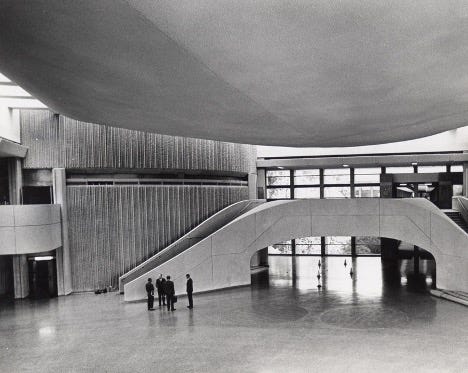
If the Baroque is defined by the figure of the fold, as the French philosopher Gilles Deleuze claimed it was, then Brutalism is defined by the cube, the block, or more broadly, the polyhedron. Opacity is a key quality; ideally, natural light should enter the structure diffuse, originating from windows placed out of human reach. In fact the later Brutalist architects would often give their creations no more windows than was necessary to make them tolerable to human beings. It is almost as if they sought to evoke Leibniz’s monads, metaphysical entities that are mysterious in every respect but for this fact, insisted upon by the German philosopher, that they “have no windows.” Now, Leibniz was the Baroque philosopher par excellence. Can we think of Brutalism as an engagement with the Baroque, and interpret the former style as the latter’s twisted echo down the chasm of the centuries? Answering the question would take us down interesting intellectual paths. Suffice it to say that Brutalism loves sharp angles as much as the Baroque despises them.
The Brutalist building, like a Rothko painting or a Kubrick film, is fundamentally modular: it consists of precisely arranged, self-contained shapes, each referencing only itself. This autonomy of each part extends to the entire structure, making it feel deeply at odds with its environment. It is as though the building had just appeared there, uncaused, like the black monolith in 2001: A Space Odyssey. In a 1954 essay focusing on the work of the Smithsons, the architecture critic Reyner Banham noted a colleague’s quip that, while Modernist architects like Berthold Lubetkin dialogued with the “great masters,” the Smithsons spoke “only with each other.” While Banham doesn’t fully endorse this claim, he recognizes that Brutalism primarily speaks to and from the present—I would add, the hidden face of the present. Brutalism is an attempt to let human artifacts speak in their own, not-quite-human voice. Perhaps no one grasped this better than the late composer and filmmaker Jóhann Jóhannsson, whose screen adaptation of Olaf Stapledon’s Last and First Men features only still-life images of Brutalist monuments in the former Yugoslavia. These spomeniks, initially conceived to materialize the utopian dream of Communism, now stand—no less proudly—for the radical otherness that haunts all human dreaming.
The Brutalist building arises from the landscape; it never stops arising. Beneath the meanings and judgments we impose upon it, it stands only for itself. Its humanism lies in its ability to meet humanity on its own ground, and then point beyond it. This beyond seems drab and grey only if we limit our conception of Brutalism to architecture, where the colourlessness of raw concrete heightens the aesthetic impact that I am sketching out. For the full Brutalist treatment of colour, we must turn to other arts. In the works of the aforementioned Rothko and Kubrick, for instance, we see that Brutalism thinks in terms of colour fields. The style grants colour a sovereignty it never had before; I suspect it was the sheer power Brutalism gives to colour that forced its architects to work mainly in greys. (Picture a hundred-foot-tall Rothko for a sense of how intolerable a colourful Brutalist building would be.) For colour to work in Brutalism, you need a smaller scale: a canvas, a film screen at most. There, colour exhibits a violence unprecedented in the arts; just look at a Rothko, any Rothko, or a single frame from The Shining or Eyes Wide Shut to know what I mean.3 The colours are at each other’s throats—whether in love or in hate, no one knows for sure—and they are at each other’s throats because they are all autonomous, because they systematically testify to the strange autonomy of all things.4 In Brutalist art, a dominant colour exists for itself; it will tolerate other colours only as long as they adopt a submissive position in the compositional field or so long as each colour gets its own zone within the composition. Brutalism discloses the obscenity of colour; to cite Lovecraft again, it treats every colour as a “colour out of space,” a self-existent monster that refuses to be conceived as a mere epiphenomenon of the human visual system.
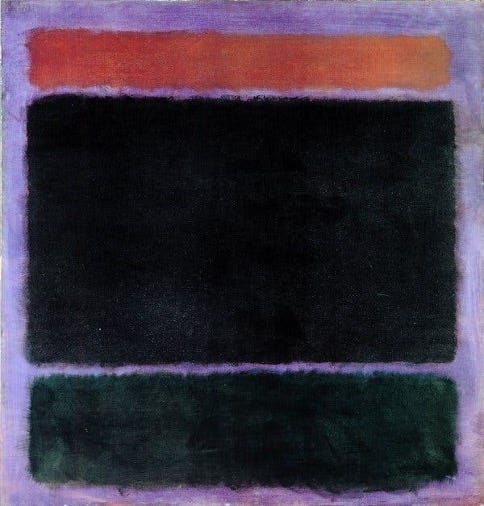
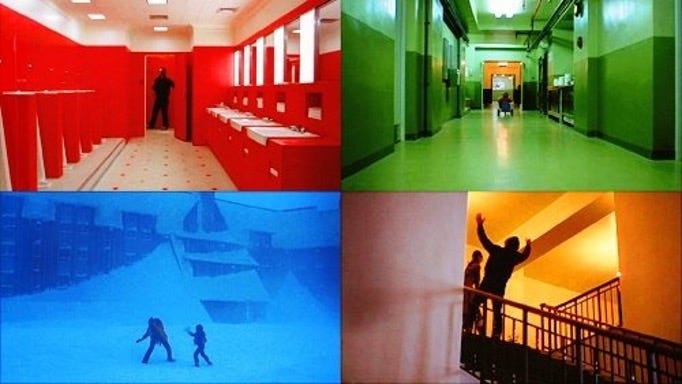
That term, obscenity, dominated discourse in the arts in the decades following the Second World War. Might it hold one of the secrets of Brutalism? Modern bureaucracy is obscene, and from an aesthetic and ethical point of view, modern bureaucracy is Brutalist. As is modern espionage, the only truly Brutalist war being a cold one, wherein the electromagnetic field replaces the field of battle. And can you think of a more Brutalist word than thermonuclear? The fact that the style got its name from the French term for raw concrete (béton brut) does not mean that the meaning most people assume, namely that Brutalism is about brutality, is entirely wrong.5
A few years ago, I read a paper by the philosopher Derek Parfit on the possibility that our universe is a “brute fact,” which is to say, a fact that exists beyond all explanation, whether causal or rational. And I asked myself: what if the universe is as brute in its parts as it may be as a whole? What if the faithful repetitions that permit us to imagine “laws” of physics, which we unjustly take to be “necessary,” were merely a fortuitous effect of a brute event without reason, a pure coincidence? We would then be living in a universe that can’t be explained metaphysically or rationally, but only axiologically, a philosophical category encompassing the ethical and the aesthetic. And that, combined with the arbitrary recurrence of the term brute,6 led me to consider the possibility that Brutalism presages a philosophical idea that is just now becoming thinkable. If the world inheres in brute facts, why can’t an entire era form one vast synchronicity pointing us to a singular thought to come? Be that as it may, my intuition is that Brutalism holds the key to the thought of a truly magical cosmos. I find support for it in the ultimate Brutalist monument, the already-mentioned monolith from 2001, which magically appears on Earth to call forth the unprecedented event of the human as a rift in the warp and weft of cause and effect.
If nothing else, then, consider these thoughts my statement to the committees, associations, and bureaucratic juntas who will determine the fate of the Ontario Science Centre.7 Asked to find a solution that satisfies both sides of the debate, I would propose that the centre be closed to human traffic but allowed to deteriorate in accordance with its own nature and the inhuman will of the elemental forces. If safety regulations require fencing, let’s ensure the fences aren’t too high, so that those of us who are willing to breach the boundaries of the human can continue to dream strange dreams in the ruins of the century.
Although there are, of course, unsightly Brutalist buildings, I reject the widespread view that Brutalism is categorically ugly. On the contrary, I am inclined to agree with Barnabas Calder, who describes Brutalism as “the high point of architecture in the entire history of humanity” (Raw Concrete, p. 5). The recent willingness, at the level of the zeitgeist, to rethink our received opinions about this architectural movement would have been cause for celebration had it not come too late to save many of these buildings from degradation and demolition—though this may have something to do with the curious role decay plays in Brutalist beauty, as outlined in this essay.
Update: Though it is still being maintained, the building is now closed to the public and slated for demolition. Any continuing outcry is now private rather than public.
I’ve mentioned Beckett, Tarkovsky, Bausch, and Soulages, but really it is in these two, Rothko and Kubrick, that the Brutalist aesthetic is most powerfully articulated outside architecture. And of the two, I would insist especially on the latter, and not just because his name is sometimes pronounced “cube-brick.” Consider, for instance, how easily one might mistake the following statement from Banham’s 1954 article for a commentary on Full Metal Jacket rather than on the Smithsons’ design of the Hunstanton School in England: “In fact it is the ruthless logic, more than anything else, which most hostile critics find distressing about Hunstanton—or perhaps it is the fact that this logic is worn on the sleeve. One of the reasons for this obtrusive logic is that it contributes to the apprehensibility and coherence of the building as a visual entity, because it contributes to the building as ‘image.’” If Kubrick never hid a cut, if he insisted that each frame of a film work as a photograph one might hang on a wall, it was in the name of giving us not stories but images, in the full metaphysical sense of the term. A future post will take up the Brutalist conception of the image as the excluded middle in the exhausted binary of “ideas” and “things.”
Brutalist colour gives the lie to the old Lockean idea that colours and other sensory phenomena are merely “secondary qualities” that would not exist in an unperceived nature. That a blue sapphire could be blue even when no one is looking at it is one of those plain truths no one feels the need to challenge until they begin doing philosophy. For centuries, the tendency has been to ascribe this to the naïveté of ordinary perception, but one hopes the hour approaches when the hopeless naïveté of modern Western philosophy will become resplendently clear. Brutalism testifies to a realism whose concept remains to be created, though it was powerfully adumbrated in Matter and Memory.
This connection between Brutalism and the obscene needs further development. The etymology of the word is unclear: I am told that it may derive from the Latin ob, “in front of,” and caenum, meaning filth. This is plausible—but we should be careful not to overmoralize filth, even if that term comes from the High German fulida, “foulness.” The foul may include everything in that more-or-less changeable category of things that commonly trigger disgust, but I am reminded here of Plato’s puzzlement at the possibility that such negligible things as hair and mud would be no less represented by a Form in the Intelligible World than silver, spheres, and kings. Arguably, all that we do not deign worthy of recognition—all that we overlook in our too-human reduction of the world to what suits our designs and expectations—would need to be included in any conceptually sound idea of the obscene. The category would then include all that calls our attention to what is regardless of whether we think it should be. As we read in the Necronomicon of Abdul Alhazred, “As a foulness ye shall know them!”
The word comes from the Latin brutus, meaning “heavy, dull, unthinking” and has always connoted the lower animals and the non-human more generally.
Too little too late, as it turns out.
No posts
Comments
Nothing yet. Say the first thing.
Sign in to join the conversation.